dsh-model-router




A DeepSeek Harness (DSH) plugin that turns model selection into intelligent routing: declare a virtual model id in config, bind it to a routing algorithm over a list of real provider/model candidates, and use the virtual id anywhere — agent options, model picker. Every call is transparently dispatched to a real model chosen by the algorithm, with automatic failover.
What it does
- Virtual model ids. A route such as
routed-chatbehaves like any real model in the picker, but is a facade over a candidate pool you define. - Transparent failover. When a candidate fails, the next one is tried — same request, no user-visible error — and the plugin records which real model served each call, so a failover is always visible in the provenance instead of silent.
- Two routing algorithms (pluggable extension point):
priority— always try the first candidate; skip it only on failure. Failed candidates get exponential backoff, giving a struggling model time to recover before it is tried again.round-robin— distribute calls across the pool.
- Your own algorithm.
RoutingAlgorithmis a factory contract (select,onFailure, optionalonDispatch/onSuccess) — implement one and register it.
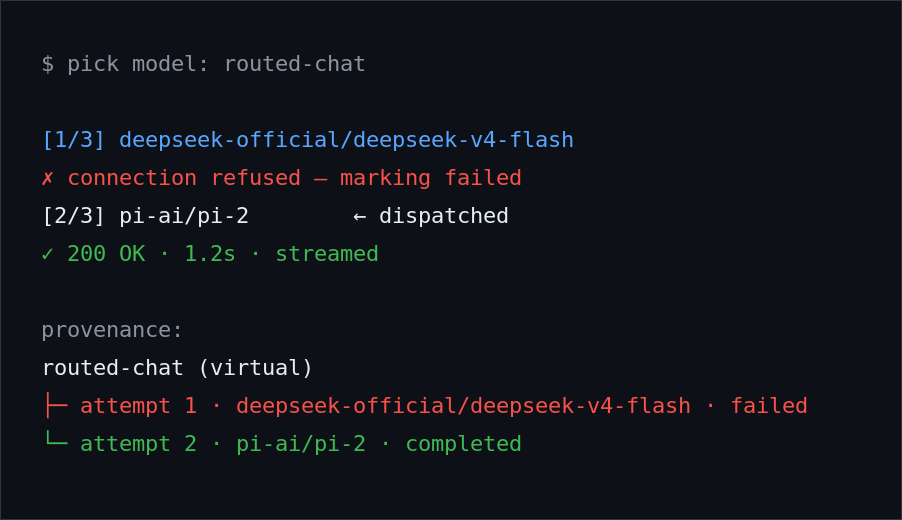
PLACEHOLDER screenshot — drafted from live CLI output; swap for a real capture at review.
Why it exists
Model pools are the reality: a cheap fast model, a strong one, a spare. Hardcoding one id means a provider outage becomes your outage. Routing at the plugin layer means the rest of the harness never learns about failure — and never has to.
Install
Requires Node ≥ 22 and a DSH profile to install into.
npm pack
dsh plugin --profile <your-profile> add file:/path/to/dsh-model-router-<version>.tgz
Or straight from GitHub:
dsh plugin --profile <your-profile> add github:andrepontesmelo/dsh-model-router
[!WARNING] Routing is config-driven and bypasses nothing you did not declare — but every candidate you list is a real provider that your prompts and completions will be sent to. Audit the
candidateslist before installing a route config you did not write, and pin the install (tag or local tarball) rather than floating on a branch.
Verify the build before installing:
npm pack --dry-run          # inspect exactly what ships
sha256sum dsh-model-router-<version>.tgz
Compare the checksum with the one published with the release you are installing. A
github: install resolves the default branch at install time — pin a tag for
reproducibility.
Useful commands once installed:
npm test            # 71-test unit suite (node --test)
npm run smoke       # 5 failover drills, in-memory, zero network
dsh plugin --profile <your-profile> list
Quick start
Add a route to your profile's cordis.patch.yml:
{
  "routes": [
    {
      "id": "routed-chat",
      "algorithm": "priority",              // "priority" | "round-robin"
      "candidates": [
        { "provider": "deepseek-official", "model": "deepseek-v4-flash" },
        { "provider": "pi-ai", "model": "..." }
      ]
    }
  ]
}
Pick routed-chat in the model picker (or set it as an agent's model) and route. On
failover, the response provenance shows the real model that answered and any candidates
sleeping in their backoff window.
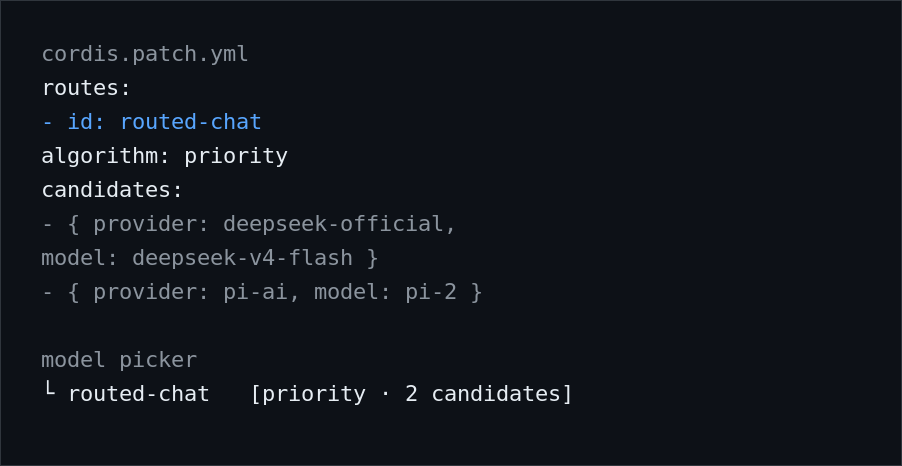
PLACEHOLDER screenshot — drafted from live CLI output; swap for a real capture at review.
Writing your own algorithm
An algorithm is a factory (ctx, routes) => algorithm:
{
  select(route, callCtx)      // -> candidate | undefined (pure — no state advance)
  onFailure(route, candidate) // record the failure so select skips it
  onDispatch?(route, candidate) // first dispatch of a request
  onSuccess?(route, candidate)  // optional
}
The shim probes select for boolean checks, so it must stay pure; state advances happen
in the on* callbacks. The test suite in test/ pins these seam mechanics.
Docs
Start at the docs index:
- Architecture — plugin wiring, shim, routing, backoff.
- Development — layout, test gate, how to run the smoke suite.
Contributing
PRs welcome — see CONTRIBUTING.md for the workflow and the local gate. Security issues: SECURITY.md (do not open a public issue).
Roadmap
- Session stickiness — pin a session to the candidate that first served it (not yet implemented).
- Per-model reasoning-level customization (not yet implemented).
Requirements
- Node ≥ 22.
- A DSH profile to install into; candidates point at providers already configured there.
Test
npm test        # unit suite
npm run smoke   # in-memory failover drills (LOCAL mode)
License
MIT — see LICENSE.
No comments yet. Be the first to write one.