DeepSeek Harness Flow
DeepSeek Harness Flow is a community plugin that adds a visual workflow canvas and a multi-model evaluation lab to DeepSeek Harness.
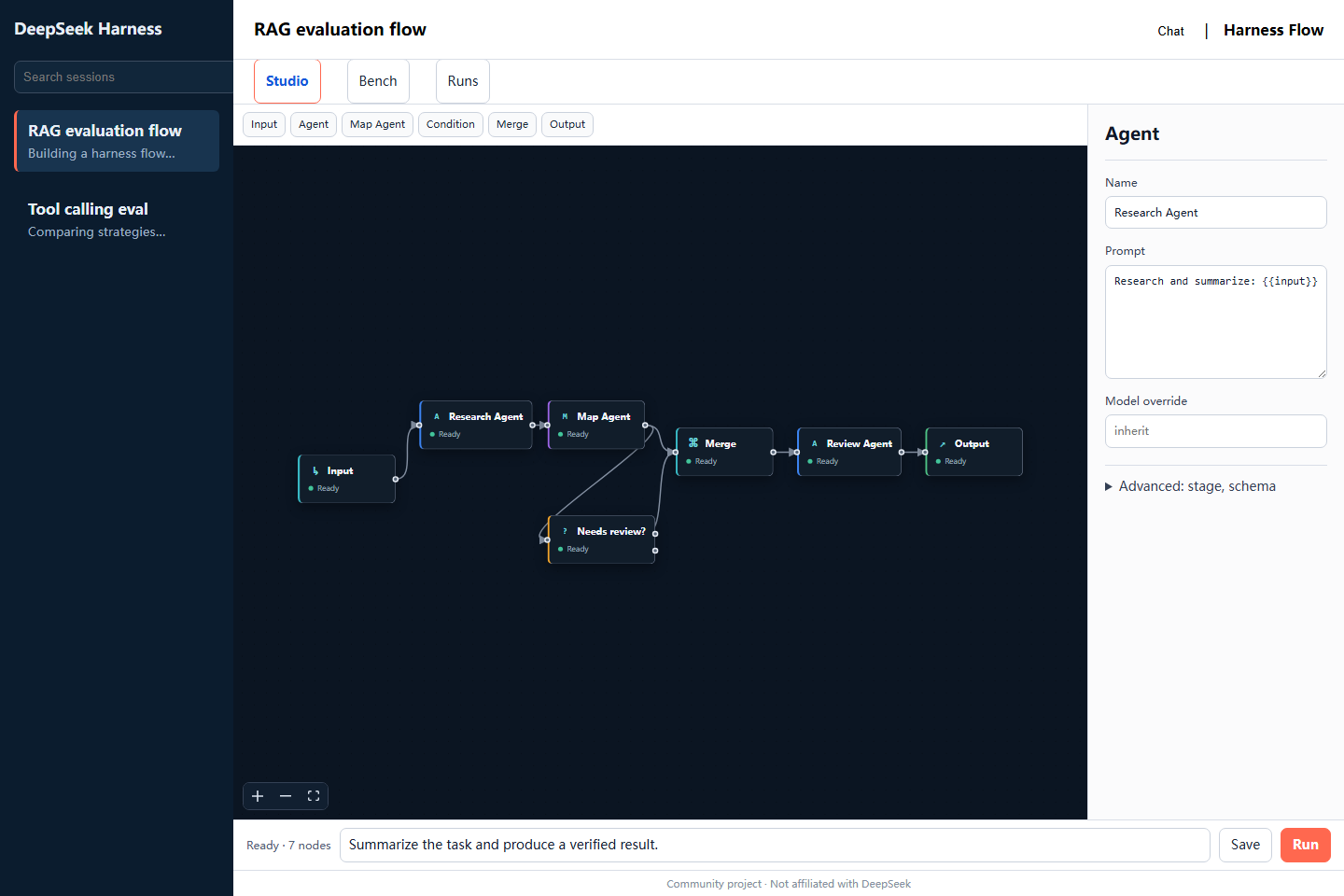
Studio preview — visual workflow editing remains an additive Harness Flow view inside a normal Harness session.
It preserves the original Harness experience. Chat, sessions, settings, tools, and existing workflow records remain unchanged; the plugin only adds a Harness Flow view with three focused tabs:
- Studio — edit and run Input, Agent, Map Agent, Condition, Merge, and Output nodes.
- Bench — run preset or imported suites against multiple provider routes and an independent judge.
- Runs — inspect persistent results, non-formal objective results, formal rankings, and redacted exports.
Community project. Not affiliated with or endorsed by DeepSeek.
Install
This beta is pinned to DeepSeek Harness commit 47f9438 and its matching RC packages.
dsh plugin --profile web add https://github.com/alison-xx/deepseek-harness-flow/releases/download/v0.1.0-beta.2/deepseek-harness-flow-0.1.0-beta.2.tgz
Restart the web profile, open any session, and select Harness Flow beside the original Chat view. See the installation guide for local-package installation and troubleshooting.
Desktop client (Tauri)
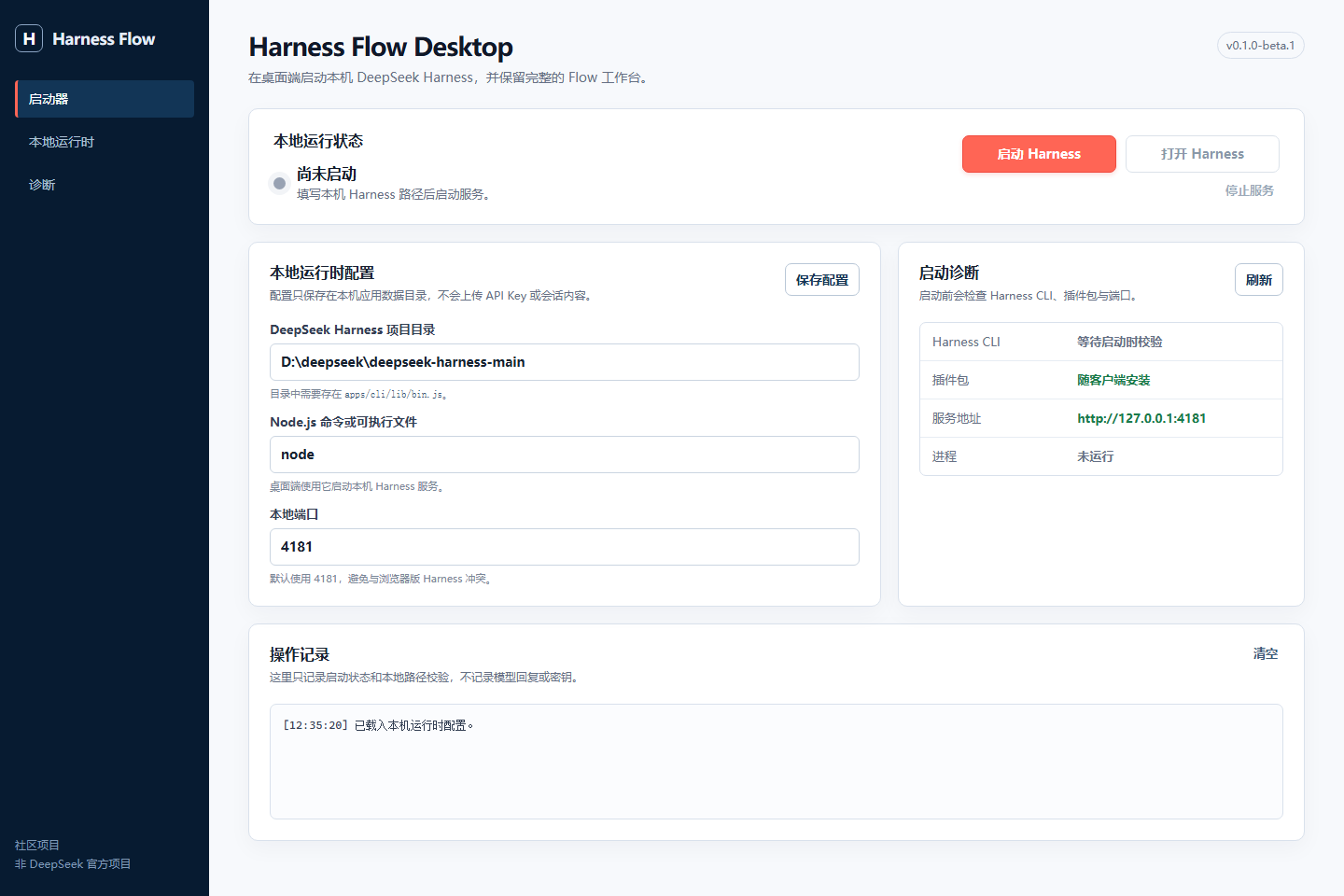
The repository also includes a Windows-oriented Tauri desktop launcher. It starts an isolated local Harness profile, installs this plugin bundle into that profile, and opens Harness in a native desktop webview.
pnpm install --frozen-lockfile
pnpm desktop:dev
The launcher asks for a local DeepSeek Harness checkout and a Node.js executable, then uses port 4181 by default. desktop:build creates an installer once Rust and the Windows build tools are installed. The first desktop beta intentionally uses a local Harness checkout and Node.js runtime rather than silently packaging credentials or a second copy of Harness. See the desktop guide.
Benchmark behavior
- Built-in MIT suites: Quick Smoke (6), Comprehensive Agent (18), Coding (8), and Safety (6).
- Default repetitions: 3. Default limits: 2 global jobs and 1 job per provider route.
- DeepSeek, OpenAI, Anthropic, Google, and custom OpenAI-compatible routes.
- Every route has its own Harness credential reference; plaintext keys are sent only to
credentials.setand are never persisted by this plugin. - A formal 100-point quality score requires a non-competing independent judge: objective 50%, judge 30%, safety 10%, stability 10%.
- Without a judge, results stay objective-only and no formal rank is assigned.
- Latency, tokens, cache reads, and estimated cost are separate metrics. Cost appears only when a pricing snapshot was entered.
- Imported commands are disabled until a run explicitly authorizes them.
Development
Requires Node.js 22+ and pnpm.
pnpm install --frozen-lockfile
pnpm verify
pnpm test:browser
pnpm pack:release
pnpm preview runs a standalone visual test shell at http://127.0.0.1:4178. Harness RC dependencies are runtime peers; the repository includes narrow compatibility declarations so a standalone clone can type-check without checking out the upstream monorepo.
Public API
Typert Remote namespaces:
flow.list/get/put/delete/run/cancel
benchmark.suites/list/import/export
benchmark.runs/start/get/list/cancel/retry/export
The primary wire and persistence contracts are FlowDefinition, ModelTarget, BenchmarkSuite, BenchmarkCase, BenchmarkRun, and BenchmarkResult.
Privacy and security
No telemetry is collected. Test prompts, model answers, reports, and API keys are not uploaded by the plugin. Exporters redact credential-like fields, absolute workspace paths, and sensitive environment-variable names. Please read SECURITY.md before importing third-party test suites.
License
MIT. Built-in benchmark prompts are original project content and are released under the same license.
No comments yet. Be the first to write one.