dsh-provider-commandcode
Command Code (commandcode.ai) provider plugin for DeepSeek Harness (dsh).
One route (commandcode), both Provider API wires: Claude on the Anthropic Messages wire, every other model on Chat Completions. Live model discovery filtered by your actual plan, the Command Code CLI's own sign-in reused with zero configuration, a quota status bar in the composer, effort-aware reasoning, tool calls, images, cached-token accounting, and /commandcode diagnostics.
Unofficial community plugin. Not affiliated with or endorsed by Command Code or DeepSeek.
Requirements
dsh0.2.x (engines.dsh: >=0.2.0 <0.3.0).- A Command Code account with Provider API entitlement (Pro, GOAT, Max, Ultra, Team, Provider). The Go plan has no Provider API: requests fail with
403 upgrade_required.
Install
# From npm (once published)
dsh plugin --profile web add dsh-provider-commandcode

# From this checkout
dsh plugin --profile web add /path/to/dsh-provider-commandcode

# From git (pnpm asks you to allow the package's build script first)
dsh plugin --profile web add github:abcdlsj/dsh-provider-commandcode
Then boot: dsh web (or dsh tui, dsh headless "task"). The row is llm-commandcode; the profile's cordis.patch.yml can override its config.
Authentication
The key is resolved per request, first match wins:
- Credentials service value for
apiKeyEnv(defaultCOMMANDCODE_API_KEY) — what the web Models page writes. $COMMANDCODE_API_KEY(or the configuredapiKeyEnvname) in the launch environment.$COMMAND_CODE_API_KEY.- Auth files, first usable one:
authFilefrom config,$COMMANDCODE_AUTH_FILE,~/.commandcode/auth.json(thecommand-codeCLI's own sign-in),$PI_CODING_AGENT_DIR/auth.jsonor~/.pi/agent/auth.json,~/.omp/agent/auth.json.
So if you already use the command-code CLI, there is nothing to configure: the plugin reuses that key. Headless profiles disable the credentials service, which is exactly why the CLI sign-in fallback exists.
An unusable value (blank, or characters no HTTP header can carry) fails as INVALID_CREDENTIAL naming the setting to fix, never echoing the key.
Cross-source fallback. When the provider answers 401 for the key this process chose, the plugin retires that key and tries the next source (keyFallback: false disables it). That is what makes a stale command-code CLI sign-in yield to a still-valid ~/.pi/agent/auth.json credential instead of failing the prompt. It retries at most five distinct keys, never the same one twice, and logs one warning naming the two sources.
Select a model
Pick Command Code in the model picker, or pin it in a profile overlay:
# web/tui profile overlay (or the profile's cordis.patch.yml)
- id: agent-default-model
  config:
    provider: commandcode
    model: claude-opus-5
Every model your plan includes is served. Claude ids go to /messages; everything else goes to /chat/completions (including models that also advertise /responses). Tool calls, streaming reasoning, images, usage (including cached and reasoning tokens), stop sequences, and max_tokens all map onto the wire.
Plan-aware catalog
The plugin reads your subscription (/alpha/billing/subscriptions) and the official CLI catalog's Min plan column, then lists only the models your tier can call:
plan |
Effect |
|---|---|
auto (default) |
Read the account plan. Bought or granted credits make every model reachable. |
go / goat / pro / max |
Pin a tier, without reading the account. |
all |
List everything and let Command Code refuse what it refuses. |
A model above the tier is refused before any request, with a message naming both the required and the current plan. If the account cannot be read, the plugin fails open: every model stays listed with a warning in /commandcode status — never an empty picker.
Quota status bar
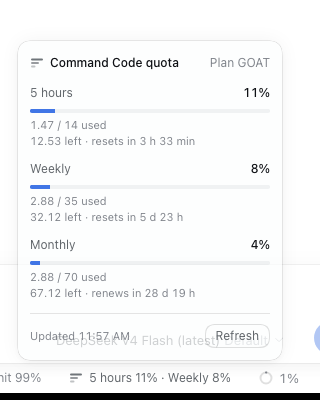
While the session's selected model belongs to commandcode, the composer dock shows a quota pill: 5 hours 11% · Weekly 8%. Clicking it opens the plan, each rolling window with its used/limit and reset countdown, the month's credits, and a manual refresh. It polls once a minute and on page visibility, and hides itself for every other provider. The browser never holds the API key: the host reads /alpha/billing/credits and answers the client's commandcode/usage call.
Configuration
All fields are optional. Defaults work with no configuration.
| Field | Default | Meaning |
|---|---|---|
apiKeyEnv |
COMMANDCODE_API_KEY |
Credential reference, also the environment variable name. |
keyFallback |
true |
On a 401, retire the refused key and try the next configured source. |
plan |
auto |
auto reads the account plan; a fixed tier filters; all lists everything. |
referenceCatalog |
true |
Refresh reasoning efforts and plan floors from the official CLI catalog. |
referenceMaxAgeMs |
21600000 |
Freshness of one refreshed CLI catalog. |
quota |
true |
Expose the account quota reading for the status bar and /commandcode quota. |
authFile |
— | Explicit command-code auth.json path, tried before the defaults. |
baseURL |
https://api.commandcode.ai/provider/v1 |
Provider API root. |
modelsURL |
<baseURL>/models |
Model listing endpoint. |
discovery |
true |
Fetch the live catalog; false serves the bundled snapshot. |
modelsMaxAgeMs |
300000 |
Freshness of a fetched listing. |
modelsTimeoutMs |
10000 |
One discovery request. |
models |
[] |
Declared models or per-model overrides (see below). |
cliVersion |
1.88.3 |
x-command-code-version header; must match a released CLI. |
projectSlug |
last segment of cwd |
x-project-slug header. |
sessionId |
one UUID per process | x-session-id header. |
zdr |
false |
Send x-cmd-zdr: 1; only zero-data-retention upstreams answer, usually at a higher price. |
thinking |
effort |
Messages-wire thinking: effort (output_config.effort), budget (budget_tokens), or disabled. |
reasoningBack |
auto |
Chat-wire replay of earlier reasoning: auto (only when a model demands it), always, never. |
maxTokens |
64000 |
Default output cap; explicit request values win. |
maxRequestImageBytes |
5242880 |
Decoded image bytes one request may carry. |
maxImagesPerRequest |
10 |
Images one request may carry. |
streamIdleTimeoutMs |
180000 |
Provider idle timeout for one stream read. |
retryPolicy |
dsh default (RATE_LIMIT, SERVER, …) |
Model-request retry policy; { mode: always } retries everything. |
Per-model overrides add a model the listing omits, or correct its capabilities:
- id: llm-commandcode
  name: dsh-provider-commandcode
  config:
    models:
      - id: acme/next-model
        name: Acme Next
        wire: chat            # or messages
        contextWindow: 400000
        maxTokens: 64000
        inputModalities: [text, image]
        efforts: [low, high, max]
Slash command
/commandcode (when the composition mounts the command registry):
/commandcode status— endpoint, catalog and CLI-catalog sources, plan, auth origin (never the key), thinking and replay policy./commandcode models [filter]— models served on the current plan, with the count excluded by it./commandcode quota— plan, rolling windows, monthly credits, reset countdowns./commandcode plan— how the tier was resolved and how many models each tier unlocks./commandcode refresh— force model, CLI-catalog, and plan refreshes, then report the source and any warning.
Behaviour worth knowing
- Degradation is learned, once per process. If a model refuses
reasoning_effort(Chat wire) orthinking/output_config(Messages wire), the plugin retries the same request without that field, logs one warning, and skips the field for that model afterwards. Same for models that demandreasoning_contentback on every earlier assistant turn. - No thinking replay on Messages. Thinking blocks are never sent back, because this adapter keeps no signatures — a replayed thinking block without its signature is refused by Anthropic.
- Model discovery never fails a prompt. A failed refresh keeps the last good listing, then the bundled snapshot; the warning surfaces in
/commandcode status. Plan resolution fails open for the same reason. - Account reads follow the same credential fallback as inference, so a stale CLI sign-in cannot be why quota or the plan is unreadable.
- Errors are stable harness codes.
401→INVALID_CREDENTIAL,403 upgrade_required→INVALID_CREDENTIALwith the plan explanation,403 MODEL_NOT_IN_PLAN→PLAN_REQUIRED,402/quota →QUOTA,429→RATE_LIMIT(withretry-after), context overflow →CONTEXT_WINDOW_EXCEEDED, Google schemas get their JSON pointers inlined. - Images go through the harness attachment service, are re-encoded once per request, and fail with
IMAGE_OFFLOAD_REQUIREDinstead of being dropped silently when the request exceeds its budget. - The status bar is a client plugin (
client.js, loaded throughdsh.client) that registers intoconversation.composer.dock; it is inert when the composition has no browser surface. - Every request carries the harness attribution header (
user-agent: deepseek-harness/…) plus the CLI's ownx-command-code-version,x-cli-environment,x-project-slug,x-taste-learning, andx-session-id.
Design boundaries
- Provider API only. The plugin never calls the CLI's
/alpha/generateendpoint: that surface is the official client's, not a documented API, and using it would route around Provider API entitlement. A403 upgrade_requiredis reported, not evaded. - Chat Completions and Messages only. Models that also advertise
/responsesare served on/chat/completions, which every one of them accepts; the Responses wire is not implemented. - No Files API and no thinking-signature replay. Images are sent inline; earlier thinking is never replayed on the Messages wire.
- One route.
commandcodeis fixed; a gateway or mirror is reached throughbaseURL/modelsURL, not a second route.
Troubleshooting
| Symptom | Cause and fix |
|---|---|
INVALID_CREDENTIAL: Invalid 'Authorization' header or token |
Key expired or wrong. Run command-code to sign in again, or set COMMANDCODE_API_KEY. |
403 upgrade_required |
The plan has no Provider API access (Go). Upgrade, or use the official CLI. |
PLAN_REQUIRED: MODEL_NOT_IN_PLAN |
The model is not in your plan. Pick another model or buy extra usage. |
MISSING_CREDENTIAL |
No key was found anywhere. Set COMMANDCODE_API_KEY or sign in with the CLI. |
422 cmd_zdr_no_providers |
zdr: true and no zero-retention upstream serves that model. Turn ZDR off for it. |
| Model list is stale or empty | /commandcode refresh; check modelsURL/proxy access. discovery: false pins the bundled snapshot. |
Development
npm install --ignore-scripts   # the first install would otherwise run `prepare`
npm run typecheck
npm test
npm run build
Layout: config.ts (schema + connection), catalog.ts (discovery, fallback, overrides, plan filtering), reference.ts (official CLI catalog and its refresh), account.ts (plan and credits reads), plan.ts (tier resolution), quota.ts (status-bar reading), remote.ts (the commandcode/usage endpoint), credentials.ts, adapter.ts (transport, headers, downgrades), chat.ts/messages.ts (wire serialization + SSE translation), sse.ts, errors.ts, images.ts, google-schema.ts, static-catalog.ts, static-reference.ts.
client.js is hand-written in the client module system's lazy-CJS factory format (no bundler); node --check client.js and npm test cover it.
What was verified live
GET /provider/v1/modelsdiscovery against the real endpoint: 95 models, 11 Claude on Messages, 84 on Chat Completions, 84 image-capable.- A full
dsh headlesstool-call round trip on a GOAT plan through Chat Completions (deepseek/deepseek-v4-flash, efforthigh): reasoning deltas, abashtool call, its result, and the final answer. - The live web client: the boot graph serves
dsh-provider-commandcode/client.js, the quota pill appears for acommandcodesession, and the panel renders the real GOAT windows, monthly credits, and reset countdowns — with zero boot exceptions or console errors. - Plan filtering on the live account:
gpt-6-sol(PRO) andclaude-opus-5(MAX) are refused locally on a GOAT plan before any HTTP request, while GOAT models run. - Cross-source credential fallback: a stale
~/.commandcode/auth.jsonkey yielded to the still-valid~/.pi/agent/auth.jsonkey after one401, without failing the prompt. - The Messages wire is covered by protocol-level tests. A GOAT plan's Provider API allowance excludes Claude (
403 MODEL_NOT_IN_PLANcomes from Command Code itself), so a live Claude request needs a Provider-or-higher key.
Attribution
- Model capability tables (input modalities, reasoning efforts, max output) derive from the
command-codeCLI manifest as published in pi-commandcode-provider (MIT). google-schema.tsadapts the JSON-pointer inlining from magpie-community's plugins Command Code package (MIT).
License
MIT.
No comments yet. Be the first to write one.