dsh-plugin-mascot
English | 中文
A clickable mascot for the DeepSeek Harness (DSH) Web GUI. It sits quietly in the bottom-right corner; click it and a panel opens with what the session has actually cost you and how well the prompt cache is doing.
- Token cache-hit rate — cache reads over every billed input bucket
- Token breakdown — uncached input / cache read / cache write / output / session total
- Context occupancy — current usage against the context window, with a bar
- Account balance — fetched host-side from DeepSeek; the API key never reaches the browser
- Three characters, seven official looks, switchable — Closure and Muelsyse (Arknights), Sengoku Yuno (BanG Dream!)
- One interface style per character — a Rhodes Island engineering console and a MEWTYPE live set are two designs, not a hue swap
- The sprite is skeletally animated — auto-rigged from its silhouette and driven by a skinned mesh: breathing, weight shifts, head leading; the two-frame Q-version look genuinely turns around
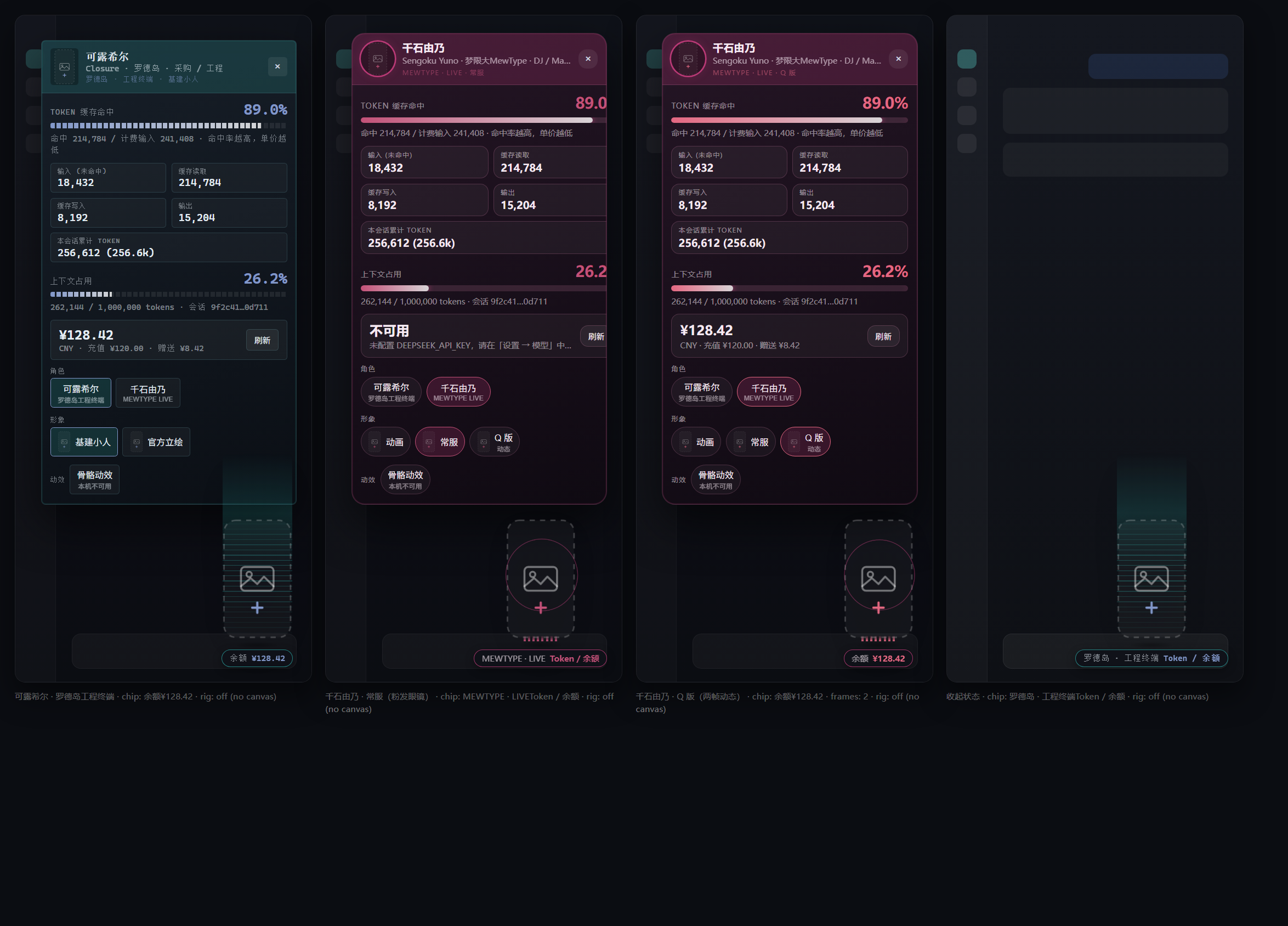
That preview is
lib/client.jsrunning in a real Chromium — opening panels, switching characters and switching looks are genuine DOM clicks. It shows the built-in placeholder, i.e. exactly what a fresh clone looks like beforenpm run fetch-art. The version with the official artwork isdocs/preview-official.png, generated locally and kept out of the repository.
Contents
- Install
- Looks
- Style
- Motion
- Usage
- Configuration
- Web console
- How it works
- Where the numbers come from
- Development
- Artwork and licensing
Install
DSH Desktop loads plugins through the profile's cordis.patch.yml.
cordis.yml is rewritten to [] on every boot — do not edit it.
The plugin has zero runtime dependencies (the host half imports nothing at all), so there are two ways in. Pick either.
Option A — no install step (simplest)
Point the patch row straight at the host half with an absolute file: URL:
# ~/.dsh/profiles/desktop/cordis.patch.yml
- insert:
    - id: mascot
      name: 'file:///C:/Users/<you>/Desktop/kexier/dsh-plugin-mascot/lib/index.js'
Note: a file: URL must name a file, not the folder. A relative
./dsh-plugin-mascot/lib/index.js also works — it is anchored to the patch
file's own directory.
Option B — a real profile dependency
Use DSH's own CLI, which forwards its arguments verbatim to pnpm inside the profile directory:
dsh plugin --profile desktop add "/absolute/path/to/dsh-plugin-mascot"
link: / file: specs and git sources work too:
dsh plugin --profile desktop add link:/absolute/path/to/dsh-plugin-mascot
dsh plugin --profile desktop add "github:ZYAONS/dsh-plugin-mascot"
then mount it by package name:
- insert:
    - id: mascot
      name: dsh-plugin-mascot
I prefer Option A: it cannot disturb the profile's dependency tree.
Configuration
Add a config block to either form (see Configuration):
- insert:
    - id: mascot
      name: dsh-plugin-mascot
      config:
        baseUrl: 'https://api.deepseek.com'
        cacheTtlMs: 30000
Restart DSH Desktop
A full app restart is required. DSH Desktop does not watch the profile
directory — patchReload: live only applies on the CLI path, and the desktop
composes its patch layers once per launch. Reloading the page is not enough:
the plugin was never part of that generation's load tree. After the first
mount, later edits to lib/client.js hot-reload through client HMR without
another restart.
Copyright
This repository contains no artwork belonging to anyone else. The characters are
© their owners — Closure and Muelsyse © Hypergryph (Arknights), Sengoku Yuno © Bushiroad
(BanG Dream! / Mugendai MewType) — and npm run fetch-art downloads the images onto
each machine rather than shipping them. Bushiroad's terms permit individual,
non-commercial derivative works and prohibit copying the content without adding
creativity, which is why the artwork is never committed and the characters are shown
from their original sources instead.
Read COPYRIGHT.md for the full position, including what is MIT, what is not, and the test that fails if artwork is ever tracked by git.
Web console
Decide how this plugin is mounted and which character it wears in a browser, before anything is installed on the machine:
https://zyaons.github.io/dsh-plugin-mascot/
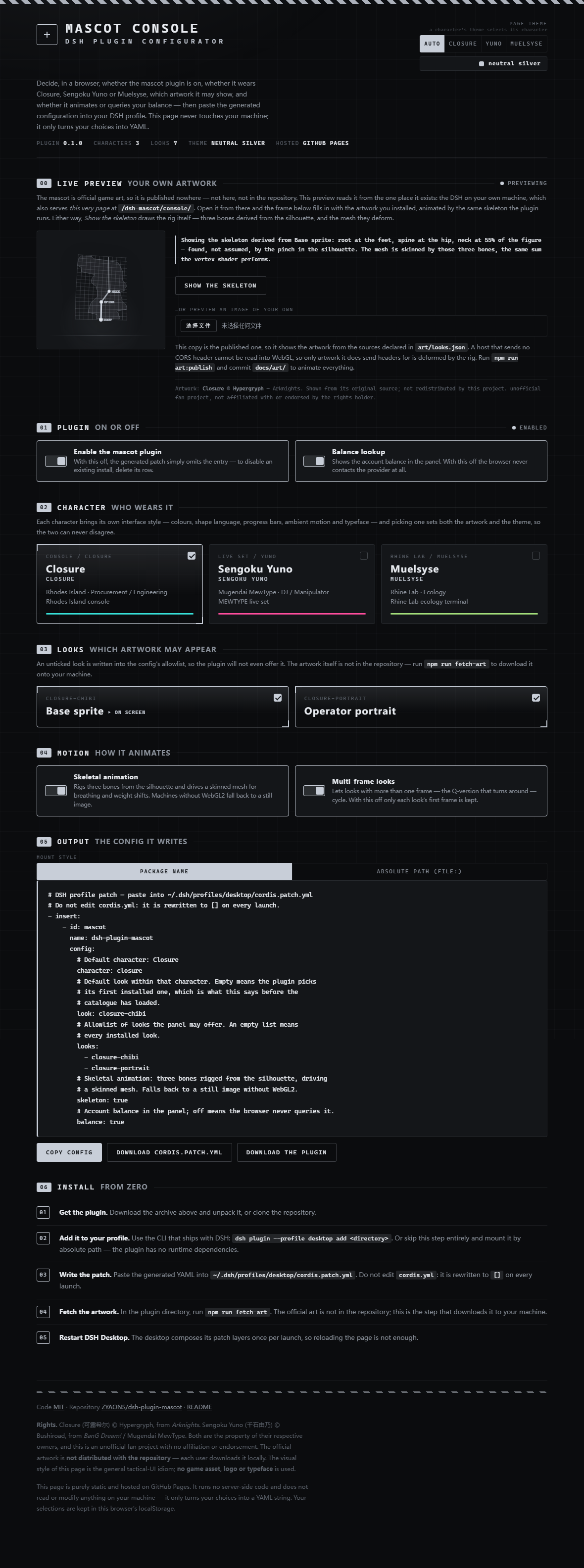
- 00 Live preview — shows the mascot animated, wearing whichever look you picked; click a look card to put it in the frame. Show the skeleton draws the rig itself — the three bones with their joints, the deformation mesh and the figure's outline — for any look, on either copy, because it needs only the measured numbers and never an image.
- 01 Plugin — the plugin itself on/off, and the balance lookup on/off
- 02 Character — Closure (Rhodes Island console), Sengoku Yuno (MEWTYPE LIVE) or Muelsyse (Rhine Lab ecology)
- 03 Looks — tick which artwork may appear; an unticked look goes into an allowlist, so the plugin will not even list it
- 04 Motion — the bone rig, and multi-frame looks
- 05 Output — a ready-to-paste
cordis.patch.yml, with copy and download - 06 Install — five steps, including fetching the artwork and restarting
Where the artwork comes from
The console renders the mascot on both copies, from three places in order of preference:
- A copy you published into
docs/art/withnpm run art:publish. Same origin as the page, so the rig always works and nothing depends on anyone else's server. Not committed by default — see below. - The declared source, loaded with CORS. The rig accepts it, so it animates.
- The declared source, loaded plainly. It displays, but a cross-origin image without a CORS header taints the canvas and WebGL refuses it, so it cannot be deformed. It can still cycle between drawn poses.
Which of 2 and 3 applies is a fact about each host, measured once and recorded in
art/looks.json as cors. Today: Closure's base sprite is served by
raw.githubusercontent and jsDelivr, both of which send Access-Control-Allow-Origin,
so it rigs and animates on the published page, as does Muelsyse's base sprite, which
comes from the same repository; the moegirl-hosted looks (both portraits and all three
of Yuno's) send no such header, so they display but do not
deform. The page says which case it is in the status line rather than leaving you
to guess why one of them is still.
Served by the plugin at /dsh-mascot/console/ there is a fourth source — the artwork
on your own machine — and there everything rigs, because it is all same-origin.
When the pixels cannot be touched, they can still be composed
Case 3 above is the interesting one: a cross-origin image with no CORS header cannot
be uploaded as a texture, so no vertex of it can be deformed. It can still be
decomposed. index.json already records where each figure's neck pinches and where
its hip sits, so the console stacks two masked copies of the same image — the head
above, the body below — and rotates each about its own joint. The head copy is a child
of the body's transform, so it inherits the sway and adds its own nod on top, the same
parent-then-child order the bone chain uses. The join is feathered across the neck
rather than cut, so a small angle reads as a head moving rather than as two pictures
sliding past each other.
Two rigid layers, no skinning — nothing bends. That is the honest description of what can be done with an image whose pixels are off-limits, and it is what puts all five looks in motion on the published page, not just the one whose host sends CORS.
It also needed one piece of geometry that did not exist before. Yuno's Q-version is
two drawn poses cut out of a single 645×645 download, and the published page
hotlinks that download — so the measured silhouette was being applied to an image
containing both figures, and the head was being masked in the wrong place. cutout.mjs
now keeps the crop rectangle it already computed, fetch-art records it in
art/crops.json, and the console maps the measurements through it. A local copy is
already cropped, so the rectangle is applied only to a fetched image.
Publishing the artwork (opt in)
npm run art:publish     # copies art/*.png into docs/art/
npm run build:site      # records which frames are now local
git add -f docs/art     # this is the deliberate step
docs/art/ is gitignored, so it cannot be committed by accident. Committing it means
this repository redistributes official game artwork — Closure © Hypergryph, from
Arknights; Sengoku Yuno © Bushiroad, from BanG Dream! / Mugendai MewType — and
GitHub Pages serves it publicly. That is a rights decision, which is why the project
does not make it for you and why the script prints the warning before it copies
anything.
build-site only advertises a local copy once it is actually tracked by git, so a
catalogue can never promise files a deployment does not have. Build with the artwork
present but uncommitted and the page correctly falls back to the sources.
Four page themes, one per character plus a neutral
The console carries an interface style for each character, and they are not hue swaps:
Neutral (auto) |
Closure | Yuno | Muelsyse | |
|---|---|---|---|---|
| Ground | neutral charcoal | blue-black | purple-black | dark green |
| Signal | silver | blue | magenta | light green |
| Corners | square | square | 14px rounded | 10px rounded |
| Selection cue | brackets | corner brackets | a glow | an inset ring |
| Labels | monospace | monospace | rounded | sans |
A character's theme selects that character. Choosing Yuno's theme switches the artwork to Yuno, and choosing Yuno switches the theme to hers — whichever control you use, the two move together, because a page showing one character in another's colours is a page contradicting itself. The neutral theme is the exception that proves the rule: it belongs to no character, so it can be chosen without disturbing who is on screen, and it is the only one permitted to disagree with the artwork.
Both are deep-linkable, and ?theme= moves the character too:
?theme=auto|closure|yuno|muelsyse ?character=closure|yuno|muelsyse
Language
The console is English; the plugin's own panel is Chinese. The split is
deliberate — the console is what strangers see first, the panel is what the operator
reads every day — and the names that need both live in one place: art/looks.json
carries nameEn / roleEn / taglineEn next to the plugin's name / role /
tagline, and build-site.mjs copies the English set into the console's catalogue.
Adding a look to the plugin gets it an English name by editing one file, and
check-site fails if a record it renders has no translation, or if Chinese text
reappears in the page outside the rights notice.
The page is purely static, hosted on GitHub Pages. It runs no server code and does not read or modify anything on your machine — it turns your choices into a YAML string. State lives in your browser's localStorage.
The palette and typography borrow from tactical-UI design generally (near-black ground, one signal colour, hairline rules, uppercase Latin labels). No game asset, logo or typeface is used.
Its catalogue comes from docs/site/catalog.json and its skeleton from
docs/site/rig.js — both generated by scripts/build-site.mjs from the plugin's
own sources, so neither can drift from what the plugin actually does. rig.js is
lifted region-by-region out of lib/client.js; the plugin's browser half has to be
one file (the module loader takes one registration per package), and copying the
geometry by hand would have been a second implementation waiting to disagree.
How the console is checked
scripts/check-site.mjs drives the page over the Chrome DevTools Protocol — a
real browser, real dispatched clicks, real console output — because the console is
the one artefact here that cannot be unit-tested by importing it. The rule its
assertions follow is that a claim has to be a fact produced by running the page,
not an inference from reading its source:
- It really moves. The page claims the sprite is animated, so the suite captures the preview region twice from the compositor and requires the bytes to differ. Nothing that merely exists can satisfy that.
- The WebGL path really ran. A canvas only appears when the shaders compiled and
a texture uploaded; the graceful fallback produces a still
<img>and no canvas, so the presence of a correctly-backed canvas is evidence rather than decoration. - Clicks are dispatched, not simulated.
Input.dispatchMouseEventat the element's centre, after scrolling it into view — a click whose coordinates fall outside the viewport lands on nothing, which would fail as though the handler were broken. - Console errors are failures.
Runtime.exceptionThrown,Log.entryAddedat error level andconsole.errorall count. - Two viewports, one of them genuinely narrow. 390px is set through
Emulation.setDeviceMetricsOverride, not--window-size: a headless window has a minimum width that crops a wider layout, which turns "text overflows" into a phantom bug. The suite asserts the viewport really is 390px before trusting the overflow result. - Both
file://and a deployed URL.npm run check:site -- https://…/runs the same assertions against the live site.
46 checks, plus 28 for the plugin.
Looks
The mascots use official art drawn by the publishers' artists, not by this project. That artwork is owned by Hypergryph and Bushiroad, and committing it here would redistribute someone else's copyrighted asset — so the repository ships the declaration instead of the images:
npm run fetch-art              # download, cut out where needed, then re-index
npm run fetch-art -- --force   # re-download regardless of hash
| Character | Look | Asset | Processing |
|---|---|---|---|
| Closure | Chibi | Official Q-version operator sprite (512×640, transparent, drone included) | as-is |
| Closure | Portrait | Official operator art (1024×1024, transparent) | as-is |
| Yuno | Anime | Official anime art (1550×2085, transparent) | as-is |
| Yuno | Casual | Official anime everyday-clothes art — the pink-haired, glasses design (1499×2088, transparent) | as-is |
| Yuno | Q-version | Official first-generation Q-version sheet, two poses | cut out → split into 2 frames |
art/looks.json is the hand-authored declaration; art/index.json is the
generated index. Every entry carries source URLs and a sha256, verified on
download, with a loud report when an upstream file changes.
Adding a look
No code changes:
- add an entry to
looksinart/looks.json(id/character/name/urls/rights); npm run fetch-art.
scripts/art-sync.mjs measures each image's alpha bounding box in a real
browser, derives the framing for both seats (the 104×172 sprite and the 38×50
portrait), and samples an accent colour from the figure. So the framing numbers
and the palette are measured, not hand-tuned. The result lands in
art/index.json, which the host half reads, filters to what is actually on disk,
and serves to the browser.
It syncs itself
npm run fetch-artcallsart-syncwhen it finishes, so the index is never stale;npm run art:syncre-measures on demand;npm run art:watchwatchesart/and re-indexes the moment you drop an image in — refresh the page and the new look is there, with no restart and no edit.
It works without the artwork
A neutral placeholder — a dashed box with a generic "image missing" glyph —
takes over whenever a file 404s, and the panel says to run fetch-art. The
placeholder depicts no character.
Style
One interface style per character, and not a colour swap: the two themes differ in shape language, how a ratio is drawn, ambient motion, portraiture and figure type.
| Closure · Rhodes Island console | Yuno · MEWTYPE LIVE | |
|---|---|---|
| Shape | Square (6px), instrument-like | Rounded (18px), gummy |
| Progress | Segmented ticks, like a gauge | VU meter, glowing |
| Ambient | A scanline sweeping through | A pulse ring plus a bouncing equaliser |
| Portrait | Rounded rectangle | Circle with a glow ring |
| Figures | Monospace, engineering readout | Rounded, stage energy |
| Header tag | 罗德岛 · 工程终端 |
MEWTYPE · LIVE |
Themes live in THEMES in lib/client.js and are selected by the theme field a
character carries in art/looks.json — so a new character themes itself by naming one.
Motion
The sprite moves in three layers. The first two are real motion; the third is the browser playing a file.
1. Skeletal animation (on by default, switchable in the panel)
A small 2D bone + skinned-mesh renderer written for this plugin.
- Automatic rigging.
art-syncalso measures each image's silhouette profile (32 horizontal bands of left/right extents). The client finds the neck from it — the band where the silhouette pinches. It has to be found rather than assumed, because a chibi's head is most of the figure while a full-body portrait's head is a tenth of it, and no fixed fraction frames both. - Three bones in a chain.
root(pivot at the feet — the whole body's sway and bounce) →spine(pivot at the hip) →neck(pivot at the neck, carrying the head). Children inherit their parents' transforms, so the head follows the body instead of drifting independently. - Skinning. Vertex weights are distributed vertically only — three bones stacked down the figure, blended across a smooth band at each joint — because that is the only axis a single flat image supports without tearing.
- Rendering. Linear blend skinning in WebGL2 (three weights per vertex). The
texture is uploaded with
UNPACK_PREMULTIPLY_ALPHA_WEBGL, so filtering across the figure's edge blends toward transparent black instead of leaving a dark fringe. - Deliberately small amplitudes. Idle sway ±1.5°, nod ±2.4°, breathing ±1.1%, bob 0.6%. Larger angles on a flat image read as rubber, not as breathing. A click adds a decaying oscillation (squash-and-stretch plus a nod) timed from the click itself, gone within 1.6 s.
What this is not: true Live2D or Spine skeletal animation. The games' animated chibi are Spine projects, and Arknights uses a modified Spine 3.8 format — the skeletons are 404/403 on the public CDN, and the stock runtime cannot read them anyway (which is why the community maintains tools like Ark-Models). So there is no pre-authored skeleton to load; the rig has to be inferred from a still. That is the honest description of what this is: it makes a static portrait breathe, shift its weight and lead with its head the way a standing body does. It is not a full character rig, and it has no arm bones — arms overlap the torso in a single flat image, and driving them independently would tear the artwork.
If any link fails — no WebGL2, a refused context, a shader that will not compile, an
image tainted by cross-origin data — it renders the plain <img> instead. So this can
only ever add motion, never remove the mascot. The preview script prints
rig: ON (canvas 140x232) precisely to keep an eye on that.
1a. Where the idle's numbers come from
Not from taste. Arknights ships its base chibi as Spine 3.8 models, and they are readable — Ark-Models mirrors them and the official 3.8 runtime parses them:
npm run rig:reference # Closure's base chibi, its Relax animation
Relax: 8.00 s, 240 samples
  hip  (F_Waist_I)   ±0.19°  2.00 s
  head (F_Head_I)    ±0.51°  2.00 s
That last column is the one that mattered. The rig used to nod ±2.4° over eight seconds — several times too far and four times too slow, which is why it read as a slow lean rather than as breathing. It now runs on the measured 2.00 s beat.
The degrees are not copied: the game rigs 297 bones and this rigs three, so an angle does not mean the same thing in both. The period does, and the order of magnitude does.
Neither the runtime nor the model is committed — both land in .cache/spine, which is
ignored, because the runtime is Spine's under the Spine Runtimes License and the models
are Hypergryph's. The extractor fetches one .skel rather than the repo's ~1 GB, and
skips the texture atlas entirely: it hands the reader the real attachment classes with
a dummy texture region, which satisfies its bookkeeping without an image.
2. Multi-frame animation
Yuno's Q-version source is two poses. cutout.mjs runs with mode: "all", keeps
both figures, crops each to its own bounding box, and gives them one shared scale
— otherwise the narrower pose would be blown up and she would appear to grow. The
browser cross-fades between them every 5.2 s, which reads as her turning around. It
stands down when the bone rig is on, since two sources of motion would fight.
3. Animated files
Any frame that is a GIF or an animated WebP simply plays — the browser handles it.
Usage
| Interaction | Result |
|---|---|
| Click the sprite | Toggle the panel |
| The "角色" row in the panel | Switch character |
| The "形象" row in the panel | Switch that character's look (a "动态" badge marks a multi-frame one) |
Click the backdrop or press Esc |
Close the panel |
| The "动效" row in the panel | Toggle the bone rig (shows "本机不可用" when the machine cannot run it) |
| Click "刷新" | Re-read the balance immediately (it also refreshes every 2 minutes while open) |
The choice is stored in localStorage. With the system's "reduce motion" preference set, every animation is switched off.
While open, the pill under the sprite shows the balance. If the lookup fails it reads "点我 Token / 余额" instead of pretending to know.
Configuration
Every field has a default, so the config block is optional.
| Field | Default | Meaning |
|---|---|---|
routePrefix |
/dsh-mascot |
Path prefix this plugin claims on the host webserver |
baseUrl |
https://api.deepseek.com |
Provider origin hosting the balance endpoint |
apiKeyRef |
DEEPSEEK_API_KEY |
Credentials reference name (~/.dsh/.credentials.yaml) |
cacheTtlMs |
60000 |
Freshness of one balance answer; failures are never cached |
timeoutMs |
10000 |
Upstream request budget |
artDir |
the plugin's own art/ |
Directory holding the artwork; derived from the plugin location |
Behind a proxy or self-hosted gateway, point
baseUrlat it — the only requirement is that it implementsGET /user/balance.
How it works
One package, two halves:
dsh-plugin-mascot/
├── lib/
│   ├── index.js        host half: the /dsh-mascot routes (balance, index, artwork)
│   └── client.js       browser half: sprite, panel, two themes, skinned-mesh renderer
├── art/
│   ├── looks.json      hand-authored declaration: characters, themes, urls, hashes
│   ├── index.json      generated by art-sync: framing, accents, frame lists
│   ├── closure-*.png   ← npm run fetch-art, gitignored
│   └── yuno-*.png      ← ditto; the Q-version sheet is cut out then split
└── scripts/
    ├── fetch-art.mjs   download → cut out → hand off to art-sync
    ├── cutout.mjs      key a background out; split a multi-pose sheet into aligned frames
    ├── art-sync.mjs    measure alpha boxes and accents, write index.json; --watch
    ├── chrome.mjs      Chromium discovery, shared by preview, cutout and art-sync
    ├── check.mjs       self-test: declaration/index agreement, bundle, routes
    ├── preview.mjs     renders docs/preview*.png from the real code in a browser
    └── verify-profile.mjs  pre-flight for a live DSH profile
Which seat the browser half takes
The DSH GUI is a slot registry. This plugin registers exactly one entry:
shell.overlay— a frame-wide floating layer above every column and outside their scroll containers. It is alistslot, so a freshid: "mascot"adds an entry instead of replacing one, and the layer itself is click-through, so the sprite opts back into pointer events rather than blocking the app underneath.
The wrinkle: shell.overlay is root-scoped and therefore does not receive
useProjection. So the entry declares a session-maybe-scoped child slot
of its own (mascot.panel) and renders the panel through
props.renderSlot("mascot.panel", …) — the renderer then hands that child
useProjection / useSession / sessionId for free. It is session-maybe
rather than session so the panel still opens before any session is selected.
The host half
The balance is the one figure the browser cannot reach: answering it needs the API key, and the key must never leave the host process. The artwork is the other one — the official files are not in the repository, so something has to read them off disk and decide which are installed. So the host half owns one same-origin route prefix:
GET /dsh-mascot/api/balance   account balance, cached
GET /dsh-mascot/api/health    route liveness, for debugging
GET /dsh-mascot/api/looks     which looks are installed, with framing and accents
GET /dsh-mascot/art/<file>    artwork out of the plugin's own art/ directory
- The key is resolved per request through
ctx.credentials.resolve(), so a rotated key takes effect on the next call with no restart; - it is used only as an
Authorization: Bearerheader and never appears in a response body, a log line, or an error message; - the routes are gated on
ctx.connection.isAuthenticated(req)— the same browser cookie the rest of the GUI uses. If Connection is absent from the composition they fall back to accepting only a loopbackHostheader; - the artwork route checks path containment first (
.., encoded separators → 403), then the extension, and only then touches the disk. A missing file is a 404, which the browser half turns into the placeholder; /api/looksre-readsart/index.jsonper request and drops any look whose files are not on disk — so a fresh clone (index present, images absent) answers with nothing and gets the placeholder rather than a broken image.
Where the numbers come from
Every figure in the panel comes from DSH's own session projections; the plugin does not count tokens itself.
| Shown | Source | Shape |
|---|---|---|
| Token breakdown | useProjection("tokenUsage") |
{ uncachedInputTokens, outputTokens, cacheReadTokens, cacheWriteTokens } |
| Cache-hit rate | derived from the row above | cacheReadTokens ÷ (uncachedInputTokens + cacheReadTokens + cacheWriteTokens) |
| Context occupancy | useProjection("contextPressure") |
{ contextWindow?, pressureTokens?, projectedTokens? }, preferring projectedTokens |
| Account balance | this plugin's /dsh-mascot/api/balance |
GET {baseUrl}/user/balance |
| Available looks | this plugin's /dsh-mascot/api/looks |
re-reads art/index.json, filtered to files on disk |
| Artwork | this plugin's /dsh-mascot/art/<file> |
art/ on disk, with the built-in placeholder as fallback |
Anything unmeasurable renders as — rather than 0: with no session there is
no hit rate to report, and the panel does not invent one.
Development
npm install                # react / react-dom, devDependencies for the preview only
npm run fetch-art          # download → cut out → re-index, in one go
npm run art:sync           # just re-measure and rewrite art/index.json
npm run art:watch          # watch art/ and re-index whenever a file lands
npm test                   # self-test (27 checks)
npm run check              # node --check on both halves plus the self-test
npm run preview            # docs/preview.png — placeholder, committed
npm run preview:official   # docs/preview-official.png — official art, gitignored
npm run verify             # pre-flight the current DSH profile
Running the cut-out pass on its own (a multi-pose sheet becomes several frames):
node scripts/cutout.mjs <sheet.png> <frame1.png> <frame2.png> --mode all
Framing needs no manual numbers. npm run art:sync re-measures and writes
them into the index. To override by hand, edit the seat block of a frame in
art/index.json and refresh the page.
To add a theme: add a key to THEMES in lib/client.js, then have a character
name it in art/looks.json.
Artwork and licensing
- Code: MIT
- Official artwork (
art/*.png, not committed): Closure's Arknights official Q-version operator sprite and operator art, and Sengoku Yuno's official BanG Dream! anime art, everyday-clothes art and Q-version design. The rights belong to their respective owners; this is publisher-commissioned art. This repository does not distribute those files; it ships theart/looks.jsondeclaration and thenpm run fetch-artscript so each user downloads them onto their own machine. Fine for personal use — get permission before redistributing or using commercially.scripts/cutout.mjskeys a background out of Yuno's Q-version sheet and splits its two poses; that is pixel processing and changes no content. - Built-in placeholder: the generic "image missing" glyph in
lib/client.js(a dashed box plus a picture symbol). It depicts no character and is MIT alongside the code. - Characters: Closure © Hypergryph (Arknights); Sengoku Yuno © Bushiroad (BanG Dream! / Mugendai MewType). Both are the property of their respective owners. This is an unofficial fan work with no affiliation or endorsement.
- DSH: DeepSeek Harness and its
@deepseek-ai/*packages belong to their respective authors; this repository only builds against its plugin surface.
No comments yet. Be the first to write one.