dsh-okf-memory
English | 简体中文
会话记忆 → OKF 知识沉淀插件(神经自我学习驱动)
把会话中高价值内容按 OKF v0.1 规范自动沉淀为长期记忆,跨会话自动唤起。Agent 越用越准:每次选择、跳过、纠错都是学习信号,记忆权重持续更新。
Session-to-OKF memory plugin with neuro-self-learning: predictive recall, uncertainty-driven capture, reinforcement feedback, consolidation & forgetting.
特性
- 记忆四阶段闭环:捕获 → 概念化 → 沉淀 → 唤起
- OKF v0.1 合规:每个概念是标准 Markdown 文档(frontmatter 硬要求
type),index.md渐进式目录 +log.md变更历史,交叉链接用包内绝对路径 - 神经自我学习驱动:预测性唤起(先预测再检索校验)、不确定性量化(置信低扩大探索)、预测误差驱动捕获(用户纠正/首次披露触发写入)、权重衰减+归档(巩固与遗忘)
- 强化反馈回路:
score = relevance × weight × recency,用户选中候选权重↑、跳过权重↓ - 技术选型记忆(TechChoice):前端/后端/语言/方案/配置 按维度沉淀候选表 + 当前使用;三档选择规则(多候选展示、单候选直用、领域命中按维度)
- 写入许可门:type 合法性 → 去重(互补不复制,互建交叉链接)→ OKF 符合性校验
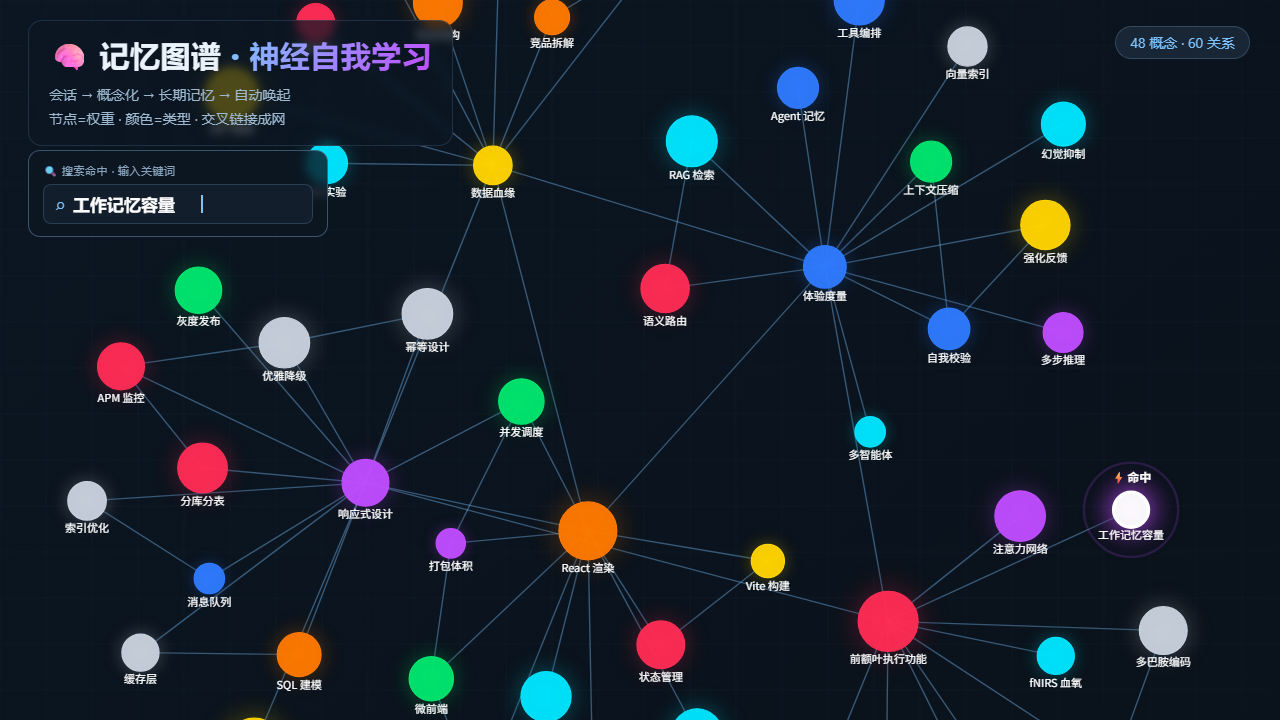
- 记忆图谱可视化(M2):client 面板在 DSH 对话视图渲染力导向记忆图谱——节点大小=权重、颜色=类型;搜索命中→脉冲光环+⚡命中+神经传导;滚轮缩放/拖拽平移/拖节点/悬停详情
- 图谱数据接口:
okf_graph工具 +service.graph输出{nodes,edges,timeline}JSON,契约稳定,可被任意前端复用
安装
# 任意 profile(如 web):已发布到 npm,一行安装,免构建授权
dsh plugin --profile web add dsh-okf-memory
# 或从本地 checkout(开发用):
dsh plugin --profile web add ./dsh-okf-memory
# 或从 GitHub 源码(需 prepare 构建并向用户授权构建):
dsh plugin --profile web add github:ZHI-QI/dsh-okf-memory
已发布到 npm:dsh-okf-memory@0.1.0 → https://www.npmjs.com/package/dsh-okf-memory
插件零运行时依赖(peer 依赖 @deepseek-ai/cordis 由 dsh 运行时提供,安装时若有 peer 警告可忽略),安装即用,无需构建脚本。
如何使用
装好后你无需手敲命令。插件会给 Agent 注入一段「记忆纪律」系统提示,让它在会话里自主判断该记什么、该查什么,并调用下面的工具完成。你也可以随时显式地说「记住XX」或「查一下记忆里关于XX的」来主动触发。
5 个工具一览
| 工具 | 作用 | 什么时候用 |
|---|---|---|
okf_remember |
写入一条记忆(自动去重、校验、落盘) | 有值得沉淀的新知识时 |
okf_search |
按关键词召回,按权重/近因排序 | 开场预取、回答前找相关记忆 |
okf_read |
精读某条全量(含交叉链接),并记录一次使用反馈 | 需要完整细节时 |
okf_forget |
撤回一条记忆 | 记错 / 不需要时 |
okf_graph |
导出记忆图谱 JSON(nodes/edges/timeline) | 可视化 / 传递图谱数据 |
让它记住(写入)
- 自动(推荐):你在对话里披露新事实、拍板决策、纠正 Agent、提到技术选型时,Agent 会自己判断是否值得记,不用你开口。
- 手动:直接说「记住…」即可触发,例如
记住,我的三家门店是韶山/湘乡/塘厦,共用局域网共享文件夹。
什么才算「值得记」:新背景事实/偏好、决策及理由、可复用方法论/流程/经验教训、用户纠正、被确认的反直觉结论、技术选型。
不记:寒暄、单轮临时任务、已有记忆的重复内容、未验证的猜测(猜测归入 Idea,等成熟再沉淀)。
让它回忆(召回)
- 你问相关问题时,Agent 会先
okf_search召回再作答。 - 也可显式说「查一下记忆里关于XX的」。
- 检索不到会明确告诉你「记忆库没有」,不会编造。
技术选型怎么用(TechChoice)
针对前端/后端/语言/方案/配置这类选型,插件按「三档规则」处理(细节见下文「技术选型三档规则」专节):命中 2+ 候选 → 全部展示给你选;命中 1 个 → 直接用;你未指定技术但命中维度关键词(如「前端」)→ 按该维度记忆处理;你提出新方案/切换/配置 → 追加式更新,不覆盖旧候选。
示例:怎么记、怎么查
// ① 记一条门店事实(Fact)
用户: 记住,我的三家门店是韶山/湘乡/塘厦,共用局域网共享文件夹
Agent: okf_remember(title="门店布局", type="Fact",
        content="# 核心\n\n三家门店共用局域网共享文件夹…", tags=["门店"])
       → 已沉淀记忆 fact/门店布局

// ② 记住前端方案(TechChoice)
用户: 前端就用 React 18 + Vite 吧
Agent: okf_remember(type="TechChoice", title="前端方案",
        content="## Options\n\n| 候选 | 状态 |\n|---|---|\n| React 18 + Vite | active |",
        tags=["前端","技术选型"])

// ③ 问数据库时先召回(而不是去翻本地文件)
用户: 帮我查询数据库
Agent: okf_search(query="查询数据库")
       → 命中「鼎赞数据统一用 mcp-dezensaas-mysql」
       → 按该记忆走 mcp-dezensaas-mysql 服务
视觉图谱(DSH 对话视图标签)
插件带有 client-plugin,在 DSH web 的对话视图注册一个「记忆图谱」标签:
- 力导向图谱:节点大小=权重、颜色=类型(fact/preference/decision/method/insight/idea/lesson/techchoice)、连线=交叉链接
- 搜索命中:顶部输入框命中 title/type/tags → 命中节点白色描边 + 脉冲光环 +
⚡命中,并 BFS 传导激活相关节点 - 交互:滚轮缩放、拖拽平移、拖节点、悬停查看详情(标题/类型/权重/描述/标签)
数据来自后端 /okf-graph 路由(webServer,仅 web profile),由 okf_graph 工具 / service.graph 提供。
记忆库结构
默认 ~/.dsh/memory/(环境变量 OKF_MEMORY_ROOT 覆盖):
~/.dsh/memory/
├── index.md              ← 渐进式目录(okf_version: "0.1")
├── log.md                ← 变更历史(## YYYY-MM-DD)
├── fact/                 ← Fact 背景事实
├── preference/           ← Preference 用户偏好
├── decision/             ← Decision 决策(三段式:数据/分析/结论)
├── method/               ← Method 方法论
├── insight/              ← Insight 洞察
├── idea/                 ← Idea 未成型灵感
├── lesson/               ← Lesson 经验教训
├── techchoice/           ← TechChoice 技术选型(Options 候选表 + Active)
└── .meta/weights.json    ← 学习权重元数据(不污染 OKF 符合性)
技术选型三档规则(用户既定协议)
- 命中 2+ 候选 → 全部展示给用户选择,不擅自决定
- 命中 1 个候选 → 直接使用
- 用户未指定技术但命中维度关键词(如"前端")→ 按该维度记忆处理
- 用户说出新技术/切换/配置 → 追加式更新,不覆盖旧候选(保留 v1→vN 迭代轨迹)
配置
| 项 | 方式 | 默认 |
|---|---|---|
| 记忆库根目录 | 环境变量 OKF_MEMORY_ROOT 或 settings okfMemory.root |
~/.dsh/memory/ |
| 学习参数 | lib/learning.js 中 PARAMS(衰减天数/归档阈值等) |
见文件 |
开发与测试
npm test                      # 全量测试(smoke + integration + schema + concurrency + regression)
node scripts/smoke.js         # 核心模块功能验证(含并发写锁断言)
node scripts/integration.js   # mock dsh ctx 集成验证(含错误路径断言)
node scripts/schema-check.js  # 工具 schema 合规
node scripts/concurrency.js   # 写锁并发压测(50 并行写 / 5 并行反馈)
node scripts/regression.js    # P0 回归:锁可重入/异常恢复、merge 边界、路径穿越、forget 幂等
License
MIT
No comments yet. Be the first to write one.