




三合一工具台 · dsh-s-m-c-center
Chinese name: 三合一工具台 (Triple Tool Console) | UI entry: Settings → Web UI Plugins → Tool Manager | Aliases: 工具管理, 工具中心, 技能管理, MCP 服务器管理, CLI 工具管理, Skills / MCP / CLI manager
Tool Manager — a self-contained DSH web plugin that adds a first-class settings page for the agent's three tool families: Skills, MCP servers, and local CLI tools — plus a guide page that explains how each works and gives all of it back cleanly.
Mounted purely as a profile bundle patch + package — no DeepSeek Harness source changes.
✨ What it is
One settings page (「Web UI 插件 → 工具管理」) covering the agent's three tool families — plus a guide page that doubles as the manual and as the escape hatch when you want to uninstall:
| Tab | Manages | Backing |
|---|---|---|
| Skills 技能 | browse / enable / disable / delete / import skills (project + user roots) | user-level canonical copy in ~/.dsh/S-M-C/skills + directory junction; project-level SKILL.md frontmatter rewrite |
| MCP 服务 | create / edit / test / enable / archive / delete MCP servers | real @deepseek-ai/dsh-mcp-client connections (mcp__<server>__<tool>); archived ones move to S-M-C/mcp-archive.json |
| CLI 工具 | discover / probe local CLI tools; register system CLIs | skill-embedded scripts/run-cli + S-M-C/cli.json |
| Guide | how each tool family works (store & junctions, real connections & archiving, CLI discovery & announcement), plus the uninstall preparation | the copy that used to sit on the management tabs lives here; the management tabs stay purely operational |
Full feature guide (in Chinese):
docs/功能介绍.md.
💡 Features
- Skills — group by project/user level & source (
.dsh/skills,.agents/skills,~/.dsh/skills,~/.agents/skills); user-level skills are adopted into the unified store~/.dsh/S-M-C/skills— enable = inject a directory junction into the skills root, disable = remove it (SKILL.mdis never rewritten); project-level skills stay in place and still use frontmatter; deletion is two-step and physical; a detail view (description / whenToUse / body); import from an arbitrary directory (native picker or typed path) straight into the store, enabled. - MCP — two sub-pages (manage / create): the list gives each server one switch (enable / archive) plus delete, the create page holds the form or JSON editor with test connection (one-shot real probe) before saving; enable / archive actually connects/disconnects and registers
mcp__<server>__<tool>tools (an archived definition moves toS-M-C/mcp-archive.json— not connected, not announced, kept whole so it can be moved back); live status (connecting/running/failed/stopped). - CLI — auto-discovers the CLI a skill wraps (
scripts/run-cli.*/cli-state.*, the tencent-news pattern) and keeps aS-M-C/cli.jsonregistry for system CLIs (gh,git,tencent-news-cli…). Every entry reports: installed? / version / update due? / API-key state (parsed fromcli-stateJSON) / subcommands (parsed fromhelp) — and each row shows its origin and location (Skill CLI · <path>/System CLI · <path>). The announce / hide switch only decides whether the CLI goes into the agent announcement — the plugin cannot start or stop a system CLI — so entries are hidden by default; the ones a skill ships (labelled "Skill CLI") are best kept hidden, since their own skill is what calls them. - Guide — how the three tool families work, with the escape hatch before removing the plugin at the bottom. "Undo migration" (撤销迁移, red) moves every stored skill back to its original location; when the store is empty but skills still sit in the skills directories, the same button turns green and reads "Migrate" (迁移), bringing them back into the store — reversible in both directions. "Inject all MCP" (MCP 全部注入) moves every archived server back into
mcp.jsonin one pass and reconnects it. The page also lists exactly which store directory and config block must be removed by hand. - UI — fully bilingual copy (zh / en, 189 keys each; an English shell renders no Chinese); the announce section folds its long explanation behind an inline toggle, collapsed by default; destructive actions use two-step confirmation.
📷 Screenshots
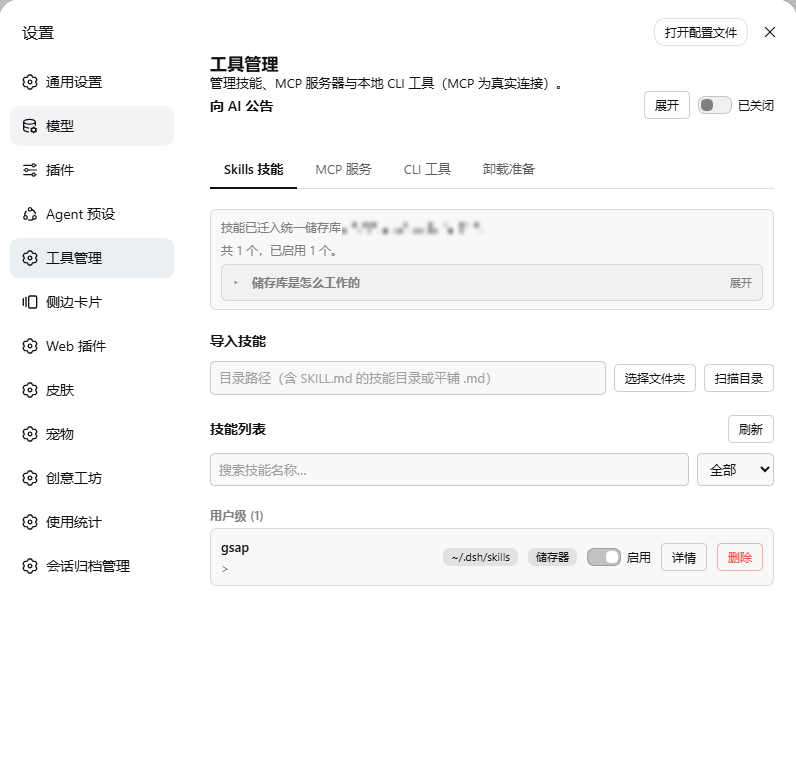
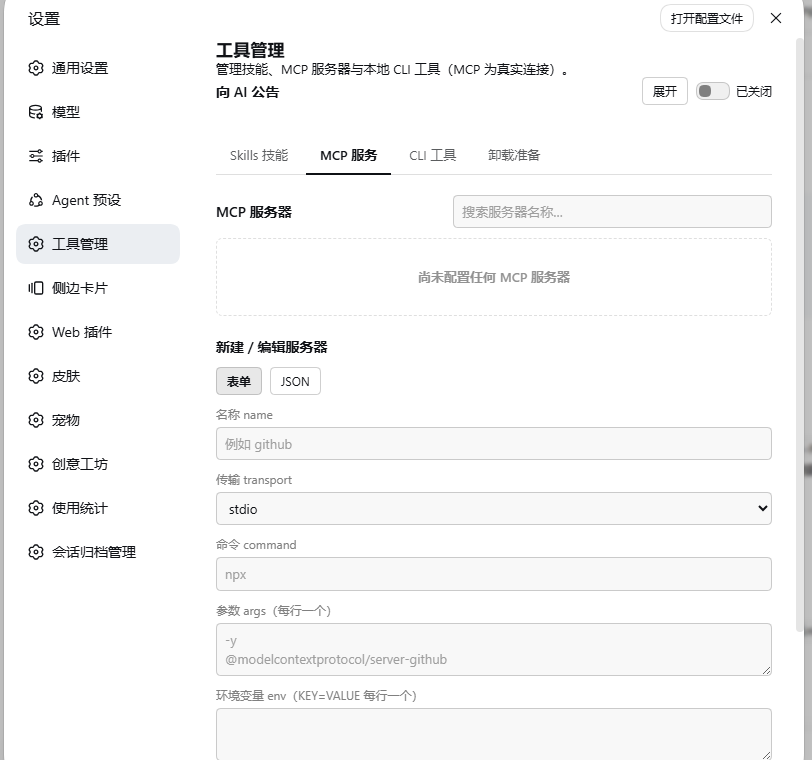
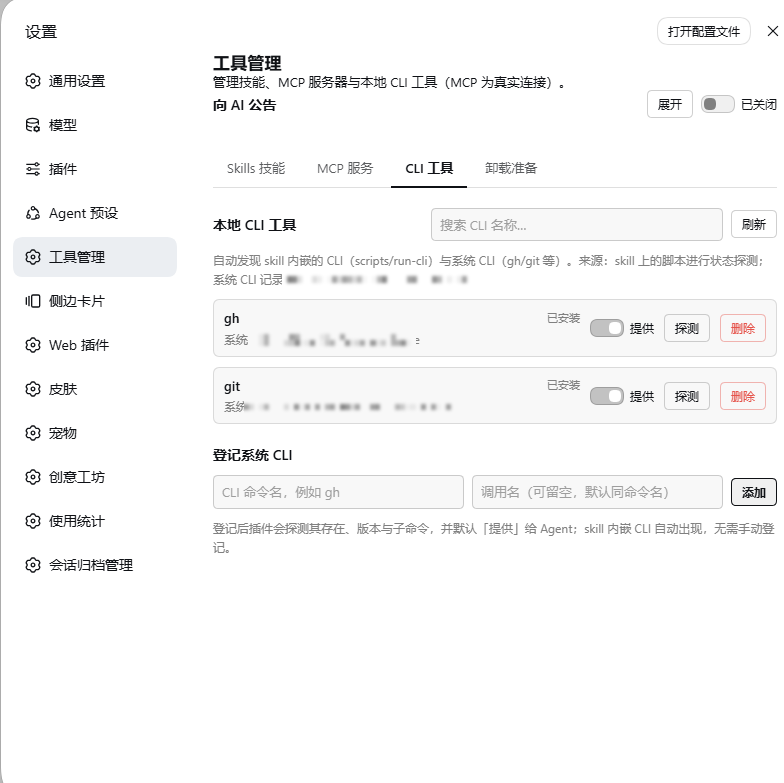
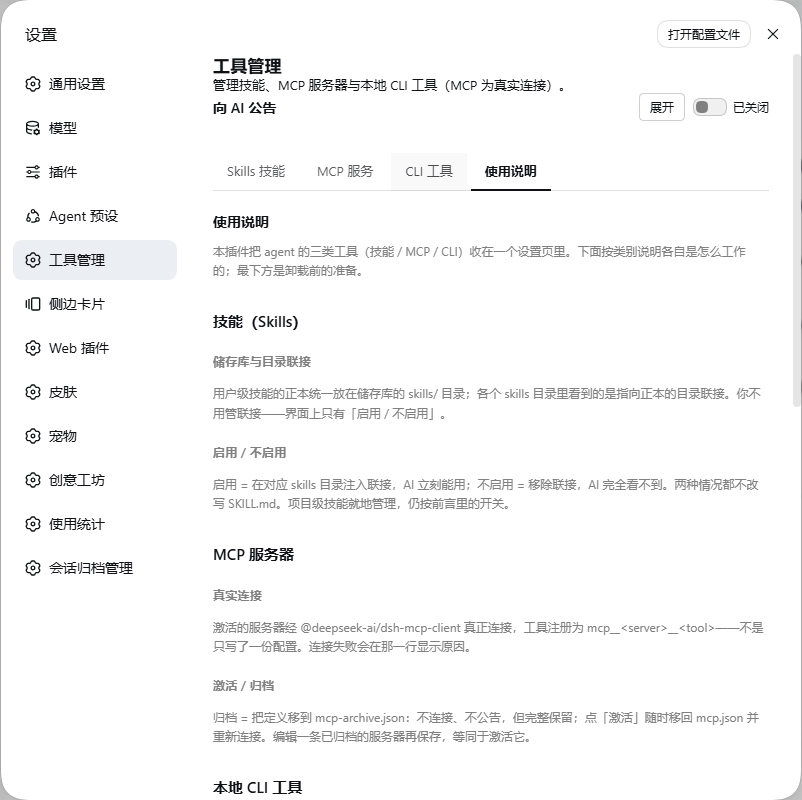
The four tabs: Skills (unified store + junctions), MCP (real connections), CLI (discover / probe / register), and Guide (how it works + reversible migration + the manual cleanup checklist). Personal paths are mosaicked.
🏗️ Architecture
Mounting & the two halves — the plugin is just an npm package plus one profile bundle patch line; zero changes to dsh source:
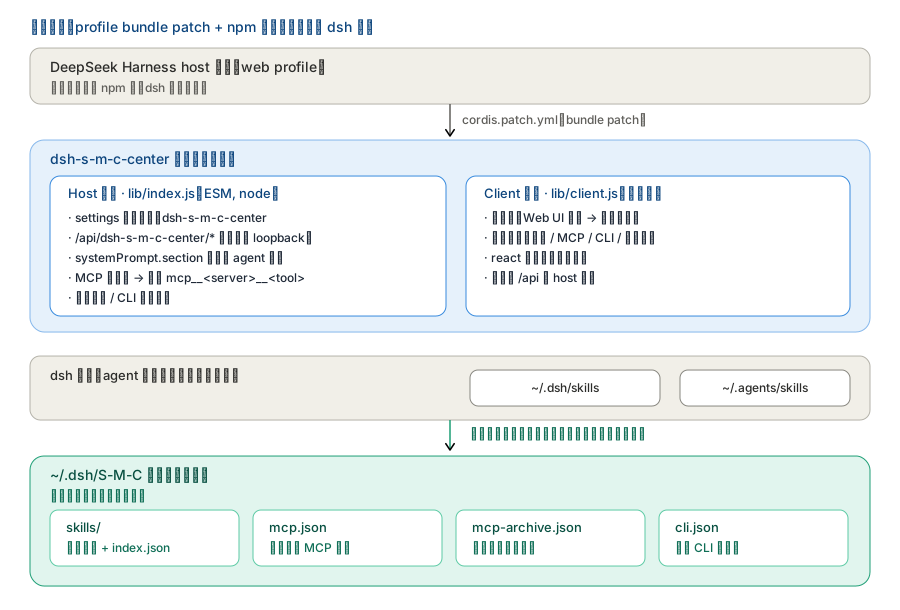
Labels are in Chinese (file names, routes and API paths are verbatim): the host half registers the routes, announces every agent and really connects MCP; the client half only renders the settings page. They talk over /api/dsh-s-m-c-center/*.
Store layout — everything the plugin owns lives in ~/.dsh/S-M-C; the two directories dsh
scans deliberately stay outside it (the plugin only injects / removes links inside them):
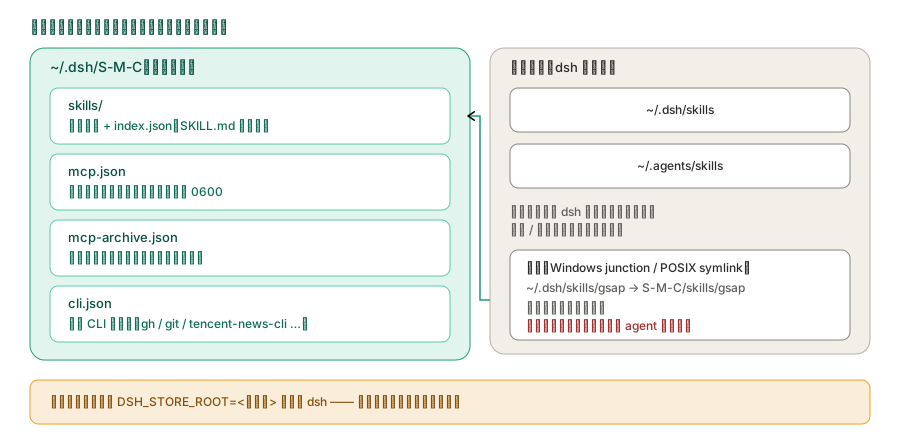
The canonical copy of a skill always lives in the store; the entry under ~/.dsh/skills is just a link pointing at it.
What the three switches actually do on disk — not a config field, but real file / connection changes:
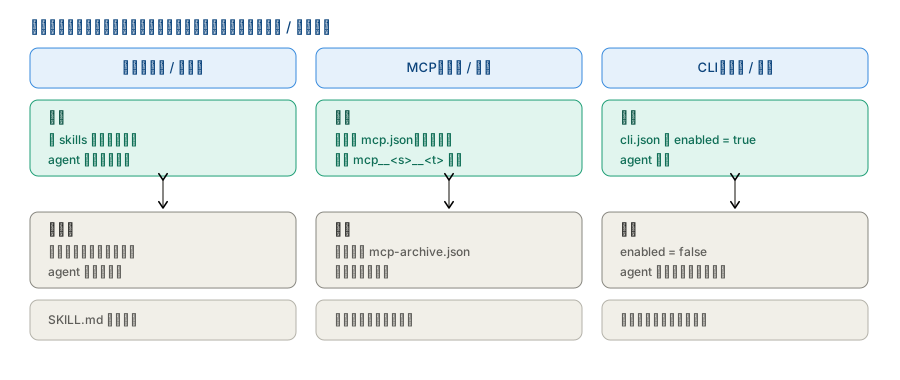
Skills = add/remove a link; MCP enable/archive = move the definition between mcp.json and mcp-archive.json; CLI = visibility only.
🚀 Install
Requires: DeepSeek Harness
>= 0.1.2-alpha.2(all@deepseek-ai/*packages are released in lockstep). Verified end-to-end on0.1.5-rc.2; every API this plugin uses was checked to exist with a matching signature from0.1.2-alpha.2onwards.
Install as a normal package — do NOT link it via a junction. A junction makes dependencies fail to resolve upward (e.g.
schemastery/react) and desyncs the package name fromcordis.patch.yml; both break DSH startup.
npm release note: this package (
dsh-s-m-c-center) is not on npm yet — for personal reasons on the author's side the publish is deferred past September 17. Until then, install from source or from the tarball below.
# From npm (live after Sep 17): https://www.npmjs.com/package/dsh-s-m-c-center
dsh plugin --profile web add dsh-s-m-c-center
# or: npm install dsh-s-m-c-center

# From source (this repo / after cloning)
dsh plugin --profile web add <absolute path to this folder>

# Or the built tarball
dsh plugin --profile web add <path>/dsh-s-m-c-center-<version>.tgz

# Or the convenience scripts
bash scripts/install.sh                                        # macOS / Linux / Git Bash
powershell -ExecutionPolicy Bypass -File scripts/install.ps1   # Windows
The first install needs a DSH restart plus a hard browser refresh (Cmd/Ctrl+Shift+R). Then open 「设置 → Web UI 插件 → 工具管理」 (Settings → Web UI Plugins → Tool Manager).
No restart needed to update: once the plugin is installed, later upgrades should not require restarting DSH — overwrite the files and hard-refresh the browser. (Only changes that touch Host-side routes or backend logic need a DSH restart; UI-only changes take effect on refresh.)
⚙️ Configuration
# This plugin's own settings namespace (dsh settings)
dsh-s-m-c-center:
  enabled: true        # master switch (routes, MCP connections, CLI probes)
  announceToAgent: true # announce the plugin to every agent's system prompt
Runtime state:
- Unified store: everything this plugin owns lives in
~/.dsh/S-M-C/(Skills / MCP / CLI) —skills/,mcp.json,mcp-archive.json,cli.json. Old locations are migrated on first start; the whole store can be relocated withDSH_STORE_ROOT(the plugin rebuilds the junctions for you). - MCP: active servers in
S-M-C/mcp.json, archived ones inS-M-C/mcp-archive.json(credentials/headers stored plaintext — keep both files at0600). - CLI registry:
S-M-C/cli.json.
🔒 Capability & dependency disclosure
The plugin runs with the DSH process's privileges and touches files, network, commands and credentials. What each is used for, and where it stops:
| Capability | What it does | Scope and bounds |
|---|---|---|
| Files | reads/writes the store ~/.dsh/S-M-C/** (skills/, mcp.json, mcp-archive.json, cli.json); creates and removes directory junctions in the skill roots; reads SKILL.md and skill-embedded scripts |
only the store and the four roots dsh scans (project/user .dsh/skills, .agents/skills); in-place skills get their frontmatter rewritten and nothing else; no other path is touched |
| Network | connects to the MCP servers the user configures (a child process for stdio, HTTP for streamable-http) | only the addresses typed into the management page; the plugin itself has no built-in external service, no telemetry, and uploads nothing |
| Commands | probes local CLI tools: runs their --help / --version or the probe command declared in cli-state, to report installed / version / subcommands |
only commands that are in the registry and visible in the management page; nothing the user did not register |
| Credentials | persists MCP env / headers / API keys and reads a CLI's cli-state |
plaintext, local only, in ~/.dsh/S-M-C/*.json; never sent anywhere. Keep both files at 0600 |
External dependencies: schemastery is the only runtime dependency (settings
validation); @deepseek-ai/* and react are peer dependencies provided by DSH.
No native modules and no postinstall / prepare lifecycle scripts.
Failure bounds: a directory scan or route failure degrades to an empty list
with a placeholder; a failed migration is recorded in failures and startup
continues; a failed MCP connection only changes the displayed status and leaves
files alone; a failed announcement render falls back to the static blurb. None
of them can stop DSH from starting.
Known risks: deleting a skill is a physical, unrecoverable delete; MCP
credentials are stored in plaintext; enabling depends on junctions, so moving
the store by hand breaks them (relocate with DSH_STORE_ROOT instead — the
plugin rebuilds the junctions itself).
🗂️ Repository structure
dsh-s-m-c-center/
├── src/                # TypeScript source (host + client halves)
│   ├── index.ts        # host entry (plug-in load, settings namespace, agent announcement)
│   ├── skills.ts       # skills filesystem engine
│   ├── mcp.ts          # MCP config store + real connection manager
│   ├── cli.ts          # CLI discovery / probe / registry + cli-state parsing
│   ├── routes.ts       # /api/dsh-s-m-c-center route family
│   ├── protocol.ts     # shared types + API paths
│   └── client/         # browser half (entry, SettingsCard, manager, api, locales, css)
├── lib/                # built plugin (host: index.js; client: client.js; types/*)
├── cordis.patch.yml    # DSH bundle patch (package name must match package.json)
├── dsh.plugin.json     # DSH plugin manifest (id / version / main / client.main)
├── package.json        # npm package (dsh.bundle.patch + dsh.client)
├── LICENSE             # MIT
├── README.md / README.zh.md
├── docs/
│   ├── 功能介绍.md      # full feature guide (zh)
│   ├── development.md  # dev notes (build, tests, store layout)
│   ├── arch-*.svg      # architecture diagrams (used above)
│   ├── social-preview.png  # repo social preview card (set in repo settings)
│   └── shots/          # UI screenshots (used above)
└── scripts/install.*   # one-click install into a DSH profile
🛠️ Development
See docs/development.md for the two-half build (tsdown, reconstructs
lib/index.js + lib/client.js), type-checking, and the test suite.
📄 License
MIT.
Chinese version: README.zh.md.
No comments yet. Be the first to write one.