dsh-fold
Fold consecutive tool calls inside one assistant turn in the DeepSeek Harness (DSH) Web GUI into a single line with a live running-tool label, a running call count, and expand/collapse. Long user input is folded to 3 lines with its own toggle.
Implementation is pure Slot / React. No DOM patching, no MutationObserver,
no display:none, no querySelector games — the official product renderers
are reused for every expanded tool card (and the user bubble is rebuilt from
official primitives).

Behaviour
- Grouping rule:
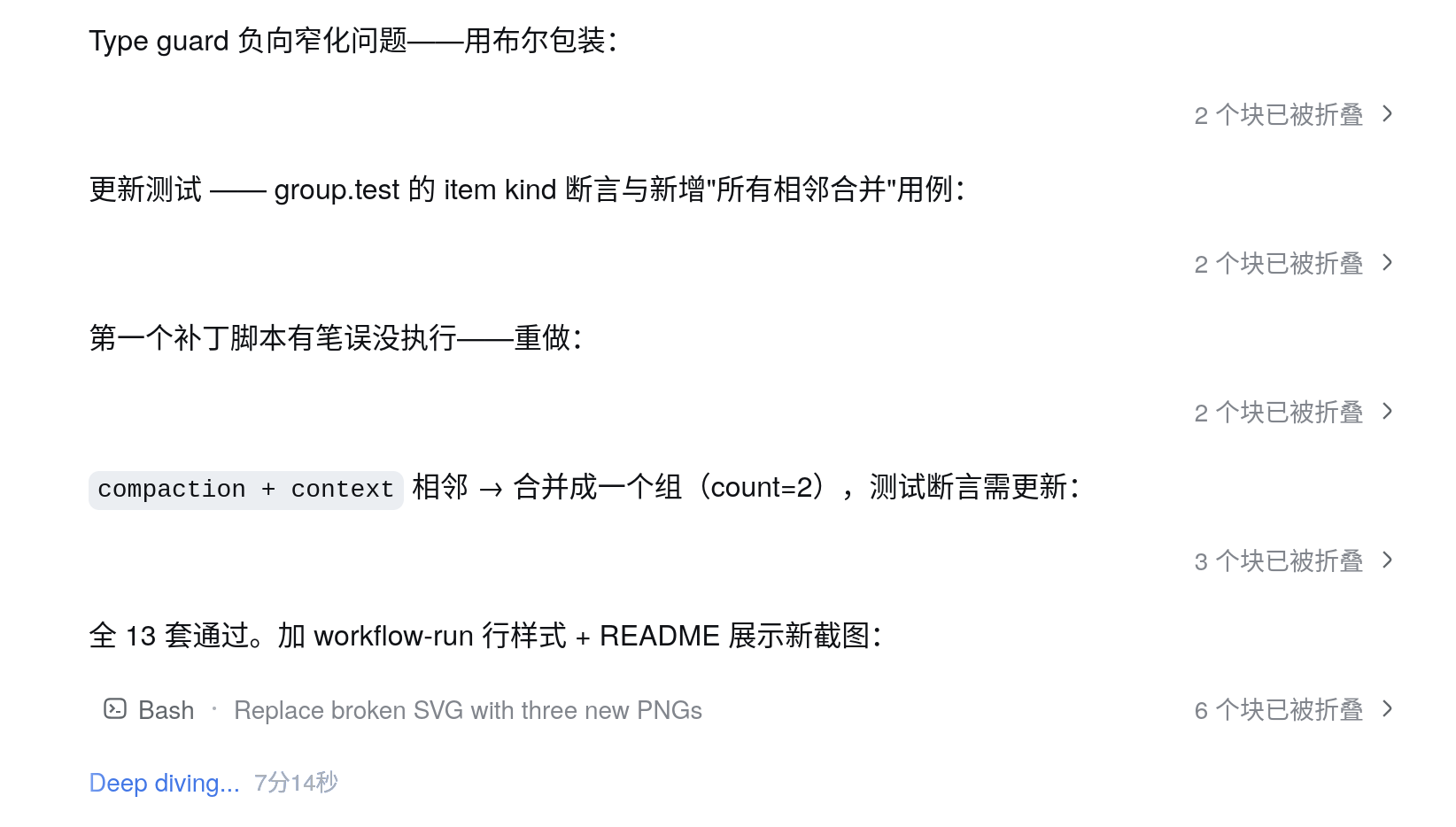
tool-callnodes that are consecutive in the chat flow (snapshot.chat.order) and belong to the same turn form one group. Assistant-step nodes whose blocks contain ONLY reasoning (Think rows) are TRANSPARENT: they neither split chains, but fold WITH the group (hidden while collapsed, re-shown between the calls when expanded). The inline notice rows — context injection (context), automatic compaction (compaction), manual compaction, commands and workflow runs — fold in with the adjacent work the same way (neighboring fold blocks merge into one bar and count toward the group's block count). Diagnostics the user must always see —model-retry(已重试模型请求),turn-error(本轮运行失败) andturn-max-tokens(达到输出上限) — are NOT folded and NOT merged: they render the official cell view unconditionally and act as run boundaries. Think rows with NO adjacent tools fold into their OWN bar (think-only group). The reasoning part of a text-bearing node is folded away too — only text stays visible. Only real assistant TEXT (and user/steering messages, commands, compaction, …) ends a run — verified against a real 288-call session: with the old rule every per-step Think row split the chain into 150 groups; with transparency the same stream folds into 85 groups split exclusively by text. (In the DSH data model every tool-producing step streams a reasoning block, so without this rule every call would isolate into its own group.) - While a call is running: the collapsed line shows only the currently
running tool (
Running <tool>), the accumulated call count (completed + running), and a chevron. When the running call settles, the label switches to the next running call, or disappears entirely once every call has settled — including error/cancelled/interrupted calls (anytool-resultform,isErroror not). - Expanded: the group bar stays on top (chevron down); below it every
member renders through the official
tool.call.toolviewdispatch — the exact same slot path the product'sToolCallTreeuses — so bash/read/grep/ web/… cards, status, parameters, output, error, subcalls and nested calls all keep their native look. New calls arriving while expanded are appended live; the user's expanded state never resets (it lives in React state of the group leader seat, keyed by the stable first-call node key). - Turn-level folding is PRODUCT-owned: the product's own turn-process controller (compact-transcript summarization, on every supported channel) handles closing-turn folding, and dsh-fold ships NO turn-level folding code — no turn bar, no double bars. The plugin only owns the small per-run groups described above, in every turn state (open, closed, summarized).
- Bar label: the folded bar reports
N blocks folded— N is the number of folded blocks (tool calls + Think rows folded into the group; subcalls inside a block are not counted). While a call runs, the left side showsRunning <tool>. - Live block in the bar = the conversation's latest state: the folded
bar's left side shows what the CURRENT conversation is doing RIGHT NOW —
the newest active block anywhere in the flow, not a per-group label: a
streaming Think row renders
[Think] · <latest line>, a working tool call renders its real row ([icon] Bash · <command description>for a terminal call,Read · <path>,Search · <query>,ask_user_question · <question>, … — the product'stoolRowModelreplicated verbatim). While a call executes the working call is the latest; once it settles and the model reasons again, the Think row takes over; when the conversation is idle the left side is empty. The live block shows ONLY while the group is COLLAPSED — expanded, the details are right below, so the bar's left goes empty. The bar whose own group hosts the active node additionally shows the product's row sweep. - Everything non-text folds except diagnostics: automatic context
compression (
compaction), context injection (context), manual compaction (manual-compaction), user commands such as/permission(command), unknown surfaces (unknown) and workflow runs (workflow-run) are folded like any other work block — merged with the adjacent tool/think run, or each behind its own1 blocks foldedbar (expandable, so they stay reachable). ONLY the three diagnostics —model-retry,turn-error,turn-max-tokens— never fold: they render the official cell view unconditionally and always stay visible. Plain text (user and steering messages, assistant text, summaries and the summary's copy/chrome row) also stays visible. - User input: a user message whose text overflows 3 lines is clamped to
3 lines with an
Expandtoggle below the bubble (shown only when the text really overflows, measured via ResizeObserver). The clamp lives on a PADDING-FREE inner box (max-height: 72px= exactly 3 × 24px line height), so every browser renders exactly 3 lines with the bubble's bottom gap intact — browsers whose legacy line-clamp behavior would show a partial 4th line flush against the bubble bottom get clipped to 3 lines (verified in headless Chromium). The bubble is a faithful replica of the product'sUserStyleBubblebuilt from official primitives (the officialprojectUserText—/name/@name/session ref chips with the exact per-release gating of the host bubble —,JsonBlockextras, the official attachment row: slot-backedImageGallerycalls on rc, per-image compact calls plus generic-file cards on alpha 0.1.3, the product time + copy actions with the officialwriteClipboard) — replication, not delegation, because Chromium's line-clamp does not clamp content inside a nested flex container (the official row isdisplay:flex; verified empirically in headless Chromium). Short messages render untouched (clamp is a no-op, toggle hidden). - Auto-load older at the top: scrolling the conversation to the very
top while older history exists automatically pulls the next page
(
loadOlder) — no button click needed; the product'sLoad olderbutton remains as a manual fallback. While the user KEEPS resting at the top andhasMorestays true, pages continue loading one after another until the history is exhausted or the user scrolls away (each completed load re-arms the pump with the refreshed snapshot). The scroll host is resolved through the product's ownscrollerOfcontract ([data-conversation-scroll]), the action is the session scope's officialconversation.loadOlder(), and guards (near-top threshold,hasMore,loadingOlder, in-flight pump) prevent duplicate or mid-scroll loads. This is the one behavioral DOM read in the plugin (a passive scroll listener); nothing is patched or restyled.
DSH version
Exclusively supports the current DSH release channel: alpha
0.1.3-alpha.2 (npm alpha tag; the version the harness ships today).
Older releases are intentionally out of scope — the version-compatibility
layers for them have been removed (no useSession-carried chat adapter, no
namespace probe, no status/final fallbacks, no plugin-owned turn-level
big fold — that fold is product-owned). The channel shares ONE chat-node
seat kit: useChat returns the chat target (chat.legacy.turnEnds is the
turn closure), useSession only the window flags, and the host registers
the chat-cell dictionaries under chat. The remaining channel details — the
loadImage owner kit, the 0.1.3 user-bubble update (official
projectUserText signature growth, file content blocks with generic-file
cards) — are sealed in
src/client/snapshot-face.ts (snapshot normalization),
src/client/registry.ts (compositeT namespace fallback) and
src/client/UserNodeWrapper.tsx (user-text + attachment kits); the runtime
overlay validates the live SlotCore shape and fails closed (plugin stays
inert) if the relevant internals change.
dsh-fold is a pure browser-side plugin: it reads only the chat
snapshot the shell hands to every seat (via the useChat/useSession
selector hooks), never the session event log. It therefore declares no
runtime dependency on the DSH core (@deepseek-ai/dsh-session,
dsh-agent, dsh-llm-*, …) — an install can never drag a second,
version-skewed DSH runtime next to the host's. The only runtime imports are
the shell-owned client packages, declared as peer dependencies and resolved
to the host's own instances at boot (dsh-client-ui-slots,
dsh-client-ui-primitives, dsh-client-ui-attachment, dsh-attachment,
react).
Architecture / extension seam
ChatView (conversation.view)
  └─ ChatNodeSeat × N                       one seat per business node
       └─ renderSlot("conversation.chat.node", {node}, {entryKey: kind})
            ├─ cell "tool-call":
            │      product:  ToolCallTree  (priority 0)
            │      ours:     ToolCallGroupView (priority -100  ← lowest wins)
            │                   ├─ collapsed bar (running label · count · chevron)
            │                   └─ expanded: interleaved items
            │                        ├─ think rows: InlineThink (ReasoningRow replica)
            │                        └─ tool calls: ToolCallBranch × N
            │                             └─ renderSlot("tool.call.toolview", …)
            │                                 ← official per-tool cards (bash, read, …)
            └─ cell "assistant-step":
                   product:  AssistantNodeView (priority 0)
                   ours:     AssistantNodeWrapper (priority -100)
                                ├─ reasoning-only node inside a tool run → null
                                │    (the group owns its Think rows)
                                └─ everything else → delegates to the official
                                     AssistantNodeView from the live registry
            └─ cell "user":
                   product:  UserMessageNodeView (priority 0)
                   ours:     UserNodeWrapper (priority -100)
                                └─ product bubble replica from official
                                     primitives + 3-line clamp + Expand/Collapse
            └─ cells "compaction" / "context" / "manual-compaction" / "command"
                / "unknown" / "workflow-run":
                   product:  CompactionItem / ContextInjectionRow / … (priority 0)
                   ours:     NoticeNodeWrapper (priority -100)
                                └─ merges with the adjacent run or renders a
                                     one-line folded bar; expands to the official
                                     view (command keeps its commandview slot)
             └─ cells "model-retry" / "turn-error" / "turn-max-tokens":
                   ours:     NoticeNodeWrapper (priority -100)
                                └─ NEVER folds: delegates straight to the
                                     official cell view, always visible
- Seam: the keyed Chat slot
conversation.chat.node, cellstool-call,assistant-step,user,compaction,context,manual-compactionandcommand, shadowed by priority (the slot core documents "register at a different priority to shadow it (lowest renders)"). The group is computed in React from the conversation snapshot (useSession→snapshot.chat.order+snapshot.chat.nodes), never from the DOM. - Only the group leader renders: each tool-call node has its own seat;
the seat of the group's first member renders the group row, every other
member seat returns
null(zero-height flowItem), so there is exactly one row per group. - One framework accommodation: the slot core forbids a second entry
from declaring
childrenfor an already-declared slot, and without that children table the shadowing entry receives norenderSlotbinding fortool.call.toolview.src/client/slots-core-overlay.tsinstalls a reversible overlay onSlotCore.prototype.register/.releaseEntry(same module instance the shell uses — ui-slots is a shell-own static module) that treats an identical child spec as a shared co-declaration. The overlay is a THIN WRAPPER around the live methods (no method-text dependency), so it works against both the published package and the minified shipped web bundle; it restores the pristine methods on unload and never disturbs the product's declarations. This is the exact change ofdocs/core-patch.md(a source-level patch), delivered at runtime so the plugin works on unmodified DSH installs. Without this overlay the pure slot API cannot express "shadow a keyed renderer AND delegate to its child slot" — that is the single architecture limitation this plugin papered over, with the core change kept strictly separated.
Install (web profile)
From GitHub (recommended)
dsh plugin --profile web add github:Yancey2023/dsh-fold
# restart the web app:
dsh --profile web
The CLI clones the repo, resolves the bundle patch, and appends dsh-fold
to the profile bundle stack. To update to the latest version:
dsh plugin --profile web update dsh-fold
# restart:
dsh --profile web
From a local checkout
pnpm install
pnpm build

# option A — official plugin CLI:
dsh plugin --profile web add /absolute/path/to/dsh-fold

# option B — helper script (equivalent):
pnpm run install:dsh          # uses DSH_PROFILE (default: web)

# then restart the web app:
dsh --profile web
dsh plugin … add sees the package's dsh.bundle.patch declaration and
appends dsh-fold to the profile bundle stack; the client loader
picks up the dsh.client.platform: "web" manifest and serves
exports["./client"] to the page. The host row is a minimal anchor only.
Uninstall
dsh plugin --profile web remove dsh-fold
# or: pnpm run uninstall:dsh
# restart the web app — the official tool-call UI renders again immediately.
There is no residue: the slot entry, the overlay, the locale dictionaries and the stylesheet are all removed with the plugin (each registration is owned by the plugin fiber / ctx.effect).
Build & test
pnpm install          # esbuild, typescript, @types/react, react, ui-slots (devDeps)
pnpm build            # tsc --noEmit + esbuild bundles (lib/)
pnpm test             # 14 suites: group · tool-row · auto-load · overlay (real ui-slots) · bundle smoke · component · assistant · user · notice · integration · session-api (real dsh-session) · runtime-hygiene
Acceptance mapping
| Case | Result |
|---|---|
| 1 single tool running | Running bash 1 ▸ |
| 2 read✓ grep✓ bash running | Running bash 3 ▸ |
| 3 all settled | 3 ▸ — left side empty |
| 4 last failed | 2 ▸ — left side empty (error = ended) |
| 5 expand | bar + official cards, in order |
| 6 expand then new call | stays expanded, count grows, member appended |
| 7 assistant text | text untouched; groups never absorb it |
| 8 two chains split by text | two independent bars |
| 9 streaming | live count/running label via snapshot re-render (no polling) |
| 10 uninstall | official ToolCallTree wins the cell again automatically |
| 11 long user input | bubble clamps to exactly 3 lines, Expand toggle appears |
| 12 expand user input | full text, Collapse toggle, copy/time actions intact |
| 13 short user input | untouched, no toggle |
| 14 user message w/ images/refs | official gallery + /name @name chips preserved |
| 15 running bash in a group | bar shows the real block row: Bash · <description/command> |
| 16 streaming think (no tool yet) | bar shows Think · <latest line> |
| 17 all settled | bar left side empty |
| 18 compaction/context/command | folded (1 blocks folded) or merged with the adjacent run; model-retry/turn-error/turn-max-tokens never fold |
| 19 long user input, legacy clamp | still exactly 3 lines + bottom gap (padding-free clamp box) |
| 20 scroll to top with older history | auto-loads the next page (no click), once per scroll-to-top |
| 21 mid-scroll / no history / loading | no auto-load |
Known limitations
- The expanded member rendering replicates the product's small
ToolCallwrapper (call-row div + subcall recursion) because that wrapper is not exported; the actual cards are the officialtool.call.toolviewentries. The generic fallback for tools without a registered toolview is a compact theme-aware card (name/args/output/error) instead of the internalGenericToolCard. - The user bubble is likewise a replica (from official primitives), not a
delegation: Chromium's
-webkit-line-clampcannot clamp through the official row's nested flex layout (verified in headless Chromium), so the clamp has to live on our own element. The replica keeps the product's bubble, ref chips, images, time and copy actions; if a future DSH changes the user bubble's visuals, the replica CSS must follow. - The bar's live content is the product's collapsed-row replica
(
toolRowModel+ the running Think row) — same titles/summaries as the product rows, but re-rendered by the plugin; a future DSH changing the row model's titles or summary keys must be mirrored intool-row.ts. - Diagnostics (
model-retry,turn-error,turn-max-tokens) are NEVER folded — they render the official cell views unconditionally and always stay visible; the other notices (compaction,context, …) fold into bars but remain expandable, so failures stay reachable in one click. - Group identity = first member's stable node key. If older history is loaded that prepends a tool call before the current leader, leadership moves to the new first node and that group's expanded state resets.
- The slot-core overlay relies on two structural invariants of this
SlotCore version (register pushes the new entry into the parent record;
releaseEntry tears down
entry.children); if a future version breaks them, the wrapper fails closed (plugin inert, official UI unaffected). - Expanding long chains re-mounts the official cards; hundreds of settled calls stay collapsed by default, so scrolling cost stays ~one row.
Files
src/client/group.ts               pure grouping over the snapshot (unit-tested)
src/client/tool-row.ts            running-tool row model (product toolRowModel replica)
src/client/auto-load.ts           scroll-to-top auto-load-older (sessions scope)
src/client/AutoLoadHost.tsx       seat ref anchor wiring seats into the auto-loader
src/client/snapshot-face.ts       chat-target snapshot adapter (consumer of the seat kit)
src/client/ToolCallGroupView.tsx  group row (live block content) + official members
src/client/AssistantNodeWrapper.tsx assistant-step shadow (official delegation)
src/client/UserNodeWrapper.tsx    user bubble replica + 3-line clamp + toggle
src/client/NoticeNodeWrapper.tsx  notice-cell shadow (diagnostics never fold)
src/client/registry.ts            shared live-registry access for delegation
src/client/translate.ts           shared fold translate slot
src/client/slots-core-overlay.ts  reversible SlotCore overlay (docs/core-patch.md)
src/client/styles.ts              theme-variable CSS
src/client/vendor.d.ts            minimal ambient types for the DSH page packages
src/client/index.ts               plugin entry (registration)
src/host/index.ts                 minimal host anchor
cordis.patch.yml                  bundle patch layer (host row)
build.mjs                         tsc + esbuild
scripts/install-dsh.cjs           install/uninstall helper
scripts/verify-pack.mjs           release gate: pnpm pack + artifact scan
test/                             group · tool-row · auto-load · overlay · bundle-smoke · render suites · session-api (real dsh-session) · runtime-hygiene
docs/core-patch.md                the one core change, as a source patch
License
MIT
No comments yet. Be the first to write one.