Lacan Knowledge OS
A corpus-grounded research environment for Lacanian psychoanalysis. Evidence first. Interpretation second. Fabrication never.
English · 中文 · 日本語 · Français · Deutsch · Italiano





The one rule this system is built around
Every claim must land on a passage number.
If the corpus cannot support a question, the system abstains — it does not answer from model knowledge. An abstention is a result, not an error.
⚠️ Rights notice — read before installing the corpus
The engine is open source. The corpus is not. Two different things, two different rules:
License / status Engine source code (this repository) Apache-2.0 — use, modify, redistribute, build on it Reference corpus (companion repo) third-party copyrighted texts. Publicly readable for research and study only; public visibility is not a licence — not licensed for commercial use, redistribution or re-serving. Public-domain demo corpus ( corpus-demo-v1·demo-corpus/)public domain (Falret 1890 · Binet 1892 · Janet 1909) — freely redistributable; ~0.3 MB, one command installs a complete research run In plain terms. The corpus repository contains French working transcriptions of Lacan's seminars, a text extraction from the Seuil print edition, and a community Chinese translation project. None of these rights belong to this project. It is published openly so that researchers can obtain it, and public availability is not a licence: it does not permit commercial use, redistribution, mirroring, repackaging, or serving the text to others. If you are unsure whether your intended use is lawful, that question is yours to answer — this project cannot answer it for you. The full analysis is in
RIGHTS.md.If you need something you can publish, share or ship commercially, use the engine with a corpus you have the right to use — the public-domain demo, your own texts, or a licensed edition. That path is fully supported:
CORPUS.md·docs/DEMO_CORPUS.md.
What it is
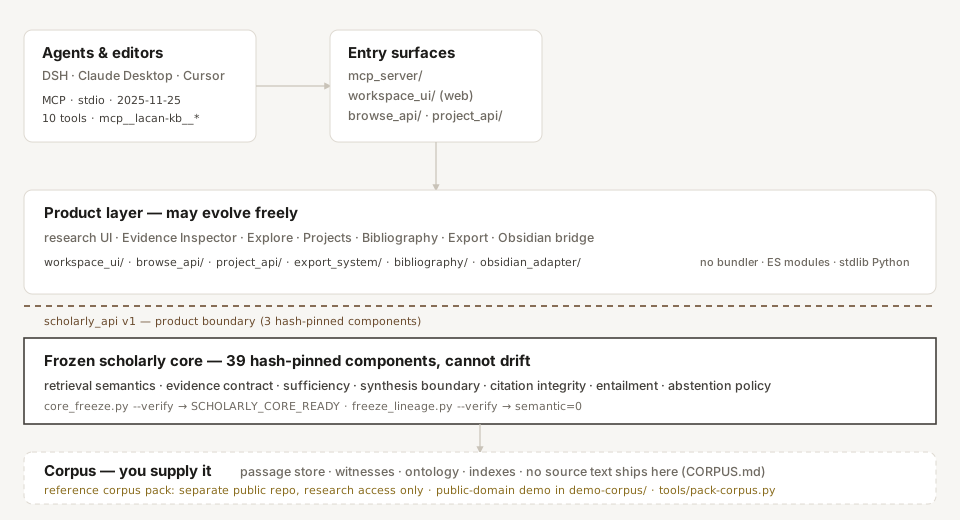
Lacan Knowledge OS turns a corpus of seminar and écrits text into a citable evidence store, and puts a frozen scholarly core between your question and any answer.
| Capability | What it gives you | |
|---|---|---|
| 🔎 | Research | Ask a question → the core retrieves passages, builds an evidence contract, and only then synthesises an answer whose every claim survives citation + entailment validation |
| 📖 | Explore | Read the corpus directly: passages, sessions, seminars, concepts, terminology — no model involved |
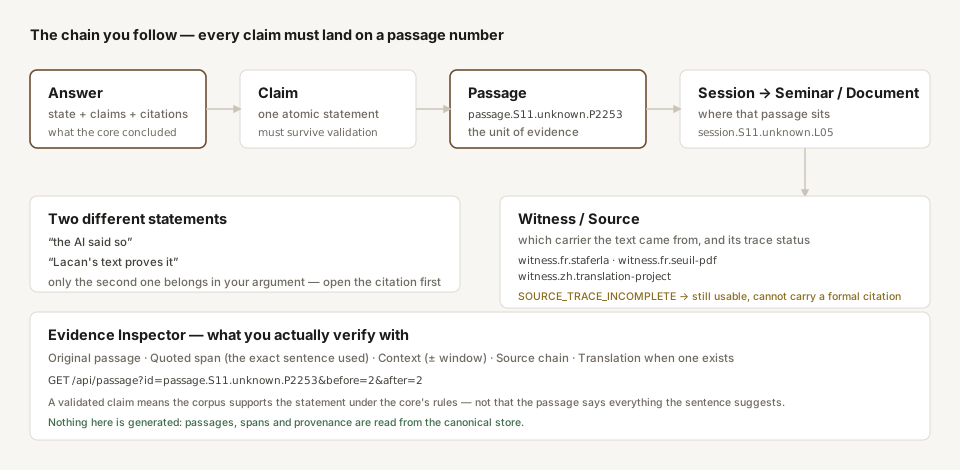
| 🔬 | Evidence Inspector | Answer → Claim → Passage → Session → Seminar → Witness/Source, with the exact quoted span and its context window |
| 🗂️ | Research Projects | Turn repeated runs into a long-term topic (questions, hypotheses, passages, persons, cases, bibliography) |
| 📚 | Bibliography & citations | Review status, metadata completeness, per-style citation availability with the reason it is unavailable |
| ✍️ | Obsidian bridge | Evidence and validation stay here; your understanding, notes and writing live in your vault |
The chain you can always audit
What it refuses to do
These refusals are the design, not limitations:
| Refusal | Why |
|---|---|
| No answering from model knowledge | The synthesis step may only use retrieved evidence. Insufficient contract → ABSTAINED. |
| No silent repair of sources | SOURCE_TRACE_INCOMPLETE stays visible; hiding it would misrepresent the source. |
| No invented bibliographic data | Publisher, year, ISBN, page numbers are never guessed. A style that cannot be produced says why. |
| No auto-promotion to canonical | Imported or AI-produced material enters as a candidate and stays one until a human promotes it. |
| No undeclared semantics | The 39 scholarly components are hash-pinned; an undeclared change fails the freeze check and the launcher refuses to start. |
Get started
Are you an AI agent? Run this first and follow what it prints — it decides whether research can run at all:
python3 tools/ensure_corpus.py --status      # exit 0 = corpus ready · exit 3 = tell the user
python3 tools/ensure_corpus.py --json        # machine-readable status
1 · Clone the engine
git clone https://github.com/YanKaFei/Lacan-Knowledge-OS.git
cd Lacan-Knowledge-OS
python3 -m workspace_ui.server.cli --port 3090
# → http://127.0.0.1:3090/help    (13-page Help Centre — fully usable with no corpus)
2 · Give it a corpus — one of three paths
| Path | What you get | How |
|---|---|---|
| A. Reference corpus (public download, research use only) | the full Lacan seminar corpus: 1,979 files · 249,105 passages · indexes ready to run | YanKaFei/Lacan-Knowledge-OS-corpus → python3 tools/ensure_corpus.py --install --pack corpus-pack-v1.tar.gz --manifest corpus-pack-v1.manifest.json |
| B. Public-domain demo | 19th-century French clinical sources (Falret · Binet · Janet) — redistributable | python3 tools/build_demo_corpus.py . && python3 _scripts/_tools/build_lexical_index.py |
| C. Your own text | anything you are entitled to use, ingested by the engine's own builders | CORPUS.md · python3 _scripts/inventory_corpus.py --help |
Path A in full. The companion repository is public, so the pack downloads without a token —
but it is third-party copyrighted text: research and study only (RIGHTS.md).
It holds a corpus pack: one hash-manifested archive
that tools/fetch-corpus.py verifies file by file before installing — a partial or altered
download cannot silently corrupt the corpus.
curl -sLO https://github.com/YanKaFei/Lacan-Knowledge-OS-corpus/releases/download/corpus-v1/corpus-pack-v1.tar.gz
curl -sLO https://raw.githubusercontent.com/YanKaFei/Lacan-Knowledge-OS-corpus/main/corpus-pack-v1.manifest.json
python3 tools/fetch-corpus.py --pack corpus-pack-v1.tar.gz \
    --manifest corpus-pack-v1.manifest.json --into .
python3 _scripts/_tools/core_freeze.py --verify      # → SCHOLARLY_CORE_READY
python3 -m workspace_ui.server.cli --port 3090       # research now answers
Path A is a plain public download and is for research use only — no commercial use, no
redistribution, no re-serving (RIGHTS.md). Paths B and C need no access at all.
Pack mechanics (handing a corpus to a colleague without publishing it):
docs/CORPUS_PACK.md.
3 · Verify the contract (this is the point of the project)
python3 _scripts/_tools/core_freeze.py --verify      # 39 scholarly components
python3 _scripts/_tools/freeze_lineage.py --verify   # zero semantic drift across 7 segments
python3 _scripts/_tools/build_i18n.py --check        # UI copy ↔ dictionary ↔ call sites
python3 _scripts/_tools/build_help.py --check        # Help links, anchors, 0 fiction
bash _scripts/run_all_tests.sh                       # 146 suites · 78 validators
Requirements: Python 3.9+ (standard library covers the core path) and a modern browser.
No bundler, no build step — index.html loads ES modules directly. Vector retrieval and real
LLM synthesis are optional extras (docs/EMBEDDING_PROVIDER.md).
How to use it
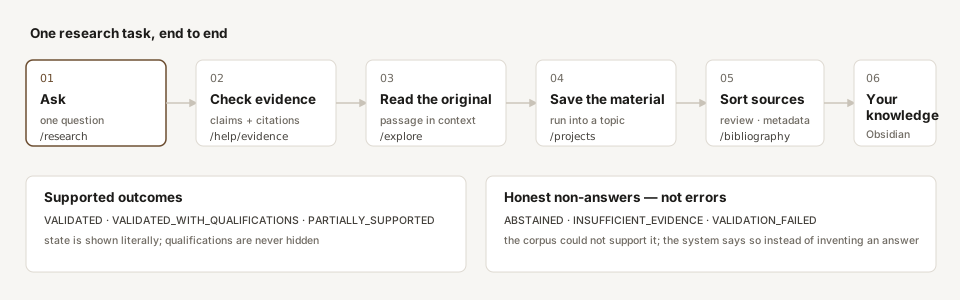
- Ask — one question per run.
- Read the state —
VALIDATED,VALIDATED_WITH_QUALIFICATIONS,PARTIALLY_SUPPORTED,VALIDATION_FAILED,INSUFFICIENT_EVIDENCE,ABSTAINED. Read it literally. - Verify — click a citation chip; the Evidence Inspector shows the quoted span, its context window and the source chain. The answer is what the core concluded; the inspector is what the corpus actually says.
- Go deeper — open the same passage in Explore and read around it.
- Keep it —
Add to Project, orSave to Obsidian.
The interface
| Where | What |
|---|---|
| Home | task-based: what do you want to do? — six task cards, the six-step workflow (with a diagram of one run end to end), a five-minute quick start. Every entry is a real link. |
| Research | question box, mode / provider / research-language, and measured provenance on every answer (provider · model · wall-clock · cached · attempts) |
| Explore | passages, sessions, seminars, concepts, terminology, persons, cases — read-only |
| Evidence Inspector | the right-hand panel: original passage, quoted span, context controls, source chain, translation |
| Help Centre | /help — 13 topics, sidebar, anchors, previous/next, topic search, instant language switch, and three in-product diagrams (system layers · evidence chain · one research task) drawn as inline SVG, so their labels follow the interface language |
| Languages | interface language (EN/中文) and research language are independent settings |
Every control name inside Help is rendered from the real interface, and every functional claim is machine-checked: 45/45 claims verified · 0 documentation fiction · 0 broken links.
Use it from DSH / any MCP client
This repository is a DeepSeek Harness plugin target: it ships an MCP server, a portable composition row, an installable bundle and an idempotent installer.
dsh plugin --profile web add github:YanKaFei/Lacan-Knowledge-OS
python3 tools/install-dsh-row.py --profile web     # bind the server path for your clone
python3 _scripts/_tools/lacan-kb-mcp               # or run the MCP server standalone
Tools appear as mcp__lacan-kb__search_passages, …get_passage, …get_context,
…resolve_entity, …list_concepts, …search_terminology, …compare_concepts,
…find_relation, …list_seminars, …get_sources — 10 tools, protocol 2025-11-25.
Proven with DSH's own MCP SDK (_data/mcp/DSH_CLIENT_PROOF.json, 14/14 checks).
See docs/DSH_PLUGIN.md.
Advantages and disadvantages
| ✅ Advantages | ⚠️ Disadvantages / limits |
|---|---|
Verifiability over fluency. Every claim ties to a passage id; you can audit the chain by hand. Honest failure. Abstention, An executable contract. The 39-component freeze and the seven-segment lineage are checked by code, not by a promise in a document. Offline-first. One contract, many clients. The same MCP surface serves the web UI, DSH, and any editor with an MCP client. Auditable history. Every run is an immutable snapshot; re-asking creates a new item instead of overwriting the old one. Corpus is separable. Engine public (Apache-2.0), corpus third-party with its own boundary or bring your own — the two never mix in one repository. | It needs a corpus you have the right to use. Out of the box it shows its interface, Help Centre and contracts; it answers only once a corpus is installed. The reference pack is public to download but research-use-only material. The reference corpus is research material, not a product asset. No commercial use, no
redistribution — see It is opinionated about scope. It answers about a corpus. Questions about publication history, attendees or dates abstain, because the corpus does not carry that metadata. No quality score. There is no “confidence %” anywhere; interpretation quality remains your judgement. Heavy at laptop scale. The reference corpus is ~2.5 GB on disk including derived indexes. Vector retrieval is optional. Without the embedding extras, retrieval falls back to lexical matching (the UI says which is active). Real-LLM synthesis is a single blocking call. Long runs take 45–60 s; the UI shows real elapsed time, and “stop waiting” does not cancel the backend job. Fast product layer, frozen scholarly layer. Convenience features change often; changing the semantics requires a formal Core Change Request. Presupposes familiarity with the domain. It will not teach you Lacan. |
Documentation map
| Document | Contents |
|---|---|
RIGHTS.md |
rights and permitted use, in full — engine vs corpus, what access does and does not grant |
NOTICE |
the same boundary in the form a distributor needs |
AGENTS.md |
the rules an AI agent must follow here — starting with the corpus check |
corpus.json |
machine-readable corpus reference: where it lives, how to install it, what to do if it is missing |
CORPUS.md |
bringing your own corpus; what the builders expect |
docs/DEMO_CORPUS.md |
the public-domain demo corpus: one command builds it (corpus → index → ontology → freeze), and corpus-demo-v1 installs a complete research run |
docs/CORPUS_PACK.md |
packing and shipping a corpus without publishing it |
docs/PUBLIC_EDITION.md |
how this repository is derived and negatively verified |
docs/ARCHITECTURE.md · docs/MCP_ARCHITECTURE.md |
the layering and the MCP surface |
DAILY_USE_GUIDE.md · docs/USER_GUIDE.md |
day-to-day operation |
CONTRIBUTING.md · SECURITY.md · CHANGELOG.md |
how to help, credential discipline, history |
Status
- Scholarly core: frozen v1 —
SCHOLARLY_CORE_READY, 39 hash-pinned components, semantic drift 0. - Product layer: complete for daily use; last acceptance run 20/20 blocking gate items, 146 regression suites / 78 validators / 0 failed / 0 skipped.
- Distribution: engine public (Apache-2.0) · reference corpus public, research use only ·
public-domain demo corpus published (
corpus-demo-v1, redistributable). - Corpus profiles:
reference→SCHOLARLY_CORE_READY(human-reviewed); any other corpus →CORPUS_HUMAN_REVIEW_NOT_AVAILABLE(research runs, no human-review endorsement). - Roadmap:
docs/ROADMAP.md.
Code: Apache-2.0 · Source texts: not distributed, not licensed for commercial use (RIGHTS.md)
If this system saves you a week of citation checking, it did its job.
No comments yet. Be the first to write one.