dsh-balance-battery · Balance Battery

DSH-only plugin. This project leans on undocumented internal APIs of DeepSeek Harness — on the browser side
window.__ModuleLoader__,ctx.remote.account,modelDirectories; on the host sidectx.credentials,connection.requestRejection,webServer; plus the host's--dsw-*theme tokens. None of these is a stable public contract: they can change on a host upgrade and the plugin can break with them. It is not a general-purpose component; it only works inside a matching DeepSeek Harness install. License: MIT — see LICENSE.
English · 中文
A battery in the tool row of the DeepSeek Harness composer: full = one top-up (¥10), and the charge is the available total of the balance source you pick by hand. The battery is split into ten cells at ¥1 per cell, so you can not only read the ratio but also count how many yuan are left. It sits in the empty stretch left of the model pill — right of the permission pill Workspace write and left of the model seat DeepSeek-V41-Flash.
You choose what it watches. Click the battery to cycle the sources (DeepSeek account → DeepSeek API → Kimi → back to account); the hover readout also offers clickable source chips, with the current source highlighted. The choice is stored in the browser and restored on restart; the battery no longer follows the model — switch models freely, it only watches the source you selected. Only the first launch adopts the provider the model currently bills to as the initial source (upgrades keep your existing view).
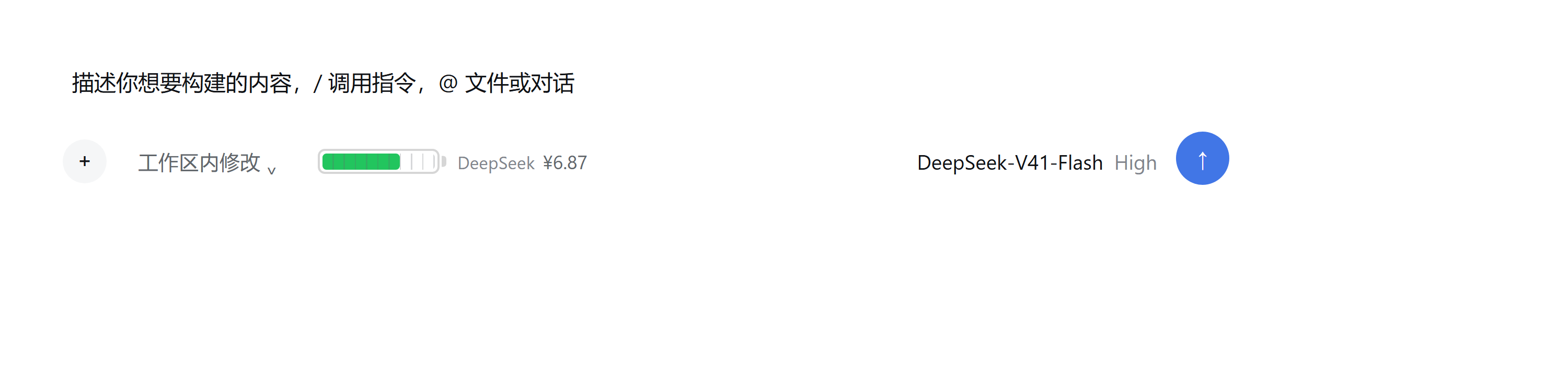
Before: [+]  [ Workspace write ⌄ ]                          DeepSeek-V41-Flash  High  [↑]

After:  [+]  [ Workspace write ⌄ ]  DeepSeek account ▮▮▮▮▮▮▮┊▮┊┊┊ ¥33.32   DeepSeek-V41-Flash  High  [↑]
Click:                              DeepSeek API ▮▮▮▮▮┊┊┊┊┊┊┊ ¥5.27  DeepSeek-V41-Flash  High  [↑]
Click again:                        Kimi ▮▮▮┊┊┊┊┊┊┊┊┊ ¥3.10          Kimi-K3.1-Pro      Max   [↑]
Hover (or focus with the keyboard) and the readout opens; it carries its own source switcher and shows:
- the source name and its available balance,
- a meter with the percentage of one full cell,
- the full-scale amount,
- the topped-up and granted components (cash and vouchers for Kimi),
- the update time,
- source chips and a Refresh button,
- a top-up link.
Quick start
- Install:
dsh plugin addthis folder into yourdesktopprofile (see Install). - Fully quit and restart DeepSeek Harness Desktop.
- A battery appears in the composer's tool row — click it to switch between DeepSeek account / DeepSeek API / Kimi.
How to read the battery
| Battery | Meaning |
|---|---|
| Green (≥ 50%) | available / ¥10 ≥ 50% — plenty left |
| Yellow (20%–50%) | time to top up |
| Red (< 20%) | running out |
| Grey/empty | signed out / no balance / read failed / no balance API — never fakes a 0 |
| Full green + amount above ¥10 | available beyond one full cell (e.g. ¥33.32): the cell caps at 100%, the readout still shows the real amount |
Ruler: ¥1 per cell, ten cells, drawn over the fill, so both the spent and the remaining part stay countable.
The default is ¥10 per full cell; change the full amount and the refresh interval (seconds, 0 = off) in the readout's settings — they apply immediately and are remembered locally.
The quantity shown is the available total: DeepSeek account = topped up + granted, DeepSeek API key = total_balance, Kimi = cash + vouchers. Granted/voucher parts are listed separately in the hover card.
Switching the source by hand
The model selection is no longer the data source; it is used once, on the first launch (and only when the directory is ready and the provider has a balance API, so a half-parsed or interface-less provider is not frozen into a permanent choice). After that:
| Action | Effect |
|---|---|
| Click the battery | cycle: account → API → Kimi → account |
| Readout chips | jump straight to a source; the current one is highlighted |
Refresh in the readout |
re-read now (bypasses the host's 20 s cache) |
| Switch the model | battery unchanged — it only follows the source you picked |
The choice lives in localStorage (key dsh-balance-battery/source); if storage is unavailable it degrades to per-session only.
Where the numbers come from
In one sentence: the DeepSeek account goes through the host's existing account Remote; the two API-key routes go through this plugin's host-side balance routes.
1) DeepSeek account (account)
The account credential and the Platform protocol belong to the host: dsh-deepseek-account-platform stores the grant and dsh-api-account-controller exposes a safe projection through the account Remote namespace — the same one the host's Settings → Account screen reads. This plugin is only a consumer:
const state = await ctx.remote.account.getState()            // { status: 'signed-out' | 'credential-stored', links }
const value = await ctx.remote.account.getBalance(client())  // { status: 'ready', value: Wallet[], bonusWallets } | { status: 'failed' } | null
// Wallet = { currency: 'CNY' | 'USD', balance: '<decimal string>' }
The battery = sum of CNY top-up wallets + sum of CNY bonus wallets; bonusWallets are also listed separately in the hover card.
2) DeepSeek API key (deepseek)
The host route GET /dsh-balance-battery/deepseek resolves DEEPSEEK_API_KEY via ctx.credentials, calls GET https://api.deepseek.com/user/balance, and normalizes total_balance / topped_up_balance / granted_balance into one response.
3) Kimi (kimi)
The host route GET /dsh-balance-battery/kimi resolves MOONSHOTAI_CN_API_KEY (falling back to MOONSHOT_API_KEY, then KIMI_API_KEY), calls GET https://api.moonshot.cn/v1/users/me/balance, takes available_balance, and splits out cash_balance and voucher_balance.
The key never reaches the browser: the browser only gets amounts, the credential name that was used (e.g. MOONSHOTAI_CN_API_KEY) and the top-up link. Both routes pass connection.requestRejection (host/origin fence + login), then read the credential; a successful result is cached for 20 s, and the readout's Refresh sends ?fresh=1 to bypass it. The response looks like:
{ "ok": true, "provider": "kimi", "ref": "MOONSHOTAI_CN_API_KEY", "currency": "CNY",
  "total": 5.26872, "recharge": 0.13433, "bonus": 5.1343904,
  "topUpUrl": "https://platform.kimi.com/console/account", "at": 1767220411000 }
Failures carry stable codes: missing-credential (with refs), unauthorized, http (with status), network, timeout, bad-response. The client turns these into concrete reasons ("no key found / key rejected / network error") instead of a 0.
Interaction
| Notes | |
|---|---|
| Placement | conversation.input.left is a list slot (in the host's composer tool row, after the permission and Plan seats); the plugin registers one entry at order: 10. In a stock install the slot is empty, so nothing is covered. |
| Click the battery | cycle the source; if the new source has a cached amount, it shows first and refreshes in the background. |
| Hover / focus | open the readout: source, amount, percentage, full-scale amount, topped-up/granted (cash/vouchers for Kimi), update time, top-up link, source chips and a refresh button. The card portals to document.body and clamps to the viewport so the composer cannot clip it. |
| Refresh button | re-read now (the button shows "Reading…" and is disabled until the read settles; the host route is called with ?fresh=1). |
| Settings in the readout | change the full amount and the refresh interval (seconds, 0 = off); applied immediately and saved to localStorage. |
| Memory | the manual choice is written to localStorage and restored on restart; the first launch adopts the provider the model was on. |
| Auto refresh | the active source every 60 s; once more when visibilitychange brings the window forward. Background refreshes do not pulse. |
| Fail loud | a render exception is shown at the seat as battery render failed: … instead of being swallowed by the slot; a read failure keeps the last good number and marks the reason in the readout. |
Install
Windows-first by design: the commands below assume Windows PowerShell.
# <DSH_DIR>    = where DeepSeek Harness is installed
# <PLUGIN_DIR> = this repository (the folder holding package.json)
& "<DSH_DIR>\resources\runtime\cli\bin\dsh.cmd" `
  plugin --profile desktop add "<PLUGIN_DIR>"

# Then fully quit and restart DeepSeek Harness Desktop (the profile is assembled at process start).
# On the author's machine, for example:
#   & "D:\deepseekHarness\resources\runtime\cli\bin\dsh.cmd" plugin --profile desktop add "D:\deepseek-Plugin development\balance-battery"
dsh plugin add puts the package into the profile's node_modules and adds dsh-balance-battery to dsh.profile.bundles in ~/.dsh/profiles/desktop/package.json. Locally it is a link: dependency, so a client.js edit takes effect after restarting the app; an index.js (host route) edit requires a full app restart — reloading the page is not enough.
Self-check and visual preview
Three browser-free dev tools (under test/, not shipped):
# From the repo root (Node 18+; CI uses 22 and 24)
# 1) Client-half smoke: loads the real bundle, runs the real apply, renders the whole component and asserts behavior
node test/balance-smoke.mjs

# 2) Host-half smoke: captures the real registered routes and verifies keys, cache, fence and failure branches with scripted fetch/credentials
node test/host-smoke.mjs

# 3) Visual preview: reads the plugin's real stylesheet plus the host's real theme tokens and composer CSS to build static HTML
#    (without a local DSH install it degrades to a token-less sheet, but still emits HTML)
node test/preview.mjs
#    -> test/preview/{composer,states,zoom}-*.html
Uninstall / rollback
Disable the bundle in the GUI's Plugins page, or:
& "<DSH_DIR>\resources\runtime\cli\bin\dsh.cmd" `
  plugin --profile desktop remove dsh-balance-battery
After disabling, the composer tool row returns to its original state (the plugin only adds to an empty slot and changes no host control), and the two host-side balance routes are removed with the plugin.
Files
| File | Purpose |
|---|---|
package.json |
bundle manifest: dsh.bundle.patch + dsh.client (platform: web, immediately, inject load order) + icon/locale exports. |
cordis.patch.yml |
inserts the plugin into the profile's layer stack. |
index.js |
host half: registers /dsh-balance-battery/{deepseek,kimi} on the local web server, resolves credentials, calls both balance endpoints, short cache + single-flight, with the connection fence first. |
client.js |
browser bundle: dictionaries, stylesheet, manual source switching (click-cycle + chips + localStorage memory), three balance channels (account Remote + two host routes), the battery component and the readout. |
locale/{en,zh}.json |
title and description shown on the plugin page. |
icon.svg |
plugin-page icon (a battery). |
test/balance-smoke.mjs |
browser-free smoke test for registration/manual switching/reading/rendering. |
test/host-smoke.mjs |
host-route test for credentials, cache, auth and failure branches. |
test/preview.mjs |
visual preview generator (real styles + real theme tokens + real composer CSS → screenshot-ready HTML). |
test/preview/*.png |
light/dark screenshots of the composer and each state. |
Key constraints (pitfalls)
1. inject declares only the required host services.
The browser ctx is a guarded proxy: touching any host service that is not listed in inject throws cannot get property "…" without inject. This plugin reads the account projection, so it declares the same as the host's account page:
const inject = ['slots', 'locale', 'remote', 'remote.account'];
modelDirectories is deliberately not in inject: it is read lazily via ctx.get('modelDirectories'), so a page without the model picker falls back to the DeepSeek account balance instead of losing the cell. The host side is the same: inject = ['webServer'], and connection / credentials are read lazily per request, so a missing one only makes one provider fail.
2. A slot entry that throws = silent abdication.
An exception thrown inside a slot entry is not shown to the user; the entry simply disappears and looks like "the plugin is not installed". So the component wraps itself in a fail-loud layer: a render exception shows battery render failed: … at the seat.
3. height:100% on a span does not work.
The fill is a <span>: a percentage height on an inline box is ignored, so the cell has width but stays invisible. .dbb-fill / .dbb-tipFill set display:block explicitly. This pitfall only shows up in a real render (a screenshot); the smoke test's assertions only see inline styles.
4. The tick colour must work on both backgrounds.
The ticks are drawn over the fill, so the same line must hold up on the white/dark background and on all three level colours. It uses color-mix(in srgb, currentColor 26%, transparent) (follows the theme and text colour), with a preceding rgba(127,132,140,.5) declaration as a fallback for engines without color-mix.
5. A client.js edit needs a real page reload; an index.js edit needs an app restart.
In a packaged install the client bundle bytes are re-fetched, but an already-mounted plugin instance still runs the old code; "takes effect without a reload" only holds in a source checkout with pnpm run dev:web running. Host routes are registered at process start, so reloading the page does not re-register them.
6. The readout must portal.
The composer card is a position: relative stacking context, so an absolutely positioned bubble is clipped/covered by it and the sticky footer; the readout uses createPortal(..., document.body) + position: fixed + viewport clamping, and keeps a 160 ms grace on pointer leave so the pointer can move into the card to click chips and the top-up link.
7. API keys stay on the host side.
The balance routes return amounts, not credentials; neither error logs nor responses contain the key. Both routes must pass connection.requestRejection before reading the credential — otherwise any local page could read your balance. The 20 s cache is shared by the 60 s poll and multiple battery instances; ?fresh=1 affects only that one read.
8. The model directory throws by design; do not "grab it once and keep it".
directoryFor(sessionId) throws resolved no scope / no binding before the session scope is ready. Putting "get the directory" and "use the directory" in the same try turns a startup jitter into permanent invisibility (a pitfall the sibling effort-slider hit). This plugin's tracker never throws: on failure it backs off and retries. In manual mode the directory is only used to adopt the initial source once, so the adoption condition is stricter: the directory is resolved (a real provider id) and the provider has a balance API; otherwise it does not adopt and keeps following the model view until it can.
9. A missing split amount must not become 0 via Number(null).
The host route allows recharge / bonus to be null (some providers do not report the split). If the client did Number(body.recharge) it would get 0 and the readout would draw "Topped up ¥0.00". Every optional amount goes through optionalAmount: null / missing / empty stays missing.
Known limitations
- Only DeepSeek and Kimi: other providers (OpenAI, Codex, …) have no balance endpoint wired; the battery shows a grey
No APIand never guesses a number. - Kimi's two sites have separate keys: it tries
api.moonshot.cnfirst and falls back toapi.moonshot.aion a rejected key or an unreachable host; keys and top-up pages (platform.kimi.com/platform.kimi.ai) are not interchangeable. - The API-key routes depend on credential names: DeepSeek uses
DEEPSEEK_API_KEY; Kimi triesMOONSHOTAI_CN_API_KEY,MOONSHOTAI_API_KEY,MOONSHOT_API_KEY, thenKIMI_API_KEY. Renaming an env var requires editingrefsat the top ofindex.js. accountneeds a login: when signed out the battery is grey and says "signed out"; switch todeepseek(API-key route) instead.- Full amount and refresh interval are configurable: defaults are ¥10 per full cell and a 60 s refresh; change them in the readout's settings (stored in
localStorageunderdsh-balance-battery/settings). - The 60 s refresh is not real-time: a spend can take up to 60 s to show; click
Refreshin the readout to read now. - Two decimals: providers return floats / decimal strings; the ratio uses the raw value and the readout is shown to two decimals (matching both backends).
The full list of engineering gaps, design trade-offs and improvement plans is in ROADMAP.md.
No comments yet. Be the first to write one.