dsh-qqbot-bridge
English · 简体中文




Route QQ private messages into the AI team sessions you already have in DeepSeek Harness — same session id, same memory, same permissions. No second QQ gateway, no copy-pasted system prompt.
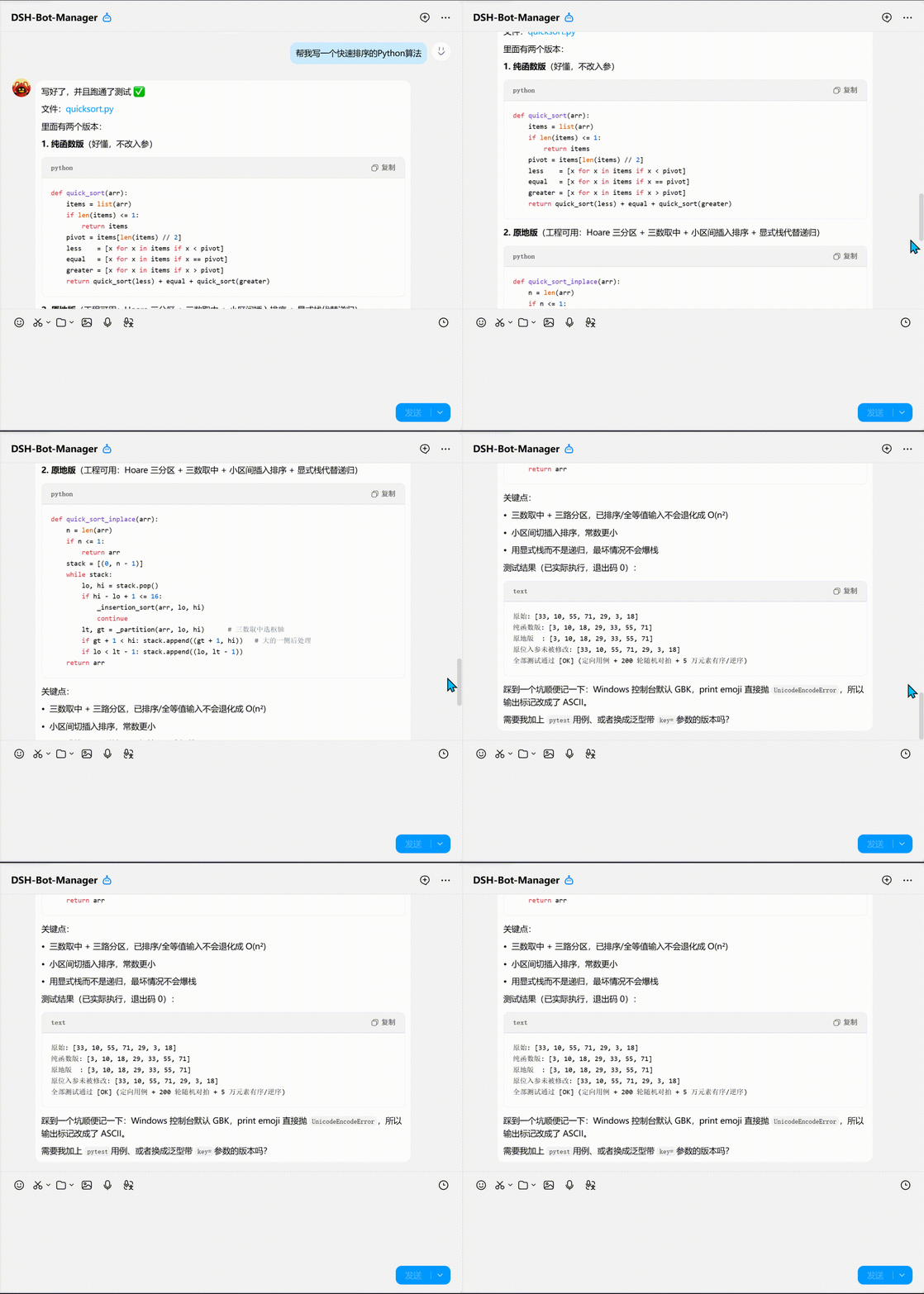
Real run: a private message on QQ, answered by the Bot's actual DSH session — code, files and all. The same conversation is waiting in the DSH Web UI.
        QQ app                          ┌─ DSH Web UI ─┐
           │                            │  程序员 chat  │
    private message                     └──────▲───────┘
           ▼                                   │  the same session
   ┌───────────────────────────────────────────┴──────────────────────────┐
   │  dsh-qqbot-bridge  →  the Bot's REAL session (history + memory + ...) │
   └──────────────────────────────────────────────────────────────────────┘
The problem
You already run a team of agents inside DSH: several Bots, each with its own long-lived session, its own role instructions, its own long-term memory, its own tools and workspace. You want to talk to them from QQ.
The obvious approach — "write a QQ bot that calls the model with the same system prompt" — silently throws away everything that made the team worth building: the conversation history, the memory files, the permissions, the workspace, the resume-after-restart behaviour. You end up with a stranger wearing the same name.
This project does not do that. It delivers a QQ message into the session that Bot already has, and relays the Bot's answer back to QQ.
What makes it different
| Typical QQ ⇄ LLM bridge | dsh-qqbot-bridge | |
|---|---|---|
| Identity | Copies the system prompt | Reuses the real session — sessionController.resolveAgent(sessionId) then agent.followup(createUserMessage({ source })) |
| Context | Starts from scratch | The Bot's actual history, memory, tools and workspace |
| Web ⇄ QQ | Two disconnected worlds | One session: start on QQ, continue in the Web UI, same context |
| QQ gateway | Opens its own connection | Borrows the one the official plugin already runs — no second login, no credential race |
| Allowlist | [] often means everyone |
[] means nobody (fail-closed); refused peers are only recorded, never auto-granted |
| Observability | Silence when it breaks | Console lines and bridge-status.json — "did it load?" always has an answer |
| Official commands | Frequently swallowed | /bot-ping, /bot-status, … keep working |
| Long conversations | Pins one session id | Re-reads state.json before every send, so a session that rolls over to a new part keeps working |
| Group chats | Often on by default | Off, and group traffic is handed back to the stock chain untouched |
Every row above is backed by a test or a real run log — see TEST-REPORT.md.
How it works
QQ private message
      │
      ▼
@tencent-connect/dsh-qqbot   (stock plugin + a tiny local fork, patch 0001)
      │   owns the only QQ websocket, holds the credentials
      │   publishes: ctx.provide('qqbot', { setMessagePreHandler, sender, replyTargetFor, … })
      ▼
dsh-qqbot-bridge   (this project — consumes the service, never opens a socket)
      │   1. allowlist gate      (empty ⇒ refuse everyone, record the OpenID only)
      │   2. command router      /管家 /设计师 /程序员 /聊天 /团队 /当前   → routing.json
      │   3. per-OpenID FIFO queue + message-id de-duplication
      │   4. read state.json (READ-ONLY) for that Bot's CURRENT session id
      │   5. sessionController.resolveAgent(sessionId) → agent.followup(msg)
      ▼
the Bot's real DSH session          ← the very same one the Web UI shows
      │   msg.source.kind = 'qqbot-bridge'   (so QQ and Web turns are distinguishable)
      ▼
ctx.on('session/event') collects the answer, turn/end closes it
      │
      ▼
back to QQ (chunked, with honest failure and timeout messages)
The bridge registers one Cordis service of its own (qqbotBridge) so an operator can ask
a live host what it is doing.
Why a fork of the QQ plugin is required
The stock @tencent-connect/dsh-qqbot keeps its QQBot instance, SessionManager and
outbound sender inside local variables and registers no Cordis service at all, so an
external plugin cannot send on the same connection, cannot intercept the middleware chain,
and cannot learn which OpenID a message came from. Starting a second gateway with the same
AppID would race the first one for the event stream.
So the only clean option is a minimal local fork, and patch 0001 adds exactly two things:
| File | Change |
|---|---|
dist/gateway/middleware-setup.js |
one optional preHandlers argument, inserted at the front of the middleware chain |
dist/gateway/bootstrap.js |
ctx.provide('qqbot', { setMessagePreHandler, sender, replyTargetFor, manager }) |
No existing statement is modified, and a host that never calls the extension point behaves
exactly as before. Rollback is one dependency range in the profile manifest.
Full evidence in patches/0001-qqbot-extension-point.md.
Quick start
Prerequisites: DSH with the Web profile, the stock QQ plugin installed and already bound to your AppID, and DS Bot with your team created.
# 1. self-check (zero runtime dependencies — no install needed)
node scripts/run-tests.mjs
node scripts/audit-constraints.mjs
node scripts/verify-host-resolution.mjs

# 2. generate the local fork (finds the installed stock package automatically,
#    or pass --from <dir>)
node scripts/make-bridged-qqbot.mjs --out ../dsh-bridged-qqbot
(cd ../dsh-bridged-qqbot && pnpm install --prefer-offline)   # pnpm does not do this for linked packages

# 3. point your Web profile at the fork and mount this bridge (see the diff first)
node scripts/install-profile.mjs --fork ../dsh-bridged-qqbot --project . --dry-run
node scripts/install-profile.mjs --fork ../dsh-bridged-qqbot --project .

# 4. stop dsh, then install inside the profile
cd ~/.dsh/profiles/web && pnpm install

# 5. start dsh again. You should see the bridge announce itself:
#    [qqbot-bridge] apply() entered (plugin v0.1.0)
#    [qqbot-bridge] allowOpenIds: 0 configured -- FAIL CLOSED, every QQ peer is refused
#    [qqbot-bridge] provided the "qqbotBridge" service
#    [qqbot-bridge] STARTED: transport=dsh-qqbot-bridge/qq | snapshot=...
Then allowlist yourself:
# send any private message to the bot on QQ (it will be refused, on purpose), then:
node scripts/show-openids.mjs          # prints the OpenID that was recorded
# put it into ~/.dsh/profiles/web/cordis.patch.yml -> allowOpenIds: ["YOUR_OPENID"]
Editing cordis.patch.yml is picked up by DSH's config hot reload — no restart needed.
Using it from QQ
| Command | Effect |
|---|---|
/管家 /设计师 /程序员 /聊天 |
switch which Bot you are talking to (persisted per OpenID) |
/团队 |
list the team |
/当前 |
show who you are talking to |
| anything else | delivered to the current Bot; its answer comes back to QQ |
Configuration
All of it lives in your profile patch, never in this repository:
- id: qqbot-bridge
  config:
    allowOpenIds: []        # EMPTY MEANS NOBODY. Add only your own OpenID.
    defaultBot: 管家         # who receives a message from a peer with no switch yet
    allowGroups: false      # v1 is private chats only
    replyTimeoutMs: 600000  # how long to wait for a Bot turn before telling the user
    queueMax: 4             # per-peer queued messages
    textChunkLimit: 4500    # max characters per QQ message
    debug: false
    # statePath / dataDir default to <DSH_HOME>/bot/state.json and <DSH_HOME>/qqbot-bridge
appId / appSecret stay in the official plugin's config block, untouched. This project
never reads, stores or logs them.
Three Cordis/DSH surprises worth reading about
Both of these cost real debugging time, and both are now pinned by tests.
1. ctx.set is not registration. In Cordis 4, ctx.provide(name, value) registers a new
service and returns a disposer; ctx.set(name, value) may only overwrite a service someone
already provided, and otherwise throws cannot set property "<name>" without provide. Both
halves of this project originally used ctx.set, which is why the host reported
2 entries did not activate. A hand-written fake context with set = assignment hid it
perfectly — hence the real-Context tests in this repo.
2. A declared-but-absent inject suspends a plugin in total silence. The fiber just sits
in pending, apply() is never called, and the plugin cannot explain itself. So this
plugin declares no dependencies at the plugin level, runs apply() unconditionally, and
does its waiting with ctx.inject([...]) plus a watchdog that names every service still
missing.
3. …and DSH mounts no console exporter for the Cordis logger. LoggerService installs
exactly one default sink: an in-memory ring buffer. Printing needs
@deepseek-ai/cordis-plugin-logger-console, which no DSH bundle depends on — so in dsh web,
ctx.logger.info(...) is invisible. That is how a perfectly healthy bridge managed to look
like a plugin that had never loaded. Lifecycle facts therefore go to the console directly
(lib/host-log.js) and to <dataDir>/bridge-status.json (lib/status.js). DSH's own e2e
fixtures confirm the contract: their observer has to attach an exporter and drain
ctx.logger.buffer to see plugin output.
Diagnostics
node scripts/bridge-status.mjs   # is it loaded? running + transportOk ⇒ exit code 0
node scripts/show-openids.mjs    # who was refused?
node scripts/run-tests.mjs       # full regression
<DSH_HOME>/qqbot-bridge/bridge-status.json is written the moment apply() runs — before the
first message — and holds phase (loading / waiting / running / failed / stopped),
available, transport, transportOk, allowOpenIdsCount, failClosed, waitingFor,
bots, timestamps and lastError. It contains counts, never credentials.
Troubleshooting
| Symptom | What it means |
|---|---|
Not a single [qqbot-bridge] line on startup |
Run node scripts/bridge-status.mjs. No file ⇒ the bundle was never mounted (check dsh --profile web --dump-config). phase=waiting ⇒ look at waitingFor. phase=running ⇒ it is fine; something else is quiet. |
cannot set property "qqbot" without provide |
Service registration used ctx.set. Cordis 4 needs ctx.provide for first registration — regenerate the fork. |
2 entries did not activate |
Same cause: neither the gateway nor the bridge started. |
warning: 1 entry did not activate + pending (waiting for service: …) |
A plugin-level inject named a service that never appeared. This bridge declares none. |
waiting for service(s): … and nothing more |
One of sessionController, sessions, qqbot is missing; the watchdog repeats it every 10s. |
No qqbot service on this host |
The stock QQ plugin is still installed instead of the fork. |
qqbot service found but it has no setMessagePreHandler |
The fork is linked but its dependencies were never installed, or it is not the patched build. |
QQ is silent and the log says refused QQ message |
Your OpenID is not in allowOpenIds (or is misspelled). |
QQ is silent, log says queue overflow |
One peer sent more than queueMax (default 4) messages back to back; the rest were dropped with a notice. |
| The Bot takes very long / never answers | Watch the Bot's chat in the DSH Web UI; after replyTimeoutMs QQ is told to look there. |
| An answer shows up in the Web UI but not on QQ | That turn was not triggered from QQ (you continued the conversation in the Web UI). By design. |
| Nothing in group chats | v1 is private-chat only; group traffic is handed back to the stock chain untouched. |
Tests
node scripts/run-tests.mjs
# files: 15, failed: 0        (# tests 139 / pass 139 / fail 0)
They are not mocks pretending to be a host:
- real
@deepseek-ai/cordisContextfor the service-registration semantics; - real
boot()from@deepseek-ai/dsh-app-boot— the very functiondsh webruns — for activation, console output and teardown; - real
loadProfile+composeEntriesover the installed Web profile for the layer that actually decides whether a bundle is mounted at all; - the real forked middleware chain for end-to-end routing.
Tests that need a DSH checkout, the fork, or an installed profile skip with a reason instead of failing, so the suite also runs on a bare clone.
Deep dive: TEST-REPORT.md · contracts: COMPATIBILITY.md.
Security model
- Fail closed. An empty
allowOpenIdsrefuses every peer. - No automatic grants. A refused OpenID is written down (so you can copy it into your own config yourself) and nothing else. The bridge never adds itself to the allowlist.
- No credential handling.
appSecretstays in the official plugin's config; the bridge owns no socket and opens no connection of its own. - Read-only on DS Bot.
state.jsonis read, never written; its lock and atomicity are respected. - No browser shortcuts. No
/api/bot, no forged cookies, no bypassing the Web UI's auth. - Credentials are scrubbed from every log line (
lib/log.js), and OpenIDs are shortened unlessdebugis on. scripts/audit-constraints.mjschecks all of the above mechanically.
Project layout
| Path | Purpose |
|---|---|
lib/index.js |
plugin entry: name / inject / Config / apply / service waiting + watchdog |
lib/host-log.js |
the always-visible console channel |
lib/status.js |
writes <dataDir>/bridge-status.json, creates the data directory |
lib/bridge.js |
ownership verdict, routing, queues, reply correlation, error handling |
lib/adapter.js |
the borrowed-gateway transport (and an explicitly failing fallback) |
lib/deliver.js |
delivery into the real session, with its own source tag |
lib/registry.js |
read-only state.json parsing, including part rollover |
lib/router.js · lib/access.js · lib/commands.js |
per-OpenID routing, fail-closed allowlist, command parsing |
scripts/ |
fork generator, profile installer/rollback, status, audit, test runner |
patches/ |
the fork patch, with the evidence behind every inserted line |
Uninstall
node scripts/rollback-profile.mjs --dry-run   # show the diff
node scripts/rollback-profile.mjs             # restore the stock plugin
cd ~/.dsh/profiles/web && pnpm install        # then restart dsh
Your Bots, team memory, chat history, skins and the bridge's data directory are untouched.
Contributing
Issues and PRs are welcome. The one rule that matters: tests must run against the real host, not a hand-written fake — a fake context is exactly what let the original activation bug ship green. If a test cannot reach the real thing here, make it skip with a reason.
Credits & licence
- Built for deepseek-harness and @tencent-connect/dsh-qqbot.
- Not affiliated with DeepSeek or Tencent. The fork is generated locally from your own installed copy; no third-party code is redistributed here.
- MIT
No comments yet. Be the first to write one.