dsh-html-live-preview



Live HTML preview inside DeepSeek Harness conversations. The model calls one tool, and the HTML it writes is rendered in the chat as it streams — not as a code block, and not in a side panel.
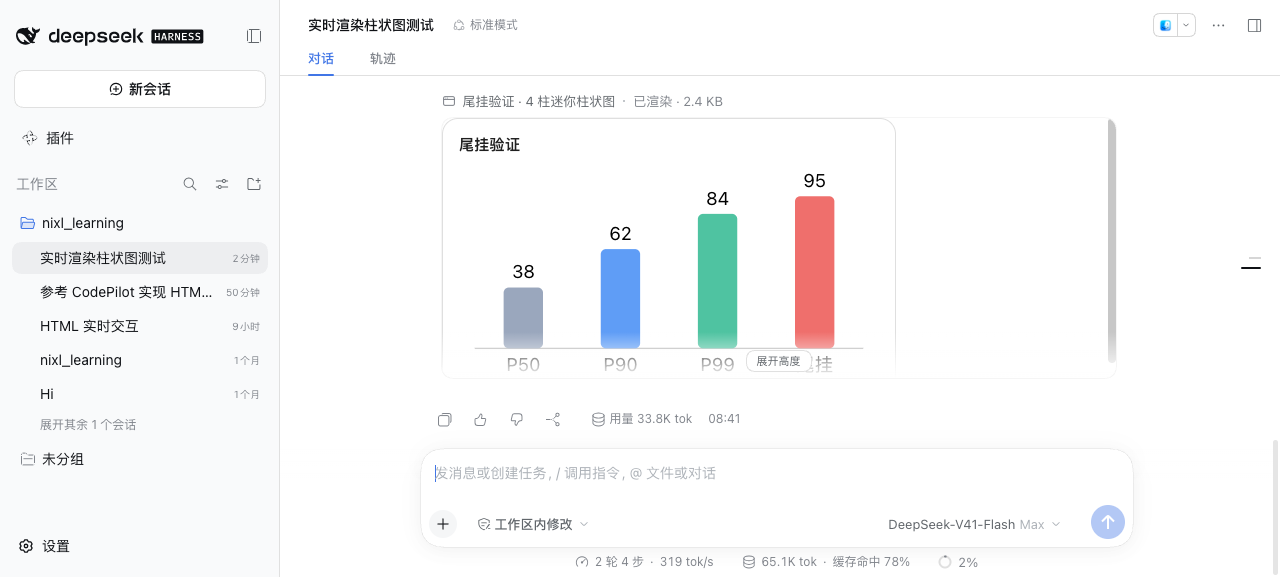
What you get
- Live while it is written. The preview grows in the conversation as the model types the arguments, decoding the partially-written JSON so you see the result before the call is even finished.
- Interactive when it settles.
<script>runs once, in document order, after the markup is final. Buttons, animations, charts and canvas all work. - It stays put. When a turn finishes, DSH folds tool rows into the turn's process disclosure — so the plugin renders the preview a second time in the turn tail, which is outside that fold. One iframe per call at any moment.
- Theme-aware. The frame inherits the host's
--dsw-*/--dsh-*design tokens plus a set of readable aliases, and follows light/dark switches live. - Honest about failure. Script errors and failed subresources surface as a dismissible strip under the card, and a preview whose recorded call fell outside the loaded session window says so instead of showing an empty frame.
Requirements
- DeepSeek Harness with the web profile:
dsh web(verified against0.1.7-rc.2and0.2.0-rc.1). - The plugin declares
@deepseek-ai/dsh-toolsas a peer, so DSH refuses to load it on a runtime outside that range instead of failing at the first call.
Install
From the registry, into the profile that runs your Web UI:
dsh plugin --profile web add dsh-html-live-preview
The same operation is available in the Web UI under Plugins. Installation selects the bundle, so the row mounts on the next composition (HMR applies it live).
From a checkout of this repository:
dsh plugin --profile web add link:/absolute/path/to/dsh-html-live-preview
Then start a new session: an existing session keeps the tool catalog it was composed with, so the tool appears in the next one.
render_html is registered in the tools registry's global layer, so every agent in the profile can call it — no agent-preset edit needed.
Usage
Ask for something visual, in any wording:
"Draw a bar chart of this week's latency" "Mock up a login page and make the button do something" "Animate how quicksort partitions this array"
The model calls render_html({ html, title?, height? }). The card offers four controls on hover: show the HTML source, copy it, re-run scripts, and expand the height (the frame is capped at 620px by default so a single preview cannot swallow the transcript).
How it works
Host half (index.js) validates the call, caps the snippet at 256 KiB, and returns a receipt of a few tokens. The markup itself stays in the recorded tool/call arguments, so reopening a session replays the preview at no extra storage or context cost.
Browser half (client.js) is a plain classic script in DSH's client-module factory form — no build step, and nothing imported beyond the seeded react:
| Surface | When | Why |
|---|---|---|
tool.call.toolview |
while the turn runs | streams the preview from the partially-written arguments |
conversation.chat.turnTail |
after the turn closes | the tail is outside the folded process disclosure, so the preview survives |
The frame itself:
- A constant receiver document is the iframe's
srcdoc— CSP, theme variables and a measurement script. Model HTML never becomes the document; it arrives overpostMessage, so streaming updates never reload the frame. - Two-phase injection. While the call streams, scripts and
on*attributes are stripped before injection (markup inserted throughinnerHTMLdoes not run<script>, but an<img onerror>does). Once the call settles, the complete markup is injected and its scripts run exactly once, waiting for each external script to load. - Sandbox.
sandbox="allow-scripts"with noallow-same-origin, so the frame is an opaque origin. The in-frame CSP isdefault-src 'none',connect-src 'none'(no fetch/XHR/WebSocket),frame-src/object-src 'none',base-uri/form-action 'none'; inline scripts, four CDNs (jsdelivr, unpkg, cdnjs, esm.sh) anddata:/https:images and fonts are allowed. Links are forwarded to the host and opened externally after a scheme check. - Auto height. A
ResizeObserverinside the frame reports its content height (60 ms debounce); the card clamps it, caches it per call id so a remount never collapses to zero, and grows. Content beyond the cap keeps its own scrollbar and can be expanded to 2400px.
Verification
Verified against a real DSH Web instance with real model calls, on 0.1.7-rc.2 and re-verified on 0.2.0-rc.1 (screenshots in screenshots/): the tool row renders the call, the turn tail keeps previews under their replies after those turns closed, heights came back measured (490px / 260px), and the console stayed clean.
The renderer itself is covered by test/harness.html, a standalone page that loads this plugin's client.js against real React and exercises streaming, finalizing, sanitizing, height caps, expansion, the source view, theme switching and in-frame error reporting:
mkdir -p /tmp/hp && cd /tmp/hp
cp /path/to/dsh-html-live-preview/client.js .
cp /path/to/dsh-html-live-preview/test/harness.html .
curl -sO https://unpkg.com/react@18.3.1/umd/react.development.js
curl -sO https://unpkg.com/react@18.3.1/umd/react-dom.development.js
open harness.html
Limitations
- No fenced-code-block rendering. DSH has no extension point for custom Markdown fence renderers (
renderCodeinsideui-primitivesis hard-coded), so```htmlstays a code block. A tool call is the supported path. - DSH updates. The declared peer range is
^0.1.7-rc.2 || ^0.2.0-rc.1, covering the 0.1.x and 0.2.x lines. A runtime outside it disables this plugin with a message naming the mismatch and thedsh plugin allow-versionescape hatch, rather than breaking at the first call; adding a verified line is a one-line change. - No network inside the frame, by design. Visualizations that need data must inline it or load a library from the allowed CDNs.
- Truncated session windows. If a recorded call fell outside the loaded window the card cannot rebuild the preview, and says so.
- Editing the plugin's own code needs a restart. DSH hot-reloads profile manifests and patches, but client bundles and host modules are cached per process.
Releasing
Tag-driven: npm version patch && git push origin main --follow-tags makes GitHub Actions verify the tag against the manifest, publish to npm through Trusted Publishing (with a provenance attestation), and open a GitHub release. See RELEASING.md.
No comments yet. Be the first to write one.