dsh-self-evolution



An agent that forgets everything it worked out is expensive to work with. This plugin is the memory.
A self-evolution layer for DeepSeek Harness (DSH) — bounded long-term memory, an automatic review that runs after every turn, procedural memory that refines skills instead of piling them up, a health check for skills the loader would silently drop, cross-session recall, a durable row inside the conversation that says what it just learned, and a card above the composer that is reserved for changes waiting on your decision.
It is a port of the self-improvement loop from Nous Research's Hermes Agent onto DSH's own primitives (ctx.tools + ctx.systemPrompt). The DSH core is not patched. The memory file format is byte-compatible with Hermes, so the two are interchangeable.

Why this exists
Out of the box, DSH starts every session from zero. Whatever it worked out with you yesterday — the build command, the deploy quirk, the thing you corrected it on — is gone.
Hermes solves this with a background self-improvement review and two bounded memory files. DSH has the primitives to do the same but no implementation. This plugin is that implementation, plus the parts that make automatic learning safe to leave switched on:
- It cannot lose what it learned by writing badly. Every write is re-read and re-linted; a skill that would be dropped by the loader is rolled back, never reported as saved.
- It cannot quietly rewrite your memory. The unattended review can only add. Deleting or rewording asks first, shows you the exact text it would destroy, and pins that text so the approval can never land on a different entry.
- It cannot become invisible furniture. Everything below the fold is optional; the only thing it insists on is being readable at the moment it has news.
Features
1. Bounded, self-managed memory
| Store | <dshHome>/self-evolution/MEMORY.md (agent notes) and USER.md (about you), entries separated by § — the same format as Hermes, so files are interchangeable |
| Actions | add / replace / remove / list; replace and remove locate an entry by a unique substring and refuse when the match is ambiguous |
| Limits | 2200 / 1375 characters by default (same as Hermes); no automatic compaction — when full, the tool returns ok:false with every current entry, so the model consolidates in the same turn and retries |
| Deduplication | An exact duplicate is rejected ("No duplicate added") |
| Safety scan | Before anything becomes durable: invisible Unicode (zero-width / bidirectional controls), instruction-override attempts, system-prompt exfiltration, private keys and cloud credentials, authorized_keys persistence, curl … | sh. A hit is refused (scanOnWrite: false to disable) |
| Injection | A system-prompt section self-evolution:memory (order 100, interpolate: false — memory text is never parsed as a {{template}}), headed by [67% — 1474/2200 chars] |
2. skill_learn — the write side of procedural memory
Turns a workflow you just worked out into a SKILL.md under a skill root DSH actually scans (default <projectRoot>/.dsh/skills — inside the workspace, no approval and no restart needed).
The point of this tool is that a skill it writes can always be loaded:
- frontmatter values are emitted as JSON double-quoted scalars, which removes whole classes of "unquoted
descriptioncontaining": "→ YAML parse failure → skill silently discarded" accidents; - the file is re-read and re-linted immediately after writing, and rolled back (created → deleted, rewritten → restored) if it would not load — it never reports a skill it cannot prove is loadable;
- a
descriptionover 500 characters is rejected outright, because the catalog truncates silently past that point.
3. skill_doctor — the curator
DSH silently discards any skill whose frontmatter fails to parse, with no warning anywhere. skill_doctor scans every skill root DSH reads, reports which skills would be dropped and why, and keeps load errors (the skill disappears) separate from quality warnings (the skill loads but gets truncated):
- load errors — no frontmatter, missing
name/description, non-kebab-case name, an unquoted value containing": "or ending in:, an unterminated quote, a duplicate key, a tab inside frontmatter; - quality warnings —
descriptionover 500 characters.
With fix: true it repairs surgically: it rewrites only the offending line (adding quotes) and leaves every other byte — other frontmatter keys and the whole body — untouched, after backing the file up to <file>.bak-<timestamp>. It re-checks afterwards and gives up rather than claim a fix it cannot verify.
4. The automatic review — it learns after every turn
Everything above only happens if the model remembers to do it. This feature makes it automatic: when a turn ends, the plugin calls a cheap auxiliary model (no tools, JSON out) to decide whether the turn contained anything worth keeping, and writes it if so.
| Trigger | listens for the session's turn/end |
| Skips | turns that ended interrupted or in error never learn; turns with fewer than reviewMinSteps (2) tool steps are treated as trivial; only one review runs at a time |
| Input | the last reviewMaxEvents (40) events of the turn as compact text, capped at reviewMaxChars (6000); the text extraction follows the official one (reasoning blocks dropped, tool calls and results kept, errors marked) |
| Output contract | strict JSON — `{"memory":[{target,content}],"skill":{name,description,body} |
| Landing | goes through the same write path as the tools — same scan, same limits, same dedupe, same read-back check — so the two can never drift apart |
| Model | defaults to whatever model the session is using; reviewProvider/reviewModel override it |
| Failure | every failure is swallowed: model down, timeout, garbage response, refused write — none of it can affect your session |
| Skills | creates and refines: a second pass merges new knowledge into an existing skill and compresses the result, instead of growing thirty near-duplicate skills |
5. Skills do not pile up
Hermes improves existing skills, which is why a month of similar tasks leaves one skill rather than thirty. Both paths exist here:
| Review verdict | Behaviour |
|---|---|
"action":"create" |
a genuinely new workflow → new skill |
"action":"improve" |
an existing skill already covers this → a second model call (that skill's current body plus the new knowledge) merges them into one deduplicated, compressed body, then replaces the file wholesale |
Four guardrails: the prompt carries the existing skill catalog (name + truncated description, 40 by default) so the model can recognise "this is the same kind of thing"; the file is backed up to <file>.bak-<timestamp> before every rewrite; a merged body over skillMaxChars (12000) is rejected and the old version kept, so skills cannot grow without bound; and the result is re-read and re-linted, rolling back if it would not load. reviewSkillUpdates: false turns rewriting off entirely and leaves creation only.
6. session_search — recall across sessions
Searches the actual messages of every past session. Memory is what the agent chose to keep; this searches everything that was ever said.
| Mode | What it does |
|---|---|
search |
full-text search across all sessions (matching excerpt + session id + seq); with session_id, only that session |
list |
recent sessions (id / creation time / working directory) |
read |
the raw events around one seq (window, default 2) for full context |
Query behaviour (measured, and worth reading): search one distinctive term at a time. Multiple terms are matched as an exact phrase, so every extra word narrows the result sharply. Chinese is tokenised by word: a whole word separated by spaces or punctuation matches, but a fragment inside a longer unbroken run does not. Hermes solves this with a purpose-built CJK tokeniser; DSH does not have one — when you need substring-level precision, scan the files with grep instead.
The tool registers optionally: if no search backend is wired up, every other part of the plugin keeps working. Enabling it means overriding DSH's own row in your profile patch:
- id: session-query-sqlite
  name: '@deepseek-ai/dsh-session-query-sqlite'
  config:
    path: '/Users/<you>/.dsh/storages/session-search.db'
    openAt: first-search      # startup | first-search | never
The index is a separate derived database (it validates its own application id and never touches session persistence) and can be deleted and rebuilt safely.
7. The learning shows up in the conversation itself
A background review that saves something also writes one row into the transcript, right after the answer it learned from:
◈ Self-evolution Saved a note: this machine builds with pnpm build ⌃
Clicking the ⌃ expands it in place: what this turn taught it, the reviewer's stated reason, how much memory is now in use, and the text of every entry it is currently holding.
Hermes prints the same thing as a system row in its transcript, and its client source carries the line that such a notice "must not be a transient toast that can be missed". DSH has no system row a plugin can append, so this uses the next best durable primitive: a logged context row — source kind, a one-line summary, and a body that expands. Same idea, DSH's own vocabulary.
Four things it deliberately does:
- The body leads with a marker. The row is logged as a user-role message, so it opens with
[self-evolution record · not a message from the user]; without that, a model reading the session back could take the record for something you asked for. - One row per turn. Learning that a tool wrote itself (
memory,skill_learn) rides out with that turn's review row instead of producing a second one. - It lands after the turn has closed. The row waits for the session to go idle, so it can never be spliced into the turn it describes — and never wakes an extra step.
- It can be switched off:
transcriptRow: falsekeeps the record in the learning timeline and the card, and out of the conversation.
The strings inside the row are plain Chinese, like everything else this plugin writes to you: a note reads 记住了一条经验:…, a skill 改进了技能「…」, and several of them join with · on the collapsed line.
8. A learning-loop nudge in the system prompt
A short, stable paragraph (guidance: true, on by default) tells the model when to write memory after a complex task, when to distil a skill, to check capacity before writing, and that a correction from the user outranks everything else.
The card above the composer
Since the transcript row exists, the two surfaces have a division of labour: the conversation holds the record of what was learned; the card holds what is waiting on you. The card still carries the timeline, the usage bars and the remembered entries, because those are things you look up, not things that happen.
At rest it takes no space. With nothing to report there is a single very faint ◈ in the composer's stats row:
⟳ 5 turns 247 steps · 271 tok/s 62.8M tok · cache 95% ◈ 39%
When there is news it appears by itself. A new learning, or a change waiting for your decision, puts one line above the composer:
◈ Self-evolution Just learned: saved a note — this machine builds with pnpm build ⌃
- The
◈takes the theme accent colour and the line brightens: a sentence where you are already looking, not an unlabelled icon in a corner. - It is a persistent line, not a flash. Hermes' own client source carries the note that this "must not be a transient toast that can be missed"; the line stays until you read it.
- Clicking it opens the panel, which counts as reading it. It then withdraws and the faint
◈comes back. - The panel holds: changes waiting for your approval, MEMORY / USER usage bars, the recent learnings timeline (when, what, and the model's stated reason), and the entries currently remembered.
| Quiet | Just learned | Expanded |
|---|---|---|
 |
|
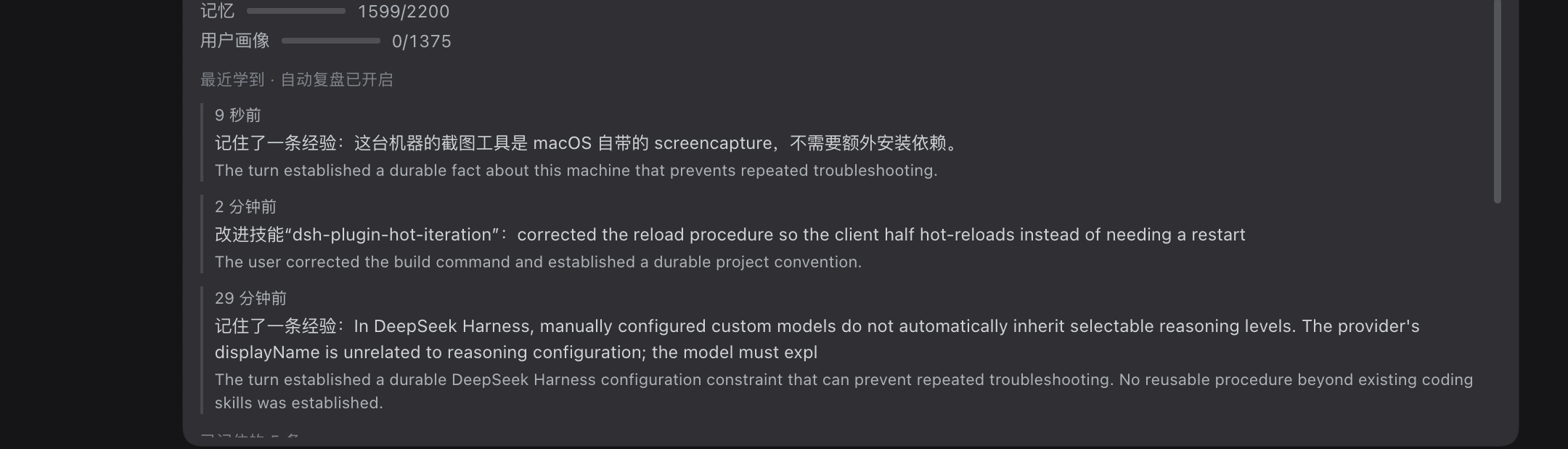 |
Two things hold the card open: a change waiting for your approval (it is asking permission — reading it once is not consent), and you having the panel open.
Motion is deliberately small: the card rises 6px, the panel unfolds downward, rows cascade in behind it, the two usage bars grow one after the other, the ◈ pulses once when something new arrives, and the chevron rotates on open. Everything is 200–460ms, nothing keeps a transform after it finishes, and prefers-reduced-motion cancels all of it.
It will not edit your memory behind your back
Three ideas ported from Hermes, all of them about making automatic learning safe to leave on:
| Design | The problem it solves | What you see |
|---|---|---|
| Provenance tags | You cannot tell "it decided to remember this" from "I told it to remember this" — the loudest complaint in the Hermes community is an agent turning an offhand config tweak into a permanent preference | Entries written by the unattended review carry a small auto tag; entries you asked for do not |
| Unattended review can only add | A deletion or rewrite made while you are away is something you would never notice | It queues a proposed delete or reword instead of performing it; nothing moves until you say yes |
| Approval shows what you would lose | An "Agree" button with no context is not a decision | Each queued change shows the full current text it would destroy, and the proposed replacement; what you see is exactly what it will touch |
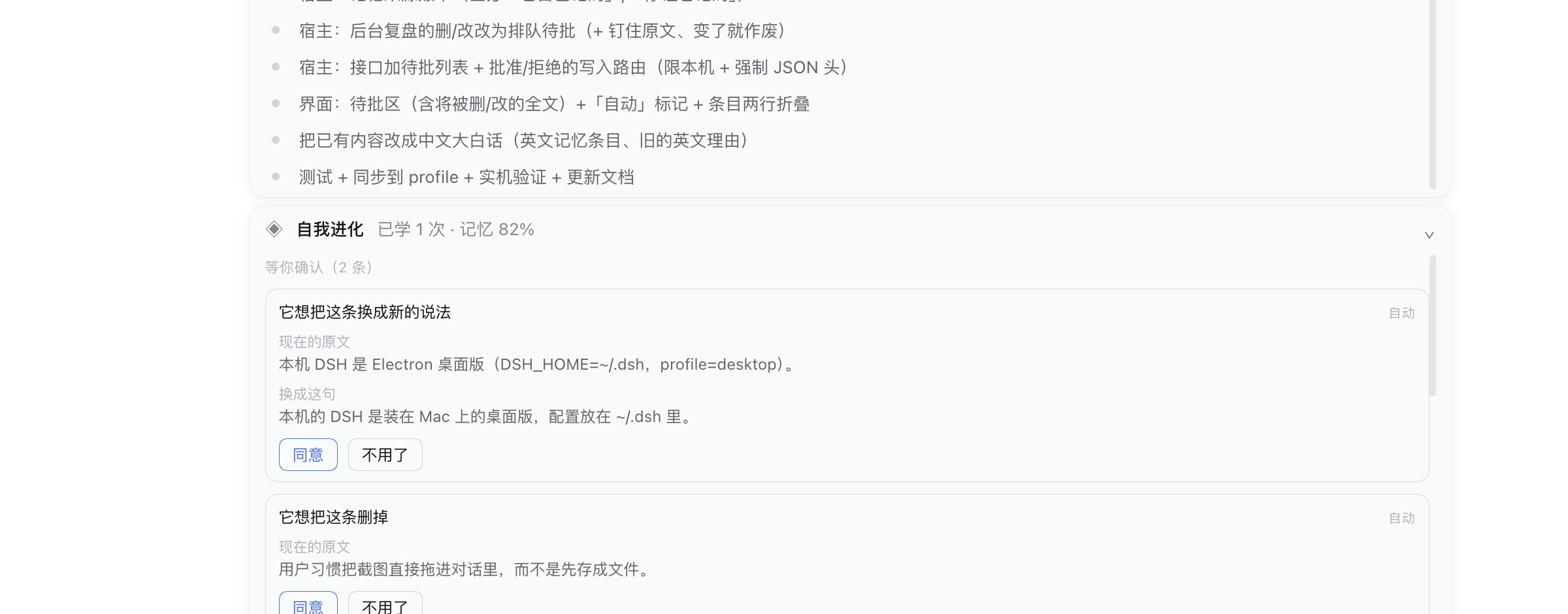
Two further belts: the queued change pins the original text when it is created, so if that entry has changed by the time you approve, the change is voided rather than applied to the wrong entry; and the write endpoint accepts only loopback requests declaring JSON (another page cannot produce that request — the browser's preflight blocks it — and non-local addresses get a 403). That is the plugin's only write endpoint.
Set approveReviewEdits: false if you would rather it merged on its own.
Install
Straight from the repository — the package name is only needed when installing from npm, which this project does not publish to:
dsh plugin --profile <your-profile> add github:Tommy00748/dsh-self-evolution
Then add the bundle to your profile patch (~/.dsh/profiles/<profile>/cordis.patch.yml):
- id: self-evolution
  name: 'dsh-self-evolution'
  config:
    memoryCharLimit: 2200
    userCharLimit: 1375
The host half (tools, prompt section, HTTP routes) loads on the next DSH start. The client half hot-reloads on its own — DSH polls client artifacts and reloads the plugin when they change, so edits to client.js appear in a running window with no restart and no page refresh. Changes to index.js need a restart.
To uninstall, remove the bundle name from the profile's dsh.profile.bundles and delete the package. Your memory and skill files are not removed; delete <dshHome>/self-evolution/ yourself if you want them gone.
Configuration
Override the bundle's row by id self-evolution in your profile cordis.patch.yml. A patch replaces the whole config object rather than merging into it, so list every key you want to keep.
- id: self-evolution
  name: 'dsh-self-evolution'
  config:
    storeDir: ''                # '' → <dshHome>/self-evolution
    memoryCharLimit: 2200
    userCharLimit: 1375
    extraSkillDirs: []          # extra skill roots to scan (absolute paths)
    skillsDir: ''               # '' → <projectRoot>/.dsh/skills
    enableMemoryTool: true
    enableSkillTools: true
    guidance: true
    scanOnWrite: true
    # background review
    autoReview: true
    reviewMinSteps: 2           # turns with fewer tool steps than this are skipped
    reviewMaxTokens: 1200       # how much one review may write
    reviewMaxEvents: 40         # events of the turn the review sees
    reviewMaxChars: 6000        # character cap on those events
    reviewProvider: ''          # '' → whatever model the session is using
    reviewModel: ''
    reviewTimeoutMs: 90000
    learningLog: ''             # '' → <storeDir>/learnings.jsonl
    # interface
    transcriptRow: true         # write one durable row into the conversation per turn that learned something
    uiMode: auto                # auto (default) | always | off
    notify: verbose             # verbose (default) | on | off
    approveReviewEdits: true    # deletes/rewrites need your yes (default); false = let it merge on its own
Trust boundary
This plugin writes with node:fs from the host process, so its writes are not subject to the session file sandbox (the sandbox only constrains the tool layer). There are two default paths, both configurable:
<dshHome>/self-evolution/{MEMORY,USER}.md— the memory itself<projectRoot>/.dsh/skills/— skills (inside the workspace, matching the sandbox policy)
Three bookkeeping files live alongside them and rebuild safely if deleted: learnings.jsonl (the learning timeline), origins.json (which entry came from where), pending.json (changes waiting for your approval).
Memory is permanently injected into the system prompt, which is why scanOnWrite is on by default; and the plugin's only write endpoint (approve / reject a queued change) accepts only loopback requests that declare JSON — see the trust layer above.
Tests
The host half runs against a fake Cordis context through the real apply() — the registration surface, the memory tool's write path, the provenance ledger, the approval queue, the web endpoints, the background review (driven by a fake llm stream and real session/event dispatches), and the transcript row it appends: that a review which learned something posts exactly one row, that a tool-written learning posts one too, that one turn never yields two, that a turn which learned nothing yields none, and that transcriptRow: false keeps the record out of the conversation while the timeline still keeps it.
The client half is a browser module, so a mistake in it is invisible from the outside — the module still loads and the card still renders. test/client.test.mjs therefore evaluates the real factory() with a stub loader and then cross-checks the two halves against each other: every dshse-* class the components render has a stylesheet rule, every animation: name has its @keyframes, every t('…') key exists in both dictionaries, and prefers-reduced-motion cancels every animated class. It also renders the transcript row for real and checks that the collapsed line is the record's summary, that the body is hidden until the chevron is clicked, and that the expanded body is the injected text verbatim. This is not ceremony: a hand-written edit once dropped 18 stylesheet rules and a translation key while node --check stayed happy and the UI still looked fine.
npm test        # both halves
node test/host.test.mjs
node test/client.test.mjs
The tests need @deepseek-ai/* to resolve, which comes from an installed DSH:
ln -s "/Applications/DeepSeek Harness.app/Contents/Resources/app/dsh/node_modules" node_modules
Known limits
- The transcript row is a context-injection row, not a system row. DSH gives plugins no way to append a system-role message, so the row is logged as a user-role message whose source marks it as injected context (which is why the body opens with an explicit marker). The glyph and time on the left of the row belong to the host and are not this plugin's to set. If DSH ever exposes a plugin-appended system row, this layer should move to it.
- The row is add-only: it becomes part of the session history and is compacted with it. Turning
transcriptRowoff affects later turns; rows already written stay. - The row lists at most the first 8 remembered entries and gives a count beyond that; the complete list is always in the card.
- Read-only history. The card shows what was learned but cannot edit or delete a record. Hermes'
/journeyallows both; this does not yet. - The expanded timeline shows at most 6 records, with a count for earlier ones.
- "Already read" is stored in browser localStorage (
dsh:self-evolution:seen), so a different browser — or clearing storage — will re-announce the latest learning once. session_searchuses SQLite'sunicode61tokeniser: token matching, not arbitrary substrings (AIwill not matchBRAID). The Chinese boundary is described above.- The search index is single-process; do not point it at the session persistence database.
skill_doctor's frontmatter check is a targeted lint, not a full YAML parser. It covers the classes known to break the loader, exempts the legal forms (multi-line plain scalars, block scalars, CRLF), and does not claim completeness.skill_doctorreports loadability; whether a skill reaches the model-visible catalog also depends ondisable-model-invocation/user-invocable, which it does not distinguish.- The
memorytool and amemoryskill can coexist in the same session without conflicting, but the model may confuse the two names. - Memory is global (shared across sessions), matching Hermes' one-home-one-memory model. Point
storeDirinside a workspace to isolate it per project. - The plugin writes with
node:fsfrom the host process, so its writes are not subject to the session file sandbox — see the trust boundary section.
Credits
The design is a port of the self-improvement loop in Hermes Agent by Nous Research — bounded memory files, the post-turn review, skill refinement rather than accumulation, and the insistence that a notification about learning must be a persistent line rather than a toast. The implementation, the DSH client card, the curator, and the trust layer around unattended edits are this project's.
License
MIT
还没有评论,来写第一条。