Density — quality-first context compression for DSH
A DSH client plugin that compresses only the tool output it can compress without losing answers, archives the originals, and keeps a per-context-window ledger of what it saved.
It is deliberately conservative: the goal is information density (remove noise), not a smaller token bill. Token savings are a side effect.
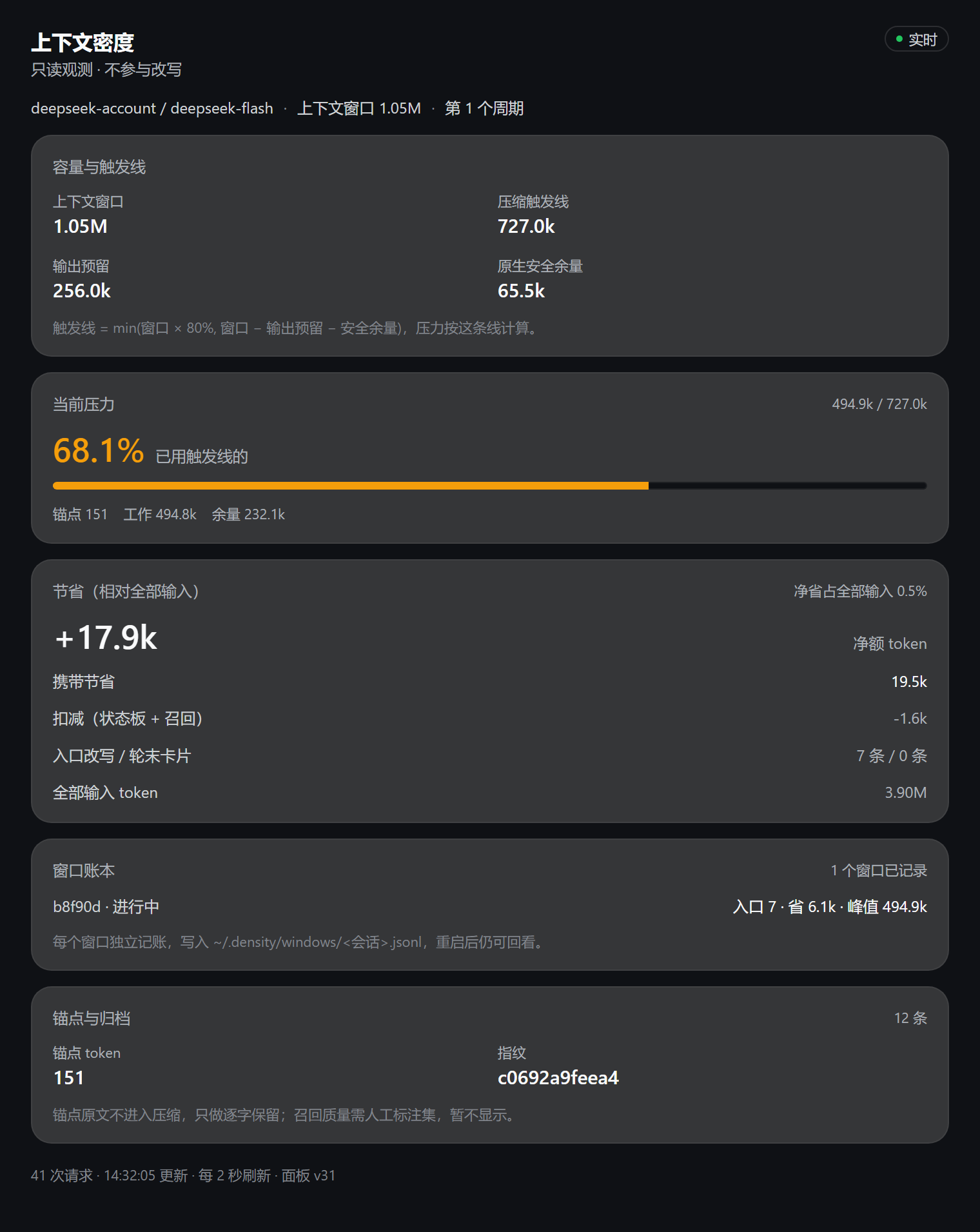
The sidebar panel, rendered from sample data: pressure against the native trigger line, savings, the per-window ledger, and anchor stability.
What it does — and what it refuses to do
| Input | Action | Why |
|---|---|---|
| JSON / JSONL arrays | convert to CSV (every value kept) | lossless in practice; 5/5 in blind tests |
| Unified diffs | drop unchanged context lines | changed lines and hunk headers stay |
| Logs | keep head, tail, every error line, plus a [统计] aggregate line |
counts stay answerable after sampling |
| Tables | never compressed | row sampling destroyed 5 of 6 answers in testing |
| Prose / long text | never compressed | sampling a narrative is data loss, not a summary |
| Source code | never compressed (v30+) | reviewers always recalled the outline; the round trip cost more than it saved |
cairn_*, density_recall output |
never touched | memory is the only copy in context |
When a tool result is compressed, the replacement carries a marker such as
[density #density-1a2b3c4d · 原文 4210B · 用 density_recall(marker) 取回], and the full
original is archived under ~/.density/archive/<session>/. The model can pull it back with
the lazily-registered density_recall tool (only registered after the first compression, so
idle sessions pay no schema cost).
Install
From this repository:
git clone https://github.com/SpiritronPersonality/dsh-density-panel.git
# then link it into your DSH profile, e.g. in <profile>/package.json:
#   "@local/density-panel": "link:<path>/dsh-density-panel"
# and add "@local/density-panel" to dsh.profile.bundles
Or configure it as a bundle:
The plugin is a normal DSH client plugin bundle:
# profile cordis patch (or the plugin's own cordis.patch.yml)
- insert:
    - id: density-panel
      name: '@local/density-panel'   # or your published package name
      config:
        mode: balanced
        write: true
        policy: quality
        surface: false
Restart DSH after changing config or code — the host snapshots plugin bundles at startup.
Configuration
| Key | Default | Meaning |
|---|---|---|
mode |
shadow |
shadow measures only; safe / balanced enable the entry path |
write |
false |
rewrite tool results (the actual compression switch) |
policy |
quality |
quality = this document's table; strict = diffs only; aggressive = legacy sampling (tables, head/tail, code outline) |
surface |
false |
extract per-turn cards and replace finished turns (off by default; changes the prefix) |
protectedTools |
['cairn_'] |
tool-name prefixes that are never compressed |
archiveDir |
~/.density/archive |
where originals are stored |
ledgerDir |
~/.density/windows |
per-window ledger |
What you can observe
- Panel: sidebar entry 「密度」, Chinese UI, cards for capacity, pressure, savings, anchors, mirror, native compaction and the window ledger.
GET /density/snapshot: JSON with the live window and the last 8 windows.- Ledger:
~/.density/windows/<sessionId>.jsonl, one JSON line per window snapshot. A window is an epoch (same provider, model, context size and trigger line). Survives restarts. - Metrics:
~/.density/shadow/<sessionId>.jsonl— every compression, recall and turn card.
Development
# run the tests one file at a time (the node --test runner spawns children,
# which some sandboxes refuse)
for f in test/*.test.mjs; do node "$f"; done
Helpers:
tools/corpus-acceptance.mjs— measure a corpus: ratio, hard-fact survival, detail survival.tools/replay.mjs— replay persisted DSH session logs through the entry compressor.tools/repair-session-id.mjs— repair sessions written by older versions without message ids.
Repository layout
index.js          host side: events, entry compression, ledger, snapshot API
client.js         sidebar panel (Chinese UI)
lib/transform.js  pure transforms + policy gate + hard-fact gate
lib/archive.js    original-text archive + recall
lib/ledger.js     per-window ledger (JSONL)
lib/stateboard.js state board rendered into turn cards
lib/turnplan.js   turn replacement planner
tools/            corpus acceptance, replay, session repair
test/             node:test files (run one file at a time)
docs/             design and test records
Publishing notes
The working copy is installed as a profile link (link:D:/.../density-panel) under the
name @local/density-panel with "private": true, which keeps accidental npm publishes
impossible. To publish under your own name:
- rename the package in
package.json(e.g.dsh-density-panel), drop"private"; - copy the name into
cordis.patch.yml(name:) so the bundle id matches; - reinstall the bundle in your DSH profile and restart.
Known limitations
- Compression is extractive; it cannot summarize semantics. That is why prose and code are skipped.
- Log sampling loses non-error lines; the
[统计]line only restores aggregate counts. - Recall costs about the size of the original — cheap only when recalls are rare.
- The UI is Chinese-only today.
License
MIT — see LICENSE.
No comments yet. Be the first to write one.