dsh-arabic
Arabic for DeepSeek Harness — proper bidi/RTL rendering plus a full Arabic UI language pack.


DSH has no RTL support and no Arabic locale. Mixing Arabic prose with English identifiers, paths and code inside the GUI makes text look scrambled, and every menu is English-only. This plugin fixes both, without patching the app.
What it does
1. Bidi-safe RTL rendering (works regardless of UI language)
Direction is decided per block by script dominance, not by the first strong
character. The tokenizer splits on whitespace only, so @deepseek-ai/dsh counts
as one word rather than three:
| Content | Direction | Why |
|---|---|---|
كيف حالك Hello |
RTL | Arabic words dominate |
Hello كيف حالك |
RTL | still Arabic words — dir="auto" would get this wrong |
Error: فشل الاتصال بالخادم |
RTL | the sentence is Arabic, the prefix is not |
npm install ثم أعد التشغيل |
RTL | 3 Arabic words vs 2 Latin ones |
شغّل npx @deepseek-ai/dsh web |
RTL | the code token binds npx … web into one unit, so 1 Arabic vs 1 Latin |
راجع commit a4c1025b قبل النشر |
RTL | a bare sha does not vote |
نسبة النجاح 15/15 |
RTL | a ratio is neutral |
افتح src/index.ts ثم عدّل الدالة |
RTL | a path does not vote |
@deepseek-ai/dsh مهم جدًا |
RTL | a leading identifier is one unit |
Hello نص |
RTL | a tie resolves to RTL |
The build failed while parsing سلام in the file |
untouched | English prose quoting a word stays LTR |
pre, code, inline code |
LTR always | code is never judged and never mirrored |
| composer, search boxes | follows typing | RTL while Arabic dominates, otherwise native auto |
The three rules behind the table:
- Code-like tokens do not vote — URLs, paths,
@scope/name, shas,15/15, dotted file names. One URL or sha can otherwise outweigh a whole Arabic sentence, and a code token also binds the Latin words around it into one technical unit. - Words vote, not letters — an Arabic word against a Latin word, because Latin technical terms are longer in characters but fewer in words. A tie goes to Arabic; a block with no Arabic word is released.
- Hysteresis while streaming — a block that is already RTL stays RTL until the text is clearly Latin (twice as many Latin words), so a growing answer cannot flicker between directions.
Only text blocks are flipped — chrome never is. A flex or grid container reorders its children when it flips, and a row that owns buttons is a toolbar: both are excluded, so the composer's send button keeps its side even though the Arabic permission label sits in that same row. The Arabic text inside such a row lives in its own block and is still handled.
If a block's direction is set by the app or by you (dir="ltr" in the markup),
this layer never touches it: that is the escape hatch for any block the estimator
gets wrong.
Known limits (asserted by the tests, not hidden)
- Bare Latin words still vote.
شغّل git statusstays LTR: two ordinary Latin words outweigh one Arabic word and there is no technical separator to glue them. Treating every Latin run as one unit was tried and rejected — it flips English paragraphs that quote a single Arabic word. - The sidebar terminal is not shaped. DSH's terminal is xterm.js, which does
not join Arabic letters (
ا ل ع ر ب ي ة). That is an upstream limitation; this plugin documents it instead of pretending otherwise. - Plural forms. DSH's locale dictionaries are flat strings, so an Arabic sentence that counts things cannot pick the right form for 1, 2, 3–10, 11+. Where it matters, the copy is phrased to be number-agnostic.
- Chrome stays LTR. Menus and the sidebar follow the shell's direction, not the selected language: flipping them by injection breaks a layout authored with physical CSS. Flex/grid containers and rows owning controls are excluded from the direction decision for the same reason — an Arabic label inside the composer's toolbar reads right-to-left without moving the send button. See docs/roadmap.md for the upstream-first plan.
The word-dominance approach, the "one identifier is one word" rule and the idea of stripping code-like tokens before counting follow the community consensus pioneered by haythamat/dsh-client-ui-rtl and kfirsch/dsh-hebrew-rtl (both MIT); this implementation is independent, adds the composer/toggle layer and the hysteresis, and is covered by its own tests.
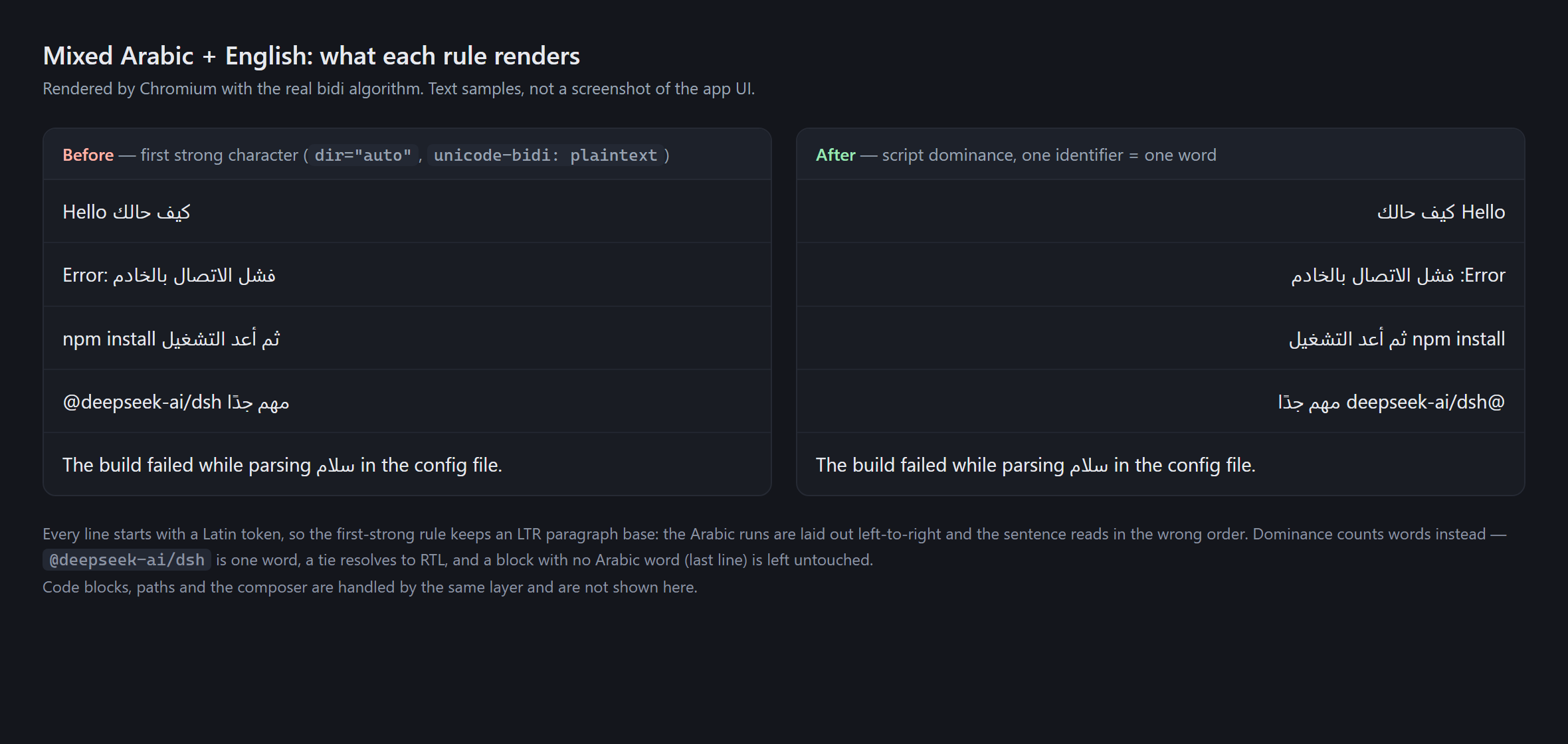
Rendered by Chromium with the real bidi algorithm: both columns contain the same five lines, each starting with a Latin token. Source: docs/direction.html.
2. Arabic UI language pack
Registered through the official locale service (ctx.locale.addLanguage +
ctx.locale.register), which is the mechanism the app itself uses — no DOM
string replacement, no monkey-patching:
- 59 namespaces / 3,228 keys taken from the official DSH source
- keys we do not translate fall back to English automatically (
fallback: 'en') - pick العربية in Settings → General → Language
Coverage and every non-obvious translation decision are auditable in
data/en-catalog.json (official English key set),
locales/ar.json (the Arabic pack) and
data/overrides.json (cross-batch consistency fixes).
3. Your choice, not ours
Arabic is added as an option, never forced:
- Settings → General → Language lists العربية next to the built-in languages; the selection is stored by the app's own locale service, so a reader who prefers the English interface keeps it.
- Settings → General → Right-to-left text direction switches the bidi layer
off and on instantly and remembers the choice (
localStorage). With it off, no block is marked and no composer direction is set — the UI behaves exactly as it would without the plugin.
Nothing about the interface changes until you choose it.
Install
# npm
dsh plugin --profile desktop add dsh-arabic

# or from a checkout (development)
dsh plugin --profile desktop add link:/absolute/path/to/dsh-arabic
Or install it inside the app: Settings → Plugins → Plugin Manager.
Restart DSH after installing. The Desktop injection table is collected once at host startup, so a page refresh alone will not apply the RTL layer.
Then, to use the Arabic interface: Settings → General → Language → العربية. The RTL layer is active for every language as soon as the plugin loads.
How it works
index.js                     host half
  └── webserver/index-inject rows
        ├── { kind: 'style',  text: <bidi CSS> }
        └── { kind: 'script', placement: 'body', text: <marker script> }

lib/client.js                browser half (generated)
  └── window.__ModuleLoader__.load({ id, factory })
        ├── ctx.locale.addLanguage({ id: 'ar', label: 'العربية', fallback: 'en' })
        │   ctx.locale.register(namespace, 'ar', dictionary)   × 59
        └── ctx.slots.inject('settings.general.item', …)
            └── one Switch row → window.__dshArabic.setEnabled()
The browser half has no top-level externals: react and the primitives are
required only when the settings seat exists, and that registration is guarded so
a future slot change can never take the language pack down with it.
Repository layout
| Path | Purpose |
|---|---|
index.js |
host half: the RTL/bidi injection rows |
lib/client.js |
generated browser half: the Arabic language pack |
locales/ar.json |
the translated dictionaries |
data/en-catalog.json |
official English key set extracted from the DSH sources |
data/en-catalog.meta.json |
the upstream ref/commit that key set was measured against |
data/glossary.yml |
machine-readable terminology (term, ar, avoid, do-not-translate) |
data/overrides.json |
pinned wording where parallel batches disagreed |
data/term-map.json |
term normalization applied to every value in the pipeline |
scripts/extract-catalog.mjs |
regenerates data/en-catalog.json from the official upstream sources (npm run extract) |
scripts/status.mjs |
coverage against the recorded upstream revision (npm run status) |
scripts/build-client.mjs |
validates the pack and regenerates lib/client.js (--check for CI) |
scripts/assemble-translations.mjs |
merges translation batches into locales/ar.json |
scripts/lint-consistency.mjs |
reports the same English string translated two ways |
tests/golden-direction.mjs |
25 golden strings with the direction each must get |
docs/roadmap.md |
the three layers, the upstream asks, and the deliberate non-goals |
AUDIT.md |
how the project was built: every step, command and gate result |
CONTRIBUTING.md |
how to add or fix a translation, and the checks CI runs |
tests/verify-rtl.mjs |
12 behavioural checks of the bidi layer on a DOM shim |
tests/verify-locales.mjs |
catalog integrity, artifact contract and registration checks |
Development
npm test                     # direction (34) + locale (28) + golden matrix (25)
npm run check                # completeness + consistency lint + golden matrix
npm run build                # regenerate lib/client.js
npm run status               # coverage against the recorded upstream revision
Keeping up with upstream
A weekly workflow (.github/workflows/upstream-sync.yml)
re-extracts the official key set and opens a pull request containing only the new
keys, so drift arrives as a reviewable diff instead of a surprise:
GITHUB_TOKEN=$(gh auth token) npm run extract   # refresh data/en-catalog.json
node scripts/build-client.mjs --check           # list every untranslated key
npm run status                                  # coverage + upstream revision
Keys that are still missing fall back to English at runtime, so a partial update never breaks the interface. See CONTRIBUTING.md and the roadmap.
Compatibility
Built and tested against DSH 0.2.0-rc.2 on the Desktop app and the served Web
UI. Both surfaces use the same two documented-but-internal seams — the
webserver/index-inject event and the client locale service — and the plugin
degrades safely if either changes: the direction layer is wrapped so it can never
break an index render, and the language pack simply stops registering. On the
Desktop app the injection table is collected once at host startup, so a restart
(not a page refresh) is what applies it.
Interactions with other Arabic/RTL plugins. This one and dsh-client-ui-rtl
or dsh-rtl-fix both set dir on content blocks; installing two of them means
they take turns and the last writer wins. The settings row in General turns
this layer off, which is the clean way to combine them. Two plugins registering
the ar language (@mimateinn/dsh-i18n does, with different coverage) will also
fight over the same language id — pick one.
Terminology. بلاقن is a deliberate choice: it is the form Arabic-speaking
developers use in speech, while plugin stays in the technical namespaces
(package names, paths, CLI output). Prefer the Latin word in the interface? The
dictionary is one edit away — see CONTRIBUTING.md.
Credits
- UI strings and key names come from deepseek-ai/deepseek-harness (MIT).
- The word-dominance direction rule and the "one identifier is one word" insight follow the community consensus pioneered by haythamat/dsh-client-ui-rtl (MIT); this implementation is independent.
- Arabic translations in this repository are original work, released under MIT.
License
MIT — see LICENSE.
还没有评论,来写第一条。