dsh-tender-matrix — Tender evaluation-factor scoring matrix arithmetic self-consistency check

dsh-tender-matrix reads one 评标因素评分矩阵 — a tender's evaluation-factor scoring matrix: the package header plus one row per evaluation factor — and checks that matrix's own arithmetic and completeness: that it names its project and its evaluation method, that no single score exceeds that item's maximum, that the item maximum scores total the figure you configure, that one bidder's scores total the figure you configure, that every score records its basis, that factor numbers are unique, and that no unreplaced placeholder survives in the basis column.
What it looks like
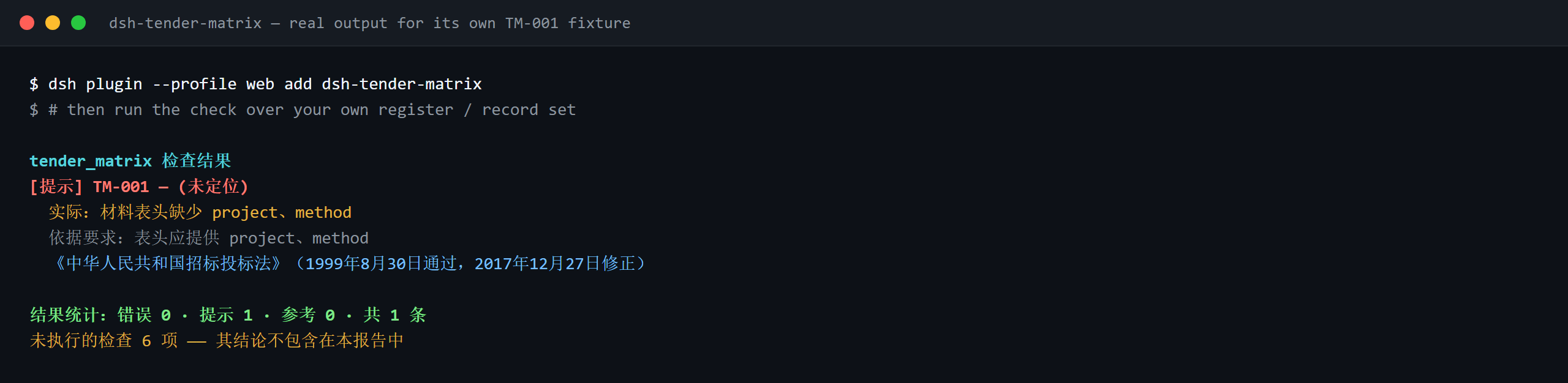
Real output from this plugin over its own TM-001 test fixture — not a mock-up. The rule pack ships no invented quotations, so a finding names both the clause it applied and the fact that the clause text was not obtained.
What it answers
| You ask | What it answers |
|---|---|
Every cell of the matrix is filled in, so why do both total checks report skipped? |
Because both totals ship unconfigured: TM-003 compares the sum of the maxScore column against its target, and TM-004 adds up one bidder's bidderA scores against its target; both carry target: 0, meaning “not configured”, so each reports itself in skipped rather than passing quietly until you enter the figure your tender document states. Once configured, a hit means only that the sum differs from the figure you set — not that the score scale is non-compliant; TM-004 is pure addition and is deliberately not wired to any per-bidder total column. |
One item's maximum is 100 but a cell says 105, and another row's score cell reads 优良. |
TM-002 reports both. It compares bidderA with maxScore item by item and reports a row whose score is above that item's maximum; when both cells are filled but neither can be read as a number or a date, that row is reported as uncomparable instead of being passed over, while a row missing one of the two is not compared at all. It is a numeric comparison only and never judges whether a score is appropriate, and it reads column A by default — cover B and C with an extra rule or a leftField override. |
| Some rows leave the scoring-basis column empty. Is that reported? | Yes. TM-005 requires the basis cell to be filled on every row the material gives that column, and reports each blank one. It checks only that something is written there — not whether the recorded basis holds, is appropriate, or matches the score. If the matrix carries no basis column at all, the rule reports that it does not apply rather than passing silently. |
| The same factor number appears on two rows of the matrix. What is reported? | TM-006 reports the repeated number, comparing with whitespace ignored. Uniqueness is all it establishes, and it matters because a repeat makes the maximum-score total come out wrong: either the same factor was registered twice or two factors were mis-numbered as one. It does not decide which of the two rows is the correct one. |
The basis cell still reads 【】 or TBD, because the matrix was copied from a template. Is that caught? |
TM-007 reports a basis cell that still contains any of its placeholder terms — 【, 】, {{, }}, XXX, xxx, 待填, 待补充, TBD, todo, 示例 — a list you can adjust to your own template. The failure it targets is a placeholder being read as a reason already recorded. Its title also names remarks, but the check reads the basis column only, and it never judges the quality of the basis itself. |
| The header does not say which project this matrix belongs to, nor which evaluation method it follows. | TM-001 requires the material's header to carry project and method and reports whichever is missing; it checks only that the header declares them, not that they agree with the tender document. If your institution's form has no evaluation-method column, set that rule's fields to [project] so it stops asking for a column your form never carries. |
Standards it follows
| Document | Number | Cited by rules |
|---|---|---|
| 《中华人民共和国招标投标法》 | 1999年8月30日通过,2017年12月27日修正(全国人大常委会《关于修改〈中华人民共和国招标投标法〉、〈中华人民共和国计量法〉的决定》),本法自2000年1月1日起施行 | TM-001, TM-002, TM-003, TM-004, TM-005, TM-006, TM-007 |
Boundary: this plugin checks an 评标因素评分矩阵 for arithmetic — that the matrix names its project and evaluation method, that no single score exceeds its item's maximum, that the maximum scores total what you configure, that a bidder's scores total what you configure, that each score records its basis, that factor numbers are unique, and that no placeholder survives. It does not decide whether a score is appropriate, whether the evaluation was fair, or who should win. Scoring is the evaluation committee's independent judgement, and the weights and criteria are the tender document's.
⚠️ Read this before trusting a citation in the report
Every
excerptin this plugin's rule pack says, in so many words, that the clause text was not obtained. The regime lives in 《中华人民共和国招标投标法》and its implementing regulations, plus each project's evaluation method inside the tender document. The verification pass could not retrieve verbatim clause text, so rather than paraphrase a quotation the pack states the gap in theexcerptfield itself and puts the honest reasoning innote. Every rule is thereforewarnorinfo, and a test asserts that no rule claims a quotation it does not have. When the texts are in hand, two things must be done: replace eachexcerptwith the real clause, and raisekindtodirect.The plugin ships no scoring scale. The two total checks ship with a target of
0, meaning "not configured":
TM-003compares the sum of the items' maximum scores againsttarget. 100 is common, but 120-point scales and weighted schemes exist, so the total is your tender document's figure and the rule reports that it could not run until you set it.TM-004compares the sum of one bidder's scores againsttarget. The check compares the column against the figure you state; it is deliberately not wired to a per-bidder total column, so it stays a pure addition check.
TM-002checks column A by default (bidderAvsmaxScore). Add a rule each for B and C, or overrideleftFieldper call.
Compatibility
| Surface | Status |
|---|---|
| Harness | Peer range >=0.1.2-rc.1 <0.2.0 || >=0.2.0-0 <0.3.0 — verified to accept both 0.2.0-rc.2 and 0.2.1-alpha.1. engines.dsh is deliberately not declared: it has no reader and cannot reject a host |
| Node | `^22.19.0 |
| Platforms | All (plain ESM; no native code, no network, no model call) |
| Tool mode | Works in native, ptc and both; for several packages use ptc |
What it does
Registers the tender_matrix tool. It reads one scoring matrix — the package header plus one row per
evaluation factor — applies a versioned rule pack, and returns a report.
| Rule | Check | Severity | Basis kind |
|---|---|---|---|
TM-001 |
the matrix names its project and method | warn | principle |
TM-002 |
no score exceeds its item's maximum | warn | direct |
TM-003 |
the maximum scores total your configured figure (off by default) | info | local |
TM-004 |
a bidder's scores total your configured figure (off by default) | warn | principle |
TM-005 |
every score records its basis | warn | principle |
TM-006 |
factor numbers are unique | warn | principle |
TM-007 |
the basis column holds no unreplaced placeholder | warn | principle |
Install
dsh plugin --profile <name> add dsh-tender-matrix
dsh --profile <name> --dump-config | grep 'dsh-tender-matrix'
Configuration
| Key | Type | Default | Description |
|---|---|---|---|
rulesFile |
string | rules/tender-matrix.yaml |
Rule-pack path, relative to the package root |
disabledRules |
string[] | [] |
Rule ids to stop running; each appears in skipped |
onlyRules |
string[] | [] |
Run only these rule ids; empty runs every rule |
skipNotes |
string | "" |
Note appended to every skipped reason |
timeoutMs |
number | 120000 |
Cooperative tool timeout budget |
Rule-level parameters worth knowing:
TM-002leftField/rightField/relation— the comparison,bidderA <= maxScoreby default.TM-003target— the total the items' maximum scores must reach.0means the rule does not run.TM-004field/target— the bidder column and the total it must reach.0means the rule does not run.TM-007terms— the placeholders to look for.
Material format
The tool accepts JSON or YAML:
project: 某某工程施工招标
tenderNo: ZB-2026-018
method: 综合评估法
rows:
  - { 序号: '1', 评审因素: 施工组织设计, 分值: '30', 投标人A: '26',
      投标人B: '24', 投标人C: '28', 评分依据: '按招标文件评标办法第 3.2 条' }
Column names are matched case-insensitively and ignoring spaces, underscores and hyphens, so 投标人A and
bidderA resolve to the same field; the matrix's own column names are kept, so a finding names the column it
read.
Rule sources
Rule data lives in rules/tender-matrix.yaml. The pack's header states the citation gap in full, and each
rule's note repeats the part that matters for that rule. The load-time guard that normally enforces "an
excerpt must be a real quotation of at least eight characters" cannot tell a quotation from a description —
so this pack leans on the header, the per-rule notes and a test that asserts every excerpt admits the gap.
Troubleshooting
TM-003orTM-004reports itself as skipped. Its target is0. Set your package's total, or the bidder's total, and the check runs.TM-002fires on a score above the maximum. That is the check: the arithmetic does not hold, so the cell is either mis-keyed or the item's maximum is wrong.TM-002does not check bidders B and C. It checks column A by default. Add a rule per column, or overrideleftFieldfor the call.TM-004fires although the matrix has a total row. The rule adds the column and compares against the configured target; a total that lives in a header field is not read. Settargetto the figure you expect.- The plugin installs but the tool never appears. Check that
mainresolves tolib/index.mjsand thatpnpm run buildproduced it; a wrongmainmakes the loader skip the entry silently. dsh plugin addrefuses the package as incompatible. The peer range covers0.1.xand0.2.x; if your runtime sits outside it, grant an explicit exemption:dsh plugin --profile <name> allow-version dsh-tender-matrix@0.1.0 --dsh-version <runtime> --accept-riskcheckreportsmanifest-peersas failed. The static checker compares against a hard-coded peer range that predates the 0.2 line. The runtime enforces peer compatibility at install time, so the declared range is the correct one; this is a known upstream issue indsh-plugin-dev.
Development
pnpm install
pnpm run typecheck   # tsc --noEmit
pnpm test            # vitest, the shared table-plugin suite plus paired fixtures
pnpm run build       # tsdown -> lib/index.mjs + lib/index.d.mts
node ../scripts/sync-shared.mjs dsh-tender-matrix   # refresh src/shared from ../_shared
The plugin is data-only: src/model.ts declares the table shape, the shared kit supplies the reader and
the check engine, and the rule pack declares every check.
License
Apache License 2.0 © 2026 dsh-tender-matrix contributors.
No comments yet. Be the first to write one.