dsh-spc-gbt-adapter — Control chart constants and process capability index consistency check

dsh-spc-gbt-adapter reads one control-chart register — rows keyed by the register's own column names, in Chinese or English — and checks that register's own arithmetic and constant-table consistency: that the characteristic and the chart type are recorded, that the control limits follow from the centre line, the dispersion statistic and the chart constants the pack freezes, that the centre line sits between the limits, that the stored Cp and Cpk follow their definitions, that the subgroup size is one the constant table covers, and that the header names the product and the process.
What it looks like
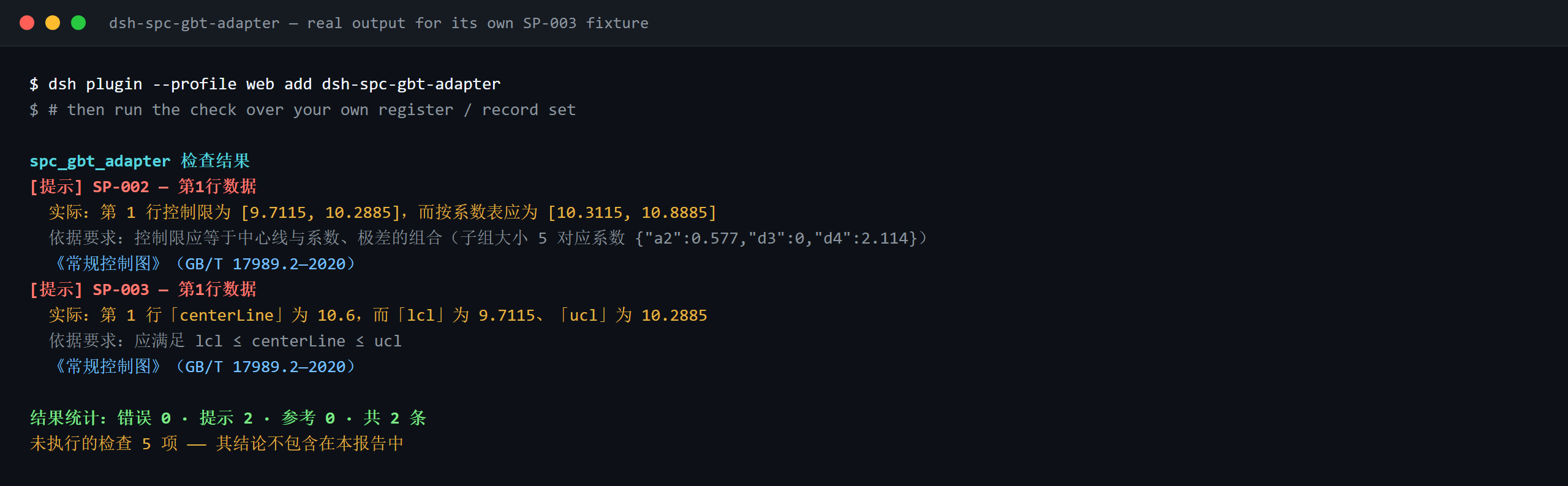
Real output from this plugin over its own SP-003 test fixture — not a mock-up. The rule pack ships no invented quotations, so a finding names both the clause it applied and the fact that the clause text was not obtained.
What it answers
| You ask | What it answers |
|---|---|
| A chart row leaves both the characteristic and the chart type blank. Is that reported? | Yes. SP-001 requires at least one of characteristic and chartType to be filled on every row that carries either column, and reports the row when both are empty. It checks that one of them is recorded, not whether that characteristic ought to be charted or whether the chart type was chosen correctly. |
| The stored control limits do not match what the centre line, the range and the chart constants give. | SP-002 recomputes ucl and lcl from centerLine, range and the coefficient entry for that sampleSize, within a tolerance of 0.005, and reports the row with the stored pair and the expected pair. It checks only that those numbers agree with one another — not that the limits or the range are correct, and never whether the process is in control. The frozen table is the X̄-R one: an X̄-s, I-MR, p or c chart has different coefficients, so disable the rule or replace coefficients. |
| The centre line is stored above the upper control limit. | SP-003 requires lcl ≤ centerLine ≤ ucl on every row that fills all three, and reports the row where that order fails. It checks the order of the three numbers only, not whether they were computed correctly. A lower limit of 0 is a normal shape for the range chart and is not reported on that account. |
| Cp and Cpk are in the register, but the report says nothing about them. Why? | SP-004 runs only on rows that carry cp or cpk together with usl, lsl, stdDev and mean; when no row carries all of them, the rule reports skipped rather than passing silently. Where it runs it tests the two definitions, Cp = (USL − LSL) / 6σ and Cpk = min(USL − X̄, X̄ − LSL) / 3σ, within a tolerance of 0.02. A difference usually means the σ convention is mixed up: Cp/Cpk take the within-subgroup standard deviation, Pp/Ppk the overall one. It does not decide whether capability is sufficient. |
| Is the process capability good enough? | The check does not answer that. SP-005 only reports a stored cpk that falls below the criterion you configure, and it ships with threshold: 0, meaning not configured, so it goes to skipped instead of inventing a criterion; the usual 1.33 and 1.67 depend on the industry, the customer and how critical the characteristic is. A finding under this rule means the value is below your own criterion, not that the process is unqualified, and the rule is reported at info severity. |
| Our subgroups hold 15 measurements each. What happens? | SP-007 reports the row: the constant table frozen into the pack covers subgroup sizes 2 to 10 only. With no entry for that size, SP-002 cannot look the coefficients up either, so it reports that rather than staying silent. The rule checks whether the size is a listed tier, not whether that subgroup size suits the process. To work with larger subgroups, add the tier to SP-002's coefficients and widen this rule's values — a rule-pack edit, not a code change. |
Standards it follows
| Document | Number | Cited by rules |
|---|---|---|
| 《常规控制图》 | GB/T 17989.2—2020(控制图 第2部分:常规控制图,采标 ISO;替代已废止的 GB/T 4091—2001;条号本次未取得) | SP-001, SP-002, SP-003, SP-004, SP-005, SP-006, SP-007 |
Boundary: this plugin checks a 控制图台账 for arithmetic and constant-table consistency — that the characteristic and chart type are recorded, that the control limits follow from the centre line, the dispersion statistic and the chart constants, that the centre line sits between the limits, that Cp and Cpk follow their definitions, that the subgroup size is one the constant table covers, and that the chart names its product and process. It does not decide whether a process is in control, whether a trend is present, or whether capability is sufficient. Reading a chart needs the pattern rules; sufficiency depends on the customer's acceptance criterion.
⚠️ What this pack can and cannot cite
The control-limit coefficients (A₂, D₃, D₄) and the capability-index definitions do have a home: GB/T 4091《常规控制图》 (identical to the ISO 7870 series). Those coefficients are mathematical constants that vary only with subgroup size, which is why they can be frozen into the rule pack. But the verification pass did not obtain GB/T 4091's verbatim text, so every rule's
excerptsays so plainly and every rule stays atwarnorinforather than claiming a quotation.Three limits are worth knowing before trusting a finding:
SP-002assumes the X̄-R chart. An X̄-s, I-MR, p or c chart uses entirely different coefficients, so the rule will report differences. Disable it, or replacecoefficientswith the right table — a rule-pack edit, not a code change.- The coefficient table covers n = 2…10.
SP-007reports any subgroup size outside that range, so "cannot look it up" is never silently read as "no problem".SP-005's criterion ships as0, meaning "not configured". Typical values are 1.33 and 1.67, but the right one depends on the industry, the customer and how critical the characteristic is, so the rule reports that it could not run rather than inventing one.The σ convention matters too: Cp/Cpk use the within-subgroup standard deviation while Pp/Ppk use the overall one. A mismatch between a ledger's σ and its index is the commonest cause of a
SP-004finding, which is why the finding says so.
Compatibility
| Surface | Status |
|---|---|
| Harness | Peer range >=0.1.2-rc.1 <0.2.0 || >=0.2.0-0 <0.3.0 — verified to accept both 0.2.0-rc.2 and 0.2.1-alpha.1. engines.dsh is deliberately not declared: it has no reader and cannot reject a host |
| Node | `^22.19.0 |
| Platforms | All (plain ESM; no native code, no network, no model call) |
| Tool mode | Works in native, ptc and both; for many characteristics use ptc |
What it does
Registers the spc_gbt_adapter tool. It reads one control-chart register — rows keyed by the register's own
column names, in Chinese or English — applies a versioned rule pack, and returns a report.
| Rule | Check | Severity | Basis kind |
|---|---|---|---|
SP-001 |
the characteristic and chart type are recorded | warn | principle |
SP-002 |
the limits follow from the centre, dispersion and constants | warn | principle |
SP-003 |
the centre line sits between the limits | warn | principle |
SP-004 |
Cp and Cpk follow their definitions | warn | principle |
SP-005 |
capability meets your acceptance criterion (off by default) | info | local |
SP-006 |
the chart names its product and process | warn | principle |
SP-007 |
the subgroup size is one the constant table covers | warn | principle |
Install
dsh plugin --profile <name> add dsh-spc-gbt-adapter
dsh --profile <name> --dump-config | grep 'dsh-spc-gbt-adapter'
Configuration
| Key | Type | Default | Description |
|---|---|---|---|
rulesFile |
string | rules/spc-gbt-adapter.yaml |
Rule-pack path, relative to the package root |
disabledRules |
string[] | [] |
Rule ids to stop running; each appears in skipped |
onlyRules |
string[] | [] |
Run only these rule ids; empty runs every rule |
skipNotes |
string | "" |
Note appended to every skipped reason |
timeoutMs |
number | 120000 |
Cooperative tool timeout budget |
Rule-level parameters worth knowing:
SP-002coefficients— the constant table, keyed by subgroup size, witha2for a mean chart andd3/d4for a dispersion chart. The default covers n = 2…10 for X̄-R; extend it or swap it for another chart type's table.tolerancedefaults to0.005.SP-004tolerance— defaults to0.02, enough for rounding in a ledger.SP-005threshold— your Cpk acceptance criterion.0means the rule does not run.SP-007values— the subgroup sizes your register may use.
Material format
The tool accepts JSON or YAML:
productNo: P-2026-001
processName: 精车外圆
rows:
  - { 控制图编号: Xbar-R-001, 特性名称: 外径, 控制图类型: Xbar-R, 子组大小: '5',
      均值: '10.00', 极差: '0.50', 标准差: '0.215', 中心线: '10.00',
      上控制限: '10.2885', 下控制限: '9.7115', 上规格限: '10.60', 下规格限: '9.40',
      Cp: '0.9302', Cpk: '0.9302' }
Column names are matched case-insensitively and ignoring spaces, underscores and hyphens, so 上控制限 and
ucl resolve to the same field; the register's own column names are kept, so a finding names the column it
read. Numeric cells may carry units.
Rule sources
Rule data lives in rules/spc-gbt-adapter.yaml. The pack's header explains that the coefficients are
mathematical constants from the conventional control-chart tables whose standard text was not obtained, and
that the citation is therefore stated as a gap rather than paraphrased. The load-time guard still requires a
document, clause, excerpt and source per rule, and still forbids a derived-from-principle or locally
configured check from being error.
Troubleshooting
SP-002fires on every row of an X̄-s or I-MR chart. Those charts use different coefficients. Disable the rule, or replacecoefficientswith the right table.SP-007fires on n = 15. The table covers n = 2…10. Add the coefficients for the sizes you use and extendvalues.SP-004fires on a chart whose capability looks fine. Check the σ convention: Cp/Cpk take the within-subgroup deviation, Pp/Ppk the overall one. Unify the source before changing the tolerance.SP-005never runs. Its criterion is0; set your Cpk target.- The plugin installs but the tool never appears. Check that
mainresolves tolib/index.mjsand thatpnpm run buildproduced it; a wrongmainmakes the loader skip the entry silently. dsh plugin addrefuses the package as incompatible. The peer range covers0.1.xand0.2.x; if your runtime sits outside it, grant an explicit exemption:dsh plugin --profile <name> allow-version dsh-spc-gbt-adapter@0.1.0 --dsh-version <runtime> --accept-riskcheckreportsmanifest-peersas failed. The static checker compares against a hard-coded peer range that predates the 0.2 line. The runtime enforces peer compatibility at install time, so the declared range is the correct one; this is a known upstream issue indsh-plugin-dev.
Development
pnpm install
pnpm run typecheck   # tsc --noEmit
pnpm test            # vitest, the shared table-plugin suite plus paired fixtures
pnpm run build       # tsdown -> lib/index.mjs + lib/index.d.mts
node ../scripts/sync-shared.mjs dsh-spc-gbt-adapter   # refresh src/shared from ../_shared
The plugin is data-only: src/model.ts declares the table shape, the shared kit supplies the reader and
the check engine, and the rule pack declares every check.
License
Apache License 2.0 © 2026 dsh-spc-gbt-adapter contributors.
No comments yet. Be the first to write one.