dsh-sop-sync-check — Works-instruction register and PFMEA / control plan sync check

dsh-sop-sync-check reads one works-instruction register — the product header plus one row per process — and checks that register's mechanical consistency with the PFMEA and control plan it cites: that each process row carries a procedure number, that the PFMEA or control plan is cited at all, that the revision a row cites matches the revision the register records as the document's current one, that a stated parameter carries a tolerance, that no process number is repeated, that the header names its product, and that the revision date parses and is not later than the check date. It does not judge whether the process parameters are right, whether the control plan covers every failure mode, or whether the PFMEA analysis is adequate; a check that cannot run is listed in skipped instead of passing silently.
What it looks like
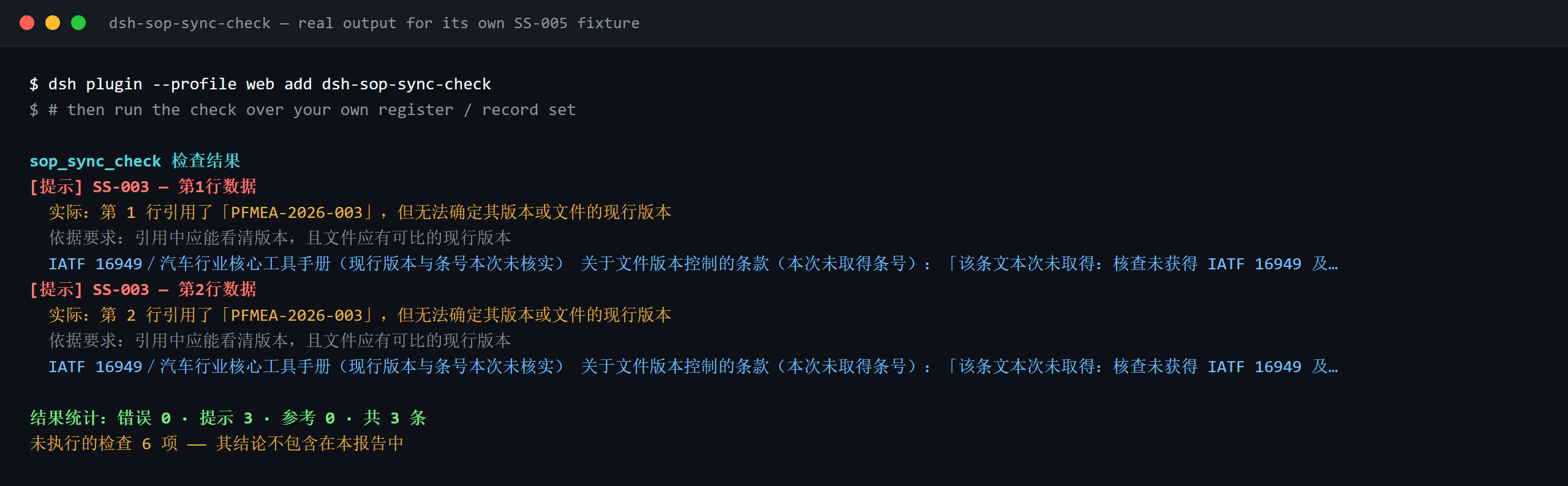
Real output from this plugin over its own SS-005 test fixture — not a mock-up. The rule pack ships no invented quotations, so a finding names both the clause it applied and the fact that the clause text was not obtained.
What it answers
| You ask | What it answers |
|---|---|
| A process row has no procedure number in the 规程编号 column. | SS-001 reports that row: the rule requires the procedure-number column to be filled on every row that carries it, and it checks presence only — not whether the procedure is the right one for that process. If the material has no such column at all, the rule reports that it does not apply instead of passing silently. |
| Nobody wrote down which PFMEA or control plan this works instruction belongs to. | SS-002 requires at least one of PFMEA编号 and 控制计划编号 to be filled on each row. It checks only that at least one is cited — not whether the reference is apt, and not whether the revision it names is the current one; that comparison is SS-003. |
| The procedure still cites the previous PFMEA revision. Will that be caught? | Yes. SS-003 reads the revision from a dedicated revision column or from a version marker at the tail of the reference text (PFMEA-2026-003 V2); the marker needs an explicit cue such as V, VER, REV, 版本 or 版次, so the trailing digits of a document number are never mistaken for a revision. It reports the reference whose version string differs from the document's current revision, and it compares version strings only — it does not decide which revision the reference should point to. When neither a revision column nor a readable version string is available it reports itself in skipped. |
| The parameter column is filled but the 参数公差 column is empty. | SS-004 reports that row — but only when the parameter column is filled, so a process that genuinely carries no parameter is not flagged. It checks that the tolerance column is filled, not that the parameter and its tolerance are reasonable. |
| The same process number appears on two rows. | SS-005 reports the repeated 工序号 and names the first row it saw with that number; whitespace is ignored in the comparison. Repetition usually means a double registration or a mistyped process number — which row is right stays a human decision. With no process-number column at all the rule reports that it does not apply rather than passing. |
A revision date reads 2026/3/8, and one row is dated next month. |
SS-007 reports a 修订日期 it cannot parse, and a date later than the check date. It checks that the date parses and does not fall after the check date; it does not judge whether the revision was made promptly. |
Standards it follows
This rule pack cites no public standard: the verification obtained no verbatim clause text from IATF 16949 or the automotive core-tools handbooks, so every rule's basis says so in as many words, each is derived-from-principle, and none rises above warn. What the checks rest on instead is the register's own stated numbers and revisions — the procedure number it writes in its own column, the revision it records against the PFMEA or control plan reference, the tolerance beside a parameter, the revision date — compared with one another.
| Document | Number | Cited by rules |
|---|---|---|
| IATF 16949/汽车行业核心工具手册 | 现行版本与条号本次未核实 | SS-001, SS-002, SS-003, SS-004, SS-005, SS-006, SS-007 |
Boundary: this plugin checks a 作业规程台账 for mechanical consistency with its PFMEA and control plan — that a number is recorded, that the PFMEA and control plan are cited, that the revision a procedure cites matches the document's current revision, that a parameter has a tolerance, that process numbers are unique, that the register names its product, and that revision dates parse. It does not judge whether the process parameters are right, whether the control plan covers every failure mode, or whether the PFMEA analysis is adequate. Those are the process and quality engineers' judgements.
⚠️ Read this before trusting a citation in the report
Every
excerptin this plugin's rule pack says, in so many words, that the clause text was not obtained. The regime lives in IATF 16949 and the automotive core-tools handbooks (APQP, PFMEA, control plan). The verification pass could not retrieve verbatim clause text from them, so rather than paraphrase a quotation the pack states the gap in theexcerptfield itself and puts the honest reasoning innote. Every rule is thereforewarnorinfo, and a test asserts that no rule claims a quotation it does not have. When the texts are in hand, two things must be done: replace eachexcerptwith the real clause, and raisekindtodirect.
SS-003is the one that earns its keep: a procedure still citing the previous PFMEA revision is the commonest and most dangerous way the three documents drift apart. It reads the revision either from a dedicated column or from a version marker at the tail of the reference text (PFMEA-2026-003 V2), and it needs an explicit cue —V,VER,REV,版本,版次— so that the trailing digits of a document number are never mistaken for a revision. With neither source available it reports itself inskipped.
Compatibility
| Surface | Status |
|---|---|
| Harness | Peer range >=0.1.2-rc.1 <0.2.0 || >=0.2.0-0 <0.3.0 — verified to accept both 0.2.0-rc.2 and 0.2.1-alpha.1. engines.dsh is deliberately not declared: it has no reader and cannot reject a host |
| Node | `^22.19.0 |
| Platforms | All (plain ESM; no native code, no network, no model call) |
| Tool mode | Works in native, ptc and both; for a full works-instruction set use ptc |
What it does
Registers the sop_sync_check tool. It reads one works-instruction register — the product header plus one row
per process — applies a versioned rule pack, and returns a report.
| Rule | Check | Severity | Basis kind |
|---|---|---|---|
SS-001 |
every process declares a procedure number | warn | principle |
SS-002 |
the procedure cites its PFMEA or control plan | warn | principle |
SS-003 |
the cited revision matches the document's current revision | warn | principle |
SS-004 |
a stated parameter carries a tolerance | warn | principle |
SS-005 |
process numbers are unique | warn | principle |
SS-006 |
the register names its product | warn | principle |
SS-007 |
the revision date parses and is not in the future | warn | principle |
Install
dsh plugin --profile <name> add dsh-sop-sync-check
dsh --profile <name> --dump-config | grep 'dsh-sop-sync-check'
Configuration
| Key | Type | Default | Description |
|---|---|---|---|
rulesFile |
string | rules/sop-sync-check.yaml |
Rule-pack path, relative to the package root |
disabledRules |
string[] | [] |
Rule ids to stop running; each appears in skipped |
onlyRules |
string[] | [] |
Run only these rule ids; empty runs every rule |
skipNotes |
string | "" |
Note appended to every skipped reason |
timeoutMs |
number | 120000 |
Cooperative tool timeout budget |
Rule-level parameters worth knowing:
SS-003referenceField/actualVersionField/sameVersionField— where the cited revision and the document's current revision live.actualVersionFieldtakes a list; the first non-empty candidate wins, and a bare version (V2) or a reference carrying one (PFMEA-2026-003 V2) both work. If your register keeps the cited revision in its own column, name it insameVersionField.SS-004conditionField/requiredFields— which column triggers the requirement, and what it needs.
Material format
The tool accepts JSON or YAML:
productNo: P-2026-001
productName: 前支架
rows:
  - { 规程编号: WI-2026-018, 工序号: OP20, 工序名称: 精车外圆,
      工艺参数: 主轴转速 1200 r/min, 参数公差: ±50 r/min,
      PFMEA编号: PFMEA-2026-003 V2, PFMEA现行版本: V2,
      控制计划编号: CP-2026-003 V2, 控制计划现行版本: V2, 修订日期: 2026-03-08 }
Column names are matched case-insensitively and ignoring spaces, underscores and hyphens; the register's own
column names are kept, so a finding names the column it read. Dates may be 2026-03-08 or
2026-03-08 09:30.
Rule sources
Rule data lives in rules/sop-sync-check.yaml. The pack's header states the citation gap in full, and each
rule's note repeats the part that matters for that rule. The load-time guard that normally enforces "an
excerpt must be a real quotation of at least eight characters" cannot tell a quotation from a description —
so this pack leans on the header, the per-rule notes and a test that asserts every excerpt admits the gap.
Troubleshooting
SS-003reports itself as skipped. Neither the cited revision nor the document's current revision could be read. Give the register aPFMEA现行版本column, or put the revision in the reference text asV2.SS-003does not fire although I know the revisions differ. Check that the revision column resolved as the current version: the first non-empty candidate column wins, so a stale column listed earlier will mask a later one.SS-003fires on a reference with no revision. That is the check — a reference that does not say which revision it is on cannot be compared.SS-004fires on a process with no tolerance. Either the parameter genuinely has one and it is missing, or the process carries no parameter and the parameter column should be empty.- The plugin installs but the tool never appears. Check that
mainresolves tolib/index.mjsand thatpnpm run buildproduced it; a wrongmainmakes the loader skip the entry silently. dsh plugin addrefuses the package as incompatible. The peer range covers0.1.xand0.2.x; if your runtime sits outside it, grant an explicit exemption:dsh plugin --profile <name> allow-version dsh-sop-sync-check@0.1.0 --dsh-version <runtime> --accept-riskcheckreportsmanifest-peersas failed. The static checker compares against a hard-coded peer range that predates the 0.2 line. The runtime enforces peer compatibility at install time, so the declared range is the correct one; this is a known upstream issue indsh-plugin-dev.
Development
pnpm install
pnpm run typecheck   # tsc --noEmit
pnpm test            # vitest, the shared table-plugin suite plus paired fixtures
pnpm run build       # tsdown -> lib/index.mjs + lib/index.d.mts
node ../scripts/sync-shared.mjs dsh-sop-sync-check   # refresh src/shared from ../src
The plugin is data-only: src/model.ts declares the table shape, the shared kit supplies the reader and
the check engine, and the rule pack declares every check.
License
Apache License 2.0 © 2026 dsh-sop-sync-check contributors.
No comments yet. Be the first to write one.