dsh-soilwater-check — Soil and groundwater monitoring register completeness and arithmetic consistency check

dsh-soilwater-check reads one soil and groundwater monitoring register — the project header plus one row per point and parameter — and checks that register's own completeness and arithmetic: that each row names its point and its parameter, that the recorded result parses as a number, that the sampling date parses and is not later than the check date, that an applicable standard is recorded, that the exceedance verdict agrees with how the result compares to the limit the register itself states, that no sample number is repeated, that the header declares the project and the survey phase, and that no template placeholder survives in the parameter column.
What it looks like
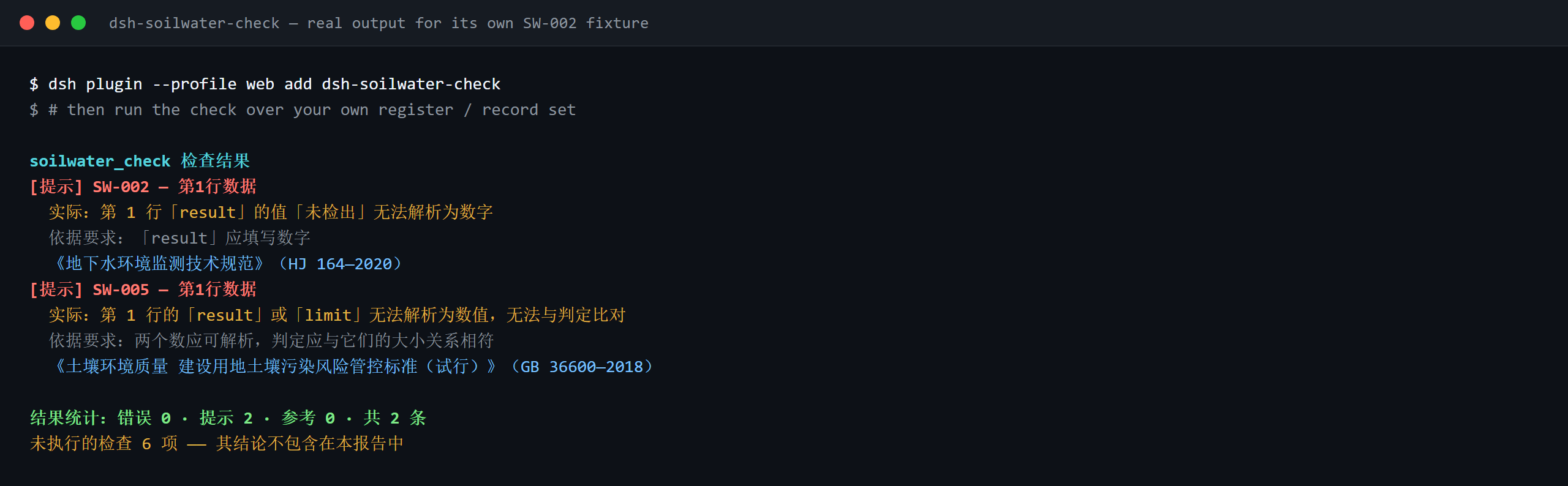
Real output from this plugin over its own SW-002 test fixture — not a mock-up. The rule pack ships no invented quotations, so a finding names both the clause it applied and the fact that the clause text was not obtained.
What it answers
| You ask | What it answers |
|---|---|
| The register's verdict says 达标, but the result is higher than the limit written beside it. Is that caught? | Yes. SW-005 compares the result with the limit the register itself records and reports the row when the verdict disagrees with that comparison. It ships no limits of its own, so it cannot find a limit taken from the wrong standard or the wrong land-use category, and a verdict outside its configured over/at-most lists is reported separately. |
The result cell reads 未检出 or <0.01, because the value is below the detection limit. What does the check do? |
SW-002 reports it. The rule reads only the numeric part of a cell (0.85 and 1.2×10⁻³ are accepted), so detection-limit notation is reported as unparseable on purpose — record the value and put the remark in another column, or disable the rule. It checks parseability, not whether the figure is true or the method correct. |
One row leaves the standard column empty. |
SW-004 requires the standard to be filled on every row that carries that column. It checks that a standard is written, not that it is the one that applies: whether the recorded standard matches the land use and the medium is a substantive question the plugin leaves to the reader. |
A row records a sampling date later than the check date, and another row writes the date as 2026/3/15. |
SW-003 reports a sampledAt later than the check date. It reads 2026-03-15 and 2026-03-15 09:30; any other form is reported as unparseable rather than silently skipped. The rule only compares the date — it does not judge whether the data is reliable. |
The same labNo appears on two rows, because one sample was analysed for several parameters. |
SW-006 reports a repeated sample number, because a repeat breaks the link between the laboratory report and the register; comparison ignores whitespace. Several parameters of one sample sharing one sample number is the intended shape — keep them on separate rows, but do not reuse the row-number column. With no sample-number column at all, the rule reports itself in skipped instead of passing silently. |
The parameter cell still reads 待填 or 【】, because the register was copied from the template. |
SW-008 reports the leftover placeholder in the parameter column (【, 】, {{, XXX, 待填, TBD, 示例 and similar terms, editable in the pack). Note that SW-001 asks only that the point name or the parameter be filled, so a placeholder counts as filled there; the placeholder rule is what catches it. Neither rule judges whether the factor is the right one to monitor. |
Standards it follows
| Document | Number | Cited by rules |
|---|---|---|
| 《建设用地土壤污染状况调查技术导则》 | HJ 25.1—2019(代替 HJ 25.1-2014;条号本次未取得) | SW-001, SW-003, SW-007, SW-008 |
| 《地下水环境监测技术规范》 | HJ 164—2020(代替 HJ/T 164—2004;2020-12-01 发布、2021-03-01 实施;条号本次未取得) | SW-002, SW-006 |
| 《土壤环境质量 建设用地土壤污染风险管控标准(试行)》 | GB 36600—2018(本次未取得条文) | SW-004, SW-005 |
Boundary: this plugin checks a 土壤与地下水监测台账 for completeness and arithmetic — that each record names its point and parameter, that the result parses as a number, that the sampling date is not in the future, that an applicable standard is recorded, that the exceedance verdict agrees with how the result compares to the limit the register states, that sample numbers are unique, that the register names its project and survey phase, and that no placeholder survives. It does not decide whether a site is contaminated, whether remediation is needed, whether remediation targets were met, or whether a survey's conclusions hold.
⚠️ What this plugin deliberately cannot do
It ships no limits, and it does not check that the limit was taken from the right standard.
SW-005compares the measured result against the limit the register itself records and checks that the verdict agrees. So it cannot find the consequential error: a screening value taken from the wrong standard or the wrong land-use category. Deciding between GB 36600's first and second category screening values, or between GB 36600 and GB/T 14848, turns on the land use and the medium — this plugin reads neither. That limit is stated in the pack's header, inSW-004's andSW-005's notes, and in the troubleshooting section.
SW-002requires a parseable number, so a register that writes detection-limit notation (未检出,<0.01) is reported as unparseable on purpose — record the value with a remark, or disable the rule.Every
excerptin the rule pack says, in so many words, that the clause text was not obtained. The regime lives in GB 36600—2018, GB/T 14848—2017, HJ 25.1 and HJ 164. The verification pass could not retrieve verbatim clause text, so the pack states the gap in theexcerptfield itself and keeps every rule atwarnorinfo. When the texts are in hand, replace eachexcerptwith the real clause and raisekindtodirect.
Compatibility
| Surface | Status |
|---|---|
| Harness | Peer range >=0.1.2-rc.1 <0.2.0 || >=0.2.0-0 <0.3.0 — verified to accept both 0.2.0-rc.2 and 0.2.1-alpha.1. engines.dsh is deliberately not declared: it has no reader and cannot reject a host |
| Node | `^22.19.0 |
| Platforms | All (plain ESM; no native code, no network, no model call) |
| Tool mode | Works in native, ptc and both; for a full sampling round use ptc |
What it does
Registers the soilwater_check tool. It reads one monitoring register — the project header plus one row per
point-and-parameter — applies a versioned rule pack, and returns a report.
| Rule | Check | Severity | Basis kind |
|---|---|---|---|
SW-001 |
the point and the parameter are recorded | warn | principle |
SW-002 |
the result parses as a number | warn | principle |
SW-003 |
the sampling date is not in the future | warn | principle |
SW-004 |
an applicable standard is recorded | warn | principle |
SW-005 |
the verdict agrees with the result and the limit | warn | principle |
SW-006 |
sample numbers are unique | warn | principle |
SW-007 |
the register names its project and survey phase | warn | principle |
SW-008 |
the parameter column holds no unreplaced placeholder | warn | principle |
Install
dsh plugin --profile <name> add dsh-soilwater-check
dsh --profile <name> --dump-config | grep 'dsh-soilwater-check'
Configuration
| Key | Type | Default | Description |
|---|---|---|---|
rulesFile |
string | rules/soilwater-check.yaml |
Rule-pack path, relative to the package root |
disabledRules |
string[] | [] |
Rule ids to stop running; each appears in skipped |
onlyRules |
string[] | [] |
Run only these rule ids; empty runs every rule |
skipNotes |
string | "" |
Note appended to every skipped reason |
timeoutMs |
number | 120000 |
Cooperative tool timeout budget |
Rule-level parameters worth knowing:
SW-005valueField/limitField/verdictField/overValues/atMostValues/tolerance— the three columns and the two verdict vocabularies, defaulting to[超标, 是, Y, yes, true, 超出, 不合格]and[达标, 否, N, no, false, 未超标, 合格]. A verdict outside both lists is reported so a new wording cannot slip through unnoticed.SW-008terms— the placeholders to look for.
Material format
The tool accepts JSON or YAML:
project: 某某场地调查
phase: 初步调查
rows:
  - { 序号: '1', 点位名称: S1 表层土, 介质: 土壤, 采样日期: 2026-03-05,
      样品编号: TR-2026-0018, 监测项目: 砷, 监测结果: '12.5', 单位: mg/kg,
      执行标准: GB 36600—2018 第二类用地筛选值, 标准限值: '60', 超标情况: 达标 }
Column names are matched case-insensitively and ignoring spaces, underscores and hyphens; the register's own column names are kept, so a finding names the column it read. Results may carry a unit; a detection-limit notation is reported as unparseable on purpose.
Rule sources
Rule data lives in rules/soilwater-check.yaml. The pack's header states the citation gap in full, and each
rule's note repeats the part that matters for that rule. The load-time guard that normally enforces "an
excerpt must be a real quotation of at least eight characters" cannot tell a quotation from a description —
so this pack leans on the header, the per-rule notes and a test that asserts every excerpt admits the gap.
Troubleshooting
SW-005passed a limit I know is wrong. It compares against the limit the register states. Whether that limit belongs to the right standard and land-use category is a substantive question it does not touch.SW-005fires on a result that equals its limit. Equality counts as not exceeding; if your rule treats "equal to the screening value" as exceeding, raisetoleranceslightly below zero or adjust the data.SW-002fires on未检出. Detection-limit notation is not a number. Record a value with a remark, or disable the rule.SW-006fires on several rows for one sample. Different parameters of one sample legitimately share a sample number — the rule keys on the sample number column, so do not reuse the row-number column for it.- The plugin installs but the tool never appears. Check that
mainresolves tolib/index.mjsand thatpnpm run buildproduced it; a wrongmainmakes the loader skip the entry silently. dsh plugin addrefuses the package as incompatible. The peer range covers0.1.xand0.2.x; if your runtime sits outside it, grant an explicit exemption:dsh plugin --profile <name> allow-version dsh-soilwater-check@0.1.0 --dsh-version <runtime> --accept-riskcheckreportsmanifest-peersas failed. The static checker compares against a hard-coded peer range that predates the 0.2 line. The runtime enforces peer compatibility at install time, so the declared range is the correct one; this is a known upstream issue indsh-plugin-dev.
Development
pnpm install
pnpm run typecheck   # tsc --noEmit
pnpm test            # vitest, the shared table-plugin suite plus paired fixtures
pnpm run build       # tsdown -> lib/index.mjs + lib/index.d.mts
node ../scripts/sync-shared.mjs dsh-soilwater-check   # refresh src/shared from ../_shared
The plugin is data-only: src/model.ts declares the table shape, the shared kit supplies the reader and
the check engine, and the rule pack declares every check.
License
Apache License 2.0 © 2026 dsh-soilwater-check contributors.
No comments yet. Be the first to write one.