dsh-review-reply-check — Review comment response table coverage and paper-trail check

dsh-review-reply-check reads one review-comment response table — the manuscript header plus one row per comment — and checks that table's own coverage and paper trail: that each comment's text is recorded, that every row carrying a comment also carries an author response, that a response states the revision made and where it was made, that each handling status comes from the vocabulary you configure, that response dates fall inside the revision deadline the table itself states, that the table header declares its manuscript and review round, and that comment numbers are not repeated.
What it looks like
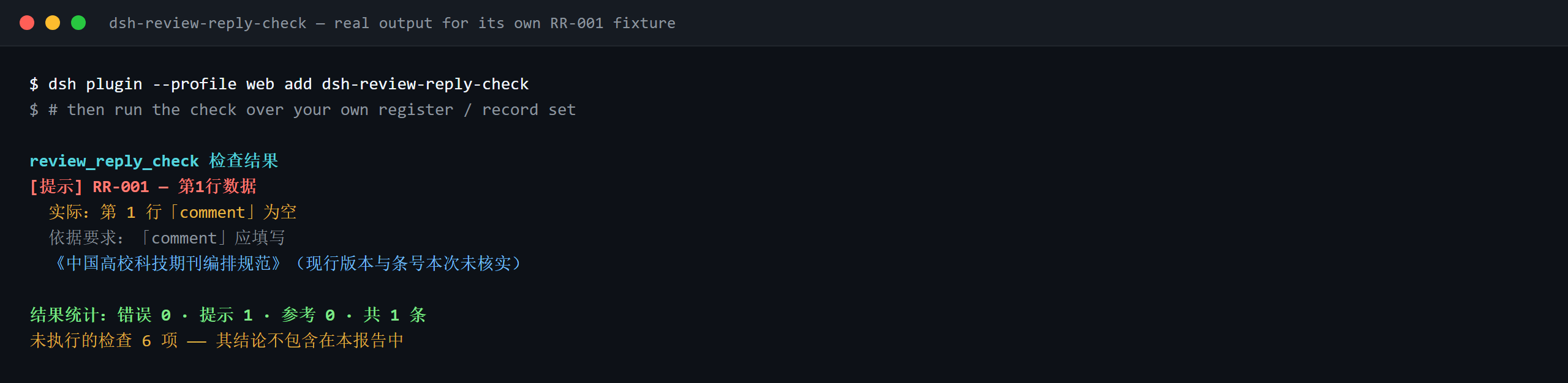
Real output from this plugin over its own RR-001 test fixture — not a mock-up. The rule pack ships no invented quotations, so a finding names both the clause it applied and the fact that the clause text was not obtained.
What it answers
| You ask | What it answers |
|---|---|
| A row carries an author response but the cell holding the comment text is empty. | RR-001 requires the comment text on every row: without it the response has no object, and the editor cannot see which comment it answers. The rule checks only that the cell is filled — it does not judge whether the comment holds or whether it is a matter of academic disagreement. |
| A comment is recorded but the author response cell is still empty — is that reported? | Yes. RR-002 requires a response on every row whose comment cell is filled, because a comment passed over in silence is not the same as a disagreement a reviewer can weigh. It checks only that the response cell is filled, not whether the response is adequate or convincing; when a comment genuinely needs no change, the pack advises writing the reason in that cell rather than leaving it blank. |
| The response says the text was revised, but the revision note and the location column are blank. | RR-003 requires both revision and revisionLocation on every row whose response is filled. It checks that the two cells are written, not that the change is where they say it is — the plugin never sees the manuscript, so a precisely located revision note describing a change that was never made still passes. |
| Every row has a handling status filled in. How does the tool decide whether the value is acceptable? | RR-004 compares the value in the status column against the list you configure. That list ships empty, meaning not configured, so until you fill it in the rule reports itself in skipped rather than passing silently. It checks only that the value is on your list; it does not decide whether a given status means the comment was properly handled. As an institutional-configuration rule it is capped at info. |
| The response date is later than the deadline column — does that mean the revision was overdue? | RR-005 compares respondedAt against the dueAt the table itself writes, and a hit means only that the two disagree with the deadline you recorded — not that the revision was late, since periods differ by journal and authors may ask for extensions. No number of days is built in and nothing is inferred for you: when dueAt is empty the rule reports itself in skipped instead of assuming a deadline. |
| Two reviewers' comments were merged into one sheet and both number from 1, so a comment number appears twice. | RR-007 reports a repeated value in commentNo, because a duplicate makes the coverage count wrong and breaks the correspondence with the review form. Registering merged comments under a numbering that carries the reviewer — R1-3, R2-1 — keeps them unique; the rule compares the numbers as written and does not merge or renumber anything. |
Standards it follows
| Document | Number | Cited by rules |
|---|---|---|
| 《中国高校科技期刊编排规范》 | 现行版本与条号本次未核实 | RR-001, RR-002, RR-003, RR-006, RR-007 |
| 本期刊同行评议与返修规定(本机构配置) | 无统一标准(本条依据为本机构配置的状态口径) | RR-004 |
| 本期刊同行评议与返修规定(本机构配置) | 无统一标准(本条依据为台账写明的返修期限) | RR-005 |
Boundary: this plugin checks a 审稿意见逐条回应表 for coverage and evidence — that every comment is recorded, that every comment carries an author response, that a response states the revision made and where it was made, that the handling status comes from your vocabulary, that response dates fall inside the revision deadline the register states, that the sheet names its manuscript and review round, and that comment numbers are unique. It does not decide whether a response is adequate, whether the revision is sufficient, or whether the manuscript should be accepted.
⚠️ What this plugin can and cannot see
It never sees the manuscript. It can check that a response says where a change was made — never that the change is there, and never that it addresses the comment.
RR-003's note and the troubleshooting section say so: a confident, well-located, entirely fictional revision note passes this plugin.The relation between "no response" and "disagreement" is the point of
RR-002: a reviewer can accept an author's disagreement but not a comment passed over in silence, so coverage is the most direct indicator of revision quality. The rule therefore fires on an empty response cell — and its note advises recording the reason rather than leaving the cell blank when a comment genuinely needs no change.No revision deadline is built in. Periods differ by journal and authors may ask for extensions, so
RR-005compares the response date against the deadline written in the register, and reports itself inskippedwhen that column is empty. A finding means "this disagrees with the deadline you recorded", never "you were late". The status vocabulary ships empty for the same reason.Every
excerptin the rule pack says, in so many words, that the clause text was not obtained. The regime lives in GB/T 7713.1, the Chinese university journal editing standard, and each journal's peer-review rules. The verification pass could not retrieve verbatim clause text, so the pack states the gap in theexcerptfield itself and keeps every rule atwarnorinfo. When the texts are in hand, replace eachexcerptwith the real clause and raisekindtodirect.
Compatibility
| Surface | Status |
|---|---|
| Harness | Peer range >=0.1.2-rc.1 <0.2.0 || >=0.2.0-0 <0.3.0 — verified to accept both 0.2.0-rc.2 and 0.2.1-alpha.1. engines.dsh is deliberately not declared: it has no reader and cannot reject a host |
| Node | `^22.19.0 |
| Platforms | All (plain ESM; no native code, no network, no model call) |
| Tool mode | Works in native, ptc and both; for a full response letter use ptc |
What it does
Registers the review_reply_check tool. It reads one response table — the manuscript header plus one row per
comment — applies a versioned rule pack, and returns a report.
| Rule | Check | Severity | Basis kind |
|---|---|---|---|
RR-001 |
the comment text is recorded | warn | principle |
RR-002 |
every comment carries a response | warn | principle |
RR-003 |
a response states the revision and its location | warn | principle |
RR-004 |
the status comes from your vocabulary (off by default) | info | local |
RR-005 |
the response date falls inside the recorded deadline | info | local |
RR-006 |
the sheet names its manuscript and round | warn | principle |
RR-007 |
comment numbers are unique | warn | principle |
Install
dsh plugin --profile <name> add dsh-review-reply-check
dsh --profile <name> --dump-config | grep 'dsh-review-reply-check'
Configuration
| Key | Type | Default | Description |
|---|---|---|---|
rulesFile |
string | rules/review-reply-check.yaml |
Rule-pack path, relative to the package root |
disabledRules |
string[] | [] |
Rule ids to stop running; each appears in skipped |
onlyRules |
string[] | [] |
Run only these rule ids; empty runs every rule |
skipNotes |
string | "" |
Note appended to every skipped reason |
timeoutMs |
number | 120000 |
Cooperative tool timeout budget |
Rule-level parameters worth knowing:
RR-004values— your status vocabulary, e.g.[已修改, 部分修改, 不修改并说明理由, 已删除]. Empty means no check.RR-005reads the register's 返修期限 /dueAtcolumn. The plugin never derives a deadline from a day count.RR-002andRR-003useconditionField/requiredFields— what triggers each requirement.RR-007keys on the comment-number column. When several reviewers' comments are merged, number them per reviewer (R1-3,R2-1) so the rule can tell them apart.
Material format
The tool accepts JSON or YAML:
manuscriptNo: XYZ-2026-0186
title: 某某研究
journal: 某某学报
round: 第 1 轮
dueAt: 2026-05-10
rows:
  - { 序号: R1-1, 审稿人: 审稿人一, 意见类型: 方法, 指向位置: 第 3 节 3.2,
      审稿意见: 3.2 节的样本量未说明估算依据,请补充。,
      作者回应: 同意补充。已在 3.2 节末增加样本量估算说明,并引用既往研究作为依据。,
      修改说明: 新增一段样本量估算依据,引用两项既往研究并给出效应量假设。,
      修改位置: 第 8 页第 12—18 行(修订稿 3.2 节末),
      处理状态: 已修改, 回应人: 通讯作者, 回应日期: 2026-05-06 }
Column names are matched case-insensitively and ignoring spaces, underscores and hyphens; the table's own column names are kept, so a finding names the column it read.
Rule sources
Rule data lives in rules/review-reply-check.yaml. The pack's header states the citation gap in full, and each
rule's note repeats the part that matters for that rule. The load-time guard that normally enforces "an excerpt
must be a real quotation of at least eight characters" cannot tell a quotation from a description — so this pack
leans on the header, the per-rule notes and a test that asserts every excerpt admits the gap.
Troubleshooting
RR-003passed a revision note describing a change that was never made. It checks that a location is stated, never that the change is there. Comparing needs the manuscript, which the plugin does not see.RR-002fires on a comment I chose not to act on. Record the reason in the response cell. A reviewer can accept a reasoned disagreement; a blank cell reads as "not addressed".RR-005reports itself as skipped. The register records no revision deadline, and the plugin will not invent one.RR-004never runs. Its vocabulary is empty; fill it with your journal's statuses.RR-007fires on comments from different reviewers. Number them per reviewer so the merged table stays unambiguous.- The plugin installs but the tool never appears. Check that
mainresolves tolib/index.mjsand thatpnpm run buildproduced it; a wrongmainmakes the loader skip the entry silently. dsh plugin addrefuses the package as incompatible. The peer range covers0.1.xand0.2.x; if your runtime sits outside it, grant an explicit exemption:dsh plugin --profile <name> allow-version dsh-review-reply-check@0.1.0 --dsh-version <runtime> --accept-riskcheckreportsmanifest-peersas failed. The static checker compares against a hard-coded peer range that predates the 0.2 line. The runtime enforces peer compatibility at install time, so the declared range is the correct one; this is a known upstream issue indsh-plugin-dev.
Development
pnpm install
pnpm run typecheck   # tsc --noEmit
pnpm test            # vitest, the shared table-plugin suite plus paired fixtures
pnpm run build       # tsdown -> lib/index.mjs + lib/index.d.mts
node ../scripts/sync-shared.mjs dsh-review-reply-check   # refresh src/shared from ../_shared
The plugin is data-only: src/model.ts declares the table shape, the shared kit supplies the reader and the
check engine, and the rule pack declares every check.
License
Apache License 2.0 © 2026 dsh-review-reply-check contributors.
No comments yet. Be the first to write one.