dsh-protest-deadline — Query and complaint register date and deadline check

dsh-protest-deadline reads one query-and-complaint register (质疑与投诉台账) — the project header plus one row per query — and checks what such a register can be held to mechanically: that the date the query was raised or the date it was answered is recorded, that the dates parse and follow one another, that the reply falls inside the deadline the register itself states, that every status comes from your own vocabulary, that the query numbers are unique, and that the header names the procurement project.
What it looks like
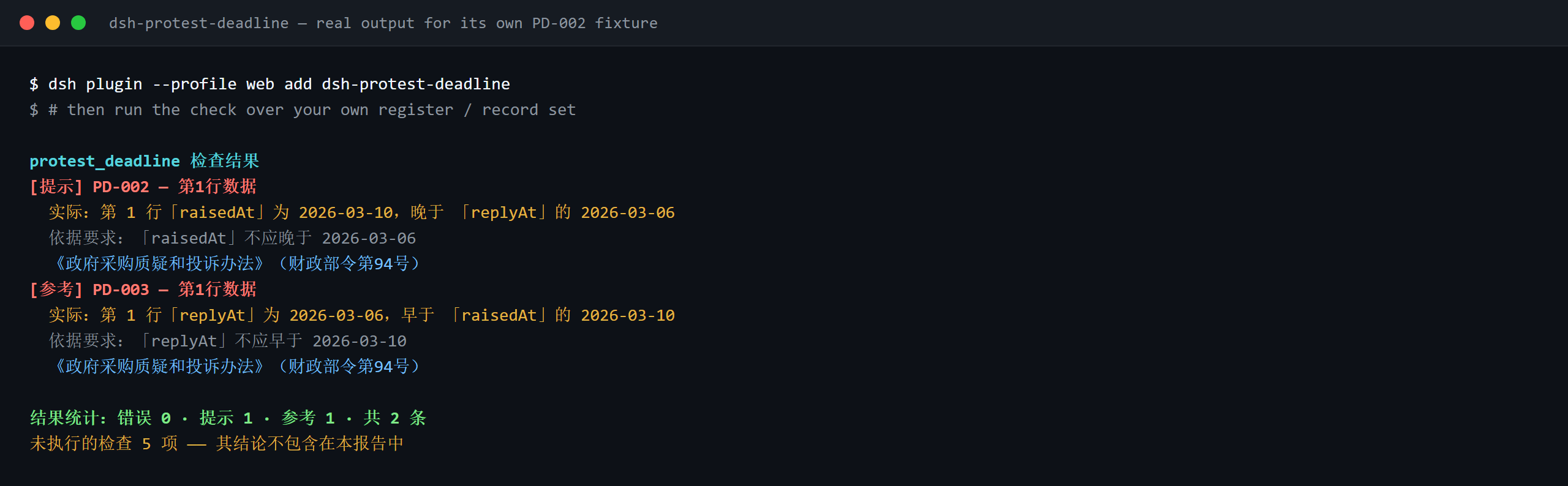
Real output from this plugin over its own PD-002 test fixture — not a mock-up. The rule pack ships no invented quotations, so a finding names both the clause it applied and the fact that the clause text was not obtained.
What it answers
| You ask | What it answers |
|---|---|
| A row leaves both the date the query was raised and the date it was answered blank. Is that reported? | Yes. PD-001 requires at least one of raisedAt and replyAt on every row and reports the row where both are empty. It checks only that one of the two is filled, not whether the query was raised inside the legal period: that needs the date the supplier knew of the harm, the service date and a working-day count a register usually does not carry. |
| The reply date is written earlier than the raise date. Is that caught? | PD-002 compares the raise date with the reply date row by row and reports raisedAt when it is later than replyAt; the same day counts as not later. A value it cannot parse — 2026年3月15日, say, where 2026-03-15, 2026/3/15 or 2026-03-15 09:30 would be read — is reported on that row instead of being passed over quietly. The rule only orders the two dates the register carries. |
| Our reply went out after the reply deadline recorded in the register. Was it late? | PD-003 hard-codes no day count and cannot say “late”: it compares the actual reply date with the deadline written in the register's own replyDueAt column, so a finding means “this disagrees with the deadline you recorded”. With that column empty there is nothing to compare against and the rule reports itself in skipped, rather than assuming a period. |
| The status column says 已答复, yet nothing came back for it. Why? | PD-005 compares the status with the vocabulary you configure, and values ships empty, so as delivered the rule reports itself in skipped — the choice of values belongs to your institution, not to the engine — instead of passing silently. Fill values with your own list (待答复, 已答复, 已投诉, 已撤回, …) and any value not on it is reported row by row. It checks that the value is on the list, never how the query should be handled. |
| The header names the project but carries no header-level raise date. Is something missing? | No. PD-006 checks the header for the procurement project only: its fields default to [project], because the raise date is normally a per-row column. If your form does state it in the header, the rule's own note says to set fields to [project, raisedAt]. A missing project is reported against the header, not against a row. |
| The same query number appears on two rows. | PD-007 reports the second row and names the first, comparing the numbers with whitespace ignored. A repeat usually means the same query was registered twice or a number was copied — telling those apart is a human call. If the register carries no number column, the rule reports that it does not apply rather than passing. |
Standards it follows
| Document | Number | Cited by rules |
|---|---|---|
| 《政府采购质疑和投诉办法》 | 财政部令第94号(2017 年 12 月 26 日公布,自 2018 年 3 月 1 日起施行;六章四十五条。⚠️ 本令第四十五条同时废止财政部令第20号《政府采购供应商投诉处理办法》) | PD-001, PD-002, PD-003, PD-004, PD-005, PD-006, PD-007 |
Boundary: this plugin checks a 质疑与投诉台账 for what a register can be held to mechanically — that the key dates are recorded, that they parse and follow one another, that a reply falls inside the deadline the register itself states, that statuses come from your vocabulary, and that query numbers are unique. It does not decide whether a query was filed in time, whether it should be accepted, or whether it should be rejected. Those calls need the purchaser or the finance department, the service dates, and a working-day basis that a ledger usually does not record.
⚠️ What the citation rests on
《政府采购质疑和投诉办法》(财政部令第94号) was obtained and read verbatim — the whole text, six chapters and forty-five articles — and
rules/evidence/clause-verification.mdrecords what was quoted: article 10 (question within 7 working days), article 13 (reply within 7 working days), article 17 (complaint within 15 working days after the reply period expires), article 21 (5 and 8 working days), article 26 (30 working days) and article 42, which fixes two calculation rules — 「期间开始之日, 不计算在期间内」 and a roll-over when the final day is a holiday. Article 45 also repealed 财政部令第20号, so this pack never cites it.The rule
excerptfields still say "本次未取得", and every rule remainswarnorinfo. What this plugin checks is an internal register's dates and columns; the measure governs how purchasers and finance departments behave. Calling a blank column adirectbreach of "shall reply within 7 working days" would dress a record-keeping gap up as a regulatory one. The government procurement law itself was not obtained.This plugin hard-codes no day count, and the text now proves why. The periods run in working days, article 42 excludes the opening day from the count and rolls the deadline forward off a holiday, and article 17 starts the complaint clock from the expiry of the reply period rather than the reply date — while a register usually records calendar dates only. So
PD-003compares the actual reply date against the deadline written in the register's own答复期限column, and with that column empty it reports itself inskipped. Its finding says "this disagrees with the deadline you recorded", not "the reply is late".
Compatibility
| Surface | Status |
|---|---|
| Harness | Peer range >=0.1.2-rc.1 <0.2.0 || >=0.2.0-0 <0.3.0 — verified to accept both 0.2.0-rc.2 and 0.2.1-alpha.1. engines.dsh is deliberately not declared: it has no reader and cannot reject a host |
| Node | `^22.19.0 |
| Platforms | All (plain ESM; no native code, no network, no model call) |
| Tool mode | Works in native, ptc and both; for a year's register use ptc |
What it does
Registers the protest_deadline tool. It reads one query-and-complaint register — the project header plus one
row per query — applies a versioned rule pack, and returns a report.
| Rule | Check | Severity | Basis kind |
|---|---|---|---|
PD-001 |
a raise date or a reply date is recorded | warn | direct |
PD-002 |
the reply date is not earlier than the raise date | warn | direct |
PD-003 |
the reply falls inside the recorded deadline | info | local |
PD-004 |
the complaint date is not earlier than the reply date | warn | direct |
PD-005 |
the status comes from your vocabulary (off by default) | info | local |
PD-006 |
the register names its procurement project | warn | principle |
PD-007 |
query numbers are unique in the register | warn | principle |
Install
dsh plugin --profile <name> add dsh-protest-deadline
dsh --profile <name> --dump-config | grep 'dsh-protest-deadline'
Configuration
| Key | Type | Default | Description |
|---|---|---|---|
rulesFile |
string | rules/protest-deadline.yaml |
Rule-pack path, relative to the package root |
disabledRules |
string[] | [] |
Rule ids to stop running; each appears in skipped |
onlyRules |
string[] | [] |
Run only these rule ids; empty runs every rule |
skipNotes |
string | "" |
Note appended to every skipped reason |
timeoutMs |
number | 120000 |
Cooperative tool timeout budget |
Rule-level parameters worth knowing:
PD-003reads the register's答复期限/replyDueAtcolumn. Compute that deadline under 财政部令第94号 (working days) and write it into the ledger; the plugin will not derive it.PD-005values— your status vocabulary, e.g.[待答复, 已答复, 已投诉, 已处理完毕, 已撤回].PD-002andPD-004compare date pairs; to also check the reply-to-complaint direction, add a second rule withfield: replyAtandnotAfterField: complaintAt.
Material format
The tool accepts JSON or YAML:
project: 某某设备采购项目
projectNo: ZC-2026-018
agency: 某某采购代理机构
rows:
  - { 序号: ZY-2026-001, 质疑人: 某某科技有限公司, 质疑提出日期: 2026-03-02,
      答复期限: 2026-03-09, 实际答复日期: 2026-03-06, 投诉日期: 2026-03-12, 处理状态: 已答复 }
Column names are matched case-insensitively and ignoring spaces, underscores and hyphens; the register's own
column names are kept, so a finding names the column it read. Dates may be 2026-03-02 or
2026-03-02 09:30.
Rule sources
Rule data lives in rules/protest-deadline.yaml. The pack's header states the citation gap in full, and each
rule's note repeats the part that matters for that rule. The load-time guard that normally enforces "an
excerpt must be a real quotation of at least eight characters" cannot tell a quotation from a description —
so this pack leans on the header, the per-rule notes and a test that asserts every excerpt admits the gap.
Troubleshooting
PD-003reports itself as skipped. The register records no reply deadline. That is deliberate: the statutory period is counted in working days and the plugin will not convert calendar dates into it.PD-003fires but I consider the reply timely. The register's答复期限disagrees with the actual reply date. Either the deadline column was computed wrongly or the reply date is wrong.PD-005never runs. Its vocabulary is empty; fill it with your register's status values.PD-002fires on dates I can read. The reader accepts2026-03-02and2026-03-02 09:30;2026年3月2日is reported as unparseable on purpose.- The plugin installs but the tool never appears. Check that
mainresolves tolib/index.mjsand thatpnpm run buildproduced it; a wrongmainmakes the loader skip the entry silently. dsh plugin addrefuses the package as incompatible. The peer range covers0.1.xand0.2.x; if your runtime sits outside it, grant an explicit exemption:dsh plugin --profile <name> allow-version dsh-protest-deadline@0.1.0 --dsh-version <runtime> --accept-riskcheckreportsmanifest-peersas failed. The static checker compares against a hard-coded peer range that predates the 0.2 line. The runtime enforces peer compatibility at install time, so the declared range is the correct one; this is a known upstream issue indsh-plugin-dev.
Development
pnpm install
pnpm run typecheck   # tsc --noEmit
pnpm test            # vitest, the shared table-plugin suite plus paired fixtures
pnpm run build       # tsdown -> lib/index.mjs + lib/index.d.mts
node ../scripts/sync-shared.mjs dsh-protest-deadline   # refresh src/shared from ../_shared
The plugin is data-only: src/model.ts declares the table shape, the shared kit supplies the reader and
the check engine, and the rule pack declares every check.
License
Apache License 2.0 © 2026 dsh-protest-deadline contributors.
No comments yet. Be the first to write one.