dsh-pleading-draft — Pleading element checklist completeness check, one row per claim

dsh-pleading-draft reads one pleading-element checklist — the case header plus one row per claim, with its 序号、诉讼请求、事实依据、证据、法律依据、金额、期限 columns — and checks that document's own completeness and internal consistency: that every claim records a factual basis, points at evidence and states a legal basis, that a claim carrying an amount also carries a performance deadline, that the header names the plaintiff and the defendant, that no element number is repeated, and that no unreplaced placeholder survives in the claim column.
What it looks like
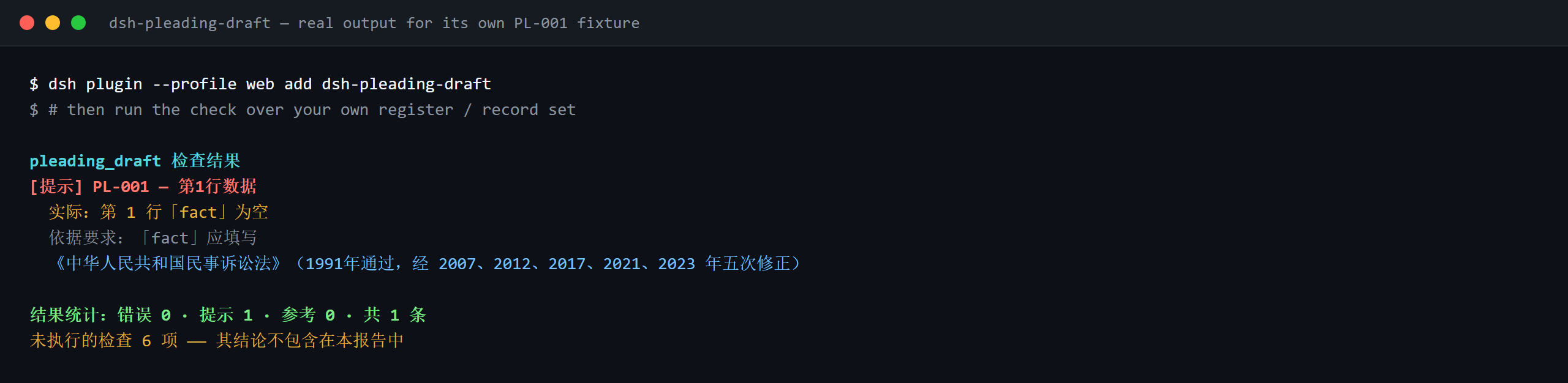
Real output from this plugin over its own PL-001 test fixture — not a mock-up. The rule pack ships no invented quotations, so a finding names both the clause it applied and the fact that the clause text was not obtained.
What it answers
| You ask | What it answers |
|---|---|
| The claim is written out, but the evidence column points at nothing. | PL-002 reports the row whose 证据 column does not point at evidence — it checks that a reference is written, not that the evidence exists, is complete or bears on that particular claim. |
| The legal-basis column holds only a general phrase such as “relevant provisions”. | PL-003 requires the 法律依据 column to be filled on every claim element. It reports an empty column; it does not verify that the provision cited exists, is in force or applies to the case. |
| The amount is stated, but no performance deadline is recorded. | PL-004 fires only when the 金额 column is filled, and then requires the 期限 column: an amount without a deadline is reported. A claim for a declaration is not asked for a deadline it does not have. Whether the amount is computed correctly or the deadline is reasonable is not checked. |
| Which fields must the case header carry? | PL-005 requires the header to name the plaintiff and the defendant; both are configuration fields, so your own form can add the cause of action and the accepting court. It does not check that the parties are the right ones for that claim. |
| What happens when the claim column still holds a template placeholder? | PL-007 reports it: the terms it looks for are 【, 】, {{, }}, XXX, xxx, 待填, 待补充, TBD, todo and 示例. A vague claim with none of those terms passes, because judging the required precision of a claim is a legal judgement. |
A rule appears in skipped instead of reporting anything. Does that mean it passed? |
No. skipped names a check that did not run: PL-002, for instance, is listed there when it was disabled in configuration, left out by the only selection, or when the material met its precondition and no difference was found. A check that does not run cannot clear a column, and its own limit stands: it never sees whether the evidence suffices or corresponds to the claim. |
Standards it follows
| Document | Number | Cited by rules |
|---|---|---|
| 《中华人民共和国民事诉讼法》 | 1991年通过,经 2007、2012、2017、2021、2023 年五次修正(现行条号据 2021 年第四次修正及 2023 年第五次修正文本核对) | PL-001, PL-002, PL-003, PL-004, PL-005, PL-006, PL-007 |
Boundary: this plugin checks a 起诉状(或申请书)要素核对表 for completeness — that every claim records its factual basis, points at evidence, states its legal basis, that a monetary claim states an amount and a performance deadline, that the document names both parties, that element numbers are unique, and that no placeholder survives. It does not decide whether a claim will succeed, whether it is time-barred, whether jurisdiction is right, whether the evidence suffices, or whether the case should be accepted. Those are the court's determinations and the advocate's substantive judgement.
⚠️ What this plugin can and cannot do
It reads a checklist, not the pleadings, the evidence or the statutes. So it can only check that a column points at evidence or names a provision — never that the evidence suffices or that the provision exists, is in force, or applies.
PL-002andPL-003say so in their own notes. Test the plugin against a pleading whose cited article was repealed: it will pass, because looking up statutes is a different job and one this plugin deliberately does not do.The rule pack states its citation status rule by rule. 4 of its 7 rules quote verbatim clause text and are marked
direct; the remaining 3 state in theexcerptfield itself that the text was not obtained, and stay atwarnorinfo. Where a rule still carries that note, treat it as a lead rather than as a citation. The regime lives in 《中华人民共和国民事诉讼法》(notably its article on what a statement of claim must record) and the Supreme People's Court's interpretation of it. For the rules whose text the verification pass could not retrieve, the pack states the gap in theexcerptfield itself rather than paraphrasing it, and those rules stay atwarnorinfo. When the texts are in hand, replace eachexcerptwith the real clause and raisekindtodirect.
PL-004fires only when an amount column is filled, so a claim for a declaration or for a change of legal relation is not asked for a performance deadline it does not have. AndPL-007catches placeholders only: a claim that is vague without containing【】or待填will pass, because judging whether a claim is stated with the required precision is a legal judgement.
Compatibility
| Surface | Status |
|---|---|
| Harness | Peer range >=0.1.2-rc.1 <0.2.0 || >=0.2.0-0 <0.3.0 — verified to accept both 0.2.0-rc.2 and 0.2.1-alpha.1. engines.dsh is deliberately not declared: it has no reader and cannot reject a host |
| Node | `^22.19.0 |
| Platforms | All (plain ESM; no native code, no network, no model call) |
| Tool mode | Works in native, ptc and both; for several claims use ptc |
What it does
Registers the pleading_draft tool. It reads one pleading-element checklist — the case header plus one row per
claim — applies a versioned rule pack, and returns a report.
| Rule | Check | Severity | Basis kind |
|---|---|---|---|
PL-001 |
every claim records its factual basis | warn | direct |
PL-002 |
every claim points at evidence | warn | direct |
PL-003 |
every claim states its legal basis | warn | direct |
PL-004 |
a monetary claim states amount and deadline | warn | principle |
PL-005 |
the document names plaintiff and defendant | warn | direct |
PL-006 |
element numbers are unique | warn | principle |
PL-007 |
the claim column holds no unreplaced placeholder | warn | principle |
Install
dsh plugin --profile <name> add dsh-pleading-draft
dsh --profile <name> --dump-config | grep 'dsh-pleading-draft'
Configuration
| Key | Type | Default | Description |
|---|---|---|---|
rulesFile |
string | rules/pleading-draft.yaml |
Rule-pack path, relative to the package root |
disabledRules |
string[] | [] |
Rule ids to stop running; each appears in skipped |
onlyRules |
string[] | [] |
Run only these rule ids; empty runs every rule |
skipNotes |
string | "" |
Note appended to every skipped reason |
timeoutMs |
number | 120000 |
Cooperative tool timeout budget |
Rule-level parameters worth knowing:
PL-004conditionField/requiredFields— which column triggers the deadline requirement; the amount column by default, requiring the performance deadline.PL-005fields— the header fields that must be present; plaintiff and defendant by default. Addcourtandcauseif your checklist records them in the header.PL-007terms— the placeholders to look for.
Material format
The tool accepts JSON or YAML:
caseNo: (2026)某民初 1234 号
court: 某某人民法院
plaintiff: 原告某某公司
defendant: 被告某某公司
cause: 买卖合同纠纷
rows:
  - { 序号: '1', 请求要素: 本金给付请求,
      诉讼请求: 判令被告支付货款本金人民币 1,250,000 元,
      事实依据: 双方于 2025 年 3 月 10 日签订买卖合同,原告已按约交付货物,被告未按期付款,
      证据: 证1、证2、证3, 法律依据: 《中华人民共和国民法典》第五百七十七条,
      金额: '1250000', 期限: 本判决生效之日起十日内 }
Column names are matched case-insensitively and ignoring spaces, underscores and hyphens; the checklist's own column names are kept, so a finding names the column it read.
Rule sources
Rule data lives in rules/pleading-draft.yaml. The pack's header states the citation gap in full, and each
rule's note repeats the part that matters for that rule. The load-time guard that normally enforces "an
excerpt must be a real quotation of at least eight characters" cannot tell a quotation from a description —
so this pack leans on the header, the per-rule notes and a test that asserts every excerpt admits the gap.
Troubleshooting
PL-003passes on a provision I know was repealed. It cannot check that: it verifies that a legal basis is named, not that it exists or applies. Statute lookup is out of scope by design.PL-002passes although the evidence proves nothing. Same reason: it checks that evidence is pointed at, not that it is sufficient.PL-004does not fire on a declaration claim. That is deliberate — the deadline is required only when an amount is stated.PL-007does not fire on a vague claim. It catches placeholders (【】,待填,TBD), not imprecision.- The plugin installs but the tool never appears. Check that
mainresolves tolib/index.mjsand thatpnpm run buildproduced it; a wrongmainmakes the loader skip the entry silently. dsh plugin addrefuses the package as incompatible. The peer range covers0.1.xand0.2.x; if your runtime sits outside it, grant an explicit exemption:dsh plugin --profile <name> allow-version dsh-pleading-draft@0.1.0 --dsh-version <runtime> --accept-riskcheckreportsmanifest-peersas failed. The static checker compares against a hard-coded peer range that predates the 0.2 line. The runtime enforces peer compatibility at install time, so the declared range is the correct one; this is a known upstream issue indsh-plugin-dev.
Development
pnpm install
pnpm run typecheck   # tsc --noEmit
pnpm test            # vitest, the shared table-plugin suite plus paired fixtures
pnpm run build       # tsdown -> lib/index.mjs + lib/index.d.mts
node ../scripts/sync-shared.mjs dsh-pleading-draft   # refresh src/shared from ../_shared
The plugin is data-only: src/model.ts declares the table shape, the shared kit supplies the reader and
the check engine, and the rule pack declares every check.
License
Apache License 2.0 © 2026 dsh-pleading-draft contributors.
No comments yet. Be the first to write one.