dsh-origin-rvc-check — Regional value content check for an origin determination register

dsh-origin-rvc-check reads one origin determination register (原产地判定台账) — the agreement header plus one row per material — and checks that register's own arithmetic: that the agreement and product are declared, that regional value content equals (FOB − non-originating value) ÷ FOB × 100, that RVC meets the threshold you configure, that every material states its origin, that the origin criterion comes from your agreement's vocabulary, that material numbers are unique, and that no unreplaced placeholder survives in the description.
What it looks like
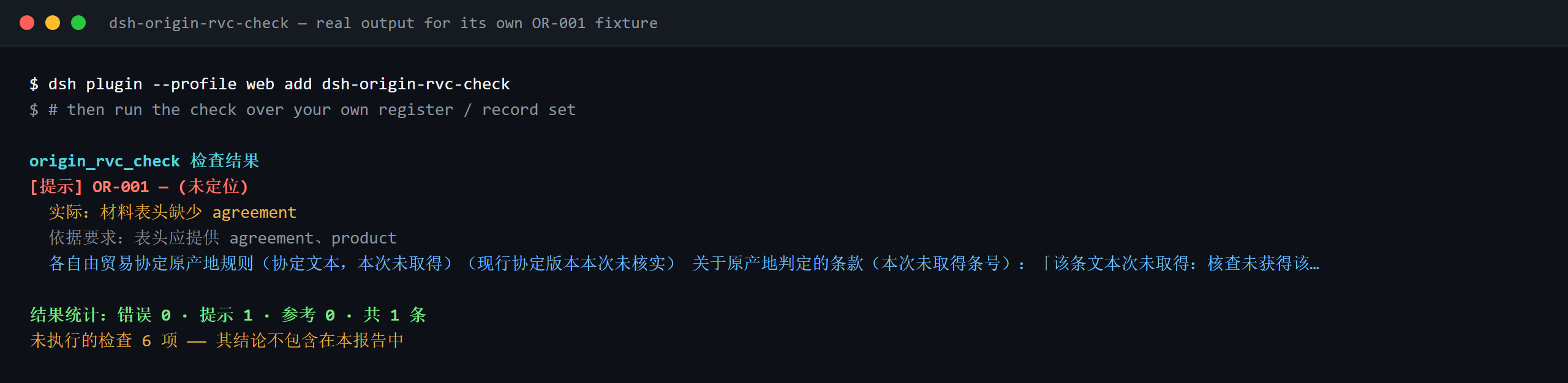
Real output from this plugin over its own OR-001 test fixture — not a mock-up. The rule pack ships no invented quotations, so a finding names both the clause it applied and the fact that the clause text was not obtained.
What it answers
| You ask | What it answers |
|---|---|
The 区域价值成分 column says 70.00, but the row's 净价值 is 220 and the header's FOB is 400. Is that caught? |
Yes. OR-002 recomputes the build-down formula (FOB − non-originating value) ÷ FOB × 100 from the 净价值 column and FOB, with a 0.5-point tolerance, and reports the row when the declared RVC differs. It does only the arithmetic, and it assumes the build-down method: a register filled in by the build-up method is reported although its own convention is right, so change expression or disable the rule. If the RVC, the 净价值 or the FOB cannot be read as a number, the rule reports itself in skipped instead of passing silently. |
| No threshold is set anywhere, and every row passed. Did it check the RVC at all? | No. OR-003 ships with threshold: 0, which means unconfigured, so the rule reports itself in skipped rather than passing silently. Set threshold to your agreement's figure (for example 40) and it reports each row whose RVC falls below it. A finding means only “below the threshold you set” — not that the goods are not originating, because origin can also be earned through wholly-obtained or tariff-classification-change criteria; RVC is only one path. |
| One material row leaves 原产国 blank. | OR-004 reports every row whose 原产国 (origin) column is present but empty. It checks only that the cell is filled, not whether the declared origin is true or whether it affects origin status; when the material carries no origin column at all, the rule reports that it does not apply instead of passing silently. |
| The 原产地标准 column holds a value that is not in my list. | OR-005 compares each value with the pack's values list. That list ships empty — criterion names and abbreviations differ per agreement, so the plugin hard-codes none — and the rule then reports itself in skipped; fill values with your agreement's criteria (完全获得, CTC, RVC, 特定加工工序 …) and any value not on it is reported. It checks only that the value is on the list, not that the goods satisfy that criterion. |
| The same 料件序号 appears on two rows. | OR-006 reports a repeated 料件序号 (itemNo), comparing the values with whitespace ignored. A duplicate double-counts the non-originating material value and therefore corrupts the RVC — this is the kind of defect that leads straight to a wrong conclusion. It reports the repetition; which of the two rows is wrong is not something it decides. |
The 品名 column still reads 【待填】 for one material. |
OR-007 reports a row whose 品名 (description) contains any of the pack's terms — 【, 】, {{, }}, XXX, xxx, 待填, 待补充, TBD, todo, 示例. A register copied from a template looks as if the materials had been counted, and the RVC then rests on a list of materials that does not exist. Only the listed terms are looked for, so a placeholder nobody listed passes; terms follows your own template. |
Standards it follows
This rule pack cites no public standard: the verification pass obtained no verbatim text from any free trade agreement's rules of origin, so every rule's basis says so, each is derived-from-principle and none rises above warn or info. What the checks rest on instead is the register's own arithmetic, plus the RVC threshold and the criterion vocabulary you configure for the agreement that applies.
| Document | Number | Cited by rules |
|---|---|---|
| 各自由贸易协定原产地规则(协定文本,本次未取得) | 现行协定版本本次未核实 | OR-001, OR-002, OR-003, OR-004, OR-005, OR-006, OR-007 |
Boundary: this plugin checks an 原产地判定台账 for arithmetic — that the agreement and product are declared, that regional value content equals (FOB − non-originating value) ÷ FOB × 100, that RVC meets the threshold you configure, that every material states its origin, that the origin criterion comes from your agreement's vocabulary, that material numbers are unique, and that no placeholder survives. It does not decide whether goods qualify as originating, whether a preferential rate applies, whether an origin declaration is valid, or whether origin circumvention occurred.
⚠️ Origin rules are treaty text, and this pack does not pretend to quote one
RVC and the other origin criteria — wholly obtained, change of tariff classification — are set by each free trade agreement's rules of origin. RCEP, ASEAN–China, China–Korea and the rest differ in their thresholds (40%, 30% and other tiers) and in their calculation methods. The verification pass obtained no verbatim text from any agreement, so every rule's
basissays exactly that and stays atwarnorinfo.Three consequences are worth knowing before trusting a finding:
OR-002assumes the build-down method — RVC = (FOB − VNM) ÷ FOB × 100. Some agreements permit the build-up method (regional value ÷ FOB × 100), which yields a different number for the same goods. A register computed that way will report a difference; changeexpressionor disable the rule. The check reads FOB and the net value through a header fallback, so a figure stated once for the whole set is found.OR-003's threshold ships unset. Thresholds vary by agreement and by tariff line, so the plugin hard-codes none. A finding means "below the threshold you set", not "these goods are not originating" — because origin can also be earned through wholly-obtained or tariff-classification-change criteria. RVC is only one path. That distinction matters, and the rule's note states it.OR-005's criterion vocabulary ships empty; criterion names and abbreviations differ per agreement.
Compatibility
| Surface | Status |
|---|---|
| Harness | Peer range >=0.1.2-rc.1 <0.2.0 || >=0.2.0-0 <0.3.0 — verified to accept both 0.2.0-rc.2 and 0.2.1-alpha.1. engines.dsh is deliberately not declared: it has no reader and cannot reject a host |
| Node | `^22.19.0 |
| Platforms | All (plain ESM; no native code, no network, no model call) |
| Tool mode | Works in native, ptc and both; for a full bill of materials use ptc |
What it does
Registers the origin_rvc_check tool. It reads one origin register — the agreement header plus one row per
material — applies a versioned rule pack, and returns a report.
| Rule | Check | Severity | Basis kind |
|---|---|---|---|
OR-001 |
the agreement and product are declared | warn | principle |
OR-002 |
RVC follows the deduction formula | warn | principle |
OR-003 |
RVC meets your configured threshold (off by default) | info | local |
OR-004 |
every material states its origin | warn | principle |
OR-005 |
the criterion comes from your vocabulary (off by default) | info | local |
OR-006 |
material numbers are unique | warn | principle |
OR-007 |
the description holds no unreplaced placeholder | warn | principle |
Install
dsh plugin --profile <name> add dsh-origin-rvc-check
dsh --profile <name> --dump-config | grep 'dsh-origin-rvc-check'
Configuration
| Key | Type | Default | Description |
|---|---|---|---|
rulesFile |
string | rules/origin-rvc-check.yaml |
Rule-pack path, relative to the package root |
disabledRules |
string[] | [] |
Rule ids to stop running; each appears in skipped |
onlyRules |
string[] | [] |
Run only these rule ids; empty runs every rule |
skipNotes |
string | "" |
Note appended to every skipped reason |
timeoutMs |
number | 120000 |
Cooperative tool timeout budget |
Rule-level parameters worth knowing:
OR-002expression/tolerance— the RVC formula,percentover[netValue, fob]with a 0.5-point tolerance. Replace it with the build-up form if your agreement uses that method.OR-003threshold— your agreement's RVC threshold, e.g.40.0means the rule does not run.OR-005values— your agreement's criteria, e.g.[完全获得, CTC, RVC, 特定加工工序]. Empty means no check.OR-007terms— the placeholders to look for.
Material format
The tool accepts JSON or YAML:
agreement: RCEP
agreementVersion: 2022 年生效文本
exporter: 某某出口有限公司
product: 某型电子元件
fob: '400'
currency: USD
rows:
  - { 序号: '1', 商品编号: '8541400000', 品名: 某型电子元件, 原产国: 日本,
      非原产材料价值: '180', 净价值: '220', 区域价值成分: '55.00', 原产地标准: RVC }
Column names are matched case-insensitively and ignoring spaces, underscores and hyphens; the register's own column names are kept, so a finding names the column it read. A figure stated once in the header — FOB, for instance — is found by the arithmetic checks, so it need not be repeated on every row.
Rule sources
Rule data lives in rules/origin-rvc-check.yaml. Because origin rules are treaty text that the verification
pass could not obtain, the pack's basis entries say so explicitly instead of citing one. The load-time guard
still requires a document, clause, excerpt and source per rule, and still forbids a principle-derived or
locally configured check from being error.
Troubleshooting
OR-002fires on every row. The register was computed with the build-up method. Changeexpression, or disable the rule — do not widen the tolerance to hide a definition mismatch.OR-002reports itself as skipped. Either the net-value column is empty (the build-up method leaves it blank) or FOB is missing. The check will not guess which convention applies.OR-003reports itself as skipped. No threshold is set. Thresholds vary by agreement and tariff line, so the plugin hard-codes none.OR-003fires although I believe the goods qualify. RVC is only one path to origin. Wholly-obtained or tariff-classification-change criteria may still be met — confirm against the applicable agreement before concluding anything.OR-006fires twice on one material. Duplicate numbering double-counts the non-originating value and therefore corrupts the RVC. Correct the number.- The plugin installs but the tool never appears. Check that
mainresolves tolib/index.mjsand thatpnpm run buildproduced it; a wrongmainmakes the loader skip the entry silently. dsh plugin addrefuses the package as incompatible. The peer range covers0.1.xand0.2.x; if your runtime sits outside it, grant an explicit exemption:dsh plugin --profile <name> allow-version dsh-origin-rvc-check@0.1.0 --dsh-version <runtime> --accept-riskcheckreportsmanifest-peersas failed. The static checker compares against a hard-coded peer range that predates the 0.2 line. The runtime enforces peer compatibility at install time, so the declared range is the correct one; this is a known upstream issue indsh-plugin-dev.
Development
pnpm install
pnpm run typecheck   # tsc --noEmit
pnpm test            # vitest, the shared table-plugin suite plus paired fixtures
pnpm run build       # tsdown -> lib/index.mjs + lib/index.d.mts
node ../scripts/sync-shared.mjs dsh-origin-rvc-check   # refresh src/shared from ../_shared
The plugin is data-only: src/model.ts declares the table shape, the shared kit supplies the reader and
the check engine, and the rule pack declares every check.
License
Apache License 2.0 © 2026 dsh-origin-rvc-check contributors.
No comments yet. Be the first to write one.