dsh-icd-rule-check — ICD coding rule check for one coded inpatient episode: combined-code and dagger/asterisk pairing hints

dsh-icd-rule-check reads one coded inpatient episode — the principal diagnosis, the other diagnoses, the principal procedure, the other procedures and the admission-condition codes — and checks that episode's own structure and cross-references: that every diagnosis code has ICD-10 form and every procedure code ICD-9-CM-3 form (the † / * markers are stripped before the form test), that the same diagnosis code is not listed twice, that an asterisk code has its dagger partner in the same episode, that a principal diagnosis is present, and that the fields each check needs are filled. Every difference names the clause it came from, and every check that could not run is listed in skipped rather than passing silently. It never looks a code up in a catalogue.
What it looks like
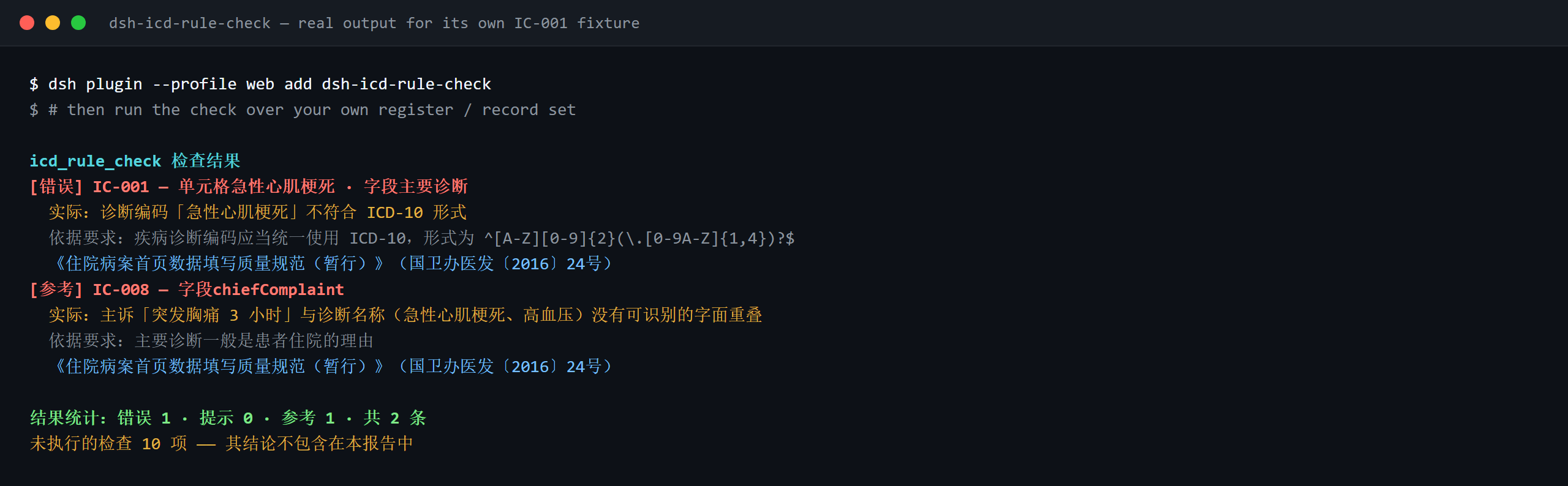
Real output from this plugin over its own IC-001 test fixture — not a mock-up. The rule pack ships no invented quotations, so a finding names both the clause it applied and the fact that the clause text was not obtained.
What it answers
| You ask | What it answers |
|---|---|
Our export stores the diagnosis code as A18.1†. Will the dagger make the form check fire? |
No. IC-001 strips the dagger and asterisk markers († / *) before it tests the code, so the marker alone never produces a finding. It checks the code's form only: a well-formed code that your catalogue does not actually contain still passes, because verifying that needs a licensed catalogue of the same version the coder uses. |
| The principal diagnosis field is empty. What is reported? | IC-009 reports that the record carries no principal diagnosis and asks for it to be filled in. Its limit is that it checks only whether the field is filled, not whether the diagnosis chosen as principal is the right one — that choice belongs to the coder, and the rule does not make it. |
| There is an asterisk code in the list and no dagger code to go with it. | IC-003 reports the asterisk code when the dagger code the pairing table assigns to it is absent from the same episode. It is the pack's most mechanical determination, and it needs your own table in pairs; with pairs empty the rule reports that it could not run instead of passing silently. Its limit is the pairing itself: the pack does not adopt the reading, common in Chinese medical-record practice, that an asterisk code may not be the principal diagnosis. |
| The same diagnosis code is listed twice. | IC-002 reports the repeated code, treating it as the same diagnosis listed twice. It is capped at warn: no clause was found that forbids repetition in those words, so its basis is a principle and it points the row out for review instead of blocking. |
| The principal diagnosis is a T82 complication and no other diagnosis is listed. | IC-011 reports that row. For a principal diagnosis in the T80-T88 series it asks only whether any other diagnosis is present at all: the clause requires an additional code to describe the complication but does not say which one, so the rule does not choose it — that belongs to the coder and to the catalogue in use. |
IC-005 never reports anything on our export — does that mean the principal procedure matches the principal diagnosis? |
No. IC-005 ships with its correspondence table empty, so it declares itself in skipped with the reason that the table is not configured; an empty finding list there is not a pass. Fill correspondence with your own diagnosis→procedure groupings — an empty procedures list means that group should carry no principal procedure — and the rule starts comparing. |
Standards it follows
| Document | Number | Cited by rules |
|---|---|---|
| 《住院病案首页数据填写质量规范(暂行)》 | 国卫办医发〔2016〕24号 | IC-001, IC-002, IC-004, IC-005, IC-007, IC-008, IC-009, IC-010, IC-012 |
| 《疾病和有关健康问题的国际统计分类》第十次修订本 第二卷 指导手册 | WHO ICD-10 Volume 2(第二版,2004,ISBN 92 4 154653 0) | IC-003 |
| 《疾病分类与代码》 | GB/T 14396-2016 | IC-003 |
| 《疾病分类与代码国家临床版 2.0》 | 国卫办医函〔2019〕371号 附件1 | IC-003 |
| 《医疗保障基金结算清单填写规范(试行)》 | 医保办发〔2020〕20号 | IC-005, IC-011, IC-006, IC-010, IC-012 |
| 《住院病案首页数据质量管理与控制指标(2016版)》 | 国卫办医发〔2016〕24号 | IC-009 |
Boundary: this plugin performs structural checks on the codes of one inpatient episode — code
form, duplicates, dagger/asterisk pairing, field completeness — and reports literal differences against
cited clauses. It is not dsh-medrec-qc (which checks the front sheet as a whole, including its logic
contradictions), not a code catalogue, and not an encoder. It never looks a code up: a catalogue lookup
needs a licensed code table whose version matches the coder's, and a version mismatch there produces
confident nonsense.
⚠️ What this plugin deliberately does not do, and why
It does not implement a combined-code (合并编码) rule, and it does not decide whether the principal procedure matches the principal diagnosis. The task this plugin was built from flagged those as a critical-path risk: the rules are scattered across ICD user guides, the clinical-version handbook and encoder training material, with no publicly quotable national clause found for them. This rule pack is built on the rule that an entry whose basis cannot be quoted does not go in, so instead of inventing a clause number the pack provides a parameterised hook (
IC-005correspondence) and ships it empty. Fill it in with your own catalogue's groupings, or leave it and read theskippedentry that says the check did not run.The dagger/asterisk rule is capped at
warnfor the same reason. The †/* system comes from the ICD-10 Volume 2 instruction manual († marks a condition classified here, * a manifestation classified elsewhere), and the pairing requirement is a structural consequence of that system — but the official Chinese text of Volume 2 was not obtainable online for verbatim quotation.IC-003therefore states in its own note that its basis is a principle and that the clause should be upgraded todirectonce an authoritative text is secured. The comparison table ships empty too: the table version must match the coder's catalogue.
Compatibility
| Surface | Status |
|---|---|
| Harness | Peer range >=0.1.2-rc.1 <0.2.0 || >=0.2.0-0 <0.3.0 — verified to accept both 0.2.0-rc.2 and 0.2.1-alpha.1. engines.dsh is deliberately not declared: it has no reader and cannot reject a host |
| Node | `^22.19.0 |
| Platforms | All (plain ESM; no native code, no network, no model call) |
| Tool mode | Works in native, ptc and both; for a batch of records use ptc |
What it does
Registers the icd_rule_check tool. It reads one coded episode — principal diagnosis, other
diagnoses, principal procedure, other procedures — applies a versioned rule pack, and returns a report
whose every finding names the clause it came from.
| Rule | Check | Severity | Basis kind |
|---|---|---|---|
IC-001 |
every diagnosis code has ICD-10 form (markers stripped first) | error | direct |
IC-002 |
the same diagnosis code is not listed twice | warn | principle |
IC-003 |
an asterisk code has its dagger partner in the same episode | error | direct |
IC-004 |
a diagnosis still uses the asterisk form (switch, off by default) | info | local |
IC-005 |
the principal procedure groups with the principal diagnosis (table, off by default) | warn | direct |
IC-006 |
a diagnosis flagged "not present on admission" is not the principal diagnosis | warn | principle |
IC-007 |
every procedure code has ICD-9-CM-3 form | error | direct |
IC-008 |
the chief complaint and the diagnosis names share a literal fragment | info | principle |
IC-009 |
a principal diagnosis is present | error | direct |
IC-010 |
diagnoses carry names, not only codes (switch, off by default) | info | local |
Every switch that depends on a code catalogue is off by default and reports itself in skipped
until configured, so an unfilled table can never read as "nothing wrong".
Install
dsh plugin --profile <name> add dsh-icd-rule-check
dsh --profile <name> --dump-config | grep 'dsh-icd-rule-check'
Configuration
| Key | Type | Default | Description |
|---|---|---|---|
rulesFile |
string | rules/icd-rule-check.yaml |
Rule-pack path, relative to the package root |
disabledRules |
string[] | [] |
Rule ids to stop running; each appears in skipped |
onlyRules |
string[] | [] |
Run only these rule ids; empty runs every rule |
skipNotes |
string | "" |
Note appended to every skipped reason |
timeoutMs |
number | 120000 |
Cooperative tool timeout budget |
Rule-level parameters worth knowing:
IC-003pairs— your dagger↔asterisk table, as[{ dagger, asterisk }]. Empty means the check cannot run and says so.IC-005correspondence— your diagnosis→procedure groupings, as[{ diagnosis: [I21], procedures: [36.06, 36.07] }]. An emptyprocedureslist means "this group should carry no principal procedure".IC-004flagAsteriskUseandIC-010requireNames— off until you enable them for your catalogue and reporting rules.IC-006flagCode— the admission-condition code that means "not present on admission". Defaults to4.
Material format
The tool accepts JSON or YAML. Every field is optional at the reader level and validated by the check engine, so a partial export produces findings about the missing parts instead of a crash.
principalDiagnosis: { code: "I21.900", name: 急性心肌梗死 }
otherDiagnoses:
  - { code: "I10", name: 高血压 }
principalProcedure: { code: "36.0600", name: 冠状动脉支架植入术 }
otherProcedures: []
chiefComplaint: 突发心肌梗死样胸痛 3 小时
admissionCondition:
  "I21.900": "1"     # drives IC-006
An entry may also be a bare code string (principalDiagnosis: I21.900), and a diagnosis or procedure
may carry the ICD-10 markers (A18.1†, N51.0*) — they are stripped before the format check, so a
marker never trips IC-001.
Rule sources
Rule data lives in rules/icd-rule-check.yaml. Every rule carries a document, a document number, a
clause in the source's own numbering, a verbatim excerpt and the URL the excerpt was read from. The
loader enforces that an excerpt is a real quotation of at least eight characters, and that a check
resting only on a general principle or a local policy can never be declared error.
The clauses that are quoted come from 《住院病案首页数据填写质量规范(暂行)》 and 《住院病案首页数据质量管理与控制指标(2016版)》(国卫办医发〔2016〕24号) and from 《医疗保障基金结算清单填写规范(试行)》(医保办发〔2020〕20号). Two research findings shaped the pack and are recorded in it:
- No quotable clause was found for combined coding, so no combined-code rule exists here. The honest output of that investigation is a parameterised hook that is empty by default, not a rule with an invented clause number.
- The asterisk form's standing depends on the catalogue version. The national clinical version and
the insurance version treat it differently, so
IC-004is a switch rather than a rule.
Troubleshooting
IC-003orIC-005reports itself as skipped. The table they need is empty. Fill inpairsorcorrespondencewith the version your encoders use.- A code you know is valid is reported as malformed.
IC-001checks form only; if your catalogue uses a spelling outside^[A-Z][0-9]{2}(\.[0-9A-Z]{1,4})?$, change the pattern in the rule pack. IC-008fires on a clinically sensible record. It compares a chief complaint against diagnosis names by literal fragment, which is a string operation, not a coding judgement. Add the name you use or disable the rule.- The plugin installs but the tool never appears. Check that
mainresolves tolib/index.mjsand thatpnpm run buildproduced it; a wrongmainmakes the loader skip the entry silently. dsh plugin addrefuses the package as incompatible. The peer range covers0.1.xand0.2.x; if your runtime sits outside it, grant an explicit exemption:dsh plugin --profile <name> allow-version dsh-icd-rule-check@0.1.0 --dsh-version <runtime> --accept-riskcheckreportsmanifest-peersas failed. The static checker compares against a hard-coded peer range that predates the 0.2 line. The runtime enforces peer compatibility at install time, so the declared range is the correct one; this is a known upstream issue indsh-plugin-dev.
Development
pnpm install
pnpm run typecheck   # tsc --noEmit
pnpm test            # vitest, paired fixtures per rule
pnpm run build       # tsdown -> lib/index.mjs + lib/index.d.mts
node ../scripts/sync-shared.mjs dsh-icd-rule-check   # refresh src/shared from ../_shared
License
Apache License 2.0 © 2026 dsh-icd-rule-check contributors.
No comments yet. Be the first to write one.