dsh-hazplan-check — HAZOP worksheet element completeness and deviation derivation consistency check

dsh-hazplan-check reads one HAZOP worksheet — rows keyed by the sheet's own column names, in Chinese or English, plus an optional header naming the 分析对象 — and checks that same sheet's completeness and internal traceability: that every row fills the fields your template requires (偏差 and 原因 by default), that each row records its 节点, that 引导词 come from the standard's tables 1 and 2 or from the list the study declared beforehand, that each row shows which element its deviation came from, that 风险等级 come from your own risk vocabulary, that the sheet names its analysis subject, and that every 偏差 is literally the 工艺参数 read through its 引导词; a check that cannot run for want of a column is reported in skipped rather than passing silently.
What it looks like
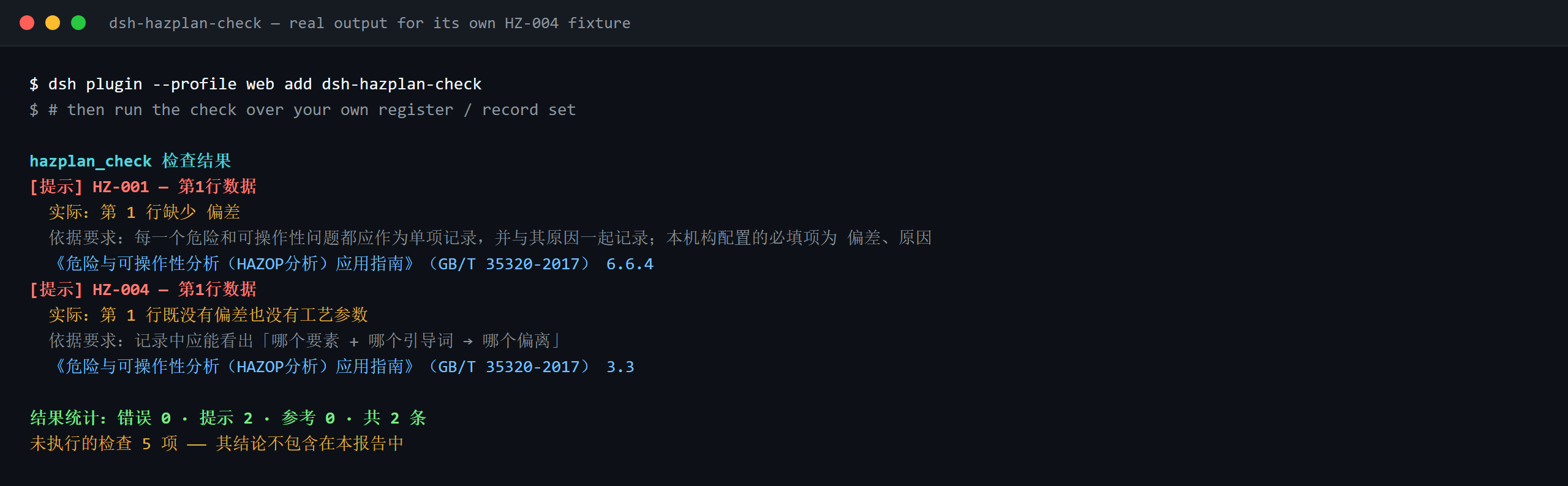
Real output from this plugin over its own HZ-004 test fixture — not a mock-up. The rule pack ships no invented quotations, so a finding names both the clause it applied and the fact that the clause text was not obtained.
What it answers
| You ask | What it answers |
|---|---|
| A row records the deviation but leaves the cause blank. Is that reported? | Yes. HZ-001 requires the fields every row must fill; shipped unset, it falls back to the pair the clause itself names, 偏差 and 原因, so a blank 原因 is a gap on its own. It checks that the column is filled, not that the problem list is complete or the cause technically sound. |
| Three rows carry no node at all. Does the check say anything, and does it judge how the nodes were divided? | HZ-002 reports those rows together and lists their row numbers, because a record without nodes cannot produce the node list the clause asks for. It checks only that 节点 is filled; it does not judge whether the node granularity is right, since clause 4.2 gives no criterion for it, and it does not decide whether any node was left unanalysed. |
Our study wrote 相逆 in the 引导词 column. Will that be flagged? |
HZ-003 reports it as a guide word outside the list: the standard's own wording is 「相反」, not 相逆, and tables 1 and 2 supply 无/多/少/伴随/部分/相反/异常 and 早/晚/先/后. The finding is a prompt rather than a verdict, because a guide word the study defined and archived before the analysis is permitted — which is why the rule sits at warn. A deployment can declare its own list instead, and then only words outside that list are reported. |
The 偏差 column reads 无流量, while 工艺参数 says 温度 and 引导词 says 无. Is that caught? |
HZ-007 reports the row when the written 偏差 does not contain the 工艺参数 read through its 引导词 in either word order; blanks and the usual separators (for example +, 、, /, -, —, 的, :) are ignored, so 流量无, 流量 + 无 and 无流量 all agree. It runs only when all three columns are present — otherwise it appears in skipped — and a hit means a likely copy-paste artefact, not that the deviation is technically wrong. |
The 风险等级 column is filled with 中, but we never configured a risk vocabulary. What comes back? |
HZ-005 reports itself in skipped, not as a pass: the standard fixes no risk-level scale, so the levels have to come from your own risk criteria and the shipped list is empty. Once levels are configured it only checks that the value is in the list, not whether the rating is correct, and its severity is capped at info. |
| The worksheet has no line naming the unit it analyses. Is that a gap? | HZ-006 reports it once, at the top level: without an analysis subject the conclusions cannot be traced back to the boundary that was analysed. The header list it rests on comes from an informative appendix — a suggestion, not a requirement — so the rule stays at warn, and requireHeader: false turns it off for sheets that legitimately carry none. |
Standards it follows
| Document | Number | Cited by rules |
|---|---|---|
| 《危险与可操作性分析(HAZOP分析)应用指南》 | GB/T 35320-2017 | HZ-001, HZ-002, HZ-003, HZ-004, HZ-005, HZ-006, HZ-007 |
| 《风险管理 风险评估技术》 | GB/T 27921-2023 | HZ-005 |
Boundary: this plugin checks one HAZOP worksheet for what a sheet can be held to — that every row records the analysis content your template requires, that each 偏差 actually follows from the 工艺参数 and 引导词 beside it, that risk levels come from your own vocabulary, that every node has rows, and that recommendations carry their closure fields. It does not judge whether the causes are complete, whether the consequences are analysed far enough, whether the safeguards are adequate, or whether a risk rating is correct. Those four judgements are the study team's, and they are where HAZOP's value lies.
⚠️ Nothing here is
error, and the clause wording is whyGB/T 35320-2017《危险与可操作性分析(HAZOP分析)应用指南》 is in force (published and effective 2017-12-29, identical to IEC 61882:2001), and its clause text was obtained verbatim.
The standard is a recommended one (the number carries "/T"), and every clause this pack cites uses 宜 — "should" — not 应. That applies to the two clauses an earlier version of this pack rated as
error: 6.6.4 reads 「每一个危险和可操作性性问题都宜作为单项记录」 and 6.6.3 opens 「HAZOP 分析输出宜包括:」. A recommendation cannot support an error rating, so both rules are nowwarnand this plugin reports no error at all — consistent with how the family treats every other recommended standard. A test pins this so a later edit cannot quietly re-escalate one.Everything else is capped at
warnorinfo, for three reasons the pack records:
- Appendix A.2 — the one place a column list appears — is a 资料性附录. Its wording is "表列的标题 可为以下各项", it adds "也可记录其他信息", and it says outright that "工作表的版面设计各有不同". There is no mandatory column list, so a missing column can only ever be a suggestion.
- Clause 4.2 gives no criterion for node granularity. It says the size of a node "取决于系统的 复杂性和危险的严重程度" and nothing quantitative follows. This plugin does not judge node size.
- The standard fixes no risk-level scale. 6.5 mentions a risk matrix as useful and defers the method to IEC 60300-3-9; GB/T 27921-2023's matrix description is likewise informative. Levels must come from your own risk criteria, so the vocabulary ships empty.
Two further honesty notes are in the pack. The guide-word vocabulary uses the standard's own wording — 「相反」, not the colloquial "相逆" — and combines table 1 with table 2; a custom guide word is not non-compliant, because 6.4.3 permits one "只要在分析开始前进行了定义". And SH/T 3240-2025 (the petrochemical HAZOP specification, in force 2025-11-01) had only its identity, status and glossary verified — its clause text was not obtained, so this pack cites none of it.
The four judgements this plugin does not make: whether the causes are complete, whether the consequences are analysed far enough, whether the safeguards are adequate, whether a risk rating is correct.
Compatibility
| Surface | Status |
|---|---|
| Harness | Peer range >=0.1.2-rc.1 <0.2.0 || >=0.2.0-0 <0.3.0 — verified to accept both 0.2.0-rc.2 and 0.2.1-alpha.1. engines.dsh is deliberately not declared: it has no reader and cannot reject a host |
| Node | `^22.19.0 |
| Platforms | All (plain ESM; no native code, no network, no model call) |
| Tool mode | Works in native, ptc and both; for several worksheets use ptc |
What it does
Registers the hazplan_check tool. It reads one worksheet — rows keyed by the sheet's own column names,
in Chinese or English — applies a versioned rule pack, and returns a report.
| Rule | Check | Severity | Basis |
|---|---|---|---|
HZ-001 |
every problem is its own row, with its cause | warn | 6.6.4 |
HZ-002 |
every analysed node is recorded on the sheet | warn | 6.6.3 |
HZ-003 |
guide words come from table 1 + table 2, or were declared first | warn | 表1、表2 + 6.4.3 |
HZ-004 |
the row shows which element the deviation came from | warn | 3.3 + 6.4.3 |
HZ-005 |
risk levels come from your risk criteria (off by default) | info | 6.5 + GB/T 27921 |
HZ-006 |
the sheet names its analysis subject | warn | 附录A.2(资料性) |
HZ-007 |
the deviation is the parameter read through its guide word | warn | 6.4.3 |
Install
dsh plugin --profile <name> add dsh-hazplan-check
dsh --profile <name> --dump-config | grep 'dsh-hazplan-check'
Configuration
| Key | Type | Default | Description |
|---|---|---|---|
rulesFile |
string | rules/hazplan-check.yaml |
Rule-pack path, relative to the package root |
disabledRules |
string[] | [] |
Rule ids to stop running; each appears in skipped |
onlyRules |
string[] | [] |
Run only these rule ids; empty runs every rule |
skipNotes |
string | "" |
Note appended to every skipped reason |
timeoutMs |
number | 120000 |
Cooperative tool timeout budget |
Rule-level parameters worth knowing:
HZ-001requiredFields— the columns every row must fill. Left empty it falls back to the pair the clause itself names:[偏差, 原因].HZ-005riskLevels— your risk vocabulary, e.g.[高, 中, 低]or[Ⅰ, Ⅱ, Ⅲ, Ⅳ]. Empty means the rule does not run. It can also be passed per call.HZ-003guideWords— the guide-word list your study declared before the meeting, when it uses its own under 6.4.3. Empty means the standard's tables 1 and 2 are used.HZ-006requireHeader— set tofalseif your sheet legitimately carries no subject line.
The plugin's own configuration also accepts riskLevels and guideWords, so a deployment can set the
risk vocabulary and the declared guide words once for every call rather than passing them each time.
Material format
The tool accepts JSON or YAML. Rows are keyed by the sheet's own column names; Chinese and English names both work, so an export from a commercial HAZOP tool loads without editing:
subject: 某装置 HAZOP 分析
revision: V1.0
rows:
  - { 节点: 进料单元, 设计意图: 将原料按设计流量送入反应器, 工艺参数: 流量, 引导词: 无,
      偏差: 无流量, 原因: 进料泵故障, 后果: 反应器液位下降, 现有安全措施: 液位低报警,
      建议措施: 增加进料泵备用泵, 风险等级: 中, 责任人: 张工, 完成期限: 2026-06-30 }
  - { Node: N2, Parameter: Temperature, "Guide Word": High, Deviation: High temperature,
      Causes: Cooling failure, Consequences: Runaway, Safeguards: High-temp trip }
Column names are matched case-insensitively and ignoring spaces, underscores and hyphens, so Guide Word,
guide_word and guideword all resolve to the same field.
HZ-002 compares the deviation against the parameter+guide-word combination over a set of separators
(, , +, 、, /, -, —, 的, :) and in both word orders, so 流量无, 流量 + 无 and 无流量
all pass. It reports a mismatch as a likely copy-paste artefact — not as a claim that the deviation is
technically wrong.
Rule sources
Rule data lives in rules/hazplan-check.yaml. Every rule carries a document, a document number, a clause
in the source's own numbering, a verbatim excerpt and the URL the excerpt was read from. The loader
enforces that an excerpt is a real quotation of at least eight characters, and that a check resting on a
general principle or a local policy can never be declared error.
The clauses quoted come from GB/T 35320-2017 — 3.3, 4.2, 6.4.3, 6.5, 6.6.3, 6.6.4, tables 1 and 2, and appendix A.2 — plus GB/T 27921-2023 appendix B.10.3 for the risk-matrix description. The clause text was read from a full-text transcription whose structure cross-checks against the standard's official metadata; the pack records that the source is a transcription.
Four findings shaped this pack and are recorded in its header:
- Appendix A.2 is informative, so its column list is a suggestion and never a requirement.
- Clause 4.2 gives no criterion for node size, so node granularity is not automatically judged.
- The standard fixes no risk-level scale, so levels are yours and the vocabulary ships empty.
- SH/T 3240-2025 exists but its clause text was not obtained, so no article of it is cited — only its identity is noted, in the pack header.
The full clause-verification report, including the sources that were checked and rejected, is in
rules/evidence/clause-verification.md.
Troubleshooting
HZ-001,HZ-003orHZ-005report themselves as skipped. Their lists are empty. Fill in the ones your template uses.HZ-002fires on a row that reads fine to me. Your sheet may write a fuller deviation than参数+引导词. The rule says "likely a copy-paste artefact"; either normalise the column or accept it as noise. It never blocks anything.HZ-002reports nothing. The sheet does not carry all three of 工艺参数, 引导词 and 偏差 — the rule says so inskippedrather than guessing.- The reader refuses a worksheet it used to accept. It found none of the known column names; the error
names the columns it saw. Rename one column or add the name to
COLUMNSinsrc/model.ts-adjacent configuration. - The plugin installs but the tool never appears. Check that
mainresolves tolib/index.mjsand thatpnpm run buildproduced it; a wrongmainmakes the loader skip the entry silently. dsh plugin addrefuses the package as incompatible. The peer range covers0.1.xand0.2.x; if your runtime sits outside it, grant an explicit exemption:dsh plugin --profile <name> allow-version dsh-hazplan-check@0.1.0 --dsh-version <runtime> --accept-riskcheckreportsmanifest-peersas failed. The static checker compares against a hard-coded peer range that predates the 0.2 line. The runtime enforces peer compatibility at install time, so the declared range is the correct one; this is a known upstream issue indsh-plugin-dev.
Development
pnpm install
pnpm run typecheck   # tsc --noEmit
pnpm test            # vitest, paired fixtures per rule
pnpm run build       # tsdown -> lib/index.mjs + lib/index.d.mts
node ../scripts/sync-shared.mjs dsh-hazplan-check   # refresh src/shared from ../_shared
License
Apache License 2.0 © 2026 dsh-hazplan-check contributors.
No comments yet. Be the first to write one.