dsh-hazchem-check — Hazardous chemical register and major hazard source identification check

dsh-hazchem-check reads one hazardous-chemical register with its major-hazard-source identification record — the site header plus one row per substance — and checks that register's own completeness and arithmetic: that each substance carries a name and a hazard class, that the stored quantity parses as a number, that a threshold is recorded, that the “major hazard source” verdict agrees with how the stored quantity compares with the threshold the register itself states, that a stored substance records its safety data sheet number, that no CAS number is repeated, that the header declares the identification basis, and that no template placeholder survives in the name column.
What it looks like
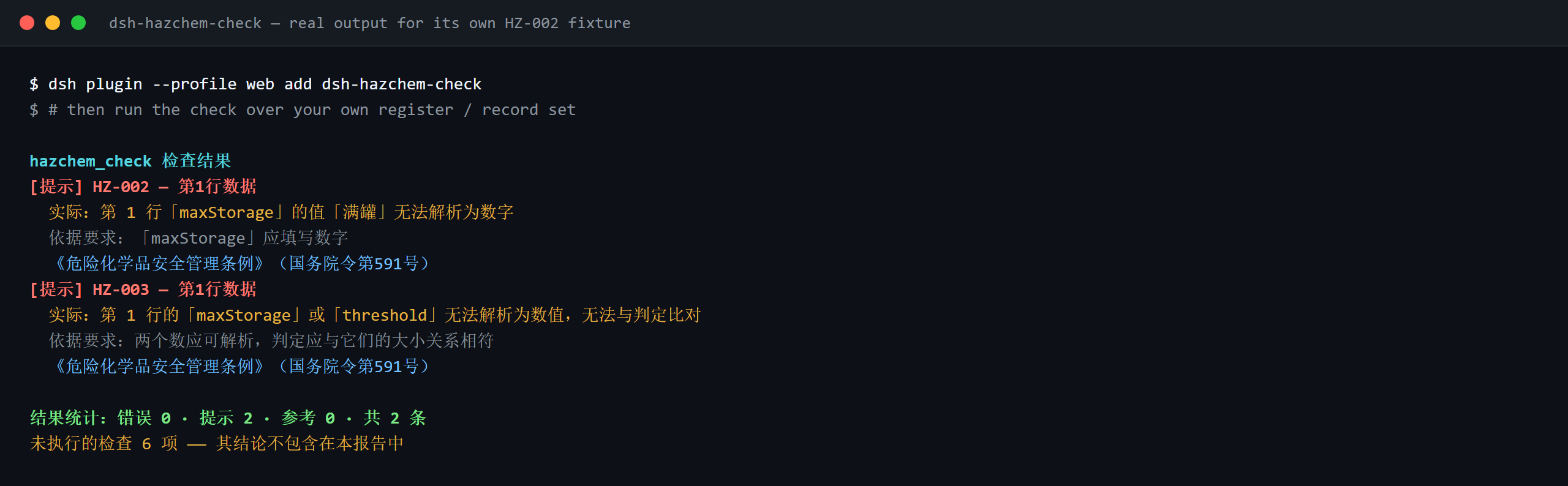
Real output from this plugin over its own HZ-002 test fixture — not a mock-up. The rule pack ships no invented quotations, so a finding names both the clause it applied and the fact that the clause text was not obtained.
What it answers
| You ask | What it answers |
|---|---|
| The register says “no”, but the stored quantity is above the threshold written beside it — is that caught? | Yes. HZ-003 compares the two numbers the register itself carries and reports the row when the verdict disagrees with them. It does not decide whether the unit really is a major hazard source. |
| A row has no threshold at all. Does the check say anything? | Yes. HZ-004 requires the threshold column to be filled on every row. It checks that a value is present, not that it is the right value for that substance — a 0 passes. |
| The chemical name is filled in but the hazard class is blank. | HZ-001 requires both on each row and reports the row missing either one. It does not judge whether the class is correct. |
The quantity column reads 1,500 kg — will that still be read? |
Yes. HZ-002 takes the numeric part; only a quantity it cannot parse is reported. Whether the figure is true, or taken at the design maximum, is not checked. |
| Which rows must carry a safety data sheet number? | HZ-006: every row that has a stored quantity. The rule checks that the number is filled in, not that the sheet is complete or belongs to that substance. |
| The same CAS number appears twice, in two warehouses. | HZ-007 reports a repeated CAS number, because it defeats both de-duplication and the quantity total. One substance split across warehouses is a legitimate shape: distinguish it in the storage-location column, or disable the rule. With no CAS column the rule reports that it could not run instead of passing silently. |
Standards it follows
| Document | Number | Cited by rules |
|---|---|---|
| 《危险化学品安全管理条例》 | 国务院令第591号(2002年1月26日国务院令第344号公布,2011年2月16日国务院第144次常务会议修订通过,自2011年12月1日起施行) | HZ-001, HZ-002, HZ-003, HZ-004, HZ-006, HZ-008 |
| 《危险化学品重大危险源辨识》 | GB 18218—2018(2018-11-19发布,2019-03-01实施;全部技术内容为强制性;代替GB 18218—2009) | HZ-002, HZ-003 |
| 《危险化学品重大危险源辨识》 | GB 18218—2018(本次未取得条文) | HZ-005 |
| 《危险化学品安全管理条例》 | 国务院令第591号(本次未取得条文) | HZ-007 |
Boundary: this plugin checks a 危险化学品台账与重大危险源辨识记录 for completeness and arithmetic — that each chemical names itself and its hazard class, that the stored quantity parses, that a threshold is recorded, that the major-hazard-source verdict agrees with how the stored quantity compares to the threshold the register states, that a stored chemical records its safety data sheet number, that CAS numbers are not duplicated, that the register declares its identification basis, and that no placeholder survives. It does not decide whether a unit constitutes a major hazard source, whether it must be registered, whether a safety assessment is required, or whether it is a major hidden danger.
⚠️ What the standard says, and the four errors this plugin cannot find
GB 18218—2018 was obtained and read verbatim (see
rules/evidence/clause-verification-tables.md): issued 2018-11-19, in force 2019-03-01, with the foreword stating 「本标准的全部技术内容为强制性的」 — the whole standard is mandatory — and it supersedes GB 18218—2009 (the 2000 and 2009 editions are both withdrawn, so citing them is simply wrong). The definitions of 临界量 (3.3), 单元 (3.2) and 重大危险源 (3.4), the determination rule 4.1.2, and table 1's first 35 rows are all quoted in that report.Table 1 is complete only to row 35 and table 2 was not obtained, so no threshold value is built in and none can be checked.
HZ-003compares the stored quantity against the threshold the register itself records and checks that the verdict agrees. It therefore cannot find four classes of error, and its own note says so:
- A threshold taken from the wrong substance or hazard class — 4.1.2 requires table 1 for listed substances and table 2 otherwise.
- A multi-hazard substance not given its lowest threshold — 4.1.2 b): 「若一种危险化学品具有多种危险性, 按其中最低的临界量确定」. Registers carry one figure, so rounding up misses a major hazard source.
- The multi-substance correction — within one unit,
S = q₁/Q₁ + q₂/Q₂ + … + qₙ/Qₙ ≥ 1also constitutes a major hazard source. This plugin does not perform that summation, because identification works per production or storage unit (3.2, 3.5, 3.6) while a register lists substances without unit grouping.- The quantity basis — 4.2.2 requires the quantity to be taken at the design maximum, while a register may record stock on hand.
⚠️ Stay inside the standard's scope. Clause 1 excludes off-site transport of hazardous chemicals (rail, road, water, air, pipeline), nuclear and military facilities, mining (except processing and storage), and offshore oil and gas extraction. Using this plugin on a transport consignment is out of scope — that is governed by dangerous-goods transport rules, not by GB 18218.
A finding therefore means only "the two numbers you wrote do not agree with your own verdict". The four items above need a unit-by-unit calculation under the standard, which is a safety-assessment and regulator-determination task. Every
excerptstill says "本次未取得" and every rule stayswarnorinfo, because what this plugin checks is a register's internal consistency, not whether a threshold value is correct.
Compatibility
| Surface | Status |
|---|---|
| Harness | Peer range >=0.1.2-rc.1 <0.2.0 || >=0.2.0-0 <0.3.0 — verified to accept both 0.2.0-rc.2 and 0.2.1-alpha.1. engines.dsh is deliberately not declared: it has no reader and cannot reject a host |
| Node | `^22.19.0 |
| Platforms | All (plain ESM; no native code, no network, no model call) |
| Tool mode | Works in native, ptc and both; for a site's register use ptc |
What it does
Registers the hazchem_check tool. It reads one chemical register — the site header plus one row per substance —
applies a versioned rule pack, and returns a report.
| Rule | Check | Severity | Basis kind |
|---|---|---|---|
HZ-001 |
the name and hazard class are recorded | warn | principle |
HZ-002 |
the stored quantity parses as a number | warn | principle |
HZ-003 |
the verdict agrees with quantity and threshold | warn | principle |
HZ-004 |
a threshold is recorded | warn | principle |
HZ-005 |
the register declares its identification basis | warn | principle |
HZ-006 |
a stored chemical records its SDS number | warn | principle |
HZ-007 |
CAS numbers are not duplicated | warn | principle |
HZ-008 |
the name column holds no unreplaced placeholder | warn | principle |
Install
dsh plugin --profile <name> add dsh-hazchem-check
dsh --profile <name> --dump-config | grep 'dsh-hazchem-check'
Configuration
| Key | Type | Default | Description |
|---|---|---|---|
rulesFile |
string | rules/hazchem-check.yaml |
Rule-pack path, relative to the package root |
disabledRules |
string[] | [] |
Rule ids to stop running; each appears in skipped |
onlyRules |
string[] | [] |
Run only these rule ids; empty runs every rule |
skipNotes |
string | "" |
Note appended to every skipped reason |
timeoutMs |
number | 120000 |
Cooperative tool timeout budget |
Rule-level parameters worth knowing:
HZ-003valueField/limitField/verdictField/overValues/atMostValues/tolerance— the three columns and the two verdict vocabularies, defaulting to[是, Y, yes, true, 构成, 重大危险源, √]and[否, N, no, false, 不构成, 未构成].HZ-008terms— the placeholders to look for.
Material format
The tool accepts JSON or YAML:
company: 某某化工有限公司
site: 某某厂区
assessmentAt: 2026-03-01
basis: GB 18218—2018 与 2025 年版危险化学品目录
rows:
  - { 序号: '1', 化学品名称: 甲醇, CAS号: 67-56-1, 危险性类别: 易燃液体,
      储存位置: 罐区 T-01, 最大储存量: '80', 计量单位: t, 临界量: '500',
      是否重大危险源: 否, 安全技术说明书编号: SDS-2026-0018, 保管人: 李工 }
Column names are matched case-insensitively and ignoring spaces, underscores and hyphens; the register's own column names are kept, so a finding names the column it read.
Rule sources
Rule data lives in rules/hazchem-check.yaml. Its header explains that the plugin holds no threshold table and
performs no multi-substance correction, and each rule's note repeats the part that matters for that rule. The
load-time guard still requires a document, clause, excerpt and source per rule, and still forbids a
principle-derived check from being error.
Troubleshooting
HZ-003passed a threshold I know is wrong. It compares against the threshold the register states. Whether that value belongs to the right substance and hazard class is a substantive question it does not touch.- It did not flag a unit that should be a major hazard source. It has no threshold table and does not perform GB 18218's multi-substance summation. Work the unit out under the standard yourself.
HZ-004passes a threshold of0. The rule checks that the column is filled, not what it contains. Only a person comparing against the standard can judge the value.HZ-007never runs. The register records no CAS numbers. Without a unique identifier the rule reports that it could not run rather than checking the wrong column.HZ-007fires on one substance in two warehouses. That is a legitimate register shape — say so in the storage-location column and disable the rule if your register is organised that way.- The plugin installs but the tool never appears. Check that
mainresolves tolib/index.mjsand thatpnpm run buildproduced it; a wrongmainmakes the loader skip the entry silently. dsh plugin addrefuses the package as incompatible. The peer range covers0.1.xand0.2.x; if your runtime sits outside it, grant an explicit exemption:dsh plugin --profile <name> allow-version dsh-hazchem-check@0.1.0 --dsh-version <runtime> --accept-riskcheckreportsmanifest-peersas failed. The static checker compares against a hard-coded peer range that predates the 0.2 line. The runtime enforces peer compatibility at install time, so the declared range is the correct one; this is a known upstream issue indsh-plugin-dev.
Development
pnpm install
pnpm run typecheck   # tsc --noEmit
pnpm test            # vitest, the shared table-plugin suite plus paired fixtures
pnpm run build       # tsdown -> lib/index.mjs + lib/index.d.mts
node ../scripts/sync-shared.mjs dsh-hazchem-check   # refresh src/shared from ../_shared
The plugin is data-only: src/model.ts declares the table shape, the shared kit supplies the reader and the
check engine, and the rule pack declares every check.
License
Apache License 2.0 © 2026 dsh-hazchem-check contributors.
No comments yet. Be the first to write one.