dsh-family-catalog



A DSH Community Market standard catalog source for the PerryLink DeepSeek Harness plugin family, generated from the npm registry, validated against the public v1 contract schemas. Every item's displayName is bilingual (English — 中文) and its summary carries the Chinese line, so Chinese stays visible and searchable inside the strict 1.0.0 fields. The pure Chinese pair and the display/status metadata the public schema does not allow live in display.json.
- Manifest:
catalog-source.json(generated; see Deploy) - Provider page:
artifacts/v1/plugins.json(generated) - Source of truth:
data/packages.json(npm name → repo → display name → categories) +data/npm-snapshot.json(npm registry snapshot) - Generator / validator:
scripts/build-catalog.mjs,scripts/validate.mjs,scripts/check-counts.mjs - Deploy: live at
https://perrylink-dsh-catalog.perrylink.workers.dev(Cloudflare Workers, automated viadeploy.yml; Vercel static alternative invercel.json; Deno unitdeploy/deno-worker.jsas manual alternative)
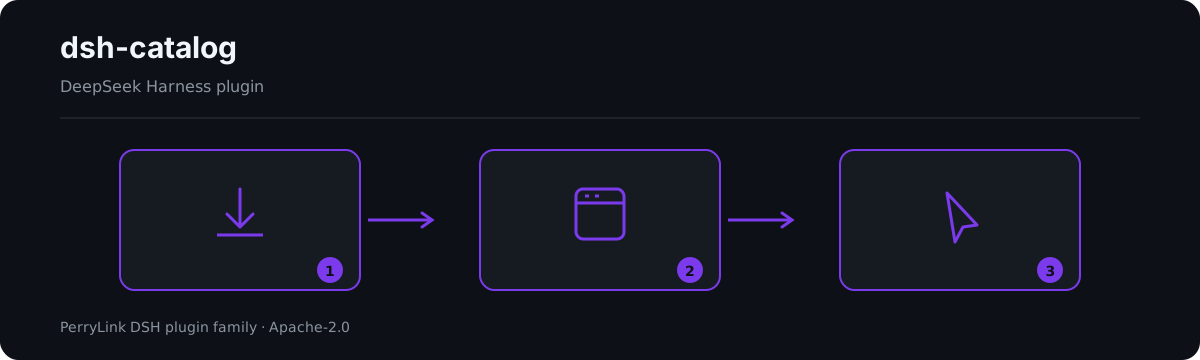
Workflow overview: install → open panel → act. The catalog is the discovery surface.
Maintenance status: family-internal tool
Reclassified on 2026-10-05 — deliberately NOT retired. A review of the whole plugin family against the official harness and the wider ecosystem classified this repository as family-internal tooling rather than a product. Its job is to inventory this family for the DSH Desktop Community Market, so it does not compete with third-party catalogs and needs no retirement. It stays maintained.
One roster, one source
The catalog is the discoverability surface, not a 1:1 projection of the family
roster. It carries npm records in data/packages.json (including
community/third-party records and the retired names kept for older installs).
Every per-plugin README carries the same collapsed roster.
Compliance notes
- Contract: catalog-provider-contract.md (v1,
manifestVersion/schemaVersion1.0.0). The schemas are vendored nowhere in this repo;scripts/validate.mjsmirrors the structural rules ofcatalog-source.schema.jsonandcatalog-provider-page.schema.jsonand the cross-field rules (unique item ids, npm name pattern, no install commands in items, HTTPS repository URLs, page shape). - The provider advertises
query.supported = ["cursor","limit"],defaultLimit = maxLimit = 100,sorts = []. The endpoint serves the complete 146-item catalog in cursor pages of up to 100 items (two requests), so DSH Desktop scans the whole catalog without exceeding the runtime's per-page limit. The Vercel static mirror serves the unpaginated 145-item JSON for browsing; use the workers.dev manifest for Desktop. - Every item carries
package.registry = "npm"+package.nameand a canonicalrepository.url; no install commands, shell fragments or executable data are ever emitted. - Every item also carries a same-origin
media.icon(/icons/<slug>.png, generated deterministically byscripts/build-icons.mjs); the Worker serves the PNGs itself, so the icons stay on the catalog origin as the market media rule requires. - The manifest endpoint and the manifest itself must share one HTTPS origin (market rule). The generated placeholder endpoint
https://replace-with-deploy-origin.invalid/...is replaced by the real deploy origin at deploy time — do not register the placeholder URL in DSH Desktop.
Build
node scripts/build-catalog.mjs            # placeholder endpoint
node scripts/validate.mjs                 # structural checks
node scripts/build-catalog.mjs https://<your-project>.deno.dev   # real origin
build-catalog.mjs writes the manifest and provider page to the repo root and mirrors both into deploy/, so deploy/deno-worker.js is a self-contained Deno Deploy unit (its ./ imports always resolve).
data/npm-snapshot.json is refreshed UTF-8-safely with:
node scripts/refresh-snapshot.mjs # re-fetch every package from registry.npmjs.org
A scheduled workflow (
.github/workflows/refresh-catalog.yml) runs this daily and opens one PR onchore/catalog-refreshonly when the registry changed. It runs the data/artifact/type gates before opening the PR; merging the PR triggers the deploy workflow. The manual command above is for a forced refresh.
Maintaining data/
data/packages.json and data/npm-snapshot.json are one unit: a new or renamed package
needs its snapshot row in the same commit. Two consecutive main deploys went red on
2026-09-09 exactly this way — first a missing comma in data/packages.json, then a package
listed without its snapshot row (Error: npm snapshot missing for …). Both are caught locally
by the pre-push gate; enable it once per clone:
git config core.hooksPath .githooks # then every push runs node scripts/check-data.mjs
scripts/check-data.mjs is read-only. Do not use node scripts/build-catalog.mjs as a
gate: called without an argument it rewrites the committed deploy/ artifacts with the
placeholder origin.
The family count is not hand-maintained: scripts/check-counts.mjs derives it from
data/packages.json and holds every place that states it — the README summaries (EN + ZH), the
manifest description, the shipped page's items/page.total and the deploy live-smoke floor —
to that one source. Run it to verify, or node scripts/check-counts.mjs --write to rewrite the
README count sites from the source. It exists because the number did drift: the README and the
manifest advertised a family one package larger than the page actually shipped (the concrete
figures and the commit that fixed them are recorded in the scripts/check-counts.mjs header).
.github/workflows/ci.yml runs scripts/check-data.mjs, scripts/check-counts.mjs and the
build/validate pair on every push to main and on every pull request, so the hook above is a
convenience rather than the only line of defence. scripts/validate.mjs resolves the committed
deploy/ mirrors first — the payload that actually ships, and the only copy a fresh clone has —
and holds page.total to items.length. CI then rebuilds to assert that the committed
deploy/catalog-source.json still matches, which catches a data/ change that was never
mirrored into deploy/. That rebuild is the one place the no-argument form is safe: the
runner's checkout is throwaway, and the manifest carries no timestamp, so it is
byte-reproducible.
Deploy
Live: https://perrylink-dsh-catalog.perrylink.workers.dev (Cloudflare Workers, deployed automatically by the deploy workflow).
Automated channels — the workflow rebuilds the manifest with the live origin, validates, then deploys; each channel skips gracefully when its token secret is absent:
- Cloudflare Workers (active):
deploy/wrangler.toml+deploy/cloudflare-worker.js. RequiresCLOUDFLARE_API_TOKEN+CLOUDFLARE_ACCOUNT_IDsecrets. Two-pass deploy: first uploads the placeholder-origin worker, reads the assigned*.workers.devURL, rebuilds the manifest pinned to that origin, and redeploys. Falls back to Cloudflare Pages (.pages.dev) whenworkers.devis unavailable. - Vercel:
vercel.jsonrewrite/v1/plugins→artifacts/v1/plugins.json. RequiresVERCEL_TOKEN. - Deno Deploy (manual): self-contained
deploy/deno-worker.js; rebuild withnode scripts/build-catalog.mjs https://<your-project>.deno.devbefore deploying.
The site serves GET /catalog-source.json and GET /v1/plugins as application/json on one HTTPS origin.
Use in DSH Desktop
Open the built-in Market → Sources → add source → paste the manifest URL https://perrylink-dsh-catalog.perrylink.workers.dev/catalog-source.json → select it. Browsing is read-only; installation of any listed plugin goes through the Market's own npm-identity verification and user confirmation.
A listing in this catalog is metadata, not a security review. The same plugins also have evidence records in dsh-plugin-certification and MCP access via dsh-cert-mcp.
Discovery search and MCP
The 1.0.0 provider page is what DSH Desktop reads, and its search is one whole-string includes over id/name/displayName/summary/description/publisher/keywords. That misses Chinese domain words that only live in summaryZh. The sidecar fixes that without changing the 1.0.0 item schema:
data/discovery.json— 146 schema-valid discovery manifests (61 authored, 85 generated from catalog fields and flagged for review) with aliases, searchPhrases, audience, facets, maturity and coverage.data/facets.json— 145/145 facet/status sidecar (domains, subdomains, tasks, artifacts, standards, maintenance, maturity, coverage, replacement).data/hubs.json— 10 domain hubs (customs, tender, construction-ehs, medical, legal, finance, government, research, quality, data).GET /v1/search?q=&domain=&task=&audience=&limit=andGET /v1/plugin?name=on both workers.mcp/plugin-search-server.mjs— stdio MCP withplugin_search/plugin_get.
node scripts/build-discovery.mjs
node scripts/discovery-bench.mjs --source=index --fail-under=85
node scripts/worker-smoke.mjs
node scripts/mcp-smoke.mjs
See docs/search-api.md for the response shape, the MCP config and the known 1.0.0 contract caveats.
中文说明
PerryLink 全家桶的 DSH Community Market 标准目录源:146 个 npm 包(145 个 PerryLink 仓 + 第三方 dsh-phocinae,后者只是并列收录,不算家族作品),由 npm registry 生成,按公开 v1 契约做结构校验;每个条目的 displayName 为中英双语(English — 中文),summary 带中文句,中文在严格 1.0.0 字段内即可显示和搜索;纯中文对与状态等 schema 外元数据放在 display.json 侧车。已上线 Cloudflare Workers(perrylink-dsh-catalog.perrylink.workers.dev,deploy workflow 自动部署;Vercel 静态重写与 Deno Deploy 为备选通道)。每个条目还带同源 media.icon 图标(/icons/*.png,由 scripts/build-icons.mjs 确定性生成)。在 DSH Desktop 的 市场 → Sources 里添加 manifest URL 即可浏览(浏览只读;安装仍走市场自身的 npm 身份校验与用户确认)。生成产物中的占位域名 replace-with-deploy-origin.invalid 在部署时替换,请勿直接注册占位地址。维护纪律:data/packages.json 与 data/npm-snapshot.json 必须同一次 commit 成对更新(2026-09-09 连续两次 main 部署红灯即由此而来:先是漏逗号,后是新增包缺 npm 快照行);执行一次 git config core.hooksPath .githooks 后,每次 push 都会跑只读门禁 scripts/check-data.mjs。切勿把不带参数的 node scripts/build-catalog.mjs 当作门禁——它会把已入库的 deploy/ 产物改写成占位域名。CI:.github/workflows/ci.yml 在每次 push 到 main 与每个 PR 上跑 scripts/check-data.mjs、scripts/check-counts.mjs 与 build+validate;scripts/validate.mjs 默认直接读已入库的 deploy/ 产物(真正上线的载荷,干净 clone 里只有它),并把 page.total 锁到 items.length;随后重建断言 deploy/catalog-source.json 未过期,可发现「改了 data/ 却没重建 deploy/」;该重建在 CI 的一次性 checkout 里是安全的,因为 manifest 不含时间戳、可字节复现。计数单一来源:包数一律由 data/packages.json 派生——scripts/check-counts.mjs 校验 README(EN+ZH)/manifest/产物/部署冒烟下限一致,--write 可从该来源重写 README 计数,禁止手写。
License
Apache-2.0. Catalog data derives from the npm registry and the PerryLink plugin repositories.
DSH family line: this repository belongs to the PerryLink DeepSeek Harness plugin family, whose current line is dsh-v0.1.7-rc.2.
PerryLink DSH Plugin Family
This project is part of the DeepSeek Harness plugin family from PerryLink. The roster stays collapsed below so every README keeps a short first screen; expand it to see every row and its status.
Expand all plugins
No comments yet. Be the first to write one.