dsh-export-ctl-check — Export-control item register and licence closure cross-check

dsh-export-ctl-check reads one export-control item register — the exporter header plus one row per item — and cross-checks that register's own completeness and closure rather than any judgement about the items: whether each item states in the 是否受控 column whether it is controlled, whether an item marked as controlled carries a 出口许可证号, whether a licence number that is filled in is accompanied by an issue date, whether the end use or the end user is recorded, whether the destination is recorded, whether a licence number repeats inside the same register, whether the control category is one of the institution's own 管制类别 values, and whether a placeholder such as 【】, XXX, 待填, TBD or 示例 still survives in the item-name column.
What it looks like
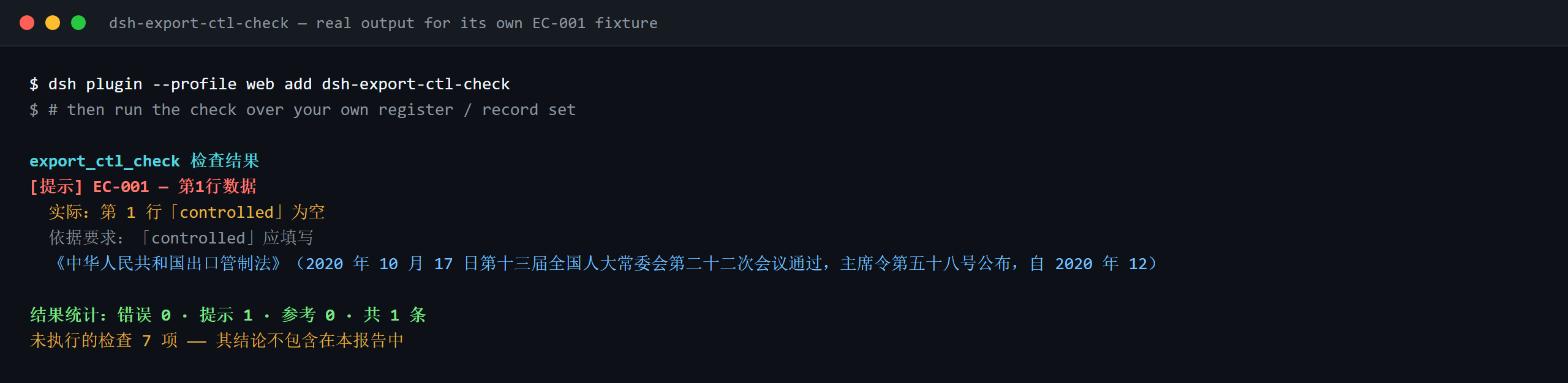
Real output from this plugin over its own EC-001 test fixture — not a mock-up. The rule pack ships no invented quotations, so a finding names both the clause it applied and the fact that the clause text was not obtained.
What it answers
| You ask | What it answers |
|---|---|
| Is it reported when an item marked as controlled has no licence number? | EC-002 reports that gap: for a row whose 是否受控 value is one the rule is configured to treat as controlled — shipped as 是, Y, yes, true, 受控, √ — it requires a 出口许可证号. It checks only that the number is filled in; it does not judge whether the licence is genuine, still valid, or covers that item and that destination. If your register writes some other word for controlled, add it to the rule's condition values, or the row counts as not controlled and the rule stays silent — this plugin holds no control list to decide the question for you. |
| An item states whether it is controlled but leaves the 最终用途 and 最终用户 columns empty — does anything catch that? | EC-004 reports the row: it asks for at least one of those two columns to be filled. One of the two is enough, and the rule does not judge whether the stated use or user is true or whether the case is one the law prohibits or restricts. |
| A licence number is written down but the issue-date column is blank. Is that a finding? | EC-003 requires it. The condition is the licence number: a row without one is not asked for a date at all. The rule does not check the licence's validity period, and it does not weigh the issue date against the export date — it establishes that a date is there, not that it comes first. |
| One and the same licence number appears on several rows. What does the check say? | EC-006 reports the number as repeated across the register. It cannot tell a single licence covering several items — a normal way to keep the register — from a number copied by mistake, so a hit needs a person to confirm it; the rule does not renumber anything, and it does not say how many rows may share one licence. If your register is deliberately written one-licence-many-items, give the rows of that licence a serial number, or switch the rule off. |
| A row has no 最终目的地 at all. | EC-005 reports it, because every item has to carry a destination. It checks that the column is filled, not that the destination is permitted: whether a country or region is embargoed or restricted is read from lists the competent authority publishes, and this plugin holds no country list of its own. |
The item-name column still reads 【示例】 or XXX — is that treated as a defect or as a real name? |
EC-008 reports the row when the name contains one of the terms the rule looks for — 【, 】, {{, }}, XXX, xxx, 待填, 待补充, TBD, todo or 示例. That term list follows your own template and can be adjusted. The rule looks for those terms in that one column only: it never judges whether the name itself is factually correct. |
Standards it follows
| Document | Number | Cited by rules |
|---|---|---|
| 《中华人民共和国出口管制法》 | 2020 年 10 月 17 日第十三届全国人大常委会第二十二次会议通过,主席令第五十八号公布,自 2020 年 12 月 1 日起施行 | EC-001, EC-002, EC-003, EC-004, EC-005, EC-006, EC-008 |
| 《中华人民共和国出口管制法》 | 现行版本本次未核实 | EC-007 |
Boundary: this plugin checks an 出口管制物项台账 for the closed loop a register can be held to — that each item states whether it is controlled, that a controlled item carries a licence number, that a licence carries an issue date, that the end use or end user is recorded, that a destination is recorded, that licence numbers do not repeat, that the control category comes from your vocabulary, and that no placeholder survives. It does not decide whether an item is controlled, whether a licence is required, or whether an export would breach the rules.
⚠️ What this plugin deliberately cannot do
It does not contain the control list, and it does not try to map a commodity code or a technical parameter onto a list entry. Because of that it cannot find the most serious defect of all: an item that should have been declared controlled and was not. Whether an item is controlled is the exporter's own determination under the law, and confirming it means checking the published list. This limit is stated in the pack's header, in each rule's note, and in the troubleshooting section below — it is the single most important thing to know about this plugin.
The 是否受控 column is therefore the register's own declaration. Everything here checks what happens after that declaration: is a licence recorded, is it dated, is the destination and end use stated, does the register hold together. It never checks whether the declaration was right.
The rule pack states its citation status rule by rule. 4 of its 8 rules quote verbatim clause text and are marked
direct; the remaining 4 state in theexcerptfield itself that the text was not obtained, and stay atwarnorinfo. Where a rule still carries that note, treat it as a lead rather than as a citation. The regime lives in 《中华人民共和国出口管制法》, the dual-use export licensing measures, and the published control list. For the rules whose text the verification pass could not retrieve, the pack states the gap in theexcerptfield itself rather than paraphrasing it, and those rules stay atwarnorinfo. When the texts are in hand, replace eachexcerptwith the real clause and raisekindtodirect.
Compatibility
| Surface | Status |
|---|---|
| Harness | Peer range >=0.1.2-rc.1 <0.2.0 || >=0.2.0-0 <0.3.0 — verified to accept both 0.2.0-rc.2 and 0.2.1-alpha.1. engines.dsh is deliberately not declared: it has no reader and cannot reject a host |
| Node | `^22.19.0 |
| Platforms | All (plain ESM; no native code, no network, no model call) |
| Tool mode | Works in native, ptc and both; for a shipment's item list use ptc |
What it does
Registers the export_ctl_check tool. It reads one item register — the exporter header plus one row per item —
applies a versioned rule pack, and returns a report.
| Rule | Check | Severity | Basis kind |
|---|---|---|---|
EC-001 |
each item states whether it is controlled | warn | principle |
EC-002 |
a controlled item carries a licence number | warn | direct |
EC-003 |
a recorded licence carries an issue date | warn | principle |
EC-004 |
the end use or end user is recorded | warn | direct |
EC-005 |
a destination is recorded | warn | direct |
EC-006 |
licence numbers do not repeat | warn | principle |
EC-007 |
the control category comes from your vocabulary (off by default) | info | principle |
EC-008 |
the item name holds no unreplaced placeholder | warn | direct |
Install
dsh plugin --profile <name> add dsh-export-ctl-check
dsh --profile <name> --dump-config | grep 'dsh-export-ctl-check'
Configuration
| Key | Type | Default | Description |
|---|---|---|---|
rulesFile |
string | rules/export-ctl-check.yaml |
Rule-pack path, relative to the package root |
disabledRules |
string[] | [] |
Rule ids to stop running; each appears in skipped |
onlyRules |
string[] | [] |
Run only these rule ids; empty runs every rule |
skipNotes |
string | "" |
Note appended to every skipped reason |
timeoutMs |
number | 120000 |
Cooperative tool timeout budget |
Rule-level parameters worth knowing:
EC-002conditionValues— the values in your 是否受控 column that mark an item as controlled, by default[是, Y, yes, true, 受控, √].EC-007values— your control categories, e.g.[核, 导弹, 生物, 化学, 军民两用]. Empty means no check; the plugin ships no list of its own.EC-008terms— the placeholders to look for.
Material format
The tool accepts JSON or YAML:
exporter: 某某进出口有限公司
contractNo: SC-2026-018
listVersion: 2026 年版
rows:
  - { 序号: '1', 物项名称: 某型高性能传感器, 商品编号: '9031809090',
      管制类别: 军民两用, 最终用途: 用于工业自动化产线的位移测量,
      最终用户: 某某工业自动化有限公司, 最终目的地: 德国,
      许可证号: EX2026-0018, 许可日期: 2026-02-25, 是否受控: 是 }
Column names are matched case-insensitively and ignoring spaces, underscores and hyphens; the register's own column names are kept, so a finding names the column it read.
Rule sources
Rule data lives in rules/export-ctl-check.yaml. Its header explains that the plugin holds no control list and
does no list lookup, so it cannot detect an undeclared controlled item. The load-time guard still requires a
document, clause, excerpt and source per rule, and still forbids a principle-derived or locally configured
check from being error.
Troubleshooting
- It did not flag an item I believe is controlled. By design: it has no control list and never maps an item to one. Confirm against the published list yourself; this plugin cannot do it for you.
EC-002fires on an item I am sure is uncontrolled. Its 是否受控 column says it is controlled. Either correct the column or record the licence — the plugin reads the declaration, not the goods.EC-006fires on one licence across several items. A single licence covering several items is normal; distinguish the rows, or disable the rule if your register is written that way.EC-005does not know which destinations are restricted. It checks only that a destination is recorded. No country list is built in, deliberately.- The plugin installs but the tool never appears. Check that
mainresolves tolib/index.mjsand thatpnpm run buildproduced it; a wrongmainmakes the loader skip the entry silently. dsh plugin addrefuses the package as incompatible. The peer range covers0.1.xand0.2.x; if your runtime sits outside it, grant an explicit exemption:dsh plugin --profile <name> allow-version dsh-export-ctl-check@0.1.0 --dsh-version <runtime> --accept-riskcheckreportsmanifest-peersas failed. The static checker compares against a hard-coded peer range that predates the 0.2 line. The runtime enforces peer compatibility at install time, so the declared range is the correct one; this is a known upstream issue indsh-plugin-dev.
Development
pnpm install
pnpm run typecheck   # tsc --noEmit
pnpm test            # vitest, the shared table-plugin suite plus paired fixtures
pnpm run build       # tsdown -> lib/index.mjs + lib/index.d.mts
node ../scripts/sync-shared.mjs dsh-export-ctl-check   # refresh src/shared from ../_shared
The plugin is data-only: src/model.ts declares the table shape, the shared kit supplies the reader and
the check engine, and the rule pack declares every check.
License
Apache License 2.0 © 2026 dsh-export-ctl-check contributors.
No comments yet. Be the first to write one.