dsh-emergency-plan — Emergency plan element completeness and clause-level page locating

dsh-emergency-plan reads one emergency plan — its section tree, headings, page numbers and body text — and checks that plan's element completeness against the drafting guideline: which elements are present, which are absent, which appear only as a heading with no text under them, and where each one sits, by page where the material carries page numbers and by line otherwise. It applies a versioned rule pack to the plan type the material declares, and every finding names the clause it came from and states whether that clause is a direct requirement, a principle or a local configuration; a check that could not run says so in skipped instead of passing silently.
What it looks like
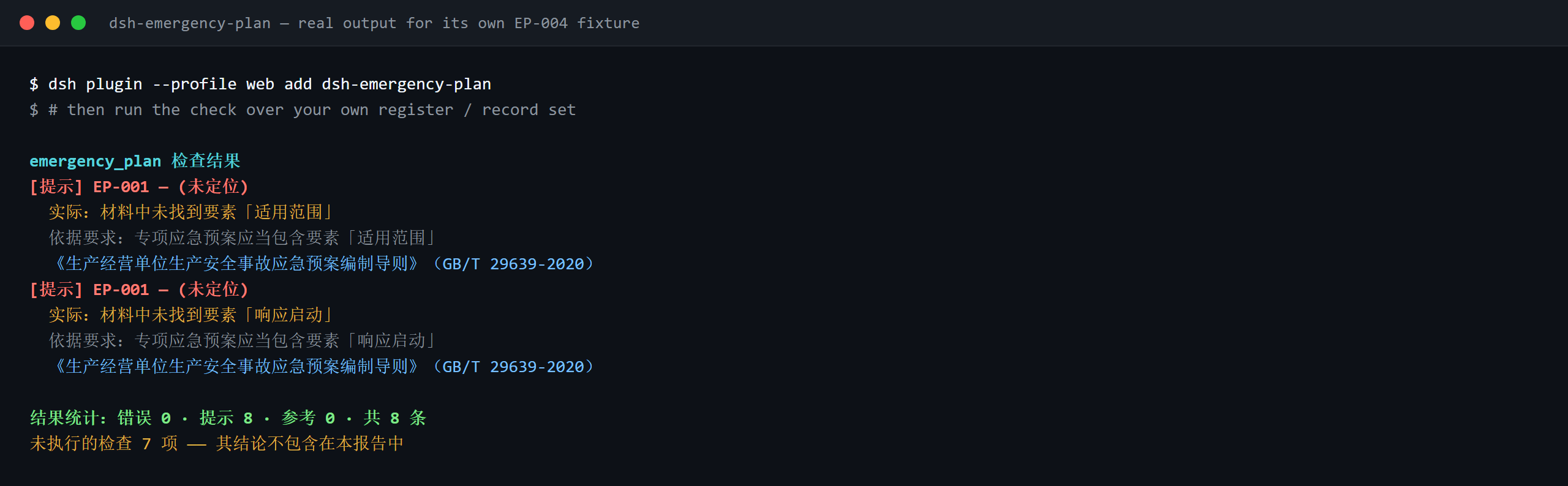
Real output from this plugin over its own EP-004 test fixture — not a mock-up. The rule pack ships no invented quotations, so a finding names both the clause it applied and the fact that the clause text was not obtained.
What it answers
| You ask | What it answers |
|---|---|
| Our material never says which of the three plan types it is. What happens? | EP-004 reports the material for not declaring planType, because each of the three types carries a different element list. It checks only that the declaration is there, not that it is the right one; while it is missing, EP-002 and EP-003 state in skipped which element list they assumed. |
| A 综合应急预案 has no 后期处置 chapter. Is that reported — and does it also need a 编制目的 section? | EP-002 looks for the five first-level elements of the current guideline's chapter 6 (6.1~6.5) one by one and reports each one it cannot find, so a missing 后期处置 is reported. 编制目的 is not one of the five: the current edition removed it, and the pack accepts it only as an alias of 总则. The finding is warn, because the drafting guideline is a recommended national standard, not a mandatory one. |
| Which elements are mandatory in a 专项应急预案 and in a 现场处置方案? | EP-001 requires the 专项应急预案's 7.17.4 elements and EP-003 the 现场处置方案's 8.18.4, each reporting the elements it cannot find in the section tree; a heading that exists with no text under it is reported as empty. Both lists are floors, not closed lists — the 现场处置 clause reads 包括但不限于 — so an extra element is not a finding. In EP-001 the 7.5 应急保障 element stays recommended; in EP-003 the shorter list in the 《生产安全事故应急预案管理办法》 is kept as a separate basis and never merged with the guideline's. |
| We merged two plans and now the same element heading appears twice. Is that caught? | EP-007 reports a required element that appears more than once and lists every heading that matched it. No clause states this outright — the pack derives it from the uniqueness of the 目次 order — so it is capped at warn, and the pack asks for human confirmation, because a duplicate usually comes from merging several plans. It compares the element list it applies, not every repeated heading in the material. |
The report shows EP-005 as skipped. Why — and must a plan carry page numbers? |
EP-005 can compare element order only when at least two elements carry a page or a line; without them it says so in skipped rather than assuming an order. EP-006 treats page numbers as locating information: it stays quiet once the share of sections carrying a page reaches minPageRatio (0.5 by default) and, below that share, only raises an info finding. Both are capped at info — the order expectation is drawn from an informative appendix, not the standard's body — and a plan without page numbers is never reported as a breach of a clause: the report locates by line number instead. |
Why do EP-008 and EP-009 appear under skipped instead of passing? |
Both wait for configuration. EP-009 runs only when requireAttachments is set to true, because a caller usually supplies the plan body without its attachments and reporting those as missing would be misleading; enabled, it looks for the eight attachment items and reports the ones it cannot find. EP-008 runs only when versionPatterns are configured: with the list empty it does not dictate what a version marker should look like, and once configured it checks only whether the configured marker appears in a section heading — never whether the revision content is correct. |
Standards it follows
| Document | Number | Cited by rules |
|---|---|---|
| 《生产经营单位生产安全事故应急预案编制导则》 | GB/T 29639-2020 | EP-001, EP-002, EP-003, EP-004, EP-005, EP-006, EP-007, EP-008, EP-009 |
| 《生产安全事故应急预案管理办法》 | 国家安全生产监督管理总局令第88号(应急管理部令第2号修正) | EP-001, EP-002, EP-003, EP-009 |
Boundary: this plugin checks an emergency plan's element completeness against the drafting
guideline and locates each element by page, reporting literal differences against cited clauses. It is
not dsh-rulefile-check (which audits a regulatory document's legality) and not
dsh-hidden-risk-map (which maps a hazard ledger to determination clauses). It reads one plan and
reports which elements are present, absent or empty, and where.
⚠️ Two corrections this plugin is built on — please read
1. "八要素" is not a current requirement. The familiar list — 总则, 事故风险描述, 应急组织机构及职责, 预警及信息报告, 应急响应, 信息公开, 后期处置, 保障措施, 应急预案管理 — belongs to GB/T 29639—2013, which has been entirely replaced. Its namesake is not found in any current national document. The standard in force, GB/T 29639-2020, gives the comprehensive plan five first-level elements in clause 6 (6.1 总则 / 6.2 应急组织机构及职责 / 6.3 应急响应 / 6.4 后期处置 / 6.5 应急保障), and its foreword records that 编制目的 was removed. Any rule citing 2013 clause numbers is citing a withdrawn standard. This pack cites only the 2020 clause numbers, and a test asserts that the 2013 number never appears.
2. Page numbers have no mandatory basis. No national document requires a plan to carry page numbers; the appendix that governs 目次 is a 资料性附录 (informative, not normative) and does not contain the word 页码. Page numbers are therefore treated as locating information that helps a reviewer, reported at
info, and never phrased as "does not comply with X". When a plan carries no page numbers the report falls back to line numbers.
A third, smaller correction is recorded in the pack: 《生产安全事故应急预案管理办法》's correct version is 国家安全生产监督管理总局令第88号 (2016), amended by 应急管理部令第2号 (2019) — not a bare "应急管理部令第2号" — and 国办发〔2013〕101号 has been replaced by 国办发〔2024〕5号.
Compatibility
| Surface | Status |
|---|---|
| Harness | Peer range >=0.1.2-rc.1 <0.2.0 || >=0.2.0-0 <0.3.0 — verified to accept both 0.2.0-rc.2 and 0.2.1-alpha.1. engines.dsh is deliberately not declared: it has no reader and cannot reject a host |
| Node | `^22.19.0 |
| Platforms | All (plain ESM; no native code, no network, no model call) |
| Tool mode | Works in native, ptc and both; for a batch of plans use ptc |
What it does
Registers the emergency_plan tool. It reads one plan's section tree — headings, page numbers and body
text — applies a versioned rule pack, and returns a report in which every finding names the clause it
came from and states whether that clause is a direct requirement, a principle, or a local
configuration.
| Rule | Check | Severity | Basis kind |
|---|---|---|---|
EP-001 |
a 专项应急预案 carries its 7.1–7.4 elements | warn | direct |
EP-002 |
a 综合应急预案 carries its 6.1–6.5 elements | warn | direct |
EP-003 |
a 现场处置方案 carries its 8.1–8.4 elements | warn | direct |
EP-004 |
the material declares which of the three types it is | warn | direct |
EP-005 |
the elements appear in the guideline's order | info | principle |
EP-006 |
the sections carry page numbers, so a finding can be located | info | principle |
EP-007 |
no element heading appears twice | warn | principle |
EP-008 |
a version or revision marker is present, as configured | info | local |
EP-009 |
the plan carries the attachment information (off by default) | info | direct |
The element lists live in the rule pack, not in the code, because they change with the guideline's
version. Severities reflect that GB/T 29639 is a recommended national standard: an incomplete
element list is a warn, not an error.
Install
dsh plugin --profile <name> add dsh-emergency-plan
dsh --profile <name> --dump-config | grep 'dsh-emergency-plan'
Configuration
| Key | Type | Default | Description |
|---|---|---|---|
rulesFile |
string | rules/emergency-plan.yaml |
Rule-pack path, relative to the package root |
disabledRules |
string[] | [] |
Rule ids to stop running; each appears in skipped |
onlyRules |
string[] | [] |
Run only these rule ids; empty runs every rule |
skipNotes |
string | "" |
Note appended to every skipped reason |
timeoutMs |
number | 120000 |
Cooperative tool timeout budget |
Rule-level parameters worth knowing:
EP-001/EP-002/EP-003elements— the element list per plan type, as[{ name, aliases }]. Replace it to check against a different guideline version or against your own institution's template. An empty list makes the rule report that it could not run.EP-006minPageRatio— the share of sections that must carry a page number before the rule stays quiet.EP-008versionPatterns— the strings that count as a version marker for your templates. Empty means the rule does not run.EP-009requireAttachments— off by default, because a caller usually supplies the body without attachments; enable it only when the attachments are actually in the material.
Material format
The tool accepts JSON or YAML, and also a plain-text plan. The section-tree form is preferred, because the caller that extracted the plan already knows where each heading sits:
name: 某公司生产安全事故综合应急预案
planType: comprehensive         # comprehensive | special | on-site
sections:
  - { title: 总则, page: 1, body: 本预案适用于…… }
  - { title: 应急组织机构及职责, page: 2, body: 明确应急组织形式…… }
  - { title: 应急响应, page: 3, body: 规定信息报告、预警与响应程序。 }
Headings are matched against each element's aliases in three widening steps: exact normalized
equality, containment, then a small edit distance, so that both 五、保障措施 and
二、组织机构与职责 find their element. Numbering prefixes (一、, 1.1, **…**) are stripped
before comparison. Pasting markdown (# 总则) also works and is split on the headings, without page
numbers — the report then says so.
Rule sources
Rule data lives in rules/emergency-plan.yaml. Every rule carries a document, a document number, a
clause in the source's own numbering, a verbatim excerpt and the URL the excerpt was read from. The
loader enforces that an excerpt is a real quotation of at least eight characters, and that a check
resting only on a general principle or a local policy can never be declared error.
The clauses quoted come from GB/T 29639-2020 clauses 5.1, 6, 7, 8, appendix C.1 and C.3, and from 国家安全生产监督管理总局令第88号(应急管理部令第2号修正) articles 13, 14, 15 and 16.
Three findings shaped this pack and are recorded in its header:
- "八要素" comes from a withdrawn standard. The current comprehensive-plan list has five first-level elements, and 编制目的 was removed.
- Page numbers have no mandatory basis, so they are a locating aid at
infolevel, never a non-conformity. - The standard code prefix changed. 应急管理部公告 2025 年第 1 号 moved AQ/T 9011-2019 and ten other standards to the YJ prefix, keeping number, year and content — so the companion evaluation guide is now written YJ/T 9011-2019(原 AQ/T 9011-2019). The evaluation guide is separate from the drafting guideline: GB/T 29639 governs drafting, YJ/T 9011 governs evaluation.
Troubleshooting
- Every element check reports itself as skipped. The rule pack's
elementslist is empty for that plan type, or the material never declaredplanTypeand the check declined to assume one. - A heading you know exists is reported as missing. Add it to that element's
aliases. Matching is literal (with the three widening steps above), not semantic, by design. EP-005reports nothing about order. The sections carry neitherpagenorline, so there is nothing to order by; the rule says so inskipped.EP-006complains about page numbers on a plan that has none. That is the point of the rule, and it isinfo: it is telling you the report can only cite line numbers. LowerminPageRatioor read past it.- The plugin installs but the tool never appears. Check that
mainresolves tolib/index.mjsand thatpnpm run buildproduced it; a wrongmainmakes the loader skip the entry silently. dsh plugin addrefuses the package as incompatible. The peer range covers0.1.xand0.2.x; if your runtime sits outside it, grant an explicit exemption:dsh plugin --profile <name> allow-version dsh-emergency-plan@0.1.0 --dsh-version <runtime> --accept-riskcheckreportsmanifest-peersas failed. The static checker compares against a hard-coded peer range that predates the 0.2 line. The runtime enforces peer compatibility at install time, so the declared range is the correct one; this is a known upstream issue indsh-plugin-dev.
Development
pnpm install
pnpm run typecheck   # tsc --noEmit
pnpm test            # vitest, paired fixtures per rule
pnpm run build       # tsdown -> lib/index.mjs + lib/index.d.mts
node ../scripts/sync-shared.mjs dsh-emergency-plan   # refresh src/shared from ../_shared
License
Apache License 2.0 © 2026 dsh-emergency-plan contributors.
No comments yet. Be the first to write one.