dsh-eia-guide-check — Environmental impact assessment guideline applicability sheet check

dsh-eia-guide-check reads one guideline-applicability sheet for an environmental impact assessment — the project header plus one row per assessed element — and checks that sheet's own traceability: that every element names its applicable guideline, that the guideline number follows the published form, that the guideline's status comes from the vocabulary you configure, that an assessment method or an applicable standard is recorded, that no element is registered twice, that the header declares the project and the report type, and that no unreplaced template placeholder survives in the standard column.
What it looks like
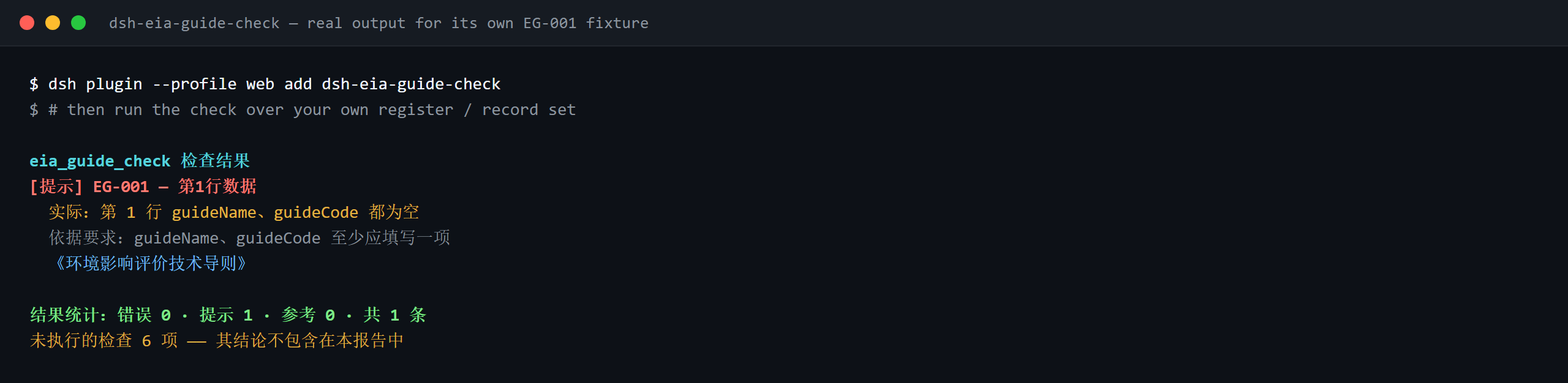
Real output from this plugin over its own EG-001 test fixture — not a mock-up. The rule pack ships no invented quotations, so a finding names both the clause it applied and the fact that the clause text was not obtained.
What it answers
| You ask | What it answers |
|---|---|
| One element row leaves both the guideline name and the guideline number blank. Is that reported? | Yes. EG-001 reports the row when guideName and guideCode are both empty, because the row has to name at least one of them. It checks only whether a guideline is named, never whether the named guideline is the right one for that element: the plugin holds no guideline catalogue and does not map an element onto a guideline. |
The guideline number is written as HJ 2.3, with no year. Is that caught? |
Yes. EG-002 checks the form HJ <number>—<four-digit year>, as in HJ 2.3—2018, so a value without the four-digit year does not match and is reported row by row. It checks the form only: not whether the number exists, not whether it is current, and not whether it matches the name beside it. A blank guideCode cell is left alone — empty values stay outside this form check. |
The status column says 现行. Why was it never checked? |
Because EG-003's values list ships empty, meaning the status vocabulary is not configured yet: the rule reports itself in skipped, with the reason that this vocabulary is the institution's own, rather than passing silently. Once configured, it checks only whether the filled value is on that list — not whether the guideline is really in force. |
The assessment method is filled in, but the standard column still reads 【待填】. Is that caught? |
EG-004 requires only that one of method or standard is filled, so a filled method satisfies it; it does not judge whether the method applies or the standard is correct. The leftover placeholder is caught by EG-007, which reports the first configured term it finds in the standard column (【, 】, XXX, 待填, TBD, 示例 and similar). Those terms are adjustable, and a wholly empty standard cell is reported by neither rule. |
地表水 is registered twice, once for water quality and once for sediment. What happens? |
EG-005 reports the repeated element value and names the earlier row it matches, because a duplicate makes it impossible to tell which guideline governs that element. It compares the text with whitespace removed only, and the finding needs human confirmation: assessing one element by medium is normal, so write the sub-item into the element name instead of deleting the row. With no element column the rule reports that it could not run rather than passing silently. |
| The header carries no project name and no report type. What happens? | EG-006 reports the header as missing project and reportType, because the report type (报告书/报告表/登记表) decides which set of requirements applies. It checks only that the header declares them; it does not judge whether the type was classified correctly. |
Standards it follows
| Document | Number | Cited by rules |
|---|---|---|
| 《环境影响评价技术导则》系列 | 各导则现行版本号本次未逐一核实 | EG-001, EG-002 |
| 本机构环评质量管理口径(本机构配置) | 无统一标准(本条依据为本机构配置的状态口径) | EG-003 |
| 《环境影响评价技术导则 总纲》 | HJ 2.1(现行版本号与条号本次未核实) | EG-004, EG-005, EG-007 |
| 《建设项目环境影响评价分类管理名录》 | 现行版本与条号本次未核实 | EG-006 |
Boundary: this plugin checks an 环评导则适用性核对表 for traceability — that each environmental element names its applicable guideline, that the guideline number follows its published form, that the guideline's status comes from your vocabulary, that an assessment method or an applicable standard is recorded, that elements are not double-registered, that the sheet names its project and report type, and that no placeholder survives. It does not decide whether an environmental assessment is compliant, whether the assessment level is right, whether a prediction model applies, or whether the conclusions hold.
⚠️ What this plugin deliberately cannot do
It does not contain the guideline catalogue, and it does not map an element onto the guideline that should govern it. Because of that it cannot find the most consequential error: using the wrong guideline for an element. Choosing between HJ 2.2, HJ 2.3, HJ 2.4, HJ 964 and the rest turns on the project's category and the element in question, and confirming it means reading the classification list and each guideline's scope. This limit is stated in the pack's header, in
EG-001's note, and in the troubleshooting section below.The 适用导则 column is therefore the register's own statement. Everything here checks what can be checked mechanically: is it written down, does the number look like a guideline number, is the status one you recognise, is a method or standard recorded.
The plugin also ships no current-version table — tracking which guidelines are in force and which have been superseded means following the ministry's announcements, and the status vocabulary is yours to configure.
EG-002checks the form of a number (HJ 2.3—2018) and never whether that number exists, is current, or matches the name next to it.Every
excerptin the rule pack says, in so many words, that the clause text was not obtained — the verification pass did not retrieve the guidelines' verbatim text, nor verify each one's current version. When the texts are in hand, replace eachexcerptwith the real clause and raisekindtodirect.
Compatibility
| Surface | Status |
|---|---|
| Harness | Peer range >=0.1.2-rc.1 <0.2.0 || >=0.2.0-0 <0.3.0 — verified to accept both 0.2.0-rc.2 and 0.2.1-alpha.1. engines.dsh is deliberately not declared: it has no reader and cannot reject a host |
| Node | `^22.19.0 |
| Platforms | All (plain ESM; no native code, no network, no model call) |
| Tool mode | Works in native, ptc and both; for a full assessment sheet use ptc |
What it does
Registers the eia_guide_check tool. It reads one guideline-applicability sheet — the project header plus one row
per element — applies a versioned rule pack, and returns a report.
| Rule | Check | Severity | Basis kind |
|---|---|---|---|
EG-001 |
each element names its applicable guideline | warn | principle |
EG-002 |
the guideline number follows its published form | warn | principle |
EG-003 |
the guideline status comes from your vocabulary (off by default) | info | local |
EG-004 |
a method or an applicable standard is recorded | warn | principle |
EG-005 |
elements are not double-registered | warn | principle |
EG-006 |
the sheet names its project and report type | warn | principle |
EG-007 |
the standard column holds no unreplaced placeholder | warn | principle |
Install
dsh plugin --profile <name> add dsh-eia-guide-check
dsh --profile <name> --dump-config | grep 'dsh-eia-guide-check'
Configuration
| Key | Type | Default | Description |
|---|---|---|---|
rulesFile |
string | rules/eia-guide-check.yaml |
Rule-pack path, relative to the package root |
disabledRules |
string[] | [] |
Rule ids to stop running; each appears in skipped |
onlyRules |
string[] | [] |
Run only these rule ids; empty runs every rule |
skipNotes |
string | "" |
Note appended to every skipped reason |
timeoutMs |
number | 120000 |
Cooperative tool timeout budget |
Rule-level parameters worth knowing:
EG-002pattern— the number's shape,HJ 数字(可带小数)—四位年份by default. Widen it if your register writes numbers another way.EG-003values— your status vocabulary, e.g.[现行, 已废止, 被替代, 部分适用]. Empty means no check; no current-version table is built in.EG-007terms— the placeholders to look for.
Material format
The tool accepts JSON or YAML:
project: 某某建设项目
industry: 某某行业
reportType: 报告书
compiler: 某某环评单位
rows:
  - { 序号: '1', 评价要素: 环境空气, 导则名称: 环境影响评价技术导则 大气环境,
      导则编号代码: HJ 2.2—2018, 导则状态: 现行, 应用章节: 第 5 章 大气环境影响预测与评价,
      评价方法: AERMOD 预测模式, 评价范围: 二级评价,边长 5 km 矩形,
      评价因子: PM10、PM2.5、SO2、NOx, 执行标准: GB 3095—2012 环境空气质量标准 }
Column names are matched case-insensitively and ignoring spaces, underscores and hyphens; the sheet's own column names are kept, so a finding names the column it read.
Rule sources
Rule data lives in rules/eia-guide-check.yaml. Its header explains that the plugin holds no guideline
catalogue, does no element-to-guideline mapping, and did not verify each guideline's current version. The
load-time guard still requires a document, clause, excerpt and source per rule, and still forbids a
principle-derived or locally configured check from being error.
Troubleshooting
- It did not flag the wrong guideline for an element. By design: it has no catalogue and never maps an element to one. Confirm against the classification list and each guideline's scope yourself.
EG-002passes a number I know is withdrawn. The check reads the number's form, never its validity or currency. Tracking versions is a different job.EG-002fires on a number I wrote correctly. The pattern wants theHJprefix, the number, and a four-digit year separated by a dash or em dash. Adjust the pattern, or fix the cell.EG-003never runs. Its vocabulary is empty; fill it with the statuses your quality system uses.EG-005fires on two rows for one element. Assessing one element by medium (surface water quality and sediment, for instance) is legitimate — write the sub-item into the element name rather than deleting a row.- The plugin installs but the tool never appears. Check that
mainresolves tolib/index.mjsand thatpnpm run buildproduced it; a wrongmainmakes the loader skip the entry silently. dsh plugin addrefuses the package as incompatible. The peer range covers0.1.xand0.2.x; if your runtime sits outside it, grant an explicit exemption:dsh plugin --profile <name> allow-version dsh-eia-guide-check@0.1.0 --dsh-version <runtime> --accept-riskcheckreportsmanifest-peersas failed. The static checker compares against a hard-coded peer range that predates the 0.2 line. The runtime enforces peer compatibility at install time, so the declared range is the correct one; this is a known upstream issue indsh-plugin-dev.
Development
pnpm install
pnpm run typecheck   # tsc --noEmit
pnpm test            # vitest, the shared table-plugin suite plus paired fixtures
pnpm run build       # tsdown -> lib/index.mjs + lib/index.d.mts
node ../scripts/sync-shared.mjs dsh-eia-guide-check   # refresh src/shared from ../_shared
The plugin is data-only: src/model.ts declares the table shape, the shared kit supplies the reader and
the check engine, and the rule pack declares every check.
License
Apache License 2.0 © 2026 dsh-eia-guide-check contributors.
No comments yet. Be the first to write one.