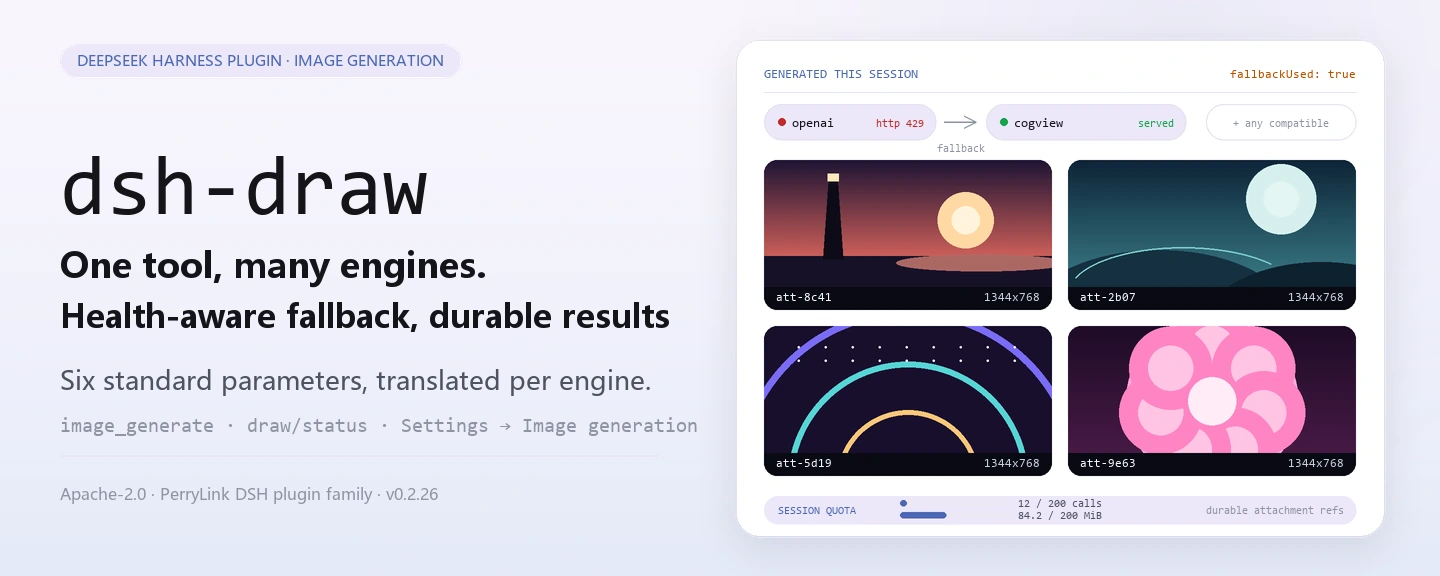
dsh-draw
Unified static-image generation routing for DeepSeek Harness.
One tool, many engines — health-aware fallback, durable results, counted usage.
简体中文 · Español · Português · हिन्दी
🧊 FROZEN since 2026-10-05 — only real breakages are fixed. The ecosystem has converged on a more widely adopted implementation, recorded below.









dsh plugin --profile <name> add dsh-draw
Community plugin, not affiliated with DeepSeek. Canonical repository: https://github.com/PerryLink/dsh-draw (Gitee is a mirror).
Install & uninstall
- git channel (latest
main):dsh plugin --profile web add github:PerryLink/dsh-draw— thepreparescript builds with production dependencies only. - npm channel (published releases):
dsh plugin --profile web add dsh-draw. - tarball channel:
pnpm packin this repo, thendsh plugin --profile web add ./dsh-draw-<version>.tgz. - uninstall:
dsh plugin --profile web remove dsh-draw(or remove the row from the profile patch).
If pnpm reports
ERR_PNPM_IGNORED_BUILDSfor this package (esbuild's harmless platform-binary validation), addallowBuilds: { esbuild: true }to yourpnpm-workspace.yaml— thedshCLI prints the exact snippet.
⭐ 如果它帮到了你
这个插件是 DSH 插件家族的一员(95 个,全部 Apache-2.0)。如果你在用,给个 star —— 它不会解锁任何功能,但会让下一个人在搜索里更容易找到它。
English: part of a 95 plugin family for DeepSeek Harness. If it is useful, a star helps the next person find it — nothing is gated behind it.
What is dsh-draw?
Unified static-image generation routing for DeepSeek Harness.
One tool, many engines — health-aware fallback, durable results, counted usage.
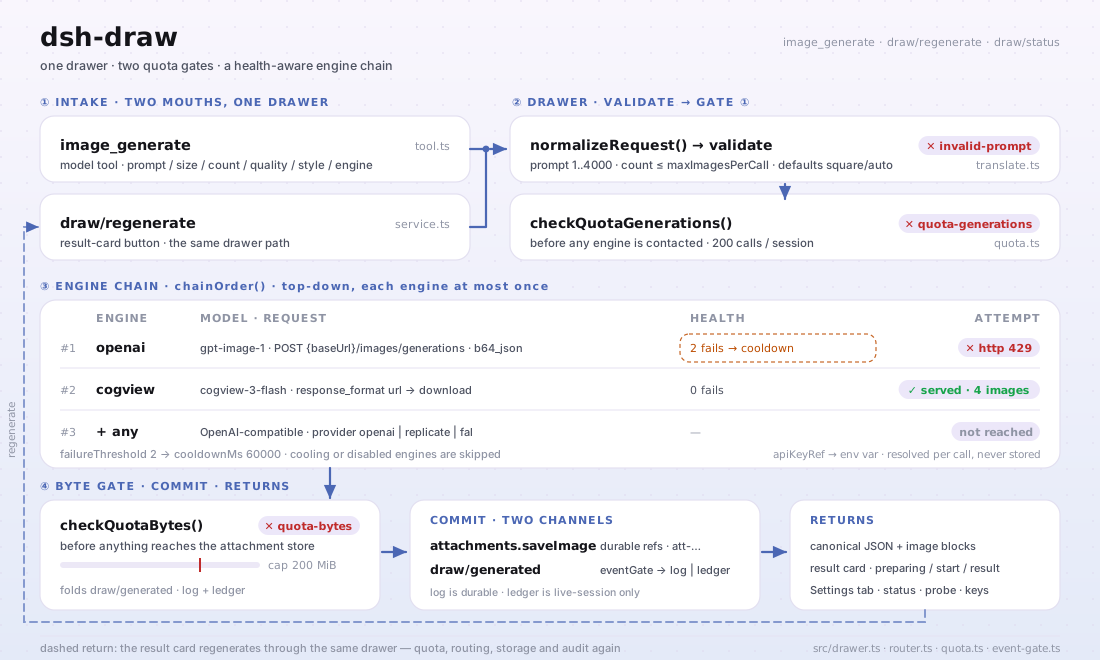
Structure: the tool and the card's regenerate converge on one drawer — validate → checkQuotaGenerations (before engine spend) → the engine chain with cooldown health → checkQuotaBytes (before storage) → durable attachment refs plus a gated draw/generated event. The dashed return is regenerate re-entering the same path, so it cannot skip quota, routing, storage or audit. The examples below use the real command surface.
Maintenance status: 🧊 FROZEN
Frozen on 2026-10-05. No new features. This package still works, and it is not retired — but it no longer receives feature work. Only a genuine breakage will be fixed.
Maintainers treat this capability as one where the ecosystem has converged on a more widely adopted implementation, so effort has moved elsewhere. The comparison below was measured on 2026-10-05 and is recorded so nobody has to redo it.
| package | weekly downloads | |
|---|---|---|
| this package | dsh-draw |
973 |
| more widely adopted implementation | dsh-image-gen |
7,216 |
| another alternative | @goodandready/dsh-image-gen |
4,822 |
Why it is the mainstream choice. dsh-image-gen provides Gemini, OpenAI, Seedream, DashScope and a local ComfyUI in one plugin.
Compatibility. declares no dsh peers, so the compatibility guard never blocks it.
👉 For new work, dsh-image-gen is the mainstream choice. Existing installs keep working unchanged; nothing is being removed.
Full evidence, including the host-version compatibility matrix: dsh-plugin-supersession-review-20261005.md.
Comparison
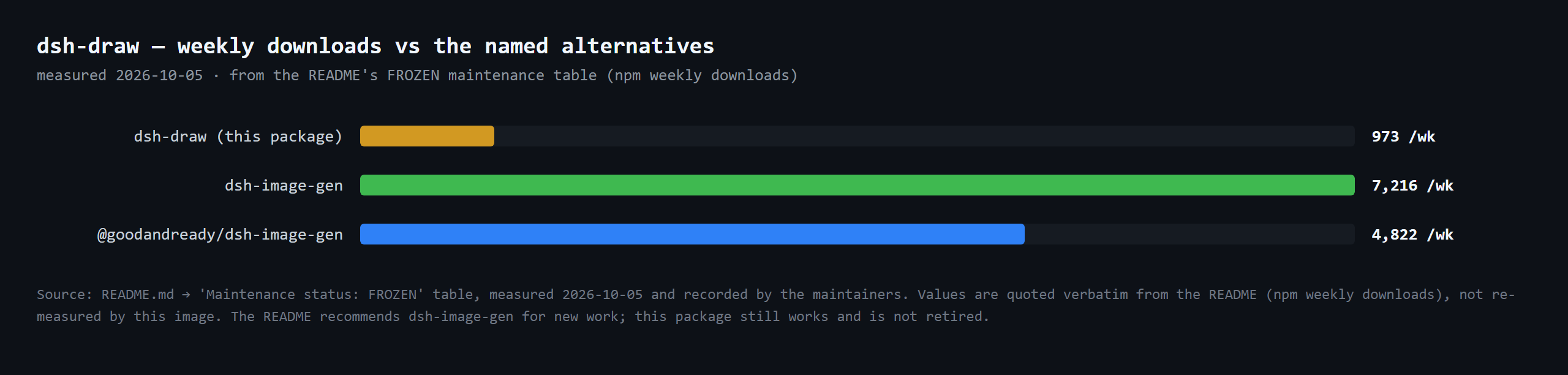
measured 2026-10-05 · from the README's FROZEN maintenance table (npm weekly downloads)
Compatibility
| Surface | Status |
|---|---|
| Harness | DeepSeek Harness dsh-v0.2.1-alpha.1 (compat declared for 0.1.5-rc.2) |
| Node | ^22.19.0 || >=24.0.0 |
| Engines | Any OpenAI-compatible images endpoint; presets for OpenAI Images (gpt-image-1) and Zhipu CogView (cogview-3-flash) |
| Surfaces | Host image_generate tool + web result card + Plugins settings tab |
The browser half rides the cordis Context and the published client packages (dsh-client-ui-slots, dsh-client-ui-settings, dsh-client-ui-tool, dsh-client-locale, dsh-client-connection); it no longer depends on the removed dsh-client-runtime package (the tool-call block is read through a local structural contract), so the client surface also lines up with 0.1.2-rc.1 hosts.
0.1.2-rc.1 (adapted 2026-09-02): the session envelope keeps its ignorable field for stored-log read compatibility only - Session.append still cannot stamp it, so audit-gate behavior is unchanged. Verified 2026-09-06 against the dsh-v0.1.7-alpha.1 master checkout (full gate chain + profile install smoke).
0.1.6-alpha.2 (adapted 2026-09-18): Session.append's third parameter exists only for surface-eligible event types and is a SurfaceIntent, never an ignorable envelope, so draw/generated (a non-surface type) is still not written on this line — quota is counted in memory per session and resets when the session restarts, exactly as the "Quota durability" note below describes. Verified 2026-09-18 (dual typecheck rulers + the full suite + self-contained/artifacts/readme gates).
0.1.7-rc.2 (adapted 2026-10-04): the client tool.call.toolview contract split its owner into three stages (preparing / start / result), and a keyed card is now dispatched while the arguments are still streaming. The result card therefore also renders the in-flight row for those earlier stages — an occupied keyed slot never reaches the host's own generic row, so answering a prepared stage with nothing blanked the line for the whole streaming window. Nothing else changed: the settled card, the accounting line, and regenerate behave exactly as before. Verified 2026-09-23 (dual typecheck rulers + the full suite + the new host-contract gate).
What you get
dsh-draw gives the harness one unified image_generate tool with standard parameters (prompt/size/count/quality/style/engine) that are translated per engine:
- Multi-engine routing — a config-driven chain (OpenAI Images, Zhipu CogView, or any OpenAI-compatible endpoint) walked top-down with health-aware fallback: consecutive failures push an engine into cooldown, and the next healthy engine serves the call.
- Durable results — generated images are saved as workspace attachments (content-addressed, under the harness's attachment policy) and returned as canonical file references.
- Quota accounting — per-session caps on generation calls and image bytes, folded from the durable session log and enforced before engine spend and before storage.
- Credentials as references — engine API keys are environment-variable names resolved per call through the official
ctx.credentialsseam; literal keys are never stored in configuration and never logged. - Web surfaces — an in-conversation result card (images, engine, quota, one-click regenerate) and a Plugins settings tab (engine chain, credential status, probes, quota limits).
model                           harness
  │ image_generate {prompt, ...} ──▶ validate ──▶ quota check ──▶ router
  │                                  openai ──(fail)──▶ cogview ──▶ images
  │ ◀── canonical JSON + image blocks (durable attachment refs)
  │                       └── draw/generated session event (quota + audit)
Quick start
dsh plugin --profile web add github:PerryLink/dsh-draw
# 1. install the bundle into your profile
dsh plugin --profile web add github:PerryLink/dsh-draw

# or from npm (published releases)
dsh plugin --profile web add dsh-draw

# 2. provide the engine keys as credential references (environment variables)
#    OPENAI_API_KEY and/or ZHIPU_API_KEY — never in the profile patch

# 3. restart and verify the row
dsh --profile web --dump-config | grep -A2 'id: dsh-draw'
Then ask the agent to draw:
> Draw a 1536x1024 landscape of a lighthouse at dusk, vivid style.
Examples
These are the plugin's real entry points; install once, then call one.
Detailed example
Command
image_generate
Input
{
  "prompt": "a cat"
}
Output
{
  "ok": true,
  "engine": "openai",
  "images": [
    { "attachmentId": "att-1" }
  ]
}
Observed from plugins/dsh-draw/tests/index.spec.ts:50-66; same fields asserted at plugins/dsh-draw/tests/drawer.spec.ts:59-69
Failure branch
Input
{"prompt":" "}
Output
Error: image_generate: prompt must be a non-empty string
Observed from plugins/dsh-draw/src/drawer.ts:141-147; plugins/dsh-draw/src/tool.ts:137-140; plugins/dsh-draw/tests/drawer.spec.ts:77-82
Brief examples
Configuration
All tunables are Schemastery Config fields (changeable from cordis.yml). An id-targeted override replaces the whole row — restate every key you need. cordis.patch.yml documents each key inline.
| Key | Default | Meaning |
|---|---|---|
engines |
OpenAI + CogView presets | Ordered engine chain, walked top-down with fallback; each entry: id, baseUrl (no credentials), model, apiKeyRef (env-var name), provider (openai/replicate/fal, default openai), enabled, sizeMap, qualitySupported, styleSupported, responseFormat (b64_json/url), imageMediaType |
defaultEngine |
openai |
Engine id the router prefers; must name a configured engine |
requestTimeoutMs |
120000 |
Per-generation HTTP timeout (1000..600000) |
maxImagesPerCall |
4 |
Cap on images one call may produce (1..10) |
maxPromptLength |
4000 |
Prompt length cap in characters (1..32000) |
maxGenerationsPerSession |
200 |
Per-session generation-call cap (1..100000) |
maxBytesPerSession |
209715200 |
Per-session image-byte cap (1048576..4294967296) |
failureThreshold |
2 |
Consecutive failures before an engine enters cooldown (1..10) |
cooldownMs |
60000 |
Engine cooldown after the threshold trips (1000..3600000) |
Example override in your profile patch:
- insert:
    - id: dsh-draw
      name: dsh-draw
      config:
        defaultEngine: cogview
        maxImagesPerCall: 2
Tools & surfaces
| Surface | Notes |
|---|---|
image_generate |
Standard parameters; returns canonical JSON (engine/model/size, image references, quota, fallback flag, attempts) plus image content blocks |
Result card (tool.call.toolview, key image_generate) |
In every stage of the call: an in-flight row while the arguments stream, then images, engine/quota line, and one-click regenerate once it settles (full drawer path: quota + routing + audit) |
| Settings tab (Plugins → Image generation) | Engine chain, credential status, set/remove API keys (credential references), connectivity probes, quota limits |
Permissions & data
- Permissions: the plugin makes outbound HTTPS calls to the configured engine endpoints only; every other surface is read-only. The settings tab's only writes are credential set/remove calls on the official
ctx.credentialsseam. - Data: generated images are saved through the official attachment store under the harness's own attachment policy. Quota usage is folded from the
draw/generatedsession events, plus the in-memory fallback ledger on hosts that cannot log those events — nothing else is stored. - Session log: the
draw/generatedevent records engine, model, standardized request, byte totals, and attachment ids — the audit facts, never the API keys. The event is appended only when the host knows the type or honors theignorableenvelope (probed at mount); on rc.6/rc.7 hosts and the0.1.2-rc.1line (whoseSession.appendcannot stamp the marker and which fails closed on unknown types at read) the payload goes to the in-memory fallback ledger instead, so generating images can no longer make a session refuse to reopen.
Security boundaries
- Credential references, never literals.
apiKeyRefnames an environment variable; abaseUrlembedding credentials fails the load loudly. - Sanitized display. URLs, probe notes, and error text are redacted (userinfo passwords, credential query values, bearer tokens, JWTs) before any display or log.
- Quota before spend. Generation and byte caps are checked before engine calls and before attachment storage; exhausted sessions fail fast without spending engine credits.
- Fail loud, fall back deliberately. Malformed responses surface as structured errors; a failing engine is skipped after its cooldown threshold, and a fully exhausted chain returns the complete attempt record instead of pretending success.
Known limitations
- Image models only. No video, audio, or edit endpoints; no vision understanding.
- Engine compatibility. Three vocabularies are supported through the provider seam:
openai(thePOST /images/generationsshape),replicate(prediction create + poll), andfal(thefal.runqueue). Provider-specific extras beyondprompt/size/count (e.g. seed, scheduler) are out of scope. - Cost awareness is structural. The plugin counts calls and bytes but does not know engine pricing — pair with
dsh-budgetfor cost governance. - Quota durability on rc.6/rc.7, 0.1.2-rc.1 and 0.1.6-alpha.2. On hosts whose session log cannot carry
draw/generated(static event whitelist, noignorableenvelope;0.1.2-rc.1cannot stamp the marker and fails closed on unknown event types at read; on0.1.6-alpha.2the append's third parameter is aSurfaceIntentfor surface types only, so a non-surface event cannot be marked), quota stays exact for the live session from the in-memory fallback ledger but resets on restart; durable accounting resumes on hosts with a plugin event surface. The first refused commit warns once, so a degraded session is visible instead of silent.
Development
pnpm install        # node ^22.19 || >=24
pnpm run typecheck  # tsc: src + tests against the local harness checkout
pnpm run typecheck:ci  # tsc against the published 0.1.7-rc.2 faces (no paths)
pnpm test           # vitest: 19 spec files (scripted transport, real Context/Session/ToolRuntime)
pnpm run build      # tsc declarations + tsdown bundles (lib/)
pnpm run verify:self-contained  # dependency specs resolve from the registry
pnpm run verify:host-contract   # the host tool-view contract still matches what this plugin declares
pnpm run verify:artifacts       # host ESM face + typert manifest + browser bundle + config files
pnpm pack           # the published tarball
Topics
dsh, dsh-plugin, deepseek-harness, deepseek, cordis, image-generation, openai-images, cogview, zhipu, text-to-image
Contributors
- @PerryLink — creator and maintainer: engine router, drawer, quota accounting, Typert wire vocabulary, browser half, and the five-language docs.
- @Mohei-Muun — reported the
draw/generatedsession-log unload bug on rc.7 hosts (#2), which led to the adaptive event gate.
PerryLink DSH Plugin Family
This project is part of the DeepSeek Harness plugin family from PerryLink. The roster stays collapsed below so every README keeps a short first screen; expand it to see every row and its status.
Expand all pluginsLicense
Apache License 2.0 © 2026 dsh-draw contributors
No comments yet. Be the first to write one.