
NeoXider Agent Deck
Your agents, within reach. And a slime that lives on your desktop.
A desktop chat for DeepSeek Harness, a live session board, a little pet that climbs your screen, or just a glowing hinge.








Download · Meet the pet · Get started · What's new · Security
Agent Deck brings DeepSeek Harness onto your desktop. Follow several agents at once, carry on a conversation, change models, answer an agent's question and share a screenshot without leaving what you are doing. Fold the chat away when you need the room and a green slime keeps you company instead: it tells you when an agent finishes, asks you when one needs you, and spends the rest of its time climbing, hopping and napping around your screen.
Meet the pet
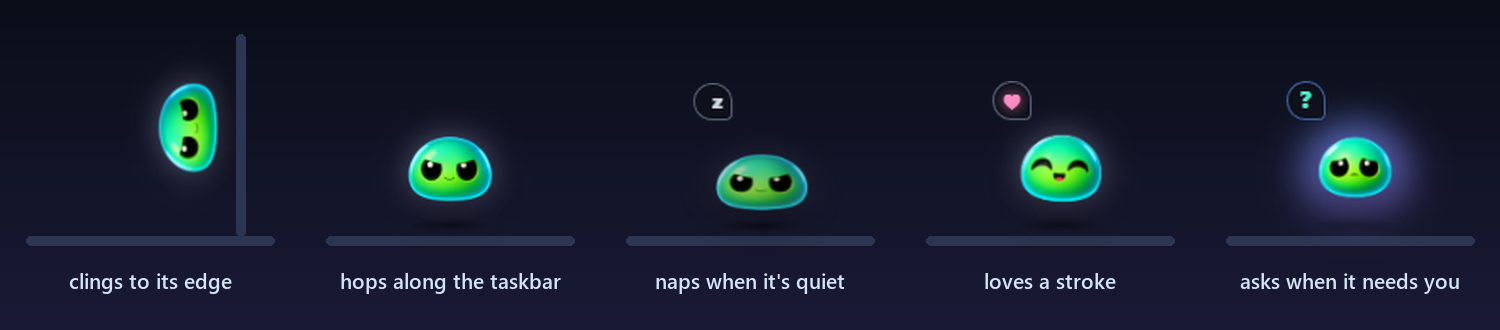
Fold the widget and it becomes a slime. The slime is a proper desktop pet, built the way the classics are (Shimeji, eSheep, oneko): a small state machine picks its next move by weight, gravity is real, and it rests far more than it moves.
| It… | When |
|---|---|
| clings to its screen edge and inches up and down it | most of the time; the edge is home |
| drops to the taskbar and lands with a squash | now and then, under real gravity |
| hops along the taskbar, looks around, sits, scoots | when nothing needs you, never past the middle of the screen |
| climbs back home | after a while away, or whenever it feels like it |
| naps with its eyes shut, z's floating up | after a minute and a half of quiet; the pointer or any agent wakes it |
| blushes and squishes with a ♥ | when you stroke it: move the pointer back and forth over it |
| flies where you throw it | grab it and fling it; it bounces off the top of the screen and lands on the taskbar or its wall |
| splats into drops and pulls itself back together | after a high fall or a hard throw at its wall; the harder the hit, the farther the drops fly. A short hop down only squashes it |
| holds still | while you point at it, a notification or the panel is open, an agent works, or motion is reduced |
| nudges you with a ?, looking curious, or with a ! | when an agent asks a question or fails |
| celebrates | when an agent finishes |
Its glow is its own silhouette in the colour of what the agents are doing. Hover it and three little buttons appear: recent chats, status (the eye: every message the agent writes, or only finished replies), and folding into the screen edge. Pet mode can be switched off in Settings → Pet mode; the slime then stays put at its edge.
Four ways to stay connected
| Chat Messages, tools, attachments and model controls. 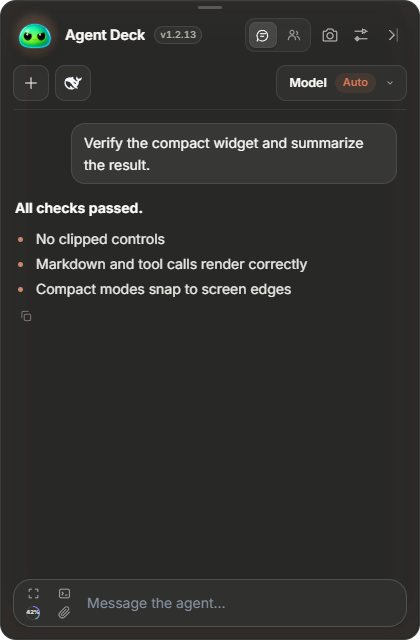 | Sessions See who's working and jump into any session. 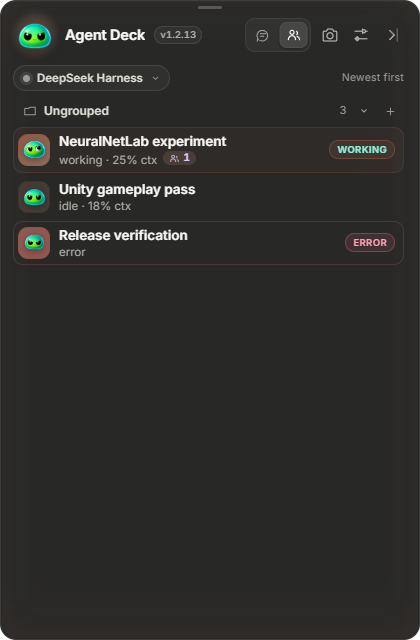 |
| Avatar The slime, with recent chats and a message box. 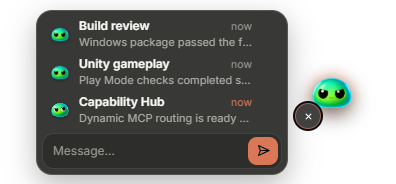 | Hinge A discreet status handle at the screen edge.  |
These are screenshots of the UI with demonstration sessions. Avatar and Hinge are called Orb and Edge in some internal settings and diagnostics. Hover the hinge and a little slime peeks out above it: click it to become the avatar again.
Small window. Full conversation.
- Answer the agent here. When an agent stops on a question, it appears above the message box with its options. Answer or skip without opening the browser, or fold it into one line for now to read the chat under it, and open it again when you are ready.
- Chats from the avatar. Click a recent chat to address the message box to it; click it again and the chat opens right in the panel, its newest messages above the same message box, so you read the answer and reply without leaving the slime. The arrow beside a chat opens the full chat.
- Subagents in sight. The chip under the Thinking line counts subagents and background jobs as working/total (
Subagents 2/29 · Jobs 1/3); open it to see each one working, stop it, read a job's output, or open a subagent as a chat of its own and write to it. - Fast on long chats. A chat opens on its newest messages and fetches older ones as you scroll; a chat of thousands of messages opens in a fraction of a second, and one you opened before is back instantly.
- Open what the chat points at. Click an image, an attached file, a link to a file or a path an agent writes, and it opens in a viewer window: images to zoom, Markdown to read, code highlighted at the line named.
- What it cost. Hover the context meter: spend and cost per turn, context and what fills it, turns and tool calls, tokens and cache hits, time worked. A chat's spend includes its subagents, every level down, each at its own model's price, and the card splits it into the chat and its subagents. A subagent's chat shows the same in its bar. A local build of a listed model (Qwen3.8 Flash in LM Studio, say) is priced as that model; any other local model is free.
- Pin, delete, undo. Pin a chat to the top of its group or delete it from its card's menu; deleting archives it the way DSH does, and Undo brings it back.
- One model and effort control. Open the combined chip, adjust reasoning on the slider, or choose another model from the same menu.
- Agent presets in one click. The chip beside the model names the preset the chat runs. Pick another to start a new chat with it, in the same workspace. Deck remembers the pick for new chats, and the model menu has the same choice under "Choose model".
- Readable activity. Streaming Markdown, grouped tools, queued messages, a compact goal strip and context usage. Background jobs have their own waiting state.
- Motion that feels like a Mac. Folding shrinks the window into the slime or the edge on a spring and it grows back out the same way. Buttons, menus and new tool calls bounce a little.
- Your space, your look. Claude (the Claude Code colours, the default), Aurora, Graphite, Midnight, Cyberpunk and Cave themes; custom images, saved design profiles, separate background and text opacity.
- Text that reads small. Inter is bundled and is the default, with tall lowercase letters that stay legible at small sizes. Settings → Font lists System UI, Verdana, Tahoma, Calibri and Arial as well.
- Screenshots in one shortcut. Capture for review, or send the current screen straight to the selected chat. Deck stays on screen but out of the picture.
- Harness taken care of. No DeepSeek Harness installed? Deck installs it. A new stable release? Deck says so once and puts a DSH x.y.z chip in the title bar; one press installs it next to the running one and switches. Running DSH Desktop instead? Deck can follow its Harness too.
| Agents Newest first, pins on top, Recent above the groups. 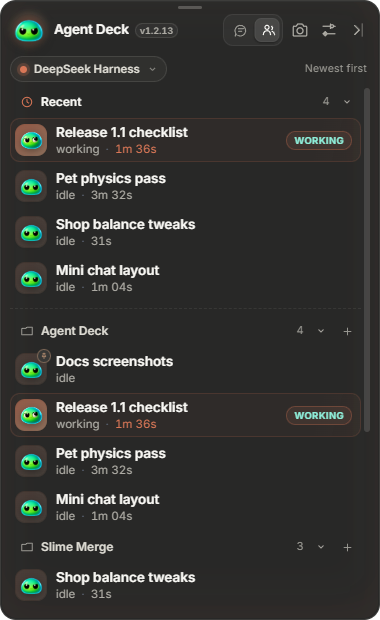 | Subagents Everything working under a chat, stoppable. 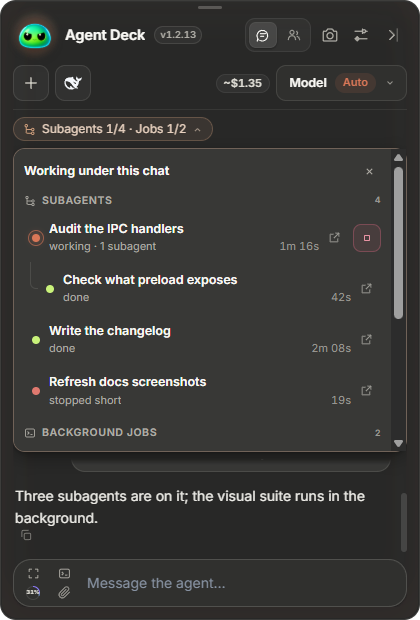 | What it cost Hover the context meter. 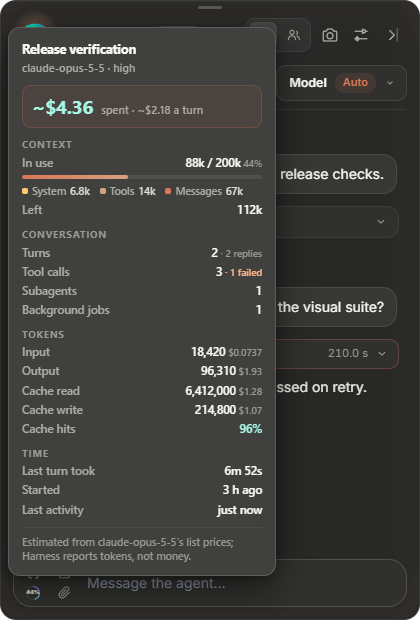 |
Get started
- Download the installer or portable build from Releases. The source version may be newer than the latest public release.
- Start Harness Web at
http://127.0.0.1:3080, or press Start in Deck's offline banner. With no Harness on the machine, Deck installs the stable DeepSeek Harness runtime with npm (Node.js 22+ required) and starts that. - If Harness asks for authentication, use Connect and paste the
dsh web:launch URL once. Pick a session and start chatting.
Deck updates itself through Settings → Updates and keeps Harness current through Settings → DeepSeek Harness: it checks npm every few hours for a newer stable release, announces it, and installs and switches to it when you press Update, never on its own, so agents are not cut off mid-turn. The same section picks which Harness Deck follows: its own, the one inside DSH Desktop, or whichever is running. Windows is the primary target; macOS and Linux packages are experimental. Current builds are unsigned, so SmartScreen or Gatekeeper may ask for confirmation.
Window layers and private capture
| Layer | Behaviour |
|---|---|
| Desktop | Desktop layer: every ordinary window covers the widget, including compact modes. |
| Above | Stays above ordinary app windows. |
| Always on top+ | Reasserts its position above ordinary and borderless windows. |
| Private overlay | Windows only: stays above apps and requests exclusion from supported screenshots and screen sharing. |
Private overlay uses Windows capture exclusion through Electron content protection. On Windows 10 version 2004 and newer, supported capture methods omit the window; older versions may show a black area. Some recording methods can ignore the request. It is not a guarantee against every capture tool, nor does any layer guarantee visibility over exclusive fullscreen games. A native Xbox Game Bar companion is available separately.
Shortcuts
All shortcuts can be changed or disabled in Settings → Shortcuts.
| Default shortcut | Action |
|---|---|
| Ctrl+Alt+Shift+Space | Show Deck; press again to collapse it back to the avatar or strip |
| Ctrl+Alt+Shift+F | Toggle Focus chat |
| Ctrl+Alt+Shift+A / E | Collapse to Avatar / Hinge |
| Ctrl+Alt+Shift+N | New session |
| Ctrl+Alt+Shift+H | Open the current session in Harness |
| Ctrl+Alt+Shift+D / S | Capture display / region for review |
| Ctrl+Alt+Shift+Enter | Capture the monitor under the pointer and send it immediately |
Immediate capture keeps your draft and foreground focus. The snapshot goes to the session selected when the shortcut was pressed. On macOS, use Command in place of Ctrl for supported shortcuts.
Open Harness from your phone
Enable Device access on Wi-Fi in the tray menu. Open the phone address on the same trusted network, request access, compare the code and approve the browser on your computer. Deck keeps Harness authentication inside its local proxy; you do not need to copy a launch token to the phone.
Run from source
Requires Node.js 22+ and a Harness Web profile.
git clone https://github.com/NeoXider/neoxider-agent-deck.git
cd neoxider-agent-deck
npm ci
npm start
Set DSH_WIDGET_URL for a different Harness endpoint. Source version 1.2.17 stops a background run_code from leaving a chat that DeepSeek Harness 0.2.2 refuses to open. 1.2.16 brings back the context meter and the context card's numbers on DeepSeek Harness 0.2.2, which stopped listing them. 1.2.15 makes a preset pick reuse the open empty chat, or an empty chat of the same folder, instead of leaving new chats behind. 1.2.14 lets a run_code that went to the background finish again on DeepSeek Harness 0.2.2, hub searches included, and answers a tool call the model wrote as text with an unknown name with an error it can correct. 1.2.13 makes every copy button work and puts an answer's copy under it, deletes a goal from its strip, starts a goal Harness left stopped, stops the round when you pause, and lists six fonts. 1.2.12 adds an agent preset chip beside the model to start a chat with any preset, a font setting with bundled Inter as the new default for small text, and DSH integrations that run tool calls a local model wrote as text and give a preset memory across sessions. 1.2.10 shows the end of a long message as you type it and keeps the Stop button after a stop while a goal goes on. 1.2.9 lets you fold the agent's question away for now and open it again. 1.2.8 keeps the amount in the context card on one line. 1.2.7 counts what a chat's subagents spent in its spend, each at its own model's price. 1.2.6 opens a chat inside the avatar's panel on a second click, its newest messages above the same message box, and the arrow beside a chat opens the full chat. 1.2.5 shows a subagent's context, spend and model in its chat, keeps the Thinking card up for the rest of the turn, and prices a local build of Qwen 3.8 as the model it was built from. 1.2.4 finds new releases even on a computer that sleeps. 1.2.3 lets you write and queue messages while /compact runs. 1.2.2 shows where DeepSeek Harness 0.2.1 compacted a chat, keeps the Thinking card to thinking, lists the newest subagent and job answers first, and shows a model on your own machine as free. 1.2.1 stays smooth while many chats stream at once: a streaming answer is formatted a block at a time, the conversation no longer makes the panel measure the whole transcript on every word, and chats already streaming live are not re-read on every poll. 1.2.0 lets you write to a continuable subagent from its chat, wears the Claude Code colours as its default theme, counts subagents and jobs as working/total under the Thinking line, and keeps Thinking steady in a subagent's chat. 1.1.3 opens a subagent's chat again on DeepSeek Harness 0.2.1, which refused to show it. 1.1.2 installs a downloaded update by itself while Deck sits as the avatar or strip with nothing typed, attached or sending, and makes the show shortcut collapse the widget back when pressed again. 1.1.1 keeps the avatar a plain pet while Harness is off, with no card or notification beside it. 1.1.0 opens long chats at once, takes screenshots in a tenth of the time, follows DSH Desktop's Harness as well as its own, updates Harness to a new stable release with one press, shows a chat's subagents and background jobs and opens a subagent as a chat, pins and deletes chats, opens images and files from the chat in a viewer window, and shows what a chat has cost when you hover its context meter. 1.0.1 let you grab the pet and throw it. 1.0.0 turned the avatar into a desktop pet, answers the agent's questions inside Deck for real, opens a chat from the avatar as a small window beside it, installs and updates DeepSeek Harness, and makes folding and unfolding start at once with no flash. Every earlier release is in the changelog.
Verify and build
npm test
npm run test:gate
npm audit --audit-level=high
npm run build
npm run test:gate runs the whole release gate in about four minutes: the unit tests, the visual suite on a pool of workers (npm run test:ui, or node scripts/ui-visual-smoke.cjs --failed to rerun only what failed), the Electron smokes, and npm run test:scale, a benchmark of forty sessions with thirteen streaming at once over a 2,400-message chat. Each suite's time and a rerun hint are printed at the end.
The tests cover session contracts, streaming, attachments, window geometry, compact layouts and the pet's behaviour. npm run test:harness -- --entry /absolute/path/to/dsh/lib/bin.js runs real Harness acceptance in an isolated home against a local deterministic model server without touching user chats or credentials. Add --compaction to exercise automatic and manual compaction. npm run test:dsh-integrations -- --entry /absolute/path/to/dsh/lib/bin.js runs Deck's DSH integrations the same way in a headless Harness: background run_code, tools called after the hand-off, and recovery of calls written as text. Release CI builds Windows, Intel and Apple Silicon macOS, Linux and the Game Bar companion, then publishes checksums with the artifacts. The Windows portable output is release/NeoXider-Agent-Deck-1.2.17-windows-x64-portable.exe.
Trust and integration
Deck uses Harness RPC directly. It does not scrape the web UI or read provider API keys. The renderer is sandboxed; file preparation and requests pass through a narrow IPC bridge.
Sessions created or prompted through Deck are set to Harness danger-full-access. Agents may read, write, run commands and use configured tools without another permission prompt. Use trusted models, workspaces and MCP servers. See SECURITY.md.
- NeoXider MCP Hub: load tools on demand.
- DSH background code integration: return long-running scripts as background jobs and deliver their completion to the agent.
- DSH tool call recovery: run the tool calls a local model wrote as text, such as
read_fileforread, instead of ending the turn on them. - DSH memory: memory across sessions for one preset, one Markdown file per fact, with its index in the model's context.
- DSH Agent Deck integration: open the Deck widget from a Harness session and check that it is installed, running and following the same Harness.
- Architecture · Changelog · Roadmap
MIT © NeoXider
No comments yet. Be the first to write one.