@nelsonlongxiang/dsh-prompt-templates
English | 中文

Quick prompt templates for DeepSeek Harness: global and per-session templates, a right-side browser panel, and pure-TS SQLite persistence via node:sqlite — one self-contained plugin, installable with dsh plugin.
Install
dsh plugin --profile web add @nelsonlongxiang/dsh-prompt-templates
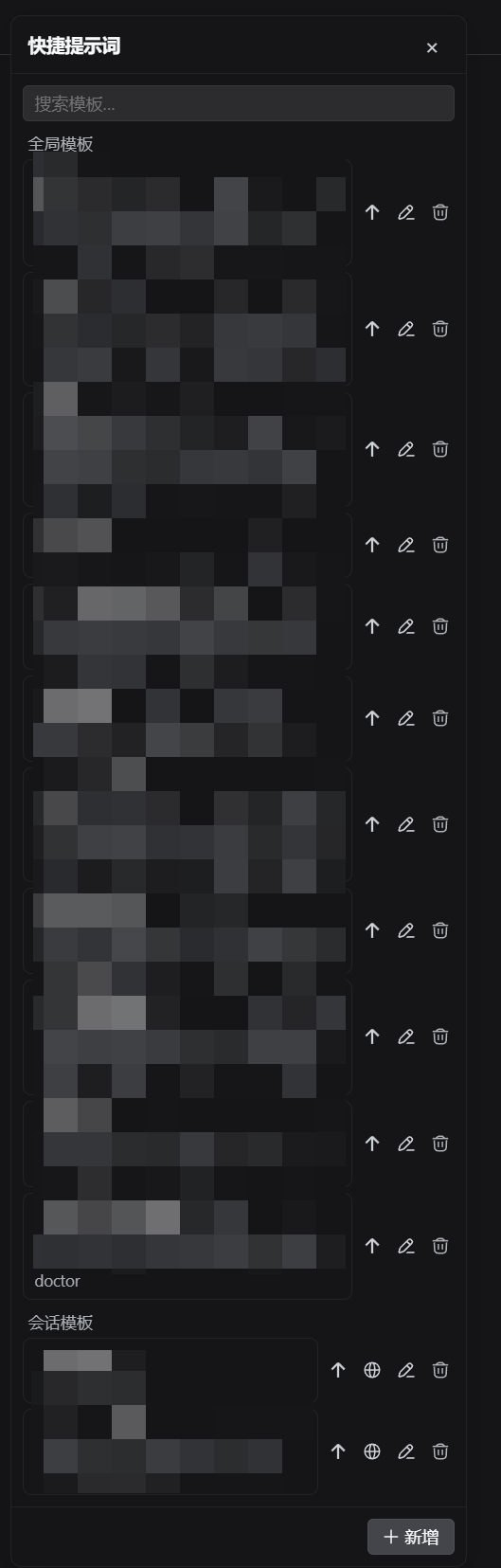
Restart dsh web, then look for the templates button in the composer tool row. Since 0.12.0 the same library is also a right-sidebar tab: open it from the sidebar's + guide page (entry “Prompt templates”) — it lives beside the conversation, keeps the composer visible, and always targets the session the sidebar is viewing. On hosts without the sidebar services the tab stays dormant and the floating panel keeps working.
No Python toolchain required — since 0.3.0 the host half persists templates through node:sqlite (Node ≥ 24) directly inside the host process, reading and writing the same $DSH_HOME/ext/prompt-templates/db.sqlite3 the former Python child owned (zero data migration).
What you get
- Global + per-session templates — globals apply everywhere; session templates stay private to one conversation and can be promoted to global in one click
- Scheduled auto-injection — per-template switch and interval: the host re-surfaces an enabled template into the model context at the first request of every Nth round, persisted in SQLite and logged as a durable session event; click the toolbar
⟳Nbadge to open the session's last 20 injections (turn, time, template names, injected bodies) - Template variables — content supports
{{date}}{{time}}{{datetime}}{{weekday}}{{session}}{{turn}}, expanded at delivery across insert, send-now, interject, and scheduled injection; unresolved values stay literal and storage keeps the raw text - Cross-instance sharing — copy one template or a whole category as a clipboard payload; paste-import on the target instance with an explicit same-name overwrite confirm
- Insert or send — one click inserts the template at the composer caret (or replaces the current selection); send-now dispatches immediately; edit, delete, and make-global all live in the row
- Right-sidebar tab — the full library also docks as a sidebar tab (DSH ≥ 0.2.x): open it from the
+guide and it follows the session you are viewing; the floating panel remains for quick one-shot use - Search & scroll — filter the list as you type, reliable scrolling for long collections
- Drag to reposition, double-click to reset — the panel remembers where you put it
- Durable by design — templates persist in SQLite through a pure-TS store (
node:sqlite) owned by the host plugin and closed with its lifecycle
Sharing (cross-instance copy)
- The row ⧉ button shares one template; the category tab ⧉ shares a whole category (member templates + the category definition)
- The payload is self-describing JSON (
format/versionmarkers) carried over the clipboard — no files, no network - Paste into the toolbar Import box on the target instance: missing categories are created, and same-name same-scope templates raise an explicit overwrite confirm — overwrite updates the existing row (content/description/category/inject facts), declining skips; the result reports created/overwritten/skipped counts
- What is shared is the raw text:
{{date}}/{{turn}}re-expand at delivery on the receiving instance
Auto-inject
Each template (global or session-scoped) carries its own switch + interval N. When on, the host injects the template at the first request of every Nth round of the conversation — N=5 means rounds 5, 10, 15, …; rounds count user→assistant exchanges and keep their numbering across restarts.
- The injected content arrives as one durable
<system-reminder>user message recorded in the session log (source kindprompt-template-schedule), so replays and audits reconstruct exactly what the model saw - A boundary round is never injected twice, even across restarts or step retries
- Config persists in the plugin's SQLite database (schema v4); the deployment can silence everything with
injectEnabled: falsein the patch config - Each template picks a delivery mode: silent (default, model context only) or visible in chat (rendered as a normal user message with a ⚙️ scheduled-injection header)
Template variables
Placeholders {{date}} {{time}} {{datetime}} {{weekday}} {{session}} {{turn}} expand at delivery time — insert, send-now, interject, and scheduled injection all expand:
- Clock variables read the local clock;
{{session}}is the target session id;{{turn}}resolves only on the scheduled-injection path (it stays literal on insert/send) - Unknown names pass through untouched — nothing is silently deleted; the template form shows a variable hint line
- Storage always keeps the raw text; expansion happens at the moment of delivery, so the history dropdown shows exactly what went out
How it works
src/                  TypeScript plugin (host half + browser half)
  index.ts            Host: owns the TS store, exposes the HTTP routes
  store.ts            Pure-TS template store over node:sqlite (schema v3)
  inject.ts           Host: scheduled auto-injection on the pre-step waterfall
  invariant.ts        Host: registers the package's invariant companion
  cli/                The sync CLI (export/diff/merge/import) shipped as bin
  client/             Browser: shared template library mounted as both the
                      shell.overlay floating panel and the right-sidebar
                      tab body (sidebar.right.pane.tab), plus the
                      conversation.input.right toggle button
cordis.patch.yml      Bundle patch: mounts the plugin row
The store is pure TS inside the host half; no child process is spawned.
Security
- Template content reaches a model request in exactly two ways: as ordinary user text the user chose to insert, or as scheduled auto-injection of templates where the switch was explicitly enabled — every injection is a durable session event
- The panel talks to the host store over the Host's plugin routes only; no extra listener, no outbound network
Database sync CLI
The package ships a deterministic, local-only CLI for comparing and merging prompt-template databases across DSH homes. It never writes a remote database directly.
# Export a schema-v4 snapshot (canonical order + data_sha256)
dsh-prompt-templates export --db /path/to/db.sqlite3 --out snapshot.json --output=json

# Compare two snapshots (exit 1 with --fail-on-diff)
dsh-prompt-templates diff left.json right.json --output=json --fail-on-diff

# Merge into a JSON artifact only; equal-time or name conflicts block by default
dsh-prompt-templates merge base.json incoming.json --strategy newer --out merged.json --output=json

# Dry-run import (the default): review summary_sha256 and database hash
dsh-prompt-templates import --db /path/to/db.sqlite3 --in merged.json --output=json

# Apply only after binding both reviewed values; creates a backup, then one transaction
dsh-prompt-templates import --db /path/to/db.sqlite3 --in merged.json --apply \
  --expect-db-sha256 <db-sha256> --confirm-summary-hash <dry-run-summary-sha256> --output=json
import inserts/updates by template id and never prunes rows. It rejects unknown snapshot fields, unsupported schemas, mismatched hashes, same-name/different-id conflicts, and changes above --max-changes (default 100). Schema-v2 snapshots (pre-auto-inject) still import — the inject facts default to off; exports are always v3.
Development
pnpm install
pnpm verify            # everyday gate (local and CI)
pnpm verify:release    # alias of pnpm verify
pnpm verify is the gate to run before pushing. It does not boot a DeepSeek Harness process. In order:
- typecheck —
tsc --noEmitfor the host project and the client project - test:cli —
node:testovertests/*.test.ts: CLI sync, store rules, schema migration, inject helpers, client filters, and an in-process host check. That check mountsapply()on Cordis with a stand-in web server, drives the/plugins/dsh-prompt-templatesroutes (including inject-status), and runs theagent/pre-steplistener against a fake session log - build — host
tsc, clienttsc, and the tsdown browser bundle - test:package — every CSS module class is present in
lib/client.js, thennpm packand the packeddsh-prompt-templates --helpshim
GitHub Actions (.github/workflows/verify.yml) runs the same command on pushes and pull requests to master. test:cli also carries the DSH 0.2.x contract tests (peer version line, patch sandbox, real store execution, slot declarations, icon exports) — upstream drift fails the gate. Repo scripts/ hold the ops stable entries (branch-budget audit, absorption classification, privacy-checked push). and on v* tags, with Node 24. The @deepseek-ai/* devDependencies are public npm packages, so CI needs no registry token and no harness checkout.
Still manual, because they need a live harness profile: booting dsh web, the browser panel against the real web server, and resume or compaction against a real session log.
Known limitations
- Session templates need a current session — with no session open, only global templates are reachable
- Injections don't render in the chat transcript — the DSH chat view omits injected context rows by design (they carry a non-
usermessage source); see them in the trajectory tab. Templates with delivery mode visible are the exception: they render as ordinary user messages - Install from the npm registry, not from a Git URL — the plugin compiles against the DSH harness checkout;
pnpm add github:<user>/<repo>fails at the prepare build step because the published@deepseek-ai/*npm snapshots lag the harness source. Usedsh plugin --profile <name> add @nelsonlongxiang/dsh-prompt-templatesinstead
License
MIT
No comments yet. Be the first to write one.