dsh-api-cost
DeepSeek cost estimation for DeepSeek Harness: peak / off-peak rates, delegation or team spend attributed to the session that caused it, folded by the host's session projections.


English · 中文
dsh-api-cost 2.0 is a TypeScript, projection-first rewrite. Instead of metering streams, replaying logs and polling on a timer, the plugin registers one pure session projection; the Harness owns the event drive, the per-session watermark, the durable checkpoint and the delivery to the browser. The client half reads the host's own projection through the framework useProjection seat.
What that buys you:
- Correct history without a recount button — the first read of a session, a resumed conversation, or a restart all fold from the durable log through the host's checkpoint cache, so a figure never starts at ¥0 and never double counts.
- Real settlement semantics — one billed event per
assistant/message(orassistant/attemptfallback), priced at the event's own settlement time, with fork-inherited prefixes excluded from a child's own spend. - Honest delegation and team totals —
self,treeandteamscopes resolved from durable subagent catalogs and the team roster, withownalways meaning this session andothers = total − own. - Lightweight by construction — no replay framework, no database, no own polling loop. Built artifacts: client ≈ 9.3 KiB gzip, host ≈ 10.3 KiB gzip.
Contents: Requirements · Install · Usage · HTTP · Rates · Configuration · What it does not promise · Development · Migrating from 1.x · License
Requirements
- DeepSeek Harness 0.2.0-rc.2 with the
sessionProjections,sessionProjectionCacheandsessionQuerycapabilities mounted (the shippedwebanddesktopprofiles have them). - Node.js 24 or newer for development only; the published package ships prebuilt JavaScript.
The plugin declares those services in inject, so in a composition without them it stays inactive rather than half-working.
Install
dsh plugin --profile web add dsh-api-cost                # from npm
dsh plugin --profile web add /absolute/path/to/checkout  # from a checkout or a git URL
The package ships dist/index.js (ESM host) and dist/client.js (the lazy browser factory), so installation never runs a compiler. A local source checkout must be built once with pnpm build before it is installed that way.
Host-side features (the projection, /cost, session_cost, the HTTP reads) take effect immediately. The composer pill appears once the client bundle is composed at startup, so restart DSH once.
Usage
The pill
Beside the shipped session-stats pills, the cost pill shows this session's estimated spend and the period in force (peak / off-peak spelled out in words, never colour alone). It reads the host projection directly, so it repaints when a settlement lands — not on a timer. A Partial marker appears whenever any contributing session is unpriced, truncated or unreadable.
| Off-peak | Peak |
|---|---|
 |
 |
The panel
Clicking the pill (or pressing Enter on it) opens a trigger-anchored dialog: totals, the this-session / other-session split, the peak / off-peak split, the priced-call count, coverage, the team roster when the scope is a team, current rates, a rate-card notes row when the published card carries a caveat that affects this scope, the countdown to the next period change, and a Refresh button that re-reads the scope instead of replaying logs. Token buckets and the per-model breakdown are deliberately not on the panel; they stay available through /cost, session_cost and detail=full.
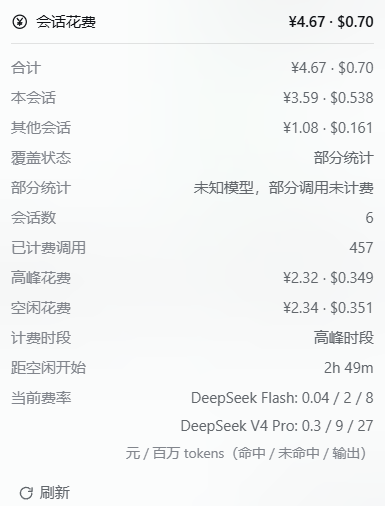
Scopes
| Scope | Meaning |
|---|---|
auto (default) |
The verified team when the session is a team member, otherwise its delegation tree. |
self |
This session only. |
tree |
This session plus every durable subagent descendant. |
team |
The whole team: lead, members and their descendants. Refused when membership cannot be verified. |
A team scope names every member's own money under Team roster, with the Lead marked ★:
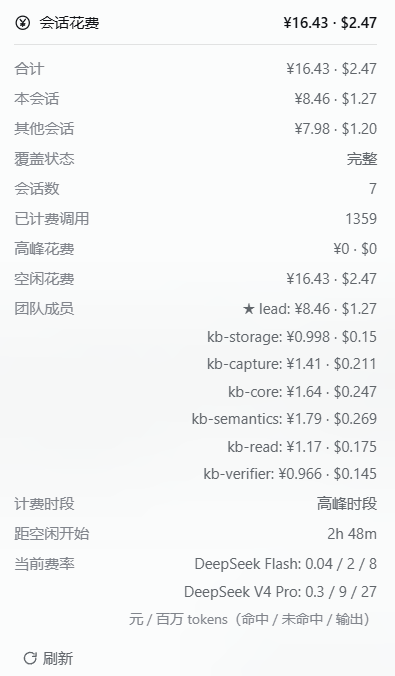
Command and tool
| Surface | Behaviour |
|---|---|
/cost [sessionId] [auto|self|tree|team] |
Prints the same summary the pill shows, including coverage warnings. |
session_cost |
Lets the assistant read a session's estimate; defaults to the calling session. |
HTTP
Two GET-only routes on fixed paths, with no configuration knob:
| Route | Returns |
|---|---|
/dsh-api-cost/v2/view?session=<id>[&scope=…][&detail=summary|full][&force=1] |
The unified cost view (ETag; If-None-Match answers 304). |
/dsh-api-cost/v2/pricing |
Current period, next transition, rate card and provenance. |
detail=summary omits the per-model, roster and recent-call payloads. Non-GET methods answer 405; unknown parameters, scopes or details answer 400; an unknown session answers 404; a cross-site fetch is refused with 403; a read that outlives its 8-second budget answers 503. Responses never carry local paths.
Rates
Published DeepSeek prices, in force from 2026-09-10 12:00 +08:00 (CNY per million tokens):
| Model | Period | Cache hit | Cache miss | Output |
|---|---|---|---|---|
deepseek-flash |
peak | 0.04 | 2 | 8 |
deepseek-flash |
off-peak | 0.02 | 1 | 4 |
deepseek-v4-pro |
peak | 0.30 | 9 | 27 |
deepseek-v4-pro |
off-peak | 0.15 | 4.5 | 13.5 |
The published USD column is billed as its own column, never converted at a guessed rate. Peak windows are Monday–Friday 09:00–12:00 and 14:00–18:00 Beijing time, excluding statutory holidays; nights, weekends, holidays and 调休 makeup days are off-peak. Money accumulates in exact integer arithmetic (nano-units) and only rounds for display. Years missing from the holiday table resolve off-peak and are reported as holiday-data-missing.
Configuration
In the profile patch:
- id: dsh-api-cost
  name: 'dsh-api-cost'
  config:
    defaultScope: auto          # auto | self | tree | team
    tool: true                  # register session_cost
    command: true               # register /cost
    holidays:                   # extend or correct the bundled Chinese calendar
      '2027':
        holidays: ['2027-01-01', ['2027-02-05', '2027-02-11']]
        makeupWorkdays: ['2027-02-20']
Changing holidays changes the projection's fold identity, so stale checkpoints are discarded and rebuilt instead of being mixed with new money.
What it does not promise
- It is an estimate, not a bill. Only published rates and reported token counts are used; grants, discounts, retry billing and third-party routing are invisible here.
- Only official DeepSeek models are priced. An unknown id is recorded as
unknown-modelwith zero money rather than guessed. - A settlement is billed at its settlement time. A call that crosses a boundary is not split proportionally, because the official documentation defines no such split.
- Unreadable sessions are reported, not guessed: they appear as
session-unavailablewithcoverage.status = partial, and a traversal that exceeds the 400-session budget is markedscope-truncated. - A malformed usage report is never billed. The call is counted as an attempt and flagged
invalid-usageormissing-usage, but it adds no money and no tokens, so a total never contains spend that no priced call explains. - The Pro routing caveat is a rate-card note, not a coverage gap. This repository records that official billing for
deepseek-v4-proafter 2026-09-14 12:00 +08:00 is disputed (whether those requests are served — and billed — as Flash, or keep the Pro column). The plugin cannot verify the provider's policy, so it prices the published Pro column and says so. That note appears only when the scope actually priced that model; other card caveats (missing holiday data, calls predating the card) always show, because they shape the rates and period on display. - Fork semantics are explicit: a forked child's own figure excludes the inherited prefix, so ancestors are not billed twice when you look at a branch.
Development
pnpm install --ignore-scripts     # dev-only toolchain
pnpm typecheck                    # strict TypeScript over src, test and scripts
pnpm build                        # dist/index.js, dist/client.js, dist/types
pnpm test                         # builds, then runs the Node suite over *.test.ts
pnpm bench                        # size/state budgets plus machine-calibrated timing budgets
| Path | Role |
|---|---|
src/pricing/ |
Rate card, holiday calendar, exact BigInt pricing engine. |
src/host/projection.ts |
The pure apiCost fold and its wire schema. |
src/host/query.ts |
Scope resolution, single-flight aggregation, bounded caches. |
src/host/http.ts |
The two GET routes, validation and the error taxonomy. |
src/client/ |
TSX pill and panel, projection seats, one shared cross-session bridge. |
test/ |
Node-native TypeScript tests: pricing, client bridge, release contract, host integration. |
scripts/build.ts |
esbuild host/client plus declaration emission. |
docs/baseline.json |
Recorded 1.0.0 measurements the budget gate compares against. |
Measured on Node 24.21 against the recorded 1.0.0 baseline and the same fixtures: 100k settlements price in 12 ms (was 22.7 ms), a 71-session historical tree aggregates completely in 1.4 ms cold and 0.05 ms warm, per-session projection state stays under 6 KiB after 100k settlements, and the shipped bundles are 9.3 KiB (client) and 10.3 KiB (host) gzip.
Migrating from 1.x
2.0 is a deliberate breaking release: no legacy routes, parameters, configuration keys or data shapes are kept.
| 1.x | 2.0 |
|---|---|
GET /dsh-api-cost/api, /api/session, /api/status, /api/reconcile |
GET /dsh-api-cost/v2/view, /v2/pricing |
tree=0, scope=corpus, force on every route |
scope=self|tree|team, force=1 on /view |
routePrefix configuration |
fixed /dsh-api-cost/v2 |
| Plugin-side log replay, LRU ledgers, recount button | Host projection, durable checkpoint, Refresh |
| Plain-number money | Exact decimal strings folded from BigInt nano-units |
index.mjs, client.js, lib/pricing.mjs |
src/**/*.ts(x) compiled to dist/ |
License
MIT — see LICENSE.
No comments yet. Be the first to write one.