dsh-quota
English | 简体中文



Multi-provider quota, balance, and Token-cost dashboard for DeepSeek Harness (DSH) Web.
dsh-quota follows the active DSH Session and distinguishes the model vendor from the route that actually bills it. If a Session runs a MiniMax model through OpenRouter, usage remains attributed to OpenRouter. It combines five native account integrations, six built-in local-accounting routes, configurable third-party providers, a draggable always-on widget, usage analytics, local model pricing, and safe route diagnostics.
Install
Install the prebuilt release into the DSH Web profile, then restart DSH Web:
dsh plugin --profile web add "https://github.com/Lottle7/dsh-quota/releases/download/v0.8.0/dsh-quota.tgz"
dsh web
The prebuilt archive does not require a local TypeScript build. To install the tagged source instead, use the command below and follow pnpm's allowBuilds prompt if pnpm 10 or later asks for it:
dsh plugin --profile web add "github:Lottle7/dsh-quota#v0.8.0"
Highlights
- Follows the active Session's route, model, reasoning effort, and official
tokenUsageprojection. - Shows the provider's balance, quota windows, key spending limit, and provider-side usage when its API exposes them.
- Persists a deduplicated per-call usage ledger in DSH Host storage and backfills existing Session logs without resuming Agents.
- Tracks current-Session, daily, and rolling 30-day Tokens and estimated CNY cost by billing platform and model, using complete Host aggregates independently of history-page size.
- Keeps a draggable mini dashboard visible while you work; switch it to icon-only mode, hide it, or reset its position.
- Migrates the pre-v0.6 browser aggregates as uncovered remainders, so upgrades preserve history without double-counting Session logs.
- Shows historical-sync progress and pageable call-level model, route, Token, cost, time, turn, and step details.
- Filters call history by billing provider, exact model, source or search text, and exports every matching row as CSV.
- Supports browser-local daily and rolling 30-day CNY budgets with a configurable warning threshold and progress in the drawer and floating dashboard.
- Detects partially unpriced usage and asks for missing model prices instead of presenting an incomplete estimate as safe.
- Displays a gap-free seven-day trend and a 30-day provider/model breakdown, with summary JSON export.
- Lets you edit per-model CNY-per-million-Token prices in the browser and restore Host defaults at any time.
- Explains route resolution, billing provider, model vendor, confidence, and cache state in a credential-free diagnostic report.
- Supports desktop drawers, a responsive mobile bottom sheet, light/dark themes, and Chinese/English UI copy.
- Registers custom local-accounting routes or hardened public HTTPS JSON billing endpoints directly from Host settings.
Supported platforms
Native account queries:
| Platform | What is displayed | Host credential |
|---|---|---|
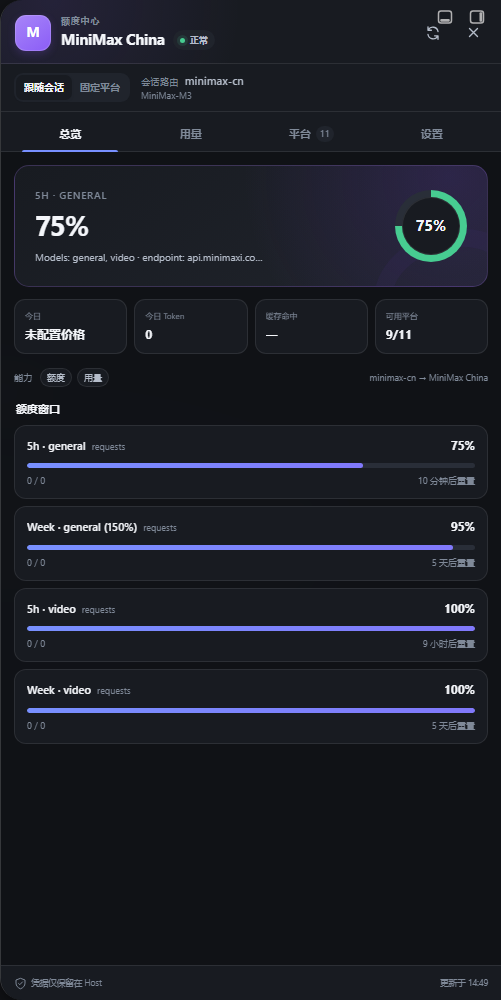
| MiniMax China | Coding Plan quota windows | MINIMAX_CN_API_KEY or MINIMAX_CN_COOKIE |
| MiniMax International | Coding Plan quota windows | MINIMAX_INTL_API_KEY or MINIMAX_INTL_COOKIE |
| DeepSeek Official | Multi-currency account balance | DEEPSEEK_API_KEY |
| OpenRouter | Key usage, spending limit, remaining allowance, and reset cadence | OPENROUTER_API_KEY or OPENROUTER_KEY |
| SiliconFlow | Recharge, gifted, and total balance | SILICONFLOW_API_KEY or SILICONFLOW_KEY |
Local Token and cost accounting, without an additional provider credential:
| Platform | Route aliases |
|---|---|
| Moonshot / Kimi | moonshot, kimi |
| Zhipu GLM | zhipu, bigmodel, glm |
| Alibaba Bailian | dashscope, bailian |
| Volcengine Ark | volcengine, ark, doubao |
| Together AI | together, together-ai |
| Fireworks AI | fireworks, fireworks-ai |
Local-accounting integrations never invent a balance. They report only the Token projection supplied by DSH and the price table configured by the user.
Interface
- Overview — active billing-platform balance/quota, today's Token cost and connection summary.
- Usage — Session, today and 30-day totals, Host history sync, seven-day chart, provider/model rankings, filtered call history, pagination, and CSV export.
- Providers — inspect all built-in and custom integrations or pin one for viewing without changing the Session model.
- Settings — control the floating widget, edit cost budgets and local prices, inspect route resolution, copy diagnostics, and export usage.
The floating widget's mode and position are browser-local. It temporarily yields while the full quota center is open and returns when the drawer closes.
Configuration
The Host settings namespace is dsh-quota:
dsh-quota:
  enabled: true
  refreshIntervalMs: 60000
  warningBalanceBelow: 10
  warningQuotaRemainingBelow: 0.2
  usageRetentionDays: 90

  # Use an explicit mapping when a custom route name cannot be identified.
  routeMappings:
    my-company-openrouter: openrouter

  providerEnabled:
    minimax-cn: true
    minimax-intl: true
    deepseek-official: true
    openrouter: true
    siliconflow: true
    moonshot: true
    zhipu: true
    alibaba-bailian: true
    volcengine-ark: true
    together: true
    fireworks: true

  customProviders:
    # Local accounting only: no remote request and no extra credential.
    - id: my-company-relay
      displayName: My Company Relay
      kind: local
      description: Internal model gateway
      region: Global
      brandColor: "#2563eb"
      routeAliases: [my-relay, company-llm]
      modelVendors: [deepseek, qwen]

    # Restricted public HTTPS JSON account endpoint.
    - id: acme-billing
      displayName: ACME Billing
      kind: http-json
      endpoint: https://billing.example.com/v1/account
      credentialRef: ACME_API_KEY
      auth: bearer                 # bearer | x-api-key | none
      balancePath: data.balance
      usagePath: data.usage
      limitPath: data.limit
      remainingPath: data.remaining
      currency: USD
      valueScale: 1
      routeAliases: [acme, acme-relay]

  pricing:
    default:
      inputCacheHitPerMTokCNY: 0
      inputCacheMissPerMTokCNY: 0
      outputPerMTokCNY: 0
    overrides: {}
    peakHours:
      weekdays: []
      windows: []
      timezone: Asia/Shanghai
usageRetentionDays accepts 30–3650 days and controls the Host ledger retention window. The dashboard queries the latest 30 days by default.
Custom providers
Use kind: local for a relay or private route without an account endpoint. It makes no remote request and attributes DSH Tokens and local prices to that billing provider.
Use kind: http-json to map a restricted JSON account endpoint into balance, provider usage, and a spending limit. The four mapping fields are safe dot paths: for {"data":{"balance":"42.5"}}, use balancePath: data.balance. Configure at least one path. Numeric strings are accepted, and valueScale multiplies every mapped value (for example, use 0.001 when the upstream unit is one-thousandth of the configured currency).
credentialRef names a DSH Host credential/environment reference; it is never the literal key. Store the same reference through DSH credentials or provide it to the Host environment that starts dsh web. Custom IDs can also be used in providerEnabled and routeMappings. Live Host-settings changes rebuild the registry and provider cards without changing the current Session model.
Prices and budgets are estimates/alerts only: they never block a model call or modify a provider bill. An empty peakHours.windows disables time-based discounts. Browser price and budget overrides stay in localStorage; model prices take precedence over matching Host prices and neither preference contains credentials.
Privacy and security
- API keys and cookies are resolved only through the DSH Host credential service.
- Credentials are not sent to the browser, stored in the usage ledger, or included in diagnostics.
- The Host ledger stores only Session identity, turn/step, timestamp, route/model, and Token buckets in DSH's storage domain; it never stores prompts, replies, tool payloads, API keys, or cookies.
- The browser keeps UI preferences, local price/budget overrides, and a compatibility aggregate mirror; message content is never persisted by this plugin.
- Provider API responses and quota snapshots are recursively redacted; usage responses are emitted only from a closed, validated numeric ledger shape.
- Write routes require JSON and validate Host, Origin, and
Sec-Fetch-Site. - Custom account endpoints are restricted to public HTTPS GET on port 443, without query strings, redirects, embedded credentials, private/reserved addresses, or arbitrary headers.
- The Host validates every DNS result and pins the TLS connection to a validated address, caps responses at 256 KiB, and permits only Bearer,
X-API-Key, or no authentication. - The plugin's quota APIs return normalized numbers and safe metadata only—not endpoint configuration, raw responses, or keys.
Please report security issues privately as described in SECURITY.md.
Compatibility
- Node.js 22 or later.
- DeepSeek Harness
0.1.1-rc.2or later Web profile (requires the official storage-domain and Session inspection services). - CI verifies Node.js 22 and 24 with type checking, unit tests, a client Loader smoke test, and package-content validation.
DSH is still evolving through release candidates. Run the Loader smoke test after upgrading DSH before deploying the plugin broadly.
Update or remove
Install a newer prebuilt archive with the same dsh plugin command and its new version URL. To remove the bundle:
dsh plugin --profile web remove dsh-quota
Restart dsh web after adding, updating, or removing a bundle.
Development
npm install
npm run test:ci
To link a local checkout into the Web profile, run this from the repository root:
dsh plugin --profile web add .
The package declares cordis.patch.yml as a DSH bundle. The patch mounts both the Host provider registry and the browser client. See CONTRIBUTING.md for adapter and pull-request guidance.
The prepared DSH registry submission records the marketplace entry, prebuilt tarball URL, screenshot, and required GitHub topics.
No comments yet. Be the first to write one.