dsh-plugin-memory
English | 中文





Long-term memory for DeepSeek Harness — a portable markdown memory store with a soul, injected at every session start.
macOS · Windows · Linux · Node ≥ 18 · DSH ^0.2.1-rc.5 / 0.2.2-rc.2 · MIT
⚠️ Using DSH 0.2.2-rc.2 or newer? Upgrade the plugin to 0.19.2+ first. Early 0.19.x reads
ctx.agents.roots(), which rc.2 replaced withlist(); the resulting throw happens inside the serialagent/createdlistener, which rejects agent registration — the visible symptom is sessions can no longer be created while the plugin is enabled. 0.19.2 reads the registry compatibly (never throws) and the change needs a full DSH restart to take effect/memoryand the panel stay offline-safe meanwhile.
Compatibility is two-way. 0.19.2+ reads the agent registry with
agents.roots()first and falls back toagents.list(), so the same build runs on legacy hosts (0.2.1-rc.5 … 0.2.2-rc.1) and on rc.2. Upgrading the plugin never breaks an older DSH install, and rc.2 support does not drop older versions.
What it does
A Cordis plugin that gives DSH agents persistent, cross-session, migratable memory: plain markdown + git (the LLM Wiki pattern), a SOUL.md persona, and a boot block auto-injected through runtime context — a hard guarantee, not a hope that the model decides to call a skill.
Quickstart
# 1. install
dsh plugin --profile <profile> add dsh-plugin-memory
Or install from a plugin index: enable Custom plugin indexes under Plugins → Experimental, open Discover → Add index source, paste
https://raw.githubusercontent.com/LittleBlackTong/dsh-plugin-memory/main/docs/market/index.json
then install Memory from the list. (A JSON index in the official format, served from this repo.)
- Restart the app. In the first session the agent starts the soul-forging conversation itself (or skip it: Settings → Memory → Basic soul, one save).
- Verify:
dsh-memory doctor, or open Settings → Memory for the health dashboard and hot settings.
Features
- Remembering across sessions — boot block = SOUL + MEMORY protocol +
index.md+ recent activity, with a per-file budget so the index tail is not truncated first. - A soul, not just storage — SOUL + BOOTSTRAP forging; a quick-setup card writes a managed block; persona names are read from SOUL, never hard-coded.
- You stay in control — per-session switch (chip /
/memory on|off/ panel) anddisabledWorkspacesdefaults. - A companion — digest nudge, proactive recall, weekly growth recap, context-sensitive tone; shared speech floor with other proactive plugins.
- Portable — plain markdown + git,
pack/unpack, optional auto-commit. - Memory graph — interactive 3D sphere: rotate / zoom / drag nodes, search-to-focus, hover or click to light up neighbours; select a node → Reveal in Finder or Copy path; double-click a node to open its file in the DSH sidebar (falls back to the OS file manager).
- Health tools — dashboard,
checkup,lint,doctor, automaticlast_accessstamping. - Zero build, bilingual panel, hot-editable config.
Screenshots
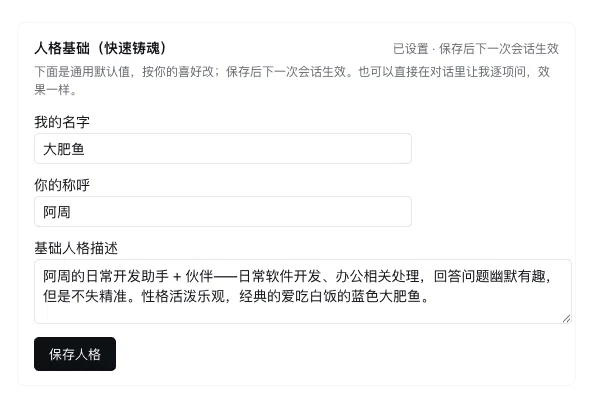
Basic soul (quick forging) — set the agent's name, what it calls you and a baseline persona in one save; the next session uses it, no restart. Chat-forged souls are echoed back from SOUL.md.
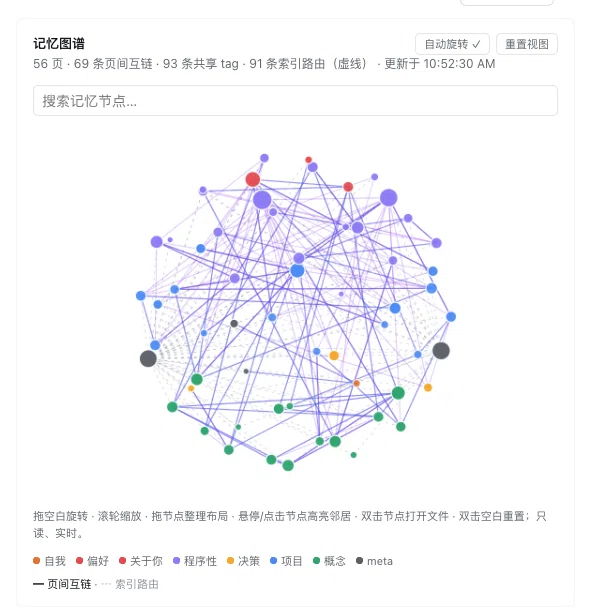
Memory graph (3D) — a live projection of the store: rotate / wheel-zoom / drag nodes to arrange, search-to-focus (the camera flies to the hit), hover or click to light up the neighbourhood. Select a node to Reveal in Finder or Copy path; double-click empty space to reset.
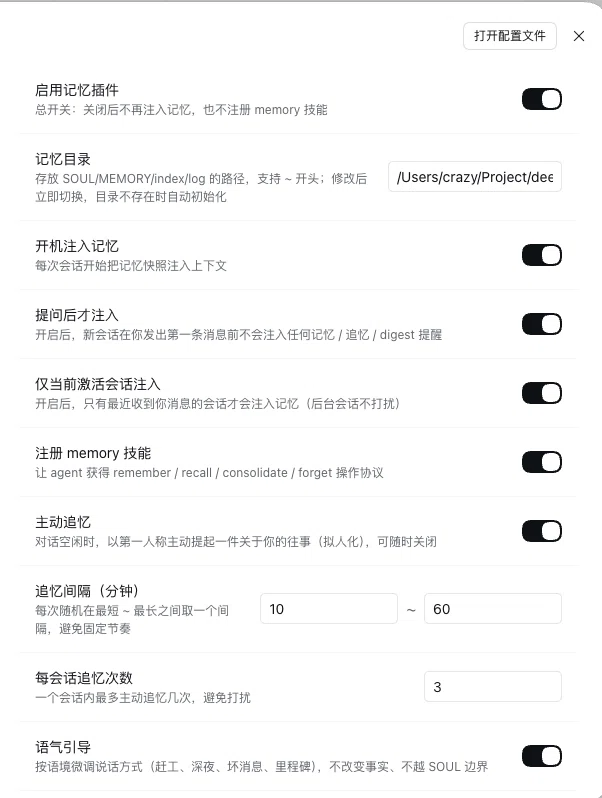
Settings panel — sixteen settings apply immediately (per-session switch, boot gates, recall cadence, tone, disabled workspaces…). The health dashboard and the graph sit right below.
Cross-platform
macOS, Windows and Linux are supported. Path settings expand ~, ~\, %USERPROFILE% and $HOME; CRLF files are parsed as LF and **written back with their own newline style**; *Reveal in Finder* maps to open -R (macOS), explorer /select, (Windows, space-safe argv) and xdg-open (Linux); disabledWorkspaces matching is case-insensitive on Windows. Details: docs/CONFIGURATION.md.
Configuration
Seventeen hot keys edit live under Settings → Memory — including bootSnapshot (live by default; session freezes the boot block for the session so mid-session writes can't invalidate the prompt-prefix cache). The full table, boot-budget rules and composition overrides are in docs/CONFIGURATION.md.
CLI
dsh-memory init [dir]        # scaffold the store
dsh-memory search <query>    # full-text search
dsh-memory checkup           # one prioritised health report
dsh-memory doctor            # environment check-up
dsh-memory graph --suggest   # who should link to whom (report only)
dsh-memory pack / unpack     # move the store between machines
Store resolution: $MEMORY_DIR → ./.memory → ~/.memory.
Docs
Configuration · Design notes · Migration · Proactive protocol · Contributing · Security · Changelog
FAQ
Does it burn tokens every request? No — runtime context is deduplicated by projection; an unchanged payload is injected once.
File skill vs plugin? The file skill is a soft guarantee (only its blurb is injected); this plugin is a hard one. They coexist (the file skill ranks higher); remove any hand-written persona to avoid double injection.
Where should the store live? ~/.memory by default; point memoryDir inside a project for isolation.
Development
git clone https://github.com/LittleBlackTong/dsh-plugin-memory.git
cd dsh-plugin-memory
node scripts/memory.mjs --self-test   # smoke test, nothing to install
node --test                          # full suite
Zero build: lib/ is runtime code as-is. CI runs both commands.
Roadmap
- Embedding / BM25 retrieval
- MCP server for non-DSH agents
- Encrypted store option
- TypeScript rewrite
Feedback & community
- Bugs / features / PRs: open an issue — that is where feedback and questions are tracked.
- WeChat group「dsh-plugin-memory 插件沟通」: scan below (QR codes expire every ~7 days; open an issue if it no longer works).

No comments yet. Be the first to write one.