Quota windows
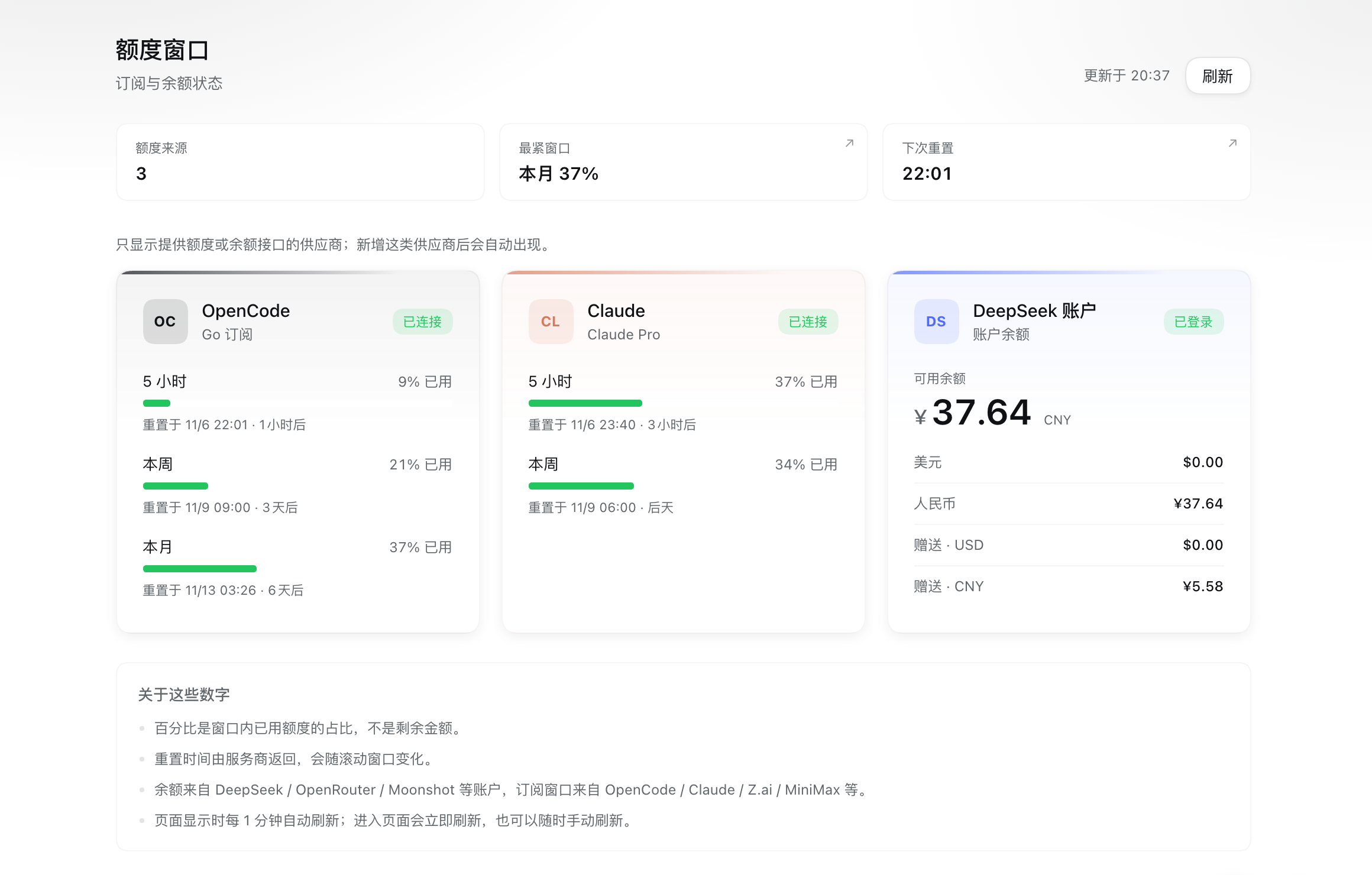
A Harness plugin that puts one 额度窗口 / Quota windows entry in the left sidebar and one page behind it, showing the subscription and balance status of every added provider whose usage or balance API this plugin supports.
Install
Clone this repository, then add it to your DSH profile as a linked dependency and
select the quota-windows bundle:
"@local/quota-windows": "link:/absolute/path/to/dsh-quota-windows"
The bundle name is @local/quota-windows; after the next load the sidebar entry
appears. Or install with the CLI:
dsh plugin --profile desktop add github:LXD-8/dsh-quota-windows
Which providers appear
Discovery is dynamic. The Host reads the live LLM routes
(llm.listProviders()) and matches them against an adapter registry; a provider
added in Settings whose family has an adapter appears automatically, with no
plugin change. Providers without a public usage or balance API are not matched
and stay out of the page.
| Family | Route ids | Data |
|---|---|---|
| OpenCode Go | opencode-go, opencode-go* |
5 小时 / 本周 / 本月 usage windows |
| Claude | anthropic (or the Claude Code credential on its own) |
5 小时 / 本周, Opus/Sonnet weekly, extra usage |
| DeepSeek | deepseek, deepseek-official, deepseek-account (or the signed-in account on its own) |
recharge + bonus wallets |
| OpenRouter | openrouter |
credit balance (total minus usage) |
| Moonshot / Kimi | moonshotai, moonshotai-cn |
available + voucher balance |
| Z.ai / GLM | zai, zai-coding-cn |
Coding Plan quota windows (5h / weekly / other durations) |
| MiniMax | minimax, minimax-cn |
Token Plan session usage |
Each subscription card lists one row per window with its used percentage, a severity-colored bar, and its reset time. Each balance card shows the available amount and its wallets. The overview's tightest-window and next-reset tiles are buttons: clicking one scrolls to the matching source card and briefly highlights it.
Credentials are resolved per provider from the settings profile's apiKeyEnv
(falling back to the conventional <ROUTE>_API_KEY reference) through
ctx.credentials; Claude reads the Claude CLI token and DeepSeek uses the
account service, so neither needs a DSH route to be live.
How it works
index.jsis the Host half: it matches live routes againstADAPTERS, reads each match, caches successes for 60 seconds (errors for 15), and servesGET /quota-windows/api/snapshot(add?refresh=1to bypass the cache).client.jsis the Web half: it registers thesidebar.panellistentry and themainpanel, re-reads the snapshot whenever the page is entered, polls every minute afterwards, and renders one grid of equally sized cards (three columns when the card count is a multiple of three, two otherwise). A page-level error boundary keeps a render crash from blanking the panel and reports it toGET /quota-windows/api/client-error.
Brand colors
Each source card uses its brand accent. The provider directory exposes ids,
names, and base URLs only — no colors — so accents are a hand-maintained table
(BRAND_ACCENTS in client.js); ids outside the table fall back to a stable
hash color, so a newly supported provider still gets a distinct accent without a
code change.
Configuration
Optional row config, validated by the Loader schema (@deepseek-ai/schemastery;
runtime coercion applies if it is unavailable), for example in the profile patch:
- id: quota-windows
  config:
    cacheSeconds: 60
    opencodeBaseUrl: https://opencode.ai/zen/go/v1
    opencodeCredentialRef: OPENCODE_GO1_API_KEY
    claudeCredentialsPath: ~/.claude/.credentials.json
    # Hosts allowed in addition to loopback/IP/same-origin, for a reverse proxy.
    allowedHosts:
      - quota.example.com
Notes
- The Claude token is read, never refreshed; when it expires the card asks you to sign in to Claude Code again.
- OpenCode Zen credit balance is not exposed by the API-key API, so only the Go subscription windows are shown.
- A provider family with no public usage/balance endpoint (for example OpenAI, Google, or a local model server) is intentionally not shown. Adding its adapter is the only step needed if such an endpoint appears later.
- All lookups are read-only.
- Provider failures are localized for HTTP status, timeout, and empty responses; provider-specific text remains as the detail after the localized prefix.
node --test tests/*.test.mjscovers the pure parsers and the OpenRouter, Moonshot, Z.ai, and MiniMax adapters against stubbed HTTP responses.
License
MIT
No comments yet. Be the first to write one.