
dsh-marginalia
Read-only side questions for DeepSeek Harness. Ask in the margin, keep the main thread clean.
marginalia (noun): notes written in the margin of a page. That is what /btw is in
oh-my-pi: a note taken beside the main conversation,
without changing it.
This is a DSH Host + Web Client bundle that implements the practical form of that contract:
- Same conversation — the side turn forks the current session, so it sees the same system prompt, the same tool catalog, and the same completed history.
- Read-only, enforced — the inherited tools remain in the request to preserve the prompt prefix, but an execution-time guard rejects every tool call. This is not a prompt request.
- Visible in-flight context — if the main answer is still streaming when you ask, the captured partial text is added to the side prompt as reference-only material.
- Topics and history — every question is persisted with its status and answer; follow-ups replay the topic and see the parent conversation as it is now.
- Streaming and cancellation — the Web Client retains the child session, renders its partial text, and preserves what was generated when you stop it.
- No fabricated branch — DSH has no public "insert an assistant message / create a branch" API. Marginalia does not pretend; it offers insert into composer as the safe replacement.
Screenshots
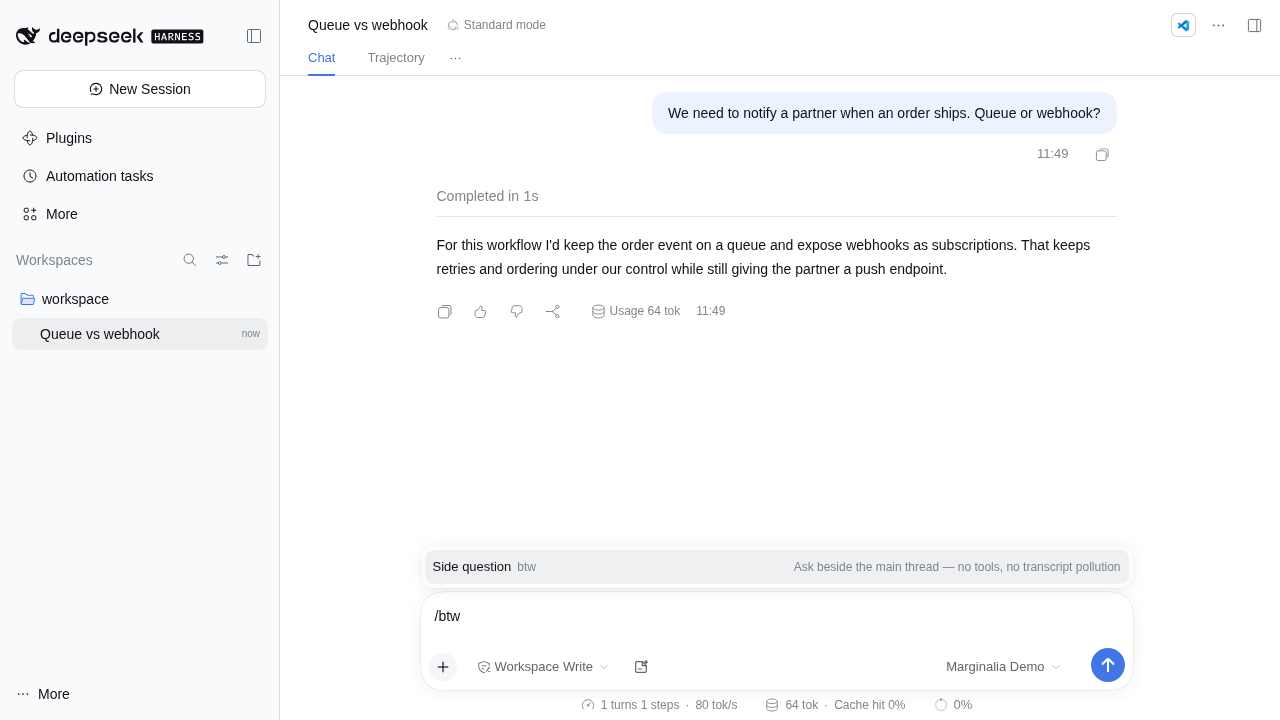
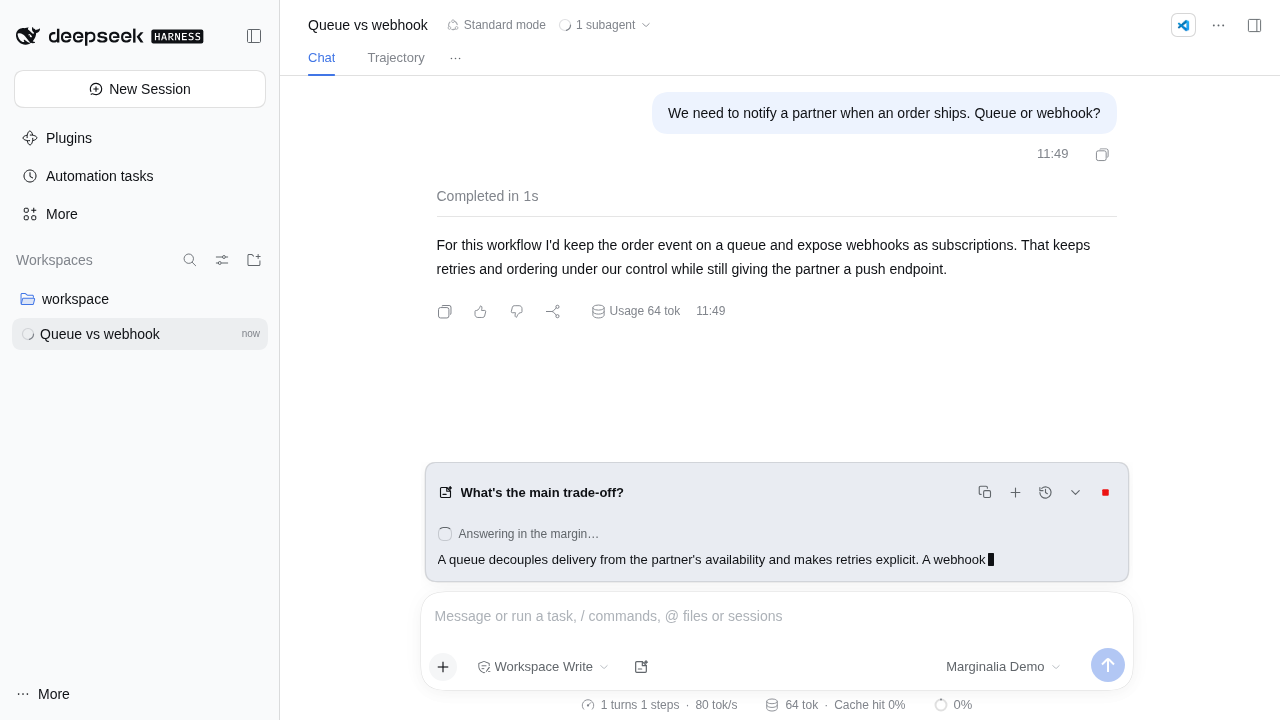
The real /btw slash entry · streaming in the margin, with Stop and insert actions
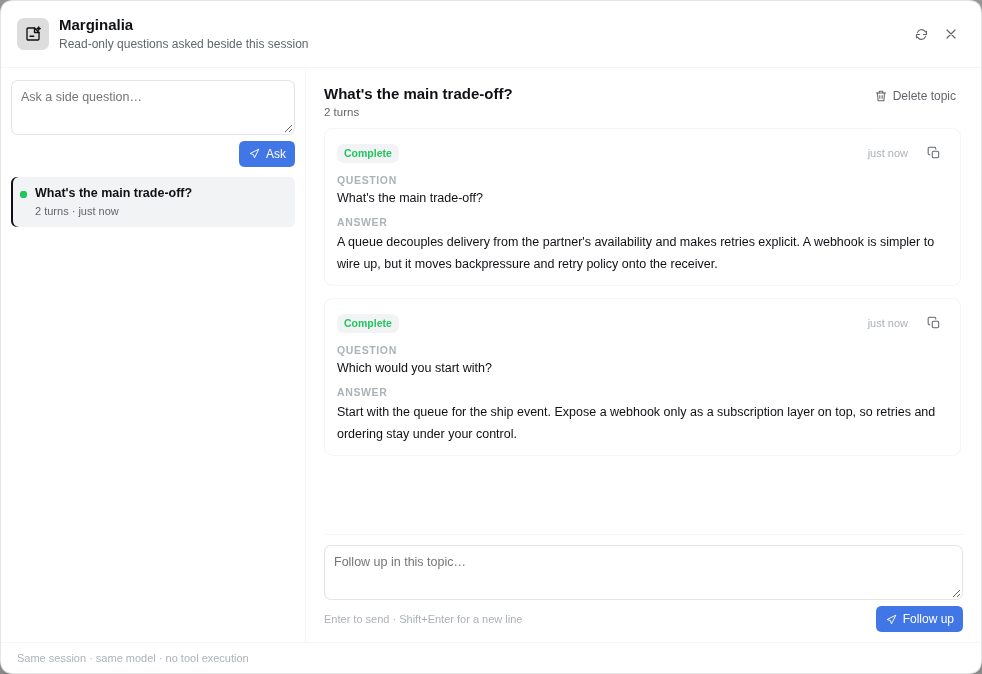
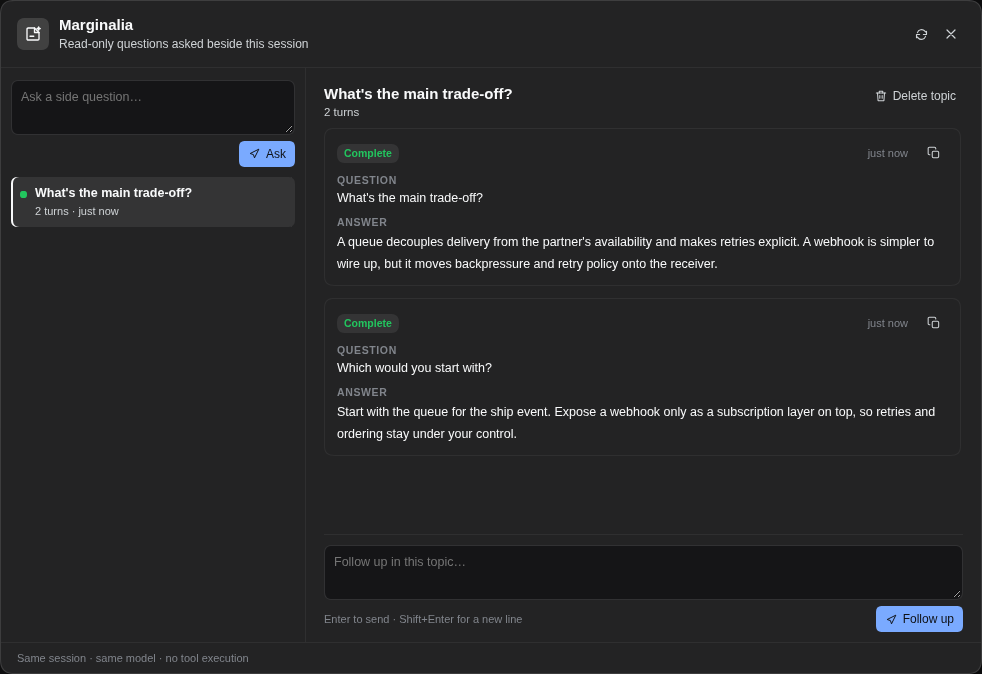
Topic history with follow-up · light and dark DSH themes
Screenshots are produced by the Playwright screenshot spec (npm run screenshots) against an
isolated Host and a deterministic demo model, not by hand-editing the UI.
Requirements
- DSH
>= 0.2.1-rc.1 < 0.3.0-0(tested against0.2.1-rc.2) - Node
>= 22 - Works on a plain-HTTP LAN Web GUI:
crypto.randomUUIDis restricted to secure contexts, so the plugin usesgetRandomValues(or a non-cryptographic identifier fallback) when needed. - A composed
forksubagent provider andstorage-domainfor durable history (both are part of the standard Web profile; the plugin falls back to process memory if the storage domain is absent) - For the browser suite:
dshonPATH(orDSH_BIN),pnpm, and Playwright Chromium + Firefox
Install
From this checkout:
npm install
npm run check          # typecheck + 53 unit tests + build + smoke
npm run test:e2e       # 16 browser tests across Chromium/Firefox + dark projects
Then install the workspace directory as a bundle through the Harness plugin manager, or add it to a bundle composition:
- insert:
    - id: dsh-marginalia
      name: dsh-marginalia
The built package is self-contained: the Host half bundles its only runtime dependency (zod) and
the Client half bundles its Markdown renderer. React and the Harness packages are supplied by the
Host's module table.
Use
| Action | How |
|---|---|
| Ask beside the current session | /btw 刚才为什么选方案 B? |
| Open topic history | /btw with no argument, or the Marginalia button at the left of the composer |
| Follow up in the same topic | The send icon on a finished bubble, or the follow-up box in history |
| Stop a running answer | The stop button on the bubble; the partial answer is kept |
| Copy / insert / retry / delete | Buttons on a bubble, a history turn, or the composer |
| Close the history panel | Esc, the close button, or click the backdrop |
/btw accepts text only. Images and files stay in the composer and the submission is refused, so
the draft is not silently lost.
How it works
/btw question
  → Client input trigger claims the line
  → Host btw-ask (authenticated command RPC, lifecycle logging suppressed)
      reserve child id → guard the id → fork the parent
      append one user-role <btw> prompt
      persist a running turn
  → Client retains the child session and follows its Chat target
  → Host stream capture keeps partial text; cancellation persists it
  → Host persists complete/cancelled/error; child is archived best-effort
The public /btw command is contributed by an inputTriggers slash source, not by patching the
official command UI. Bubbles use conversation.input.overlay; history uses shell.overlay; the
toolbar button uses conversation.input.left. The host-side compatibility shims hide the internal
transport commands from the slash directory and drop their command/run/command/done lifecycle
pair, so the main transcript and session log stay clean.
See docs/architecture.md for the full design and
docs/verification.md for what has and has not been exercised.
Data
- Domain:
marginalia, tabletopics, key${parentSessionId}:${topicId}. - A turn stores only visible question/answer text and status; reasoning and tool payloads are not persisted.
- On startup,
runningturns becomeinterrupted; they are never retried automatically. - Limits: 8k question, 8k quote, 64k replayed topic history, 256 KiB answer, 50 topics/session, 200 turns/topic, 4 active side questions process-wide, 10 minute watchdog.
The internal commands are btw-ask, btw-list, btw-get, btw-cancel, btw-delete. They are
hidden from the slash menu and quiet in the session log, but still resolve for the authenticated
RPC. This reuses the existing authenticated carrier without opening an unauthenticated HTTP route;
a native Remote namespace remains the better long-term transport. The quieting shim depends on
CommandRuntime.appendLifecycle; if a future DSH removes it, the plugin logs a warning and falls
back to visible command lifecycle events.
Security properties
- No HTTP routes. All reads/writes go through the authenticated
commands.executeRPC. - The side child can never execute a tool, including
send_message. - No raw HTML, remote images, or sanitized Markdown extensions are rendered in answers.
- Host errors are reduced to one bounded, control-character-free line.
- The plugin refuses to start from a subagent view; side questions are a main-session feature.
- Child sessions inherit the parent's sandbox/permission model; the guard only removes tool execution, it does not widen permissions.
Browser support
The Web UI is exercised in Chromium and Firefox. The dark-theme history regression pins the send
label contrast and the scroll/pinned-follow-up layout; Firefox + DSH dark was the original failure
combination.
Honest limitations
- Not truly ephemeral. A local fork creates a durable child session. Marginalia archives it after completion when the workspace registry is available; it cannot make the Host forget it. History itself is stored in a sidecar domain.
- No branch. DSH exposes no public assistant-message injection/branch API. The
bbehavior of oh-my-pi is intentionally not imitated. - History replay is text, not role-level messages. The child receives one user prompt with a
<btw-history>section. Role-level replay would require a direct LLM call and would lose the fork's system/tools/cache inheritance. - Prompt cache is preserved, not guaranteed. Marginalia never changes system/tools/messages; whether a provider reuses the prefix remains the provider's decision.
- Parent partial is best-effort. If the stream capture is unavailable, the section is omitted rather than fabricated.
- Archive is best-effort. A failed archive is logged; the side history is still correct.
- Transport is still command RPC. The lifecycle shim removes transcript/log pollution, but the internal commands remain directly callable by an authorized RPC client. A generated Remote namespace would be cleaner; it is not implemented yet.
- Subagent view is not in the browser suite. Unit tests cover the refusal and hidden toolbar; navigating into a live delegated child in the GUI is not automated.
- Real-provider acceptance is gated.
real.nightly.spec.tsis skipped unlessDSH_E2E_REAL=1andDEEPSEEK_API_KEYare set.
End-to-end verification
The browser suite starts a separate DSH_HOME and custom profile per worker, authenticates
through the real launch-token exchange, seeds a workspace, and runs a deterministic fake LLM that
streams tokens, aborts, and forces a tool call. It binds a non-loopback HTTP address by default so
the insecure-context UUID path is exercised for real. Chromium and Firefox run the core seven
specs; both browsers also run a dark-theme history regression against the real ui-theme setting.
Covered specs: slash menu claim, token-level growth, Stop with partial history, follow-up topic,
reload persistence, read-only tool denial with an untouched file, insert-to-composer, a plain-HTTP
origin with crypto.randomUUID === undefined, and dark-theme history button/layout behavior.
See docs/e2e.md. Real-preset acceptance stays out of the deterministic suite:
DSH_E2E_REAL=1 DEEPSEEK_API_KEY=... npm run test:e2e:real
Development
npm run typecheck
npm test
npm run build
npm run test:coverage
npm run test:e2e
Layout:
src/index.ts            Host entry and wiring
src/shared.ts           protocol, limits, prompt, sanitization
src/host/               engine, storage, guard, stream capture, commands
src/client/             trigger source, store, bubble, history, styles
tests/                  pure unit and wiring tests
e2e/                    isolated Host, fake LLM, Playwright specs
scripts/                build and built-artifact smoke
docs/                   design research, architecture, verification, e2e
License
Apache-2.0. See LICENSE, NOTICE, and
THIRD_PARTY_NOTICES.md. The design is based on the three-way analysis in
docs/three-way-analysis.md.
No comments yet. Be the first to write one.