dsh-claude-code-theme
Claude Desktop's visual language for the DeepSeek Harness Web GUI.
Warm paper neutrals, terracotta accent, readable prose, quiet layered surfaces and a continuous composer — applied through DSH's own theme extension point, not by patching its stylesheets.


Before and after
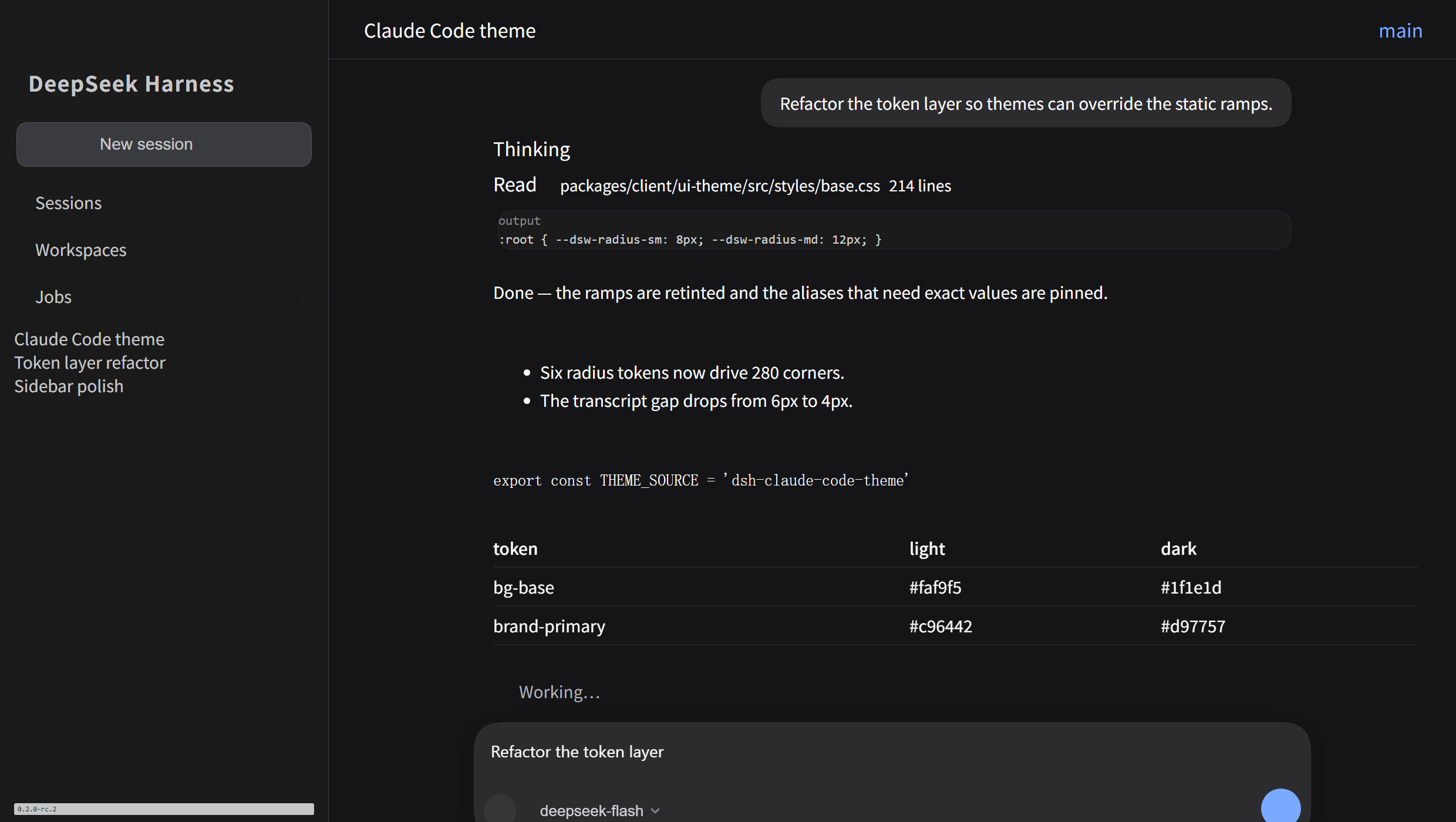
Stock DSH — right-aligned bubble on a blue-tinted canvas, soft 12–28px corners, a floating composer with a circular send button:
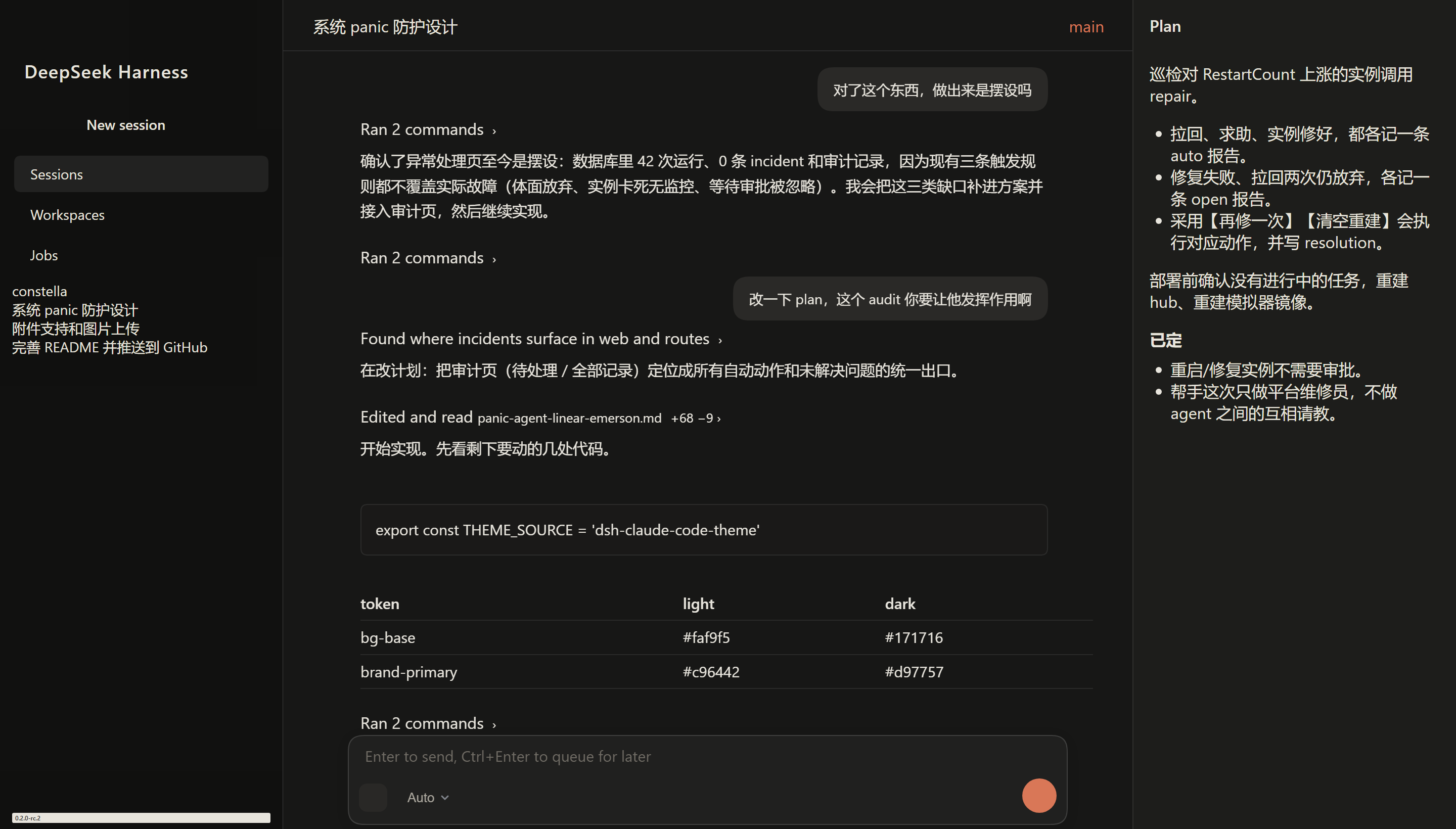
With the theme — a deeper sidebar, a raised right-hand panel, prose set for reading, compact tool summaries, and a continuous composer:
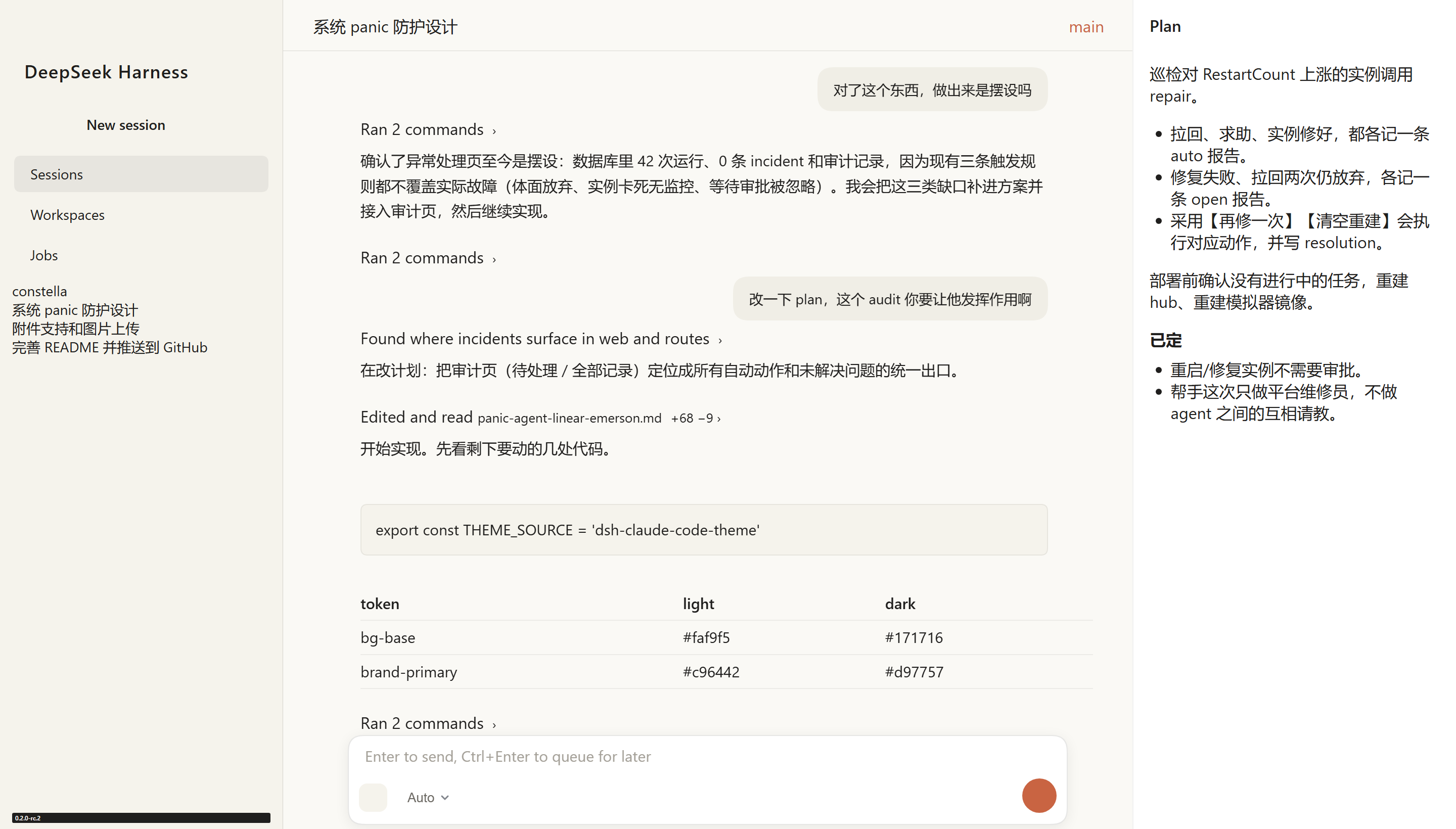
Light mode, on Claude's cream canvas with white raised sheets:
Install
dsh plugin install dsh-claude-code-theme
Or add the row to your profile's cordis.patch.yml and its package to the
profile's dsh.profile.bundles:
- insert:
    - id: claude-code-theme
      name: dsh-claude-code-theme
Reload the Web GUI. There is nothing to switch on: the theme composes over
whichever palette you already use, so light, dark and system all keep
working.
What changes
Colour. DSH's design system has three token tiers, and the theme works on all three:
| Tier | What it is | What the theme does |
|---|---|---|
--dsw-static-* |
The raw colour ramps | Retints DSH's blue-tinted greys to Claude's warm paper greys, and DeepSeek blue to terracotta. The alias tier resolves through these, so this alone recolours most of the application. |
--dsw-alias-* |
The semantic roles components consume | Pins the roles Claude treats differently: a cream canvas under raised sheets, a terracotta primary button and focus ring, warm hairlines, and text that stops short of pure white on dark. |
--dsw-specific-* |
Named surfaces | Retunes the sidebar, composer, bubbles, menus and code surfaces. |
Surface hierarchy. Claude Desktop stacks depth rather than flattening it, so the theme gives each column its own level instead of one shared grey:
| Region | Dark | Light |
|---|---|---|
| Sidebar | #111110 (deepest) |
#f5f3ec |
| Canvas | #171716 |
#faf9f5 |
| Raised sheets — cards, composer, right panel | #1d1d1b |
#ffffff |
The right panel becomes a raised sheet separated by a hairline instead of floating as a detached card.
Geometry. DSH routes 280 border-radius declarations through six
--dsw-radius-* tokens (measured across all 179 shipped UI bundles), so the
theme re-points the scale itself:
| Token | DSH | Theme |
|---|---|---|
--dsw-radius-xs |
4px | 4px |
--dsw-radius-sm |
8px | 6px |
--dsw-radius-md |
12px | 8px |
--dsw-radius-lg |
16px | 12px |
--dsw-radius-xl |
20px | 16px |
--dsw-radius-panel |
28px | 20px |
The corners that bypass the scale are reached through the stable data-slot
and data-* hooks rather than a build hash.
Typography. This is the part that most decides whether the result reads as a product or as a costume. Claude Desktop is a reading surface, so the transcript is set in the UI sans at a comfortable line height, and monospace is kept for the things that are actually code:
| Treatment | |
|---|---|
| Assistant prose | UI sans, 1.65 line height, normal heading letter-spacing |
| Inline code, code blocks, tool output | Monospace |
| Sidebar, header, composer | UI sans |
| Code-block banner | Sentence case, not shouted uppercase |
Transcript. Your turn is a right-aligned bubble on a quiet surface; the
assistant's is prose on the canvas; tool calls collapse into single-line
summaries (Ran 2 commands ›) that expand in place, which is how Claude
Desktop keeps a long working session scannable.
Composer. One continuous rounded surface: the editor and the controls share a single card with no divider between them, the submit control is a circle, and focus draws a soft terracotta ring rather than a hard outline.
Chrome. Quiet navigation rows instead of an elevated primary button,
hover states limited to enabled controls, focus-visible rings for keyboard
use, and thin warm scrollbars.
Customisation
Everything the component layer decides reads a --cct-* property declared once
on body, so you can retune it from your own CSS without patching the package:
body {
  /* A serif reading face, the way long-form prose is often set. */
  --cct-prose: Georgia, "Songti SC", serif;

  /* Roomier or tighter surfaces. */
  --cct-composer-radius: 24px;
  --cct-control-radius: 6px;
  --cct-editor-inset: 20px;
}
| Knob | Default | Purpose |
|---|---|---|
--cct-sans |
system UI stack | UI face, including the sidebar and composer |
--cct-prose |
var(--cct-sans) |
Face used for assistant prose only |
--cct-mono |
DSH's code stack | Code, tool output and paths |
--cct-control-radius |
8px |
Buttons, rows, chips, code blocks |
--cct-composer-radius |
18px |
The composer surface |
--cct-editor-inset |
16px |
Composer text inset from its edge |
--cct-focus |
brand primary | Focus ring colour |
To retune colours instead, stack your own layer on top — later layers win per token:
ctx.theme.overrideTokens('my-tweaks', {
  '--dsw-alias-brand-primary': { light: '#c96442', dark: '#d97757' },
})
How it works
The plugin is a browser half plus an inert host row.
The browser half (lib/client.js) does exactly two things, both inside one
Cordis effect, so unloading or HMR removes the theme completely:
- Calls
ctx.theme.overrideTokens('dsh-claude-code-theme', …)with 174 tokens as{ light, dark }pairs. This is DSH's documented third-party theme extension point. The service stacks the layer over the active palette andui-layoutwrites it as inline custom properties on<body>— which is why the theme outranks the base palette sheets without!important, and why overriding the--dsw-static-*ramps propagates to every alias that resolves through them. - Injects the component stylesheet as a
<style data-plugin-css>tag, the same shape DSH's own plugins use.
The half has no runtime dependencies — no React, no schema library. It never imports another plugin's code, never registers a keyboard shortcut, and never touches conversation state.
How the component layer survives a DSH update
Two kinds of hook are used, in order of preference:
data-*hooks and slot anchors —[data-slot="sidebar"],[data-slot="rightbar"],[data-conversation-region="chat"],[data-composer-card],[data-chat-flow-kind]. These are the components' published interfaces.- The semantic half of a CSS-module local name —
cJsG2q_bubblehashes the prefix but keepsbubble, so rules match[class*="_bubble"], scoped by the region hook above them. A build hash never appears in a selector.
renderSlot() emits a div[data-slot="…"] with an inline display:contents
between every parent box and its occupant. That anchor is layout-transparent
but it breaks parent > child chains, so selectors here are written against
the anchors rather than around them.
When DSH renames a local or a hook, the worst case is one rule stops matching — the theme degrades, it does not break the app.
Development
npm install
npm test        # typecheck, build, CSS validation, behavioural smoke test
npm test is not decorative. It validates the stylesheet with lightningcss,
checks every DSH token the sheet reads against an allowlist so a typo cannot
silently disable a rule, refuses any selector containing a build hash, and
executes the built bundle through window.__ModuleLoader__.load against a stub
DOM to confirm it stacks one well-formed token layer and publishes exactly one
stylesheet that disposal removes.
The visual result is checked against a replica built from DSH's own shipped component CSS, so changes are judged against the real cascade rather than against a hand-written approximation.
Compatibility
Built and verified against DSH 0.2.0-rc.2. The theme depends only on the
public theme service and on DOM hooks the UI components publish, so it is
expected to keep working across patch releases; a renamed local degrades one
rule rather than breaking the app.
Releasing
npm test
npm version patch
npm publish
git push --follow-tags
prepublishOnly runs the full suite, so a broken build cannot reach the
registry.
License
MIT
No comments yet. Be the first to write one.