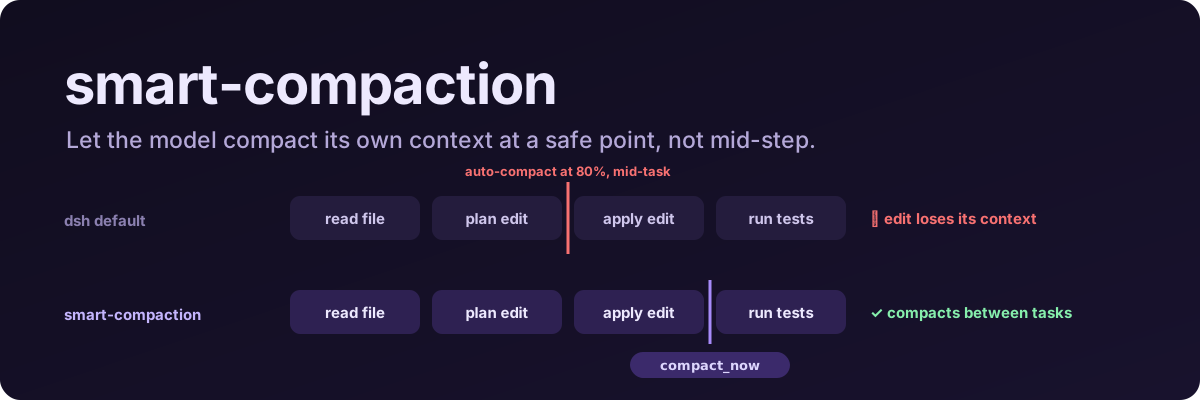


A DeepSeek Harness (dsh) plugin that lets the model decide when to compact its own context, instead of being cut off mid-task by a blind token threshold.
compact_now: compacts at a point the model knows is safe, e.g. right after finishing a todo. Works mid-turn.context_status: real token usage against the session's actual context window, so the model stops guessing.- Automatic safe-point compaction: local models rarely call a tool like this on their own, so the plugin also compacts by itself the moment a todo item is marked done and the context is over half full. No model decision needed.
- No config, no core changes: built only on dsh's public compaction APIs.
dsh plugin --profile web add smart-compaction
Restart dsh and you're done. Details and edge cases under Install.
Why
dsh's built-in compaction is purely reactive: an automatic trigger fires between agent steps whenever token pressure crosses a fixed threshold, with no idea whether that moment is a good one to interrupt. It can land between two dependent steps — e.g. right after reading a file and right before editing it based on what was just read — and the resulting summary loses exactly the context the very next step needed.
This plugin doesn't change how compaction works, only who decides when. It hands the model a tool it can call proactively, on its own judgment, instead of leaving that decision entirely to a blind token counter.
What it does
Two tools, both no-argument.
compact_now
- Selects the largest currently-compactable span of conversation history — the same
tool-call-pairing-safe boundary logic dsh's own compaction already guarantees, reimplemented
here against dsh's public APIs only (no dsh core changes, no dependency on
compaction-basic's internals). - Posts a one-line "Compacting now" notice to the chat before calling
compactRegion(), not after — the summarization call is one extra model request and can take a while (minutes, on a local model), and without this the chat just looks stuck between the tool call and its result. Tagged with its own source kind andform: 'notice'(the same tagging dsh-compaction-basic's own checkpoint messages and other host-generated asides use), so it renders as a collapsed system aside, not as if the user typed it, and needs no model output of its own. - Calls dsh's own
ctx.compaction.compactRegion()to actually do the compaction — the same summarizer, the same durablecompaction/start/compaction/endlog events, the same guarantees as any other compaction in the session. - No-ops harmlessly (
"Not enough compactable history yet.") if there isn't enough history yet — safe for the model to call speculatively. No notice is posted for a no-op call.
context_status
- Read-only — never modifies the session, safe to call anytime.
- Reports current token usage and the model's actual context-window size for this session,
e.g.
"~42,300 / 77,824 tokens used (54.3%)." - Reads dsh's own
contextPressuresession projection (registered by@deepseek-ai/dsh-token-meter, mounted wherevercompaction-basicis) via the publicctx.sessionProjections.stateOf()API — the same numbers the web UI's own context meter reads. Nothing is hardcoded: the context-window figure comes from whatever model this session is actually routed to, so it's correct unchanged across different models, profiles, and context-window sizes. - Exists because, without it, the model has zero visibility into its own context usage — the
only prior signal was a vague "if the conversation feels long" in
compact_now's own description.
Automatic safe-point compaction
Watches
todo_write. When an item flips tocompleted, that's a finished step: a safe place to cut.If usage is past
safePointRatio(default 0.5) at that moment, the next step starts on compacted history. Same notice, samecompactRegion()path ascompact_now.dsh's own 80% trigger stays as the backstop; this just gets there first, at a clean boundary.
A failure here never breaks the turn. It logs a warning and the backstop takes over.
Tune or turn it off in your profile's
cordis.patch.yml:- id: tool-compact-now config: safePointRatio: 0.6 # or false to disable
How it works
Two entry points exist on dsh's compaction service: compactNow() (what the human /compact
command uses — requires an idle agent, throws busy otherwise) and compactRegion() (what
dsh's own automatic between-step trigger uses — works fine mid-turn). A tool's execute()
always runs mid-turn — that's what calling a tool means — so compact_now is built on
compactRegion(), not compactNow().
Install
From your dsh web profile (web below is the profile name; use whichever profile backs your
session):
dsh plugin --profile web add smart-compaction
This installs the package and adds it to dsh.profile.bundles for you. (No local dsh binary?
Run the equivalent by hand from the profile directory, e.g. ~/.dsh/profiles/web/: pnpm add smart-compaction, then add "smart-compaction" to that package.json's dsh.profile.bundles
array yourself.)
No build step. Restart your dsh service after adding it — new bundles are only picked up on boot.
Requirements and preset-isolated profiles (read this ifcompact_now says no compaction service is configured)compact_now requires a compaction service reachable from wherever this plugin itself is
mounted — it reads ctx.get('compaction') at its own mount point, nothing fancier. Most profile
templates ship one at the host plane and the ordinary bundle install above is enough. But
@deepseek-ai/dsh-web-app-based profiles are different: they disable the host-plane
compaction-basic row and instead have each preset mount its own private instance inside an
isolated cordis realm (isolate: { compaction: true }). Isolation in cordis is strictly downward —
only a plugin mounted as a descendant of that exact group can see it (vendor/cordis/src/service.ts).
A plugin on the host plane, including this one installed the ordinary way, is that isolated
compaction's ancestor, not a descendant, so it can never see it no matter how cleverly it reads the
service at call time. The only fix is a second, scoped copy of this plugin mounted as a sibling row
inside that same isolated group — which safely coexists with the host-plane copy (dsh-tools' scoped
tool registrations shadow the global one in a separate layer, see ScopedLayers.merge in
packages/core/scope/src/store.ts).
This package's own postinstall script (scripts/mount-into-presets.mjs) does that automatically:
it scans $DSH_HOME/.agent-presets/*/agent.cordis.yml (your local, user-owned preset overrides —
never a shipped read-only preset under node_modules) for any preset that already isolates
@deepseek-ai/dsh-compaction-basic, and inserts a scoped smart-compaction row as its sibling if
one isn't already there. It's idempotent and a no-op (with a one-line log saying so) on profiles
that don't use presets at all. Modern npm and pnpm block postinstall scripts by default —
you'll need to approve it once: npm install-scripts approve smart-compaction, or for pnpm, add
smart-compaction: true under allowBuilds in the profile's pnpm-workspace.yaml (or run
pnpm approve-builds if your pnpm version offers it) — then reinstall. If you add a new preset
later, or skipped the approval, re-run it anytime with
npx smart-compaction-mount-into-presets (or pnpm exec smart-compaction-mount-into-presets from
the profile directory).
If compact_now still errors with "no compaction service is configured on this profile" after
that, your agent's preset genuinely has no compaction-basic anywhere in its scope chain — add one
(see docs/subsystems/compaction.md
in the harness repo).
context_status requires @deepseek-ai/dsh-token-meter mounted (it registers the
contextPressure projection this tool reads). Unlike compaction-basic, the token meter is
deliberately kept on the host plane even on preset-isolated profiles (it owns a process-wide,
per-session projection table, not something that should come and go with which preset is mounted),
so the ordinary host-plane install always sees it — no preset patching needed for this one. If it
isn't mounted at all, the tool still installs cleanly and just reports available: false instead of
erroring.
Tell the model when to use it
This is baked into both tools' own descriptions, so it works out of the box with no setup: each
tool's description tells the model to check context_status right after finishing a
self-contained step (e.g. right after todo_write marks an item completed) and to follow up
with compact_now once usage climbs past roughly 70-90%. Since both descriptions are sent to the
model on every request automatically, no AGENTS.md edit is required for this behavior — unlike
an early version of this plugin, which relied entirely on a hand-written AGENTS.md rule and
(measured directly against real session logs) got essentially no organic use as a result: the
description alone wasn't a strong enough signal.
That said, standing instructions carry more weight than a tool description competing against
everything else in a long tool catalog. If you want to reinforce it further, copy this
into your AGENTS.md (or whatever your profile injects as standing instructions):
After marking a todo item
completed(never while one isin_progress), callcontext_status. Don't just compare the number to a fixed threshold — that's still reactive, and a step that turns out bigger than expected can blow past a comfortable-looking percentage mid-step. Instead, weigh what's left against what the next step will actually cost (a big file read, a long diff, a subagent dispatch); if it's not clearly going to fit with room to spare, callcompact_nownow, even while usage still looks moderate. Compacting a little early costs nothing; running out mid-step loses exactly the context that step needed. As a hard backstop, usage past roughly 70-80% of the context window is reason enough to compact regardless. Both tools are safe to call speculatively —context_statusis read-only, andcompact_nowno-ops if there isn't enough history to compact yet.
Tying this to todo-completion matters: it's a real, already-tracked signal for "I just finished a
self-contained unit of work," instead of asking the model to estimate its own remaining work or
guess whether a conversation "feels long," both of which it's generally bad at. context_status
replaces that guess with the real number.
The snippet deliberately does not say "compact once usage crosses 70-80%" as the primary rule — a threshold check alone is still reactive: a step that turns out bigger than expected (a large file, a long diff, a subagent dispatch) can blow straight past a comfortable-looking percentage during that step, which is exactly the mid-step interruption this plugin exists to avoid. The percentage is kept only as a hard backstop; the primary check is comparing remaining headroom against the size of the step about to start, and compacting early — before that step, not during or after it — whenever the fit looks tight.
Building from source
Requires Node 22+. Plain JS, no build step — git clone, pnpm install, done.
git clone https://github.com/JoblessJoe/smart-compaction.git
cd smart-compaction
pnpm install
node test.js
test.js is a pure unit-test check of the range-selection logic (select-range.js) and the
context-usage summary logic (context-status.js) — no live dsh/Ollama session required.
Configuration
None. The tool takes no arguments and needs no setup beyond installing it.
Status
compact_now verified end-to-end against a real dsh session, including:
- Basic call: the tool loads, the model calls it, it selects a valid boundary-safe range, and it
drives
compactRegion()mid-turn without ever hitting thebusyfailure this design exists to avoid. - A real tool-call/tool-result pair (
todo_write, markedin_progressthencompleted) sitting in the compacted range — stays correctly paired, nothing split. - Three
compact_nowcalls in a row in one session (one accidental, caught by dsh's own duplicate-call guard mid-task) — each completed cleanly, no crash, nobusy, no corrupted state from operating on a surface that already contains an earlier compaction's checkpoint message.
Troubleshooting: if the tool returns an error like summarization produced no text summary content, that's not this plugin — compact_now selected a valid range and handed it to dsh's own
summarizer, which returned nothing. Observed specifically when the compacted range contains only
injected boilerplate (e.g. standing instructions) with no real assistant-generated text yet —
succeeded reliably once genuine conversation content was in the range. If it happens on ranges with
real content too, check whether your model's "thinking" level is an actually-enforced token budget
or just an instruction (e.g. Ollama's think: low is unenforced — a model can still spend its
entire output budget on hidden reasoning and return no visible summary text). Either way, this is a
model/summarizer-side issue, not something compact_now itself controls.
License
MIT
No comments yet. Be the first to write one.