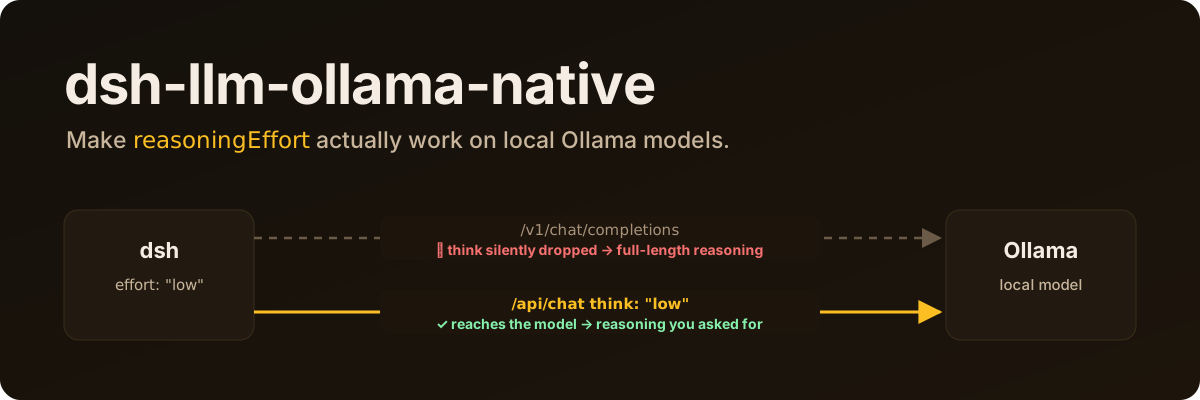



An LLM adapter for DeepSeek Harness (dsh) that talks to Ollama's native /api/chat endpoint instead of its OpenAI-compatible one, so reasoningEffort: off / low / medium / high actually changes how long your local model thinks.
offreally means off: no more minutes of hidden reasoning before a one-line answer.- Drop-in: a new provider route next to your existing
ollamaone. Switch back any time. - Runaway guard: a client-side thinking budget stops a model that reasons forever.
Why this exists
If you run dsh against a local Ollama model and set reasoningEffort to low, medium, or off, you would expect the model to actually use less (or no) chain-of-thought. Through dsh's default Ollama route, it does not.
dsh's built-in Ollama support goes through llm-pi-ai, which talks to Ollama's OpenAI-compatible endpoint (/v1/chat/completions). That endpoint silently ignores every reasoning-control field: chat_template_kwargs, a top-level think, a top-level reasoning_effort, streaming or not. The request always reaches the model with no signal, so the model falls back to its own default, which for most thinking models is the most verbose setting available.
This is not a dsh misconfiguration. It is an open, unresolved Ollama bug: ollama/ollama#16240 tracks the same chat_template_kwargs being dropped by the OpenAI-compatible endpoint. As of writing there is no fix or workaround from upstream through that endpoint.
Ollama's native /api/chat endpoint does not have this problem. Its think field (false, true, or "low" / "medium" / "high" for models whose template supports it) reliably reaches the model. This package is a small adapter that uses that endpoint instead, so reasoningEffort in your dsh config does what it says.
If you are not on Ollama, or you already get correct behavior from your provider, you do not need this.
Requirements
- dsh installed and configured to run against a local Ollama instance
- Ollama, with a model that supports
think(check withollama show <model>, capabilitythinking) - Node 22 or newer
Install
From the profile directory you want this in (for example ~/.dsh/profiles/<your-profile>):
pnpm add dsh-llm-ollama-native@github:joblessjoe/dsh-llm-ollama-native
Add it to that profile's package.json, under dsh.profile.bundles:
{
  "dsh": {
    "profile": {
      "bundles": [
        "...",
        "dsh-llm-ollama-native"
      ]
    }
  }
}
Then configure it in that profile's cordis.patch.yml:
- id: llm-ollama-native
  config:
    provider: ollama-native
    baseURL: http://127.0.0.1:11434
    models:
      - id: your-model-tag
        contextWindow: 32768
        defaultReasoningEffort: low
Point your default model at the new route in ~/.dsh/settings.yaml:
agent-default-model:
  provider: ollama-native
  model: your-model-tag
  reasoningEffort: low
Restart dsh to pick up the new bundle. settings.yaml itself hot-reloads, but adding a plugin to dsh.profile.bundles needs a restart.
Your existing ollama route through llm-pi-ai is untouched by any of this — switch provider back to ollama at any time to revert.
Verify
test.js drives the adapter directly against a running Ollama server (no dsh profile needs to be running, though @deepseek-ai/dsh-llm — the type/base-class package the adapter extends — does need to be installed):
npm install
node test.js
It checks that reasoningEffort: "off" produces no reasoning output, that "low" produces some, and that a tool call round-trips correctly. Defaults to qwen3.8:27b; point it at a different model with OLLAMA_TEST_MODEL=your-model:tag node test.js.
Configuration reference
| Field | Required | Description |
|---|---|---|
provider |
yes | Route name other dsh config refers to (e.g. agent-default-model.provider) |
baseURL |
no | Ollama server address, default http://localhost:11434 |
displayName |
no | Shown in model pickers, default Ollama (native) |
models |
yes | Array of model entries |
models[].id |
yes | Ollama model tag |
models[].contextWindow |
no | Context window size, for display and request sizing |
models[].defaultReasoningEffort |
no | off, low, medium, or high; used when a request specifies none, default low |
Limitations
This is a minimal adapter, not a full port of llm-pi-ai:
- No image or file content blocks; text and reasoning blocks only
- No replay of prior assistant reasoning into follow-up requests
- No retry policy or provider-side image pricing
- Graduated reasoning levels (
low/medium/high) depend on your model's own chat template supporting them;offis the one guaranteed to work everywhere, since it is a hard switch in Ollama itself
License
MIT
No comments yet. Be the first to write one.