
dsh-billing-card
DeepSeek balance, live unit prices and the billing window, in your DSH sidebar





English · 简体中文
Features • Screenshots • Installation • How it works • Limits • Development
A card for the bottom of the DSH (DeepSeek Harness) sidebar: how much credit is left, what the selected model costs right now, and whether this instant is billed at peak or off-peak — and for how long.
Prices come from the official DeepSeek documentation, the balance from the DSH account service. Nothing is guessed: whatever cannot be fetched falls back to a built-in copy.
[!TIP] The card fetches once at startup and serves itself from memory afterwards, so nothing in the sidebar ever waits for the network.
Features
- Balance — recharge plus bonus wallets, summed exactly and truncated to the cent, with the per-wallet detail in the tooltip.
- Unit prices for the selected model — input, cache read and output in the tier that is active right now; switching models in the composer repaints them immediately.
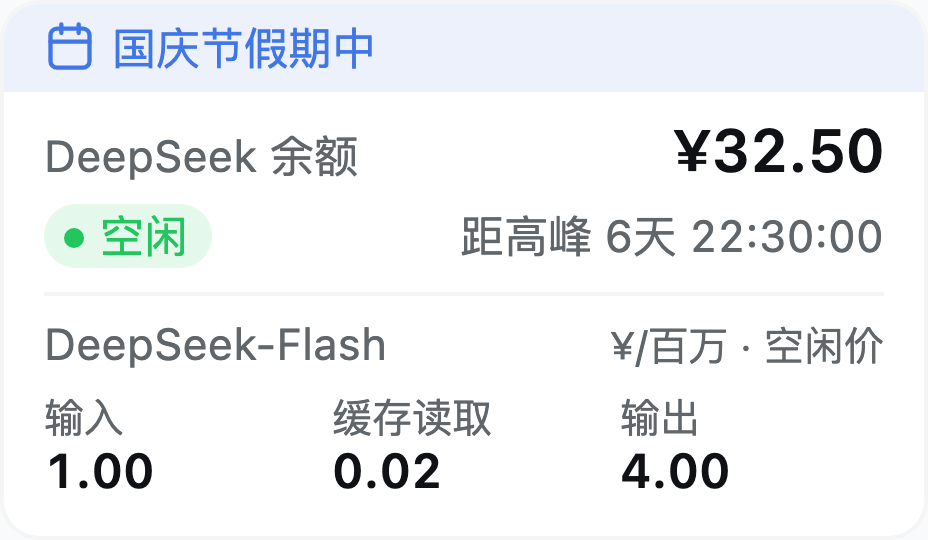
- Billing period and countdown — green
空闲/ yellow高峰, with the time until the next switch. - Holiday and make-up labels — in the Chinese UI a holiday becomes a light blue banner at the top of the card (
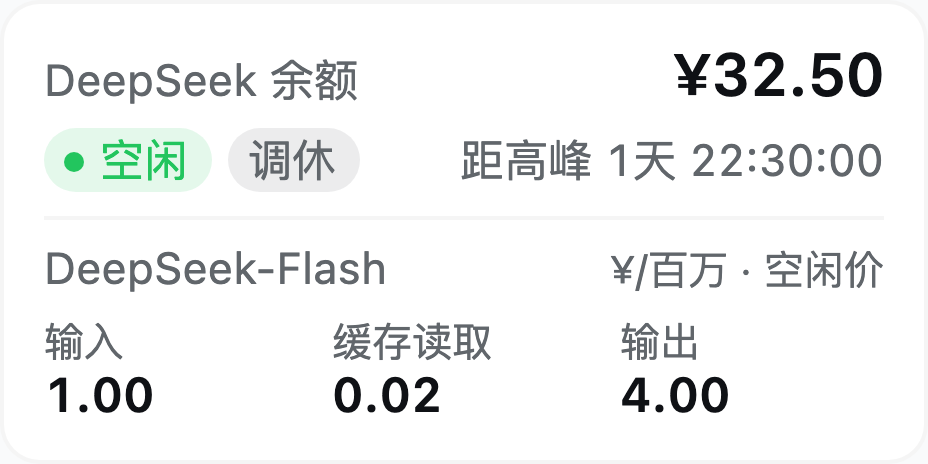
国庆节假期中), and a make-up workday gets a gray调休chip. - Currency follows the interface language — CNY prices in Chinese, USD prices everywhere else; the balance keeps its own currency.
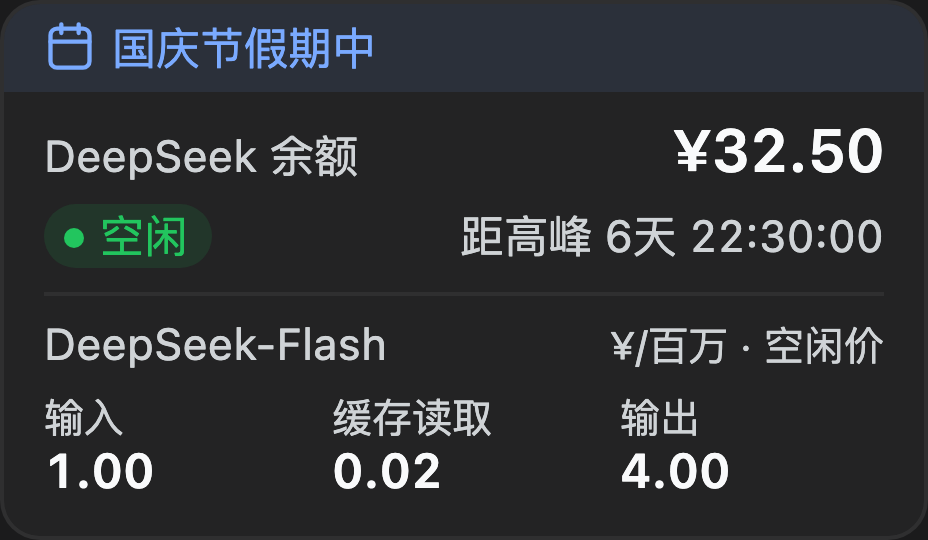
- Follows the app — light and dark themes, zh/en dictionaries, locale-aware numbers, and a quiet fallback to built-in data.
Screenshots
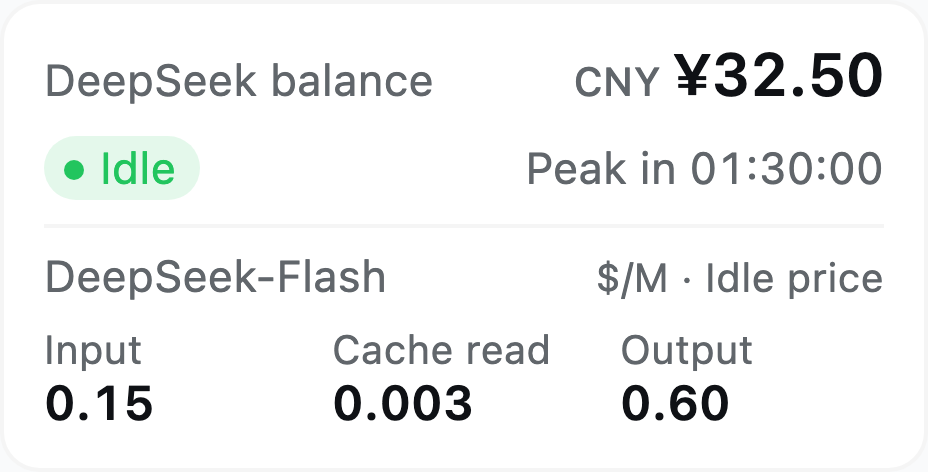
Real renders, 256 px sidebar at 2× density.
Holiday — 国庆节 |
Make-up workday — 调休 |
|---|---|
|
 |
| English UI, USD prices | Dark theme |
|---|---|
 |
 |
Installation
The package is published on npm (@jimmyzm/dsh-billing-card) as a DSH bundle. Use the profile you actually run (desktop for the desktop app, web for dsh web):
dsh plugin --profile web add @jimmyzm/dsh-billing-card
The same as Install from npm on the DSH plugin page. Refresh the GUI afterwards — the card appears at the bottom of the sidebar and hides itself when the sidebar is collapsed to the icon rail.
[!IMPORTANT] A plugin's Host half loads once per application start, so restart the application after installing or upgrading. Until then the card runs on its built-in data — same layout, only the tooltips say "built-in snapshot".
Requires a DSH build with the Web GUI, the sidebar footer slot and the account service. To uninstall:
dsh plugin --profile web remove @jimmyzm/dsh-billing-card
How it works
Host half — once per application start it fetches both official price tables and the China mainland holiday calendar, then serves the parsed result on GET /deepseek-billing-card/data. Client half — a React component in sidebar.footer.action that reads that route, follows the composer's model picker live, and refreshes the balance every 30 s. There is no build step.
Billing window
Peak is Beijing time, Monday to Friday, 09:00–12:00 and 14:00–18:00, excluding Chinese statutory holidays; everything else is off-peak and billed at half. Weekends are idle all day, which is why a make-up Saturday shows the gray 调休 chip instead of a peak price.
Currency
A Chinese UI quotes the CNY page, every other language the USD page.
[!WARNING] The two tables are fetched and fallen back independently, and nothing is converted — the card has no exchange rate and does not invent one.
Data sources
| What | Source |
|---|---|
| Balance, model | DSH account service; the composer's model selection |
| Prices | https://api-docs.deepseek.com/zh-cn/quick_start/pricing/ and https://api-docs.deepseek.com/quick_start/pricing/ |
| Holidays | https://calendars.icloud.com/holidays/cn_zh.ics |
Limits
- Prices and holidays are calibrated once per application start; a long-running app keeps what it started with.
- Nothing is converted between currencies, and the balance keeps its wallet currency.
- The card needs the same-origin HTTP GUI (
dsh web); without a web server it runs on the built-in copies. - Live model following needs the optional
uiSessionandmodelDirectoriesservices — without them the card prices the catalog default.
Development
No build step: client.js is a hand-written browser module, index.js and parse.js are the Host half. The card renders only its own subtree and reads only --dsw-alias-* tokens, so it cannot restyle the host.
package.json        # dsh.bundle.patch + dsh.client
cordis.patch.yml    # inserts the dsh-billing-card entry
index.js parse.js   # Host half: startup fetch + the data route
client.js           # Client half: the card and its built-in fallbacks
locale/             # zh/en dictionaries for the plugin manager
icon.svg            # plugin icon
docs/               # README logo and screenshots (repository only, not shipped)
test/               # offline suite: parsers, host route, client render
.github/workflows/  # ci (tests) and publish (npm with provenance)
To run a local checkout instead of the published package, add the folder — it is linked into the profile, so client.js edits show up on a page refresh:
dsh plugin --profile web add /path/to/dsh-billing-card
npm test runs the offline suite: the parsers against the pages captured in test/fixtures, the Host route with
a stubbed upstream, and the Client half in a miniature React runtime. No dependencies, no network.
Released under the MIT license.
No comments yet. Be the first to write one.