S1CAP
System-1 Context-Aware Planning



S1CAP: Context-Aware Planning via System-1 Models for Efficient LLM Agents
Authors: Yuanming Chen · LI Changzhe
Progress: M0 complete (packages, Laya runtime verified on this machine, the plugin activates in a real DSH
profile). M1 observation mode is live and verified in real sessions: the per-call pipeline runs
(SEGMENTER → RECALL → ASSEMBLER) with the prompt returned untouched, the system prompt is sourced from the
harness registry so the pinned block and the cache-stable prefix are non-zero (blocks.pinned = 684 in a real
round), association-graph upkeep is fed by real session/event traffic, and a replay harness reproduces the
control-plane records byte for byte. The settings panel that will hold the Jev key is next. Details, evidence
and per-item acceptance tests: docs/STATUS.md.
S1CAP puts a cheap System-1 decision model (Jev / Laya / Kev class, speaking the /v1/systemone protocol) in charge of an LLM agent harness's context lifecycle — instead of the expensive System-2 LLM. The S1CAP control layer intervenes at exactly two points:
- Context Awareness (what the model sees, per LLM call) — every session segment (user turn, assistant message, reasoning trace, tool call/result) is a node in a growing association graph scored by the System-1 model. Each turn, bounded BFS + relevance threshold + token budget decide which segments make it in, assembled in Trace-as-State order:
[pinned prefix | state proxy T | recalled blocks | recent tail | current input]. - Plan Ordering (the context-aware part of planning) — the LLM's candidate plans go directly to a second System-1 backend that scores them as a choice question; PLAN GATE normalizes those scores, orders the plans and caps attempts, and execution follows that order under a verification oracle, with unexecuted alternatives discarded on first success.
Everything is measured, not assumed: solve rate, token cost split by prompt-cache hit/miss (the dominant cost lever — cache-hit tokens are ~50× cheaper than misses on DeepSeek), and wall time excluding approval waits.
Why now (September 2026)
| enabler | fact |
|---|---|
| Trace as State (arXiv:2609.02702) | placing the reasoning-trace state proxy before the long context beats trace-append in 26/27 model×task×metric combos — training-free, inference-time only |
| Decision models arrive | Jev (TypeSafe AI): $0.042/M input, output free, parallel question batches 12× cheaper than serial · open Laya (Apache-2.0) · EdgeJev local runtime: 322M INT8, 324 MB, 15.6 ms/decision on 4 vCPU |
| Cache economics | DeepSeek deepseek-flash: $0.006/M cache-hit vs $0.30/M cache-miss — context assembly is a cost decision, not just a quality decision |
Architecture
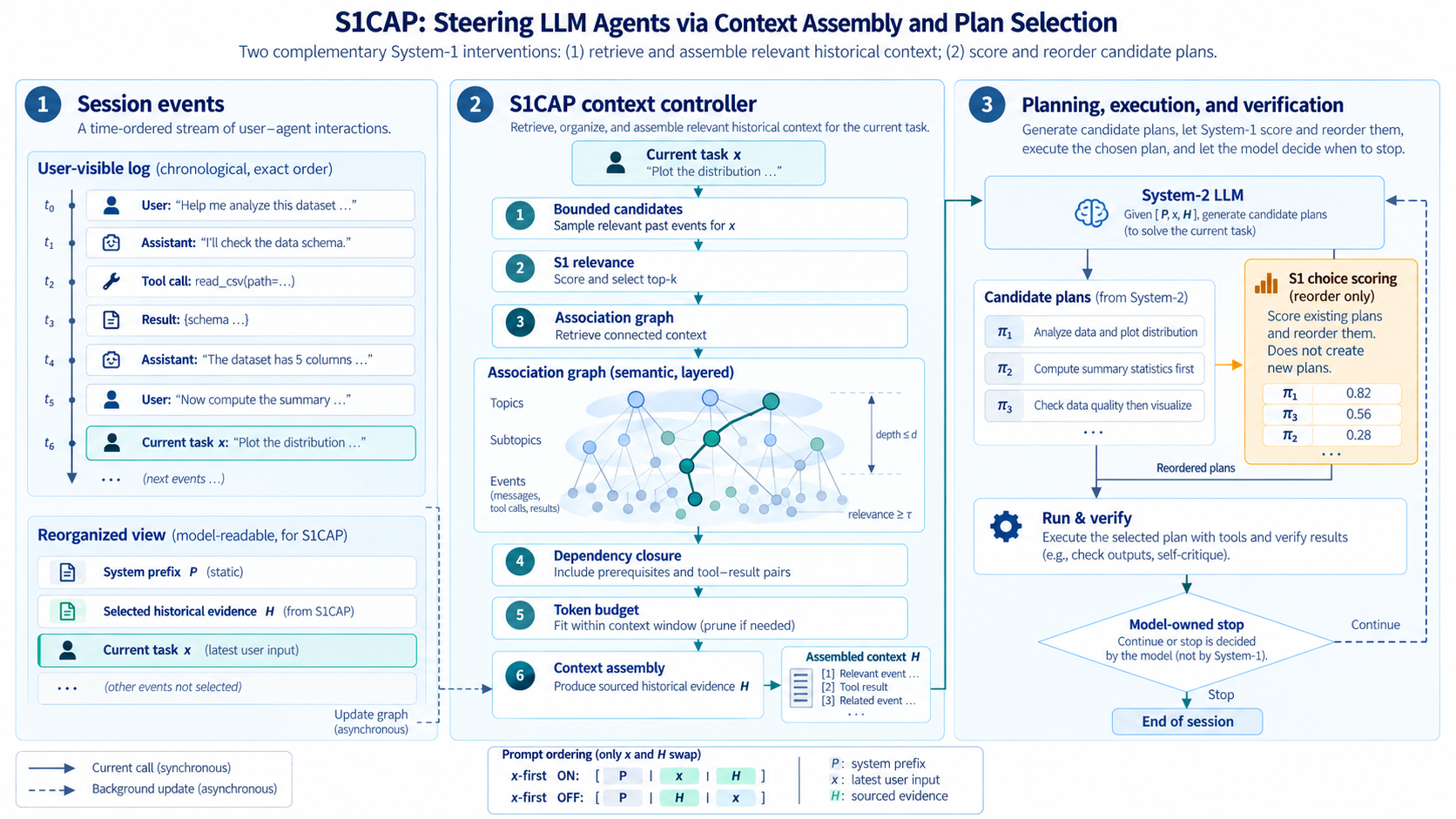
For exact control flow and asynchronous boundaries, see the detailed technical route (dark version).


The user-facing transcript stays strictly chronological; only the model view is reassembled (native in DSH's session/surface split, replicated by the portable proxy elsewhere).
Evaluation design (pre-registered)
2×2 within-task paired factorial — factor A: Trace-as-State ordering; factor B: S1 governance (selection + plan gate):
| Cell | A | B |
|---|---|---|
| C1 baseline | off | off (native compaction only) |
| C2 | on | off |
| C3 | off | on |
| C4 full | on | on |
Benchmarks (all automated scoring, no GUI, no LLM judges): SWE-bench Verified (100/cell) · Terminal-Bench 4.0 (66/cell) · τ²-bench (full base split). Model: deepseek-flash (DeepSeek-V4.1-Flash), temperature 0.
Success rule: solve-rate non-inferiority vs C1 (paired McNemar, one-sided α=0.05, margin −2 pp) AND ≥10% improvement in cost/task or time/task (paired bootstrap 95% CI excluding 0, Holm-corrected). Winning cost while losing >2 pp solve rate is not a win.
Status & roadmap
Pre-alpha — M0 scaffolding landed: monorepo, @s1cap/core (segmenter · association graph · assembler · plan gate · telemetry v1), @s1cap/s1-client, @s1cap/laya-runtime (Python discovery + laya-serve launcher), dsh-s1cap skeleton, 2×2 cell presets; node --test 34/34 offline, and a real laya-serve round trip verified (/health readiness + a noul decision over /v1/systemone). Remaining M0: live-backend smoke against Jev. Full spec: docs/AGENT_BRIEF.md §10.
| M | Scope |
|---|---|
| M0 | monorepo scaffold, core + s1-client, telemetry v1, DSH plugin skeleton — scaffold done, live-backend smoke pending |
| M1 | assembler/recall replay-correctness tests, proxy MVP, DSH hook wiring (agent/pre-step, surface ops) |
| M2 | plan gate wiring, degradation paths, settings UI, Terminal-Bench 10-task cost pilot |
| M3 | full 2×2 on SWE-bench Verified + τ²-bench (+ TB), optional Laya fine-tune |
| M4 | Terminal-Bench cells, opencode transfer check, GLM model-swap check |
| M5 | paper: Pareto + cache-waterfall figures, case studies, LaTeX draft |
Development
node --test --experimental-strip-types "packages/*/test/*.test.ts"   # 51 tests, zero deps, offline
node scripts/check-diagram.mjs   # every node box inside its lane band, no overlapping nodes
The second command guards the hand-authored route diagram: it is drawn by hand, so nothing but this check stops a node from drifting out of its lane.
Local Laya backend: @s1cap/laya-runtime discovers the Python environment that can import laya
(conda environments are resolved through conda env list --json, never by guessing paths), launches
laya-serve and health-checks /v1/models. Install the serving extra once per environment with
<python> -m pip install "laya[serve]"; configuration keys and the DSH profile patch are documented in
docs/LAYA_RUNTIME.md.
Type-checking needs TypeScript ≥ 5.8 (erasableSyntaxOnly): npm i -D typescript@^5.8 && npm run typecheck.
pnpm is the intended workspace manager; on Windows PowerShell call pnpm.cmd (the .ps1 shim is blocked by
the default execution policy).
Repository layout
s1cap/
  packages/core        # segmenter, association graph, assembler, plan gate, telemetry v1
  packages/s1-client   # /v1/systemone client + provider matrix
  packages/proxy       # OpenAI-compatible middleware (M1)
  packages/dsh-plugin  # dsh-s1cap: first-class DeepSeek Harness plugin (skeleton)
  bench/               # cells/ presets; runners + stats land with M2
  docs/                # proposal, implementation brief, related-work dossier, formulas
  paper/               # LaTeX (M5)
Documentation
| doc | audience |
|---|---|
| docs/STATUS.md | start here — done/next checklist plus agent-ready detail for every open item |
| docs/PROPOSAL.md | research proposal — supervisor / cooperator |
| docs/ARCHITECTURE.md | module reference: route SVG + connection semantics, parameters, implementation status |
| docs/LAYA_RUNTIME.md | local Laya backend: Python environment discovery, launcher, configuration keys |
| docs/CONTROL_PLANE_LOGGING.md | control-plane isolation: two-log design and the invariants that keep System-1 from scoring its own output |
| docs/AGENT_BRIEF.md | implementation brief for coding agents — verified facts base, interfaces, algorithms, milestones |
| docs/FORMULAS.md | formal definitions and formula handbook (Markdown + LaTeX) |
| docs/RELATED_WORK.md | verified related-work dossier + novelty audit |
| docs/REPO_METADATA.md | canonical repo description, topics, keywords |
Environment
Verified on the dev machine (2026-09-28): Node v22.23.1 · npm 12.0.2 · git 2.45.2 · Python 3.13.13 (miniforge) · i7-12700H (AVX2 — EdgeJev-compatible) · DSH runtime bundles Node 24.18.1.
Requirements: Node ≥ 22.19 (DSH plugin engines contract) · pnpm for the monorepo (on Windows PowerShell, invoke pnpm.cmd or relax the execution policy) · Python ≥ 3.10 for local S1 runtimes (pip install "laya[serve]", pip install edgejev) · a System-1 backend: cloud Jev key, or local EdgeJev/Laya for weak CPUs (324 MB, offline).
Name
S1CAP = System-1 Context-Aware Planning — S1 is the System-1 decision model, C-A-P is the context-aware planning it performs for an LLM agent. The control layer intervenes at two points: ① Context Awareness (which segments the model sees) and ② Plan Ordering (the order its own plans run in).
Acknowledgments
TypeSafe AI (Jev) · Convai Innovations (Laya) · yzfly (EdgeJev) · jaredpalmer (Kev) · Benchmark Heaven (JevBench) · Xu Zou & Jie Tang (Trace as State, arXiv:2609.02702) · snailium (DSH plugin engineering template) · DeepSeek Harness
Citation
Paper in preparation. Authors: Yuanming Chen, LI Changzhe. Title: S1CAP: Context-Aware Planning via System-1 Models for Efficient LLM Agents (revised 2026-09-28 after the naming erratum: the acronym expands to System-1 Context-Aware Planning).
@misc{s1cap2026,
  title  = {S1CAP: Context-Aware Planning via System-1 Models for Efficient LLM Agents},
  author = {Chen, Yuanming and LI, Changzhe},
  year   = {2026},
  url    = {https://github.com/Jaffe2718/s1cap},
  note   = {Paper in preparation}
}
License
TBD (MIT proposed).
还没有评论,来写第一条。