dsh-client-ui-model-seat
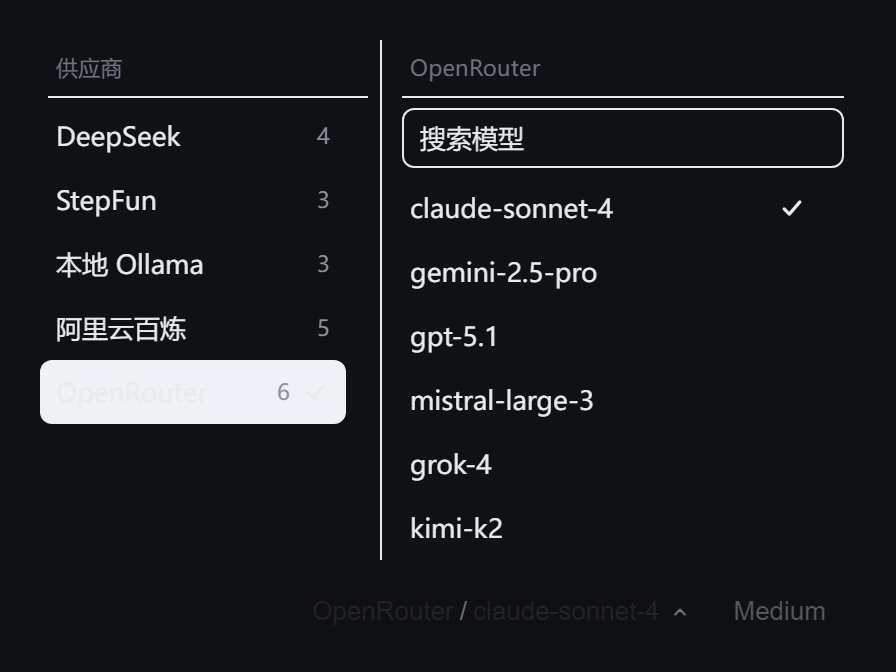
The model + thinking control of the dsh composer, merged from two plugins that both replaced the same seat and therefore could not be installed together:
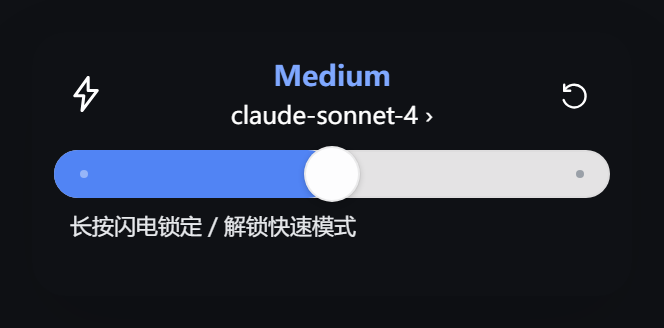
- dsh-client-ui-gpt-helper — the shell: token-driven colours, the particle thinking slider, fast mode with its long-press lock, the appearance panel, the i18n dictionaries and the per-session wiring.
- dsh-model-provider-prefix — the skeleton of the card: a provider column beside a model column, hover decides which provider the model column shows, and a failed provider turns into a retry row.
Use this one instead of either original — not beside them:
dsh plugin remove dsh-client-ui-gpt-helper
dsh plugin remove dsh-model-provider-prefix
Maintaining this file: see MAINTENANCE.md (Chinese) for the code map, the invariants that keep the card stable, the test matrix and the real-app verification recipes. Changes per release: CHANGELOG.md.
Who it is for / 适用场景:
| You are… | This plugin gives you |
|---|---|
| Someone who needs the provider next to the model | One trigger showing provider / model, one card with both columns. |
| Someone whose provider list is long | Hover the provider column; the model column swaps and the card stays put. |
| Someone who tunes reasoning effort | The effort trigger and its particle slider, plus fast mode with a long-press lock. |
| Someone carrying both original plugins | One seat instead of two that cannot coexist. |
Requires dsh >= 0.2.1-rc.2 (engines.dsh). Client-side only: no network calls,
no credential access, no host module.
What it does
| Surface | Behaviour |
|---|---|
| Model trigger | provider / model plus a caret. Opens the card on the provider+model columns; a second click closes it. |
| Effort trigger | The current thinking level (Max, Medium, …). Opens the card on the particle slider; rendered only when the selected model declares thinking levels, and its label becomes Fast on while fast mode is locked. |
| Provider column | Every provider in the session directory with its model count, a check on the current provider, and a retry row for a provider whose list failed to load. |
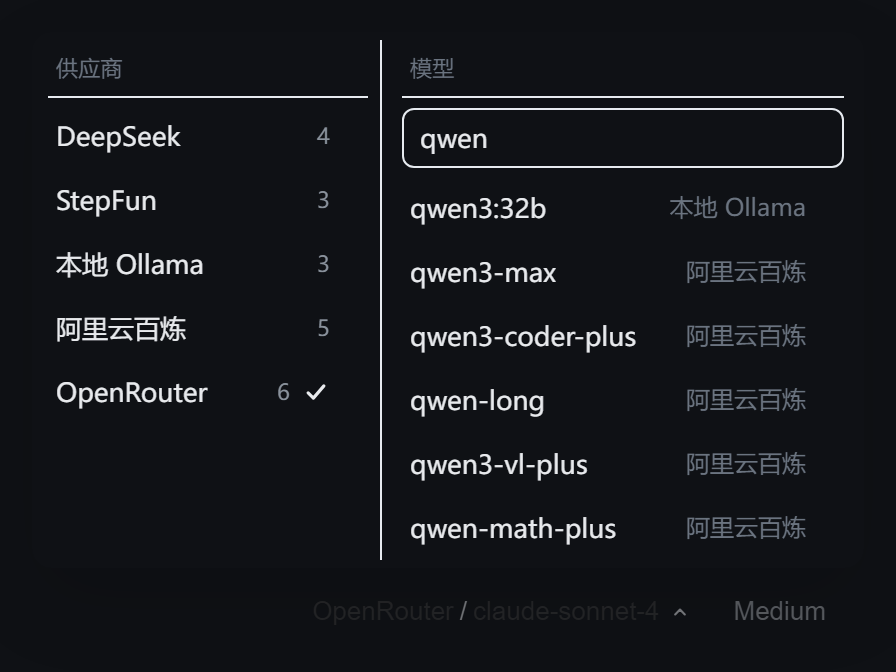
| Model column | Head shows the provider under the pointer; a 30 px search box sits inside the column. Hovering the provider column swaps the models without moving the card. |
| Search | Typing searches every provider at once and shows the provider name on each row. The card keeps its two-column shape while typing — a re-shaping card is exactly the resize flicker this plugin removes. |
| Thinking slider | The particle slider from the shell, over the level ladder of the selected model, with keyboard arrows/Home/End. |
| Fast toggle | A 600 ms long-press on the bolt locks fast mode; the lock survives a reload (…:fast:v1) and re-arms when the window regains focus. |
| Appearance panel | Ctrl+Shift+Alt+G. Colour tokens per side (light/dark), scheme library, JSON import/export, reset, cross-apply to the other side, live preview. |
Geometry: the card is 416 px wide in the column layout and 300 px in the
thinking panel, clamped to the viewport; heights clamp to 132…420 px and the
card flips above the trigger when that gives more room.
The flicker this merge had to fix
The upstream card was anchored by its bottom edge and sized by its content, while its content was chosen by the row under the pointer. With one provider holding more models than the card could show, that closed a loop:
- the card grows to fit the model list, so its top edge moves up;
- the pointer, which was over a provider row, is now over a different row (or outside the card), so the model column swaps or empties;
- the card shrinks, the pointer is back over the first row, and the loop runs again — measured at 27 height flips in 900 ms on the old bundle.
The merged card breaks the loop by making the frame a function of the anchor and the layout only:
frame(anchor, layout, natural, floor)is pure: it clamps width and height to the viewport and flips above the trigger when that gives back more room.- The natural height is measured once per (layout, status, level count),
while the card is still hidden (
data-ready="false"), and then frozen for as long as the card stays open on that key. - The columns scroll internally (
scrollbar-gutter: stable), so a long model list never changes the card outer height. box-sizing: border-boxkeeps the inline height equal to what was measured.flooris the height the card already had, so any later re-measure inside the same placement can only grow the card, never collapse it over the pointer. A new anchor (resize, scroll) starts the floor over at zero.- The query does not change the layout, so typing never resizes the card.
Re-measurement happens only on open, pane change, anchor move (scroll/resize) or a status change — never on hover.
Configuration
Everything user-facing is edited in the appearance panel; there is no profile
config key. Two localStorage records hold the state:
| Key | Shape |
|---|---|
dsh-client-ui-model-seat:config:v1 |
{ version: 3, hotkey, paused, crossApply, slots: { light: { scheme }, dark: { scheme } }, schemes: { name: { name, colors } }, sides: { light, dark } } |
dsh-client-ui-model-seat:fast:v1 |
{ fast, locked } |
paused: true switches every custom colour off (the panel master switch);
slots[side].scheme names the active scheme for a side, sides[side] holds the
per-token tune-ups (they win over the active scheme, so a manual edit is never
swallowed), and crossApply makes one side colour both.
Records written by the shell plugin (dsh-client-ui-gpt-helper:config:v1) are
not read: the schema changed and a silent half-migration would be worse than
the defaults. Both records are read on load, on a storage event, and when the
window regains focus.
DOM contract
Stable hooks, for CSS and for tests:
| Element | Attribute |
|---|---|
| Root | [data-model-seat="root"], plus data-build |
| Triggers | [data-model-seat="model-trigger"], [data-model-seat="effort-trigger"] |
| Card | [data-model-seat="menu"] with data-pane, data-layout, data-ready, data-flipped, data-fast, data-ultra, data-locked |
| Columns | .ms-col[data-col="providers"], .ms-col[data-col="models"] |
| Column head | .ms-colHead, separator .ms-sep |
| Search | .ms-search (inside the models column) |
| Rows | .ms-row[data-kind="provider"|model|retry"], data-active, data-current, count .ms-count, note .ms-rowNote |
| Slider / fast toggle | [data-model-seat="thinking-slider"], [data-model-seat="fast-toggle"] |
| Colour panel | [data-model-seat="config-panel"], backdrop [data-model-seat="config-backdrop"] |
| Fallback | [data-model-seat="fallback"] — what the error boundary renders |
That is the whole contract: since 0.1.1 nothing emits data-gpt-helper or
data-dsh-pm-*. CSS written against either upstream plugin no longer matches,
which is the point — a leftover [data-gpt-helper] rule from the shell plugin
would otherwise restyle this card. npm run validate fails if either prefix
comes back.
Install
dsh plugin add dsh-client-ui-model-seat                              # from the registry (0.1.2+)
dsh plugin add github:HimA6652/dsh-client-ui-model-seat              # from source
dsh plugin add link:/absolute/path/to/dsh-client-ui-model-seat       # local checkout
Both channels ship the same tree. The npm page is
npmjs.com/package/dsh-client-ui-model-seat;
the first release on it is 0.1.2. A pnpm profile with minimumReleaseAge may
ask once before accepting a version published in the last day.
The plugin bundle inserts one row into the profile (id: model-seat) and
registers its seat at priority: -2, so a leftover copy of either original
(-1) or the shipped control (0) is shadowed instead of colliding.
A desktop profile cannot be edited by the plain CLI — it answers
profile "desktop" is managed exclusively by the Electron application. Use the
desktop host CLI instead (see MAINTENANCE.md, "安装、升级、回滚").
Screenshots are generated, not hand-cropped: npm run shots renders the real
bundle in the harness over a demo provider set and clips each PNG at 2x.
Verifying on a real dsh
npm run e2e runs the bundle against a fixture page. To check the same bundle
inside a real dsh web app without touching your own store, give it a throwaway
DSH_HOME:
SEAT_HOME=C:/Users/you/AppData/Local/Temp/seat-live-home
mkdir -p "$SEAT_HOME" && cp ~/.dsh/.credentials.yaml "$SEAT_HOME/"
export DSH_HOME=$SEAT_HOME
DSH=<checkout>/node_modules/@deepseek-ai/dsh/lib/bin.js
node "$DSH" --profile seatcheck --from-default-profile web --help   # creates seatcheck from the web template
node "$DSH" plugin --profile seatcheck add link:$PWD
node "$DSH" --profile seatcheck --port 6124 --host 127.0.0.1 --no-open
The credentials copy is what makes the account model directory resolve; without
it the card is empty. The banner prints the URL with its ?token=; hand that to
npm run live -- --url "http://127.0.0.1:6124/?token=..."
--publish also clicks a model row and asserts the trigger relabels. That writes
the account model selection, which is why it is off by default and why the run
belongs on a throwaway DSH_HOME. The check reports the trigger labels, the
card layout/height/width, a 900 ms frame sample, the thinking pane, and any
console error naming the seat; it exits non-zero on a problem. Your own ~/.dsh
store and the desktop app are never involved.
Development
npm run check       # secrets + pack + validate + css audit + load check + tests
npm run check:secret # dev paths, tokens, private keys in every text file
npm run check:pack   # `files` vs the real npm artifact, in both directions
npm run validate     # manifest, patch row, entry module, bundle load, apply
npm run css          # stylesheet scoping and dead-class audit
npm run loadcheck    # against the installed dsh checkout (skips when absent)
npm test             # node:test unit and integration tests
npm run e2e          # drives the real bundle in headless Edge over CDP
npm run check:all    # check + e2e
npm run live -- --url URL   # the same checks inside a real dsh
npm run release 0.2.0       # gates → npm → commit → tag → push (see CHANGELOG rule)
npm run e2e serves test/harness/ on a loopback port, opens it in headless
Edge over CDP and asserts, in nine sections: the two-column card, a constant
height while the pointer rests over 60 models, close/reopen determinism, the
cross-provider query, the empty-query note (one padded .ms-empty, zero rows),
the slider keyboard path, the fast toggle (click, long-press lock, unlock), the
head status button returning to the columns, the colour-panel hotkey, and a
clean console. --shot DIR writes screenshots;
--dump prints the card box and its children. The e2e loads React from the
committed test/vendor/ UMD builds, so a fresh clone needs no external
directory and no network; --vendor DIR / REACT_VENDOR=DIR override it.
lib/client.js is hand-written — a 3642-line single-file bundle with no
build step, because dsh.client takes one ./client entry. tools/merge/gen-client.mjs
produced the first draft from the shell bundle and is kept only as a record. It
now refuses to run without --force, and even then backs the current file up to
lib/client.js.bak-gen-<timestamp> first.
Known limitations
- One seat, one owner. The plugin registers at
priority: -2forconversation.input.model. Another plugin registering the same priority for the same slot is resolved by mount order, not by this plugin. - No column-to-column keyboard navigation. Arrows move inside the focused column (the slider, the search box, the rows); Tab leaves the card. Hover and clicks are the way to change provider.
- The card does not animate. Switching panes or providers relayouts in one frame by design — an animated height is the resize loop this merge removes. A window resize re-measures the clamp, so an open card follows the viewport.
- Colours live in
localStorage(dsh-client-ui-model-seat:config:v1) per browser profile. They do not follow the account across machines; the panel's JSON import/export is the only way to move them. - Search covers model name and id, not provider names. Typing
ollamafindsollama/qwenthrough the model, not through the provider column. - Web client surface only (
dsh.client.platform: "web", which the desktop app renders). The terminal surface is untouched. lib/client.jsis one hand-written file with no build step;dsh.clienttakes a single./cliententry. There is no per-model override layer: the plugin edits the seat, not the model list.
License
MIT, see LICENSE.
No comments yet. Be the first to write one.