DSH Better Reasoning Effort







English | 中文
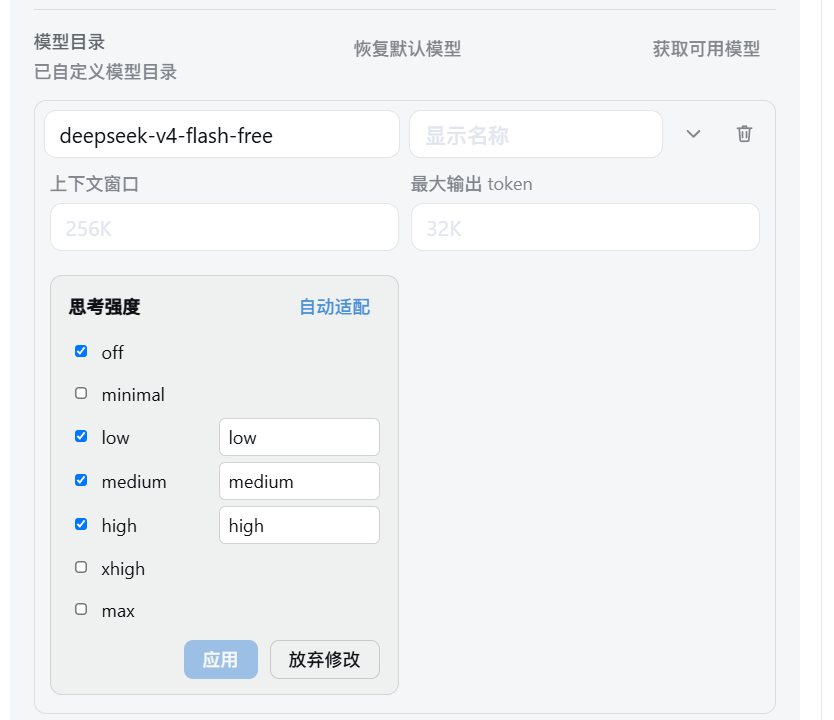
Reasoning-effort editing for third-party models in DeepSeek Harness — thinking levels declared per model, auto-adapted from a model knowledge base + wire-protocol inference, edited right inside the official Models page card.
Why
The llm-pi-ai adapter of DeepSeek Harness natively supports per-model reasoningEfforts declarations (which thinking levels a model accepts, and the exact string to send on the wire for each). But the official Models page editor deliberately keeps this field out of reach — the official notes say it is a per-model capability and a provider-level knob would break some models. As a result:
- Third-party models get no thinking-level picker in the composer (
getSupportedThinkingLevelsshort-circuits to["off"]); - Only the official DeepSeek API (the built-in catalog) can set reasoning effort;
- Setting levels for a third-party model meant hand-writing the
reasoningEfforts/compatblocks insettings.yaml.
This plugin brings that configuration back into the UI: edit right inside the official model editor card, plus one-click auto-adapt.
Features
- In-page injection: a "Reasoning effort" block appears in the official Models page under each model row's disclosure, next to context window / max tokens — not a separate settings page, but part of the official editing flow (same
settings.mutatecontract, same save style). The block spans the full row; its level rows split into the same two columns as the official capacity pair. - Create-card staging: the editor also appears while a provider is still being created — auto-adapt works from the typed protocol/endpoint, Stage holds the declaration, and the plugin writes it automatically the moment the provider is saved (a declaration already in the document is never overwritten).
- Auto-adapt: a built-in model knowledge base (DeepSeek V3/V4/R1; OpenAI GPT-5 by generation and o-series; Claude 4/5, Gemini 3.x, Grok 4.x, Mistral Magistral; Qwen, GLM 4/5, Kimi K2/K3, Doubao, Hunyuan hy3, Step — spellings verified against each vendor's docs, 2026-08) plus protocol inference keyed by pi-ai's real wire protocols (
openai-completions/openai-responses/anthropic-messages, plus a DeepSeek endpoint dialect frombaseURL) fills recommended levels and wire spellings in one click. Families whose endpoints take no effort ladder (MiniMax, Llama, Nova, Phi, Cohere, Perplexity sonar) deliberately carry no entry — the low-confidence generic suggestion is more honest. Compat suggestions are gated to the one protocol whose gate accepts them. - Endpoint evidence: Auto-adapt also probes the provider's RAW
/modelslisting through a same-origin host route (credential resolved server-side, never echoed) and fuses the signal by confidence — an explicit "does not reason" wins outright; knowledge-base wire values stay authoritative; every suggestion is labeled high / medium / low so you know what to double-check. - Host auto-fill: on every settings update, models without a
reasoningEffortsdeclaration get a recommended one (declared models, explicitfalse, and deliberately unset models are never touched). The write is optimistic-locked: if your edit moved the namespace first, the fill backs off and waits for the next update — it never fights you for the write. - Three intents: all levels off = unset the declaration (back to inheritance — persisted as a
reasoningEffortsUnsetmarker so auto-fill respects it, even across restarts); onlyoffarmed = disable reasoning (false); levels armed = write the declaration. The editor stays in sync with official-page re-renders and pushed settings changes without clobbering your in-flight edits. - Defensive injection: the injector keys off the official page's DOM (aria-labels / classes). If an official upgrade changes the structure, injection simply stops and the official page is untouched; the next scan re-injects once the structure is back.
- Bilingual copy (中文 / English).
Install
Requires DeepSeek Harness 0.1.1-rc.1 or newer (@deepseek-ai/dsh-api-remotes@^0.1.1-rc.1).
From npm
# under the dsh web profile
dsh plugin --profile web add dsh-better-reasoning-effort
From GitHub
# under the dsh web profile
dsh plugin --profile web add github:HaoyueQin/dsh-better-reasoning-effort
The github: source only pulls source; lib/ is built by the package's prepare hook. pnpm does not run build scripts of git dependencies by default — the installer prints the allowBuilds key it needs; follow that and add again.
Local development
npm install && npm run build
dsh plugin --profile web add link:D:/Project/dsh-better-reasoning-effort
Restart dsh web, hard-refresh the browser. Each model row's disclosure on the official Models page now carries a "Reasoning effort" block.
Usage
- Configure a third-party provider (API key etc.) on the official Models page.
- Expand a model row: the "Reasoning effort" block sits under the official capacity fields.
- Check levels (off / minimal / low / medium / high / xhigh / max) and fill the wire values (e.g. give
highthe spellingultra, and the gateway receivesultrawhen you pick High in the composer); - Click Auto-adapt to fill recommended levels from the knowledge base / protocol;
- Click Apply to write the setting.
- Check levels (off / minimal / low / medium / high / xhigh / max) and fill the wire values (e.g. give
- All levels off + Apply = unset the declaration; only
offchecked + Apply = disable reasoning (false).
Declared models are immediately selectable for reasoning effort in the composer's model picker.
How it works
Browser (lib/client.js)                  Host (lib/index.js)
├─ DOM injector                          └─ Auto-fill
│   MutationObserver on the models page      settings/updated → adds a
│   → mounts EffortEditor in each            recommended reasoningEfforts
│     model row's disclosure                 for undeclared models
├─ EffortEditor (React component)             (knowledge base + inference)
│   level checkboxes / wire values /
│   auto-adapt / apply
│   └─ writes settings.mutate (llm-pi-ai)
- Knowledge base + protocol inference:
suggestEfforts()insrc/knowledge.ts, a pure function shared by host and browser. - DOM injection:
reconcile()insrc/client/injector.tslocates model rows by the official button aria-label (Capacities/容量) and mounts the editor into the capacity disclosure. - Writing:
createEditorApi()insrc/client/ops.tsrewritesproviders.<route>.models[i].reasoningEffortsviasettings.mutate, preserving every other row field; on a revision conflict it re-reads and retries once (the same recovery the official settings form uses). - Shared constants:
src/constants.tscarries the plugin id, settings namespace, and DOM marker used by both halves.
Comparison
| better-model-provider | dsh-reasoning-effort-autofill | HanaAyane/dsh-reasoning-effort | This plugin | |
|---|---|---|---|---|
| Edit entry | separate settings page | no UI (silent fill) | separate settings page (paste YAML) | inside the official model editor card |
| Auto-adapt | none | hard-coded OpenAI levels | diagnose + paste | knowledge base + protocol inference, one click |
| Official page fusion | no | no | no | yes (DOM injection) |
Development
npm run typecheck   # tsc strict check on src
npm test            # vitest: knowledge / inference / autofill / DOM injection / writing
npm run build       # lib/*.js + lib/client.js (module-loader bundle)
Contract version: @deepseek-ai/dsh-api-remotes@0.1.1-rc.2 (client contract types), verified by typecheck, the test suite, and a full build against the 0.1.1-rc.2 packages.
Known limitations
- Injection depends on the official Models page's current DOM (aria-label/class). If an official upgrade changes the structure, injection pauses until adapted; the official page is unaffected meanwhile.
reasoningEffortsdeclarations are suggestions: which levels/spellings an endpoint actually accepts is up to its docs — tweak each in the UI.- The knowledge base is not exhaustive — spellings drift as vendors ship models, and families without an effort ladder carry no entry at all; unlisted models fall back to protocol inference + generic levels and can be adjusted by hand.
License
MIT
还没有评论,来写第一条。