breakthrough-harness
Make your research agent hard to fool — starting with itself.




中文版 · works with any agent stack · pure methodology + two runnable demos

That is python examples/toy_loop.py (< 30 s, numpy only): a candidate that
secretly fits the calibration answers looks like a breakthrough, and the
held-out confirmation executes it. This half screen is the entire
philosophy of the repository.
Most agent harnesses teach an agent how to work. This one teaches a research
agent how not to deceive itself — because in research the failure mode is
rarely "the code crashed" and almost always "the number looked great and was
wrong." Every rule here was paid for by a real failure; none is hypothetical.
The repository follows its own rules: what these pages claim, tests/ checks
on every push.
The core claim
Breakthroughs are a throughput problem. breakthrough ≈ many cheap attempts × a scoring function that is hard to fool.
Serial, hand-crafted experiments produce a few dozen attempts per year; the systems that actually produced constructive breakthroughs (program search over mathematical constructions, tournament-style hypothesis engines) share one skeleton: parallel cheap generation + automated selection that is hard to fool. You cannot copy their compute; you can copy the skeleton — if the scoring function is engineered with the rigor a referee would apply. That engineering is this repository.
And a quieter corollary: when every attempt is expensive, the rational move is to audit what exists rather than build what might fail — audits have guaranteed deliverables. Teams that keep sliding into negative-result papers are responding rationally to the price of an attempt. Fix the price and the sliding stops.
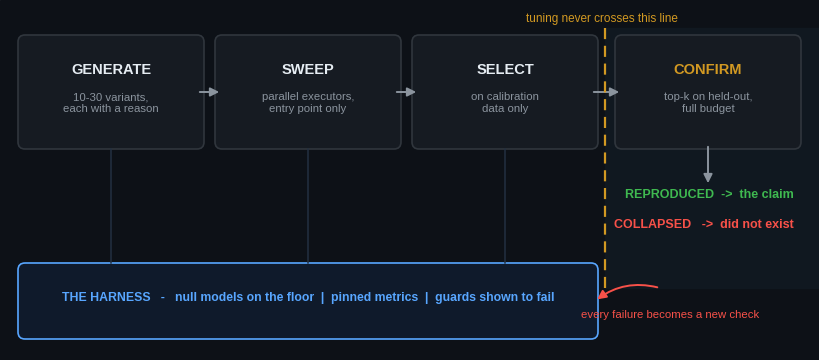
What is inside
| Directory | What it gives you |
|---|---|
loop/ |
The breakthrough loop: generate-with-reasons → parallel sweep → select on calibration → confirm on held-out |
harness/ |
Building a scoring harness, incl. the anti-cheat four: null models on the floor; metric conventions pinned & double-reported; calibration/evaluation physically separated; absurd baseline ⇒ freeze everything |
gates/ |
Go/no-go gates: target triage, the claim-polarity red line, occupancy checks at claim level |
rules/ |
11 engineering rules, each ending with the real failure that paid for it |
examples/ |
Two runnable demos: the cheater above, and "the flat sweep that lied" (force_balance.py, rule 3 live) |
adapters/ |
Drop-ins for your stack — see below |
template/ |
A runnable campaign starter: entry-point harness with registered nulls and a live freeze rule, logged held-out access, a round ledger, and guards with a deliberate-violation test — adapt it to your task in an afternoon |
The other demo: the flat sweep that lied
Act 1  lam in {0.1, 1, 10, 100}   -> scores 2.1, -0.0, -0.0, -0.0   "flat, the parameter is inert"
Act 2  one gradient-norm evaluation -> every value crushed the data term; balance is ~0.05
Act 3  sweep around the balance    -> clean interior peak at lam = 0.0015, 22.6 dB
python examples/force_balance.py: a four-decade hyperparameter sweep that
looks flat because the data term is a mean and the regulariser a sum —
every tested value sat on one side of the force balance. One gradient-norm
evaluation finds the real range. Rule 3, live.
Use it with your agent, whatever it is
The methodology is plain markdown — nothing here depends on any vendor. The adapters just package it for wherever your agent reads instructions:
| Your stack | Do this |
|---|---|
| DeepSeek Harness | nothing to copy — clone this repo and DSH already finds .agents/skills/breakthrough-loop/; its filesystem skill provider scans <projectRoot>/.agents/skills at rank 200. For your own project, copy that directory, or copy adapters/AGENTS.md to the project root, which DSH's agent-instructions plugin loads |
| OpenAI Codex | same file: copy adapters/AGENTS.md into your project root (Codex reads AGENTS.md) |
Any other AGENTS.md tool (Jules, Amp, …) |
copy adapters/AGENTS.md into your project root |
| Claude Code | /plugin marketplace add GuoCheng24/breakthrough-harness then /plugin install breakthrough-harness@breakthrough-harness — or manually cp -r adapters/claude-code/breakthrough-loop ~/.claude/skills/ |
| Cursor | mkdir -p your-project/.cursor/rules && cp adapters/cursor/breakthrough-loop.mdc $_ |
| GitHub Copilot | one click: install the Research Harness Engineer agent from GitHub's own awesome-copilot collection — or merge adapters/copilot/copilot-instructions.md into .github/copilot-instructions.md |
| Gemini CLI | copy adapters/gemini/GEMINI.md into your project root as GEMINI.md |
| Windsurf | mkdir -p your-project/.windsurf/rules && cp adapters/windsurf/breakthrough-loop.md $_ |
| Cline | mkdir -p your-project/.clinerules && cp adapters/cline/breakthrough-loop.md $_ |
| Aider | save adapters/aider/CONVENTIONS.md and launch aider --read CONVENTIONS.md |
| Anything else (OpenAI/Gemini/Anthropic raw API, LangChain, custom loop, a human) | paste adapters/SYSTEM_PROMPT.md |
All adapters carry the same methodology; the five plain-markdown ones are
generated from a single source (adapters/_core.md) and
CI fails if they drift. If your tool reads AGENTS.md, install either that
or the tool-specific file — not both.
Quick start
git clone https://github.com/GuoCheng24/breakthrough-harness
cd breakthrough-harness
python examples/toy_loop.py     # < 30 s, numpy only
The five habits, in one screen
- Null models first. Before believing any score, ask what a method that learned nothing would score. If your pipeline can't tell them apart, fix the pipeline before running a single experiment.
- Calibration and evaluation never touch. Tune on one set of files, report on another. A gain that does not survive the held-out set does not exist.
- A baseline you cannot beat is a recipe you have not finished reading. Published baselines hide layers: the optimizer, the loss, the metric convention, the operator. Read until your reproduction matches.
- Claims have a polarity. The main sentence of a result must be constructive — "we propose X, it solves Y, the number is Z." Audit output supports the claim; it is never the claim.
- Every guard must be shown to fail. A check never seen firing on a deliberately broken input is decoration — guards in this very repository were caught silently passing before this rule existed.
What this is, and is not
| Orchestration frameworks | breakthrough-harness | |
|---|---|---|
| Teaches the agent | how to work | how not to fool itself |
| Form | runtime / SDK | plain markdown + one numpy file |
| Lock-in | their stack | none — adapters for every stack |
| Guards | agent capability | scientific validity of what the agent reports |
It plugs into whatever you already run. It replaces nothing.
Where the skeleton comes from
The core claim is not folklore; the named systems and known failure modes:
- FunSearch — Romera-Paredes et al., Mathematical discoveries from program search with large language models, Nature 2023: program search + automated evaluator producing new constructions (cap set, bin packing).
- AI Co-Scientist — Gottweis et al., Google 2025-26: tournament-style hypothesis generation/ranking with automated review.
- The reusable holdout — Dwork et al., Science 2015: why repeated
consultation of a held-out set silently turns it into a calibration set
(the reason
loop/gives held-out data a lifecycle and a budget). - Test-set overfitting in practice — Recht et al., ICML 2019 (Do ImageNet classifiers generalize to ImageNet?): distribution of gains that fail to transfer, measured at field scale.
- Deep learning tuning playbook — Godbole et al., 2023: the discipline of scientific vs. nuisance hyperparameters this repo's sweep rules descend from.
License
MIT. Use it, fork it, disagree with it.
No comments yet. Be the first to write one.