


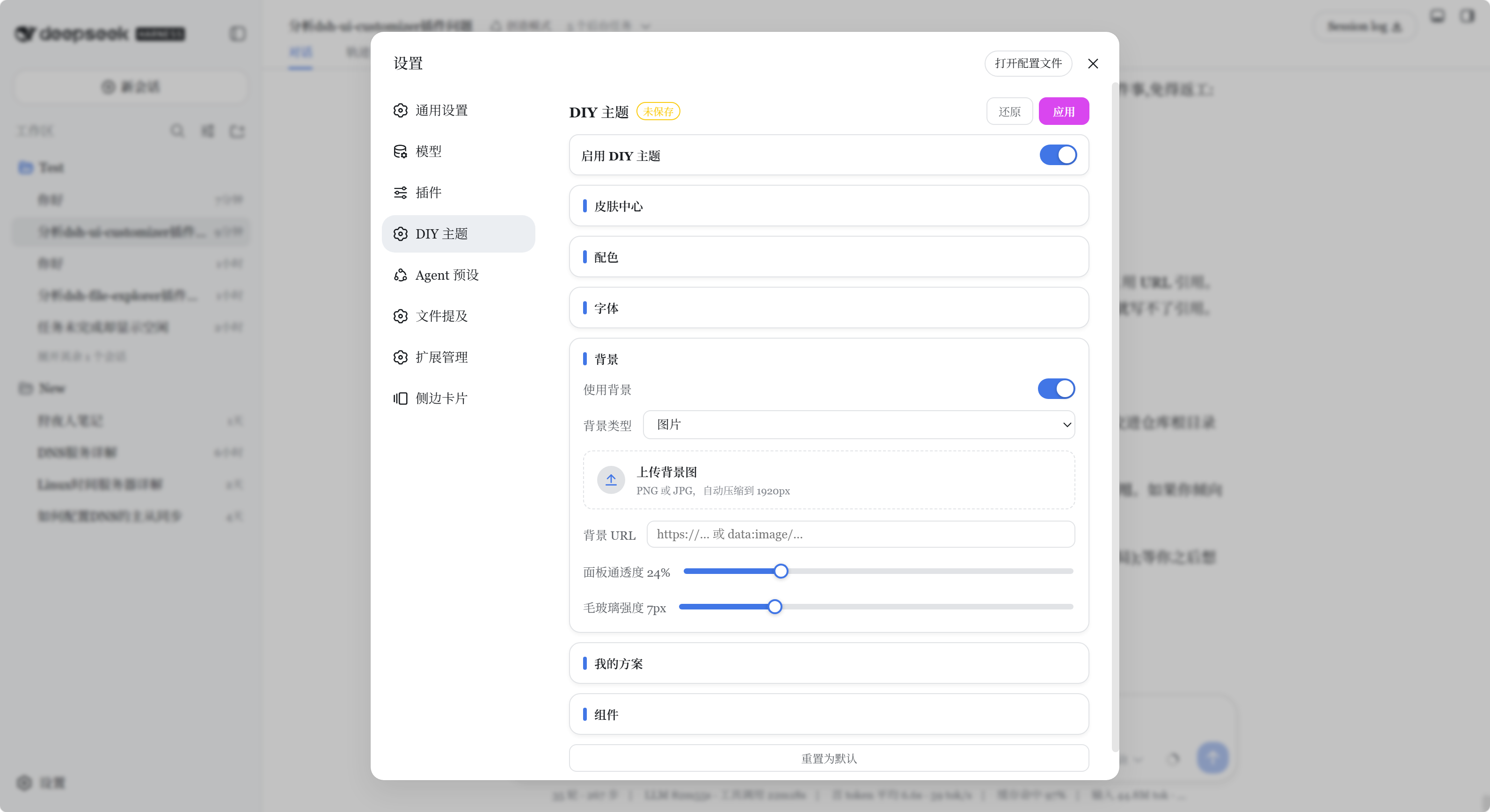
dsh-ui-customizer — a visual, no-code theme customizer for DeepSeek Harness (DSH) Web. Change colors, fonts, background and component style from the Settings → DIY Theme panel and watch it apply instantly.
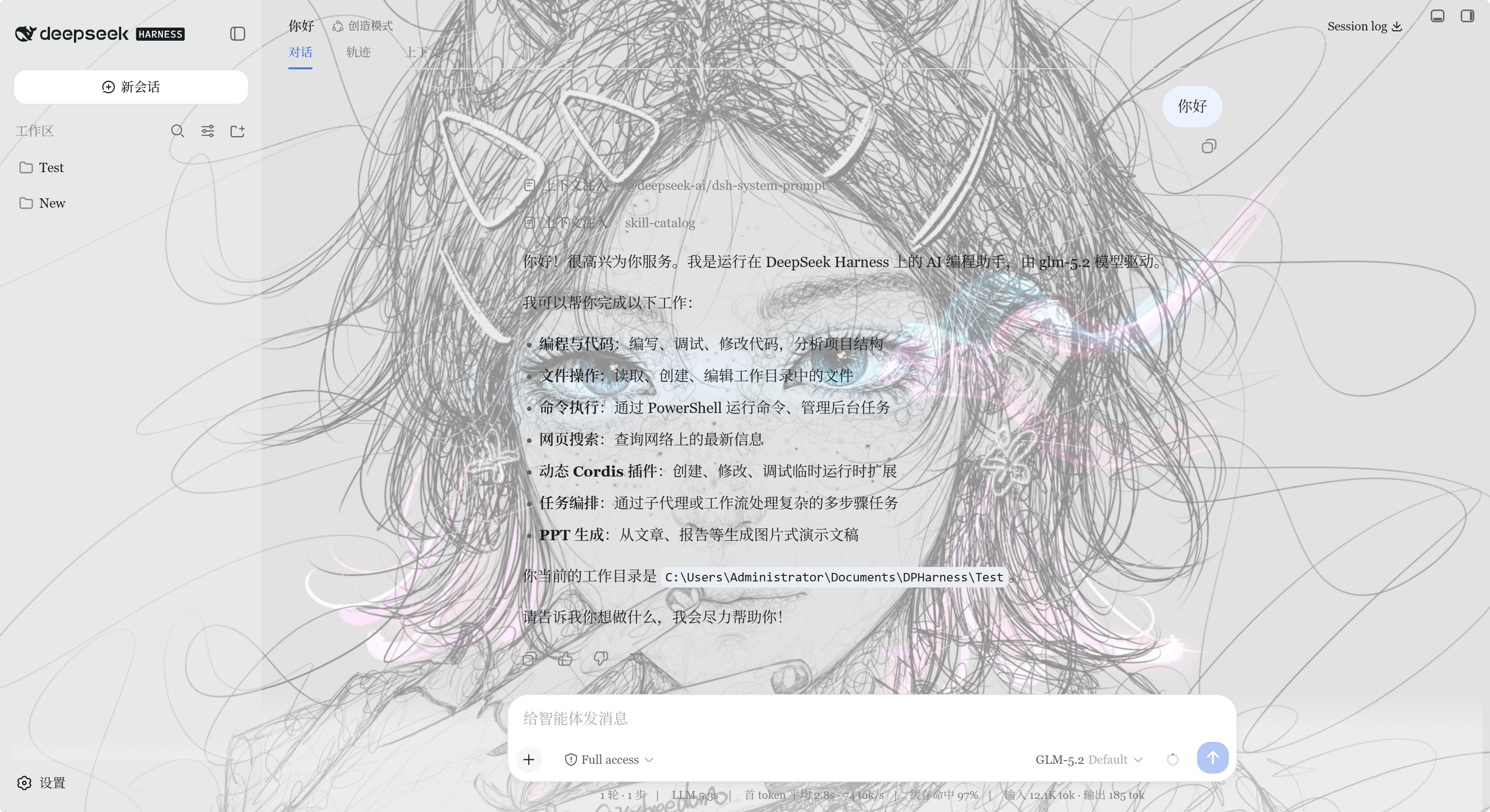
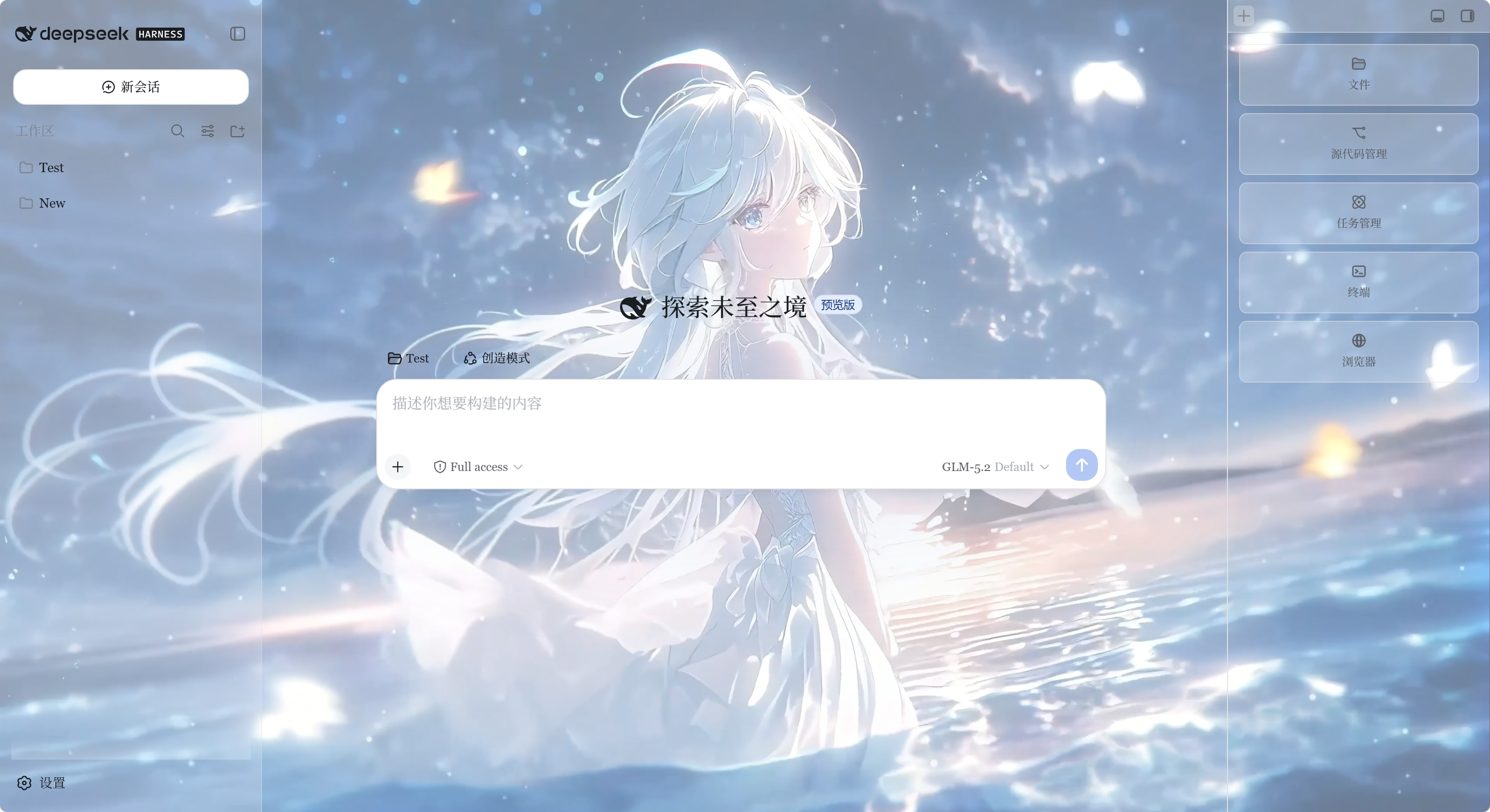
▶️ Demo video: click the cover above to open and play it in a new tab.
Languages: English · 简体中文 · 繁體中文 · 日本語
✨ Features
| Group | What you can change | Notes |
|---|---|---|
| Master switch | Enable / disable the DIY theme | Turning it off removes every override |
| Skin center | 8 one-click presets | You can keep fine-tuning after picking a preset |
| Colors | Brand, accent, success, warning, error | Color picker + hex |
| Colors | Neutral tone direction | Blue‑grey, cool grey, warm grey, graphite |
| Fonts | UI font and code font | Preset font stacks |
| Fonts | Overall zoom (80–140%) and text scale (80–130%) | Two independent controls |
| Background | Image URL (http(s): or data:) |
Kept in the browser |
| Background | Panel translucency & glass blur | High values cost more GPU/CPU |
| Components | Shadow level and border radius | Adjust depth and roundness |
| My schemes | Save & switch full theme presets | Name your setups and recall them |
The plugin is readability‑first: environment surfaces (main background, sidebar) become transparent with your translucency setting, while overlays (dialogs, menus, inputs, tooltips) stay ~94% opaque so text inside pop‑ups always remains readable.
🚀 Quick Start
You need Node.js (with
npx) to run a DSH Web profile. No git or pnpm is required for the simplest path.
Option A — install script (only Node.js needed)
Download this repo as a ZIP and extract it.
In PowerShell,
cdinto the extracted folder and run:.\install-web.ps1Start DSH Web:
npx @deepseek-ai/dsh webOpen Settings → DIY Theme in the browser.
The script copies the plugin into ~\.dsh\profiles\web\node_modules\dsh-ui-customizer and registers it in cordis.patch.yml. It is safe to re‑run.
Execution policy error? If PowerShell says the script "cannot be loaded / is not digitally signed", that is the default execution policy blocking an unsigned script. Bypass it for just this window (safe, resets when the window closes):
Set-ExecutionPolicy -Scope Process -ExecutionPolicy Bypass
.\install-web.ps1
or run it in one line:
powershell -ExecutionPolicy Bypass -File .\install-web.ps1
Option B — DSH plugin command (standard bundle, recommended)
Since v1.1.0 this plugin declares
dsh.bundle, making it a standard bundle layer:dsh plugin addautomatically appends it todsh.profile.bundlesand applies its own loader patch — no manualcordis.patch.ymledit is needed, and updates use the same command.
dsh plugin --profile web add dsh-ui-customizer@latest
If dsh is not on your PATH:
npx @deepseek-ai/dsh plugin --profile web add dsh-ui-customizer@latest
(Once published to npm, install straight from the registry; you can also use
git+https://github.com/Final-LX/dsh-ui-customizer for the git version.)
Then fully restart DSH Web (npx @deepseek-ai/dsh web) and refresh the page.
Later, update to the newest version:
dsh plugin --profile web update dsh-ui-customizer@latest
Note: v1.0.0 and earlier were a classic bundle —
dsh plugin addonly installed the dependency and you had to register the loader row manually incordis.patch.yml; v1.1.0 no longer requires that.
🤖 Install via AI (copy & paste)
Prefer to let an AI agent (e.g. DeepSeek Harness, Claude, ChatGPT) set it up for you? Copy one of the prompts below and paste it to your AI. Both are self-contained.
English prompt:
Help me install the dsh-ui-customizer theme plugin into my DeepSeek Harness (DSH) Web.
Steps:
1. Make sure I have Node.js (with npx).
2. Start DSH Web with: npx @deepseek-ai/dsh web  (this initializes the "web" profile on first run).
3. Install the plugin from npm (since v1.1.0 it is a standard bundle: dsh plugin wires it
   into dsh.profile.bundles automatically, no manual config edit needed):
   npx @deepseek-ai/dsh plugin --profile web add dsh-ui-customizer@latest
4. Fully restart DSH Web (stop and run "npx @deepseek-ai/dsh web" again), then refresh the browser.
5. Open Settings -> DIY Theme to confirm the panel appears.
If anything fails, show me the error and tell me how to fix it.
中文提示词:
帮我把 dsh-ui-customizer 主题插件安装到 DeepSeek Harness(DSH)Web 里。
步骤:
1. 确认本机已装 Node.js(含 npx)。
2. 启动 DSH Web:npx @deepseek-ai/dsh web(首次运行会初始化 web profile)。
3. 从 npm 安装插件(v1.1.0 起是标准 bundle,会自动进 dsh.profile.bundles,无需手动改配置):
   npx @deepseek-ai/dsh plugin --profile web add dsh-ui-customizer@latest
4. 完全重启 DSH Web(先停掉,再跑 npx @deepseek-ai/dsh web),然后刷新浏览器。
5. 打开「设置 -> DIY 主题」确认面板出现。
如果失败,把报错给我看,并告诉我怎么修。
🖼️ First run & how the panel works
- Start DSH and finish the built‑in model / API‑key onboarding.
- Open Settings (top‑right) → DIY Theme.
- Everything you change is previewed live (“try on”).
- Click Apply to save, Revert to undo unsaved changes, Reset to default to restore factory values.
🔒 Data, security & compatibility
- Your theme config and schemes are stored in
localStorage; uploaded media (if any) live in IndexedDB. Nothing is uploaded to the DSH server. - Remote image URLs load subject to the scheme, browser security policy, and the server's CORS / Referrer response.
- DSH is evolving quickly — official tokens, slots and page structure may change and affect compatibility. If a setting stops working after a DSH upgrade, re‑run the tests and report the mismatch.
❓ FAQ
Why isn't my theme synced between browsers? Theme data belongs to the browser (localStorage/IndexedDB). Different browsers/profiles keep their own copy; DSH server session data is shared because it lives on the server.
I changed something but nothing happened. Changes are applied on Apply. If even Apply has no effect, your DSH version may have drifted from the plugin's token set — update the plugin or report the token mismatch (see Troubleshooting).
Can I share a scheme?
Not directly — schemes are stored locally. You can Export… (via your browser's storage tools) or just note the color/scale values and recreate them.
🛠️ Troubleshooting
| Symptom | Likely cause / fix |
|---|---|
| Panel missing after install | DSH not fully restarted. Restart dsh web, then refresh. (v1.1.0+ is a standard bundle; a missing panel means the bundle patch did not apply — check that dsh-ui-customizer is in dsh.profile.bundles.) |
| Theme applies but some colors look off | Official tokens changed across DSH versions. npm test (which runs tools/test-tokens.cjs) will surface the mismatch; file an issue with the listed tokens. |
| Heavy blur / large images feel slow | Lower panel translucency / glass strength, or use a smaller background image. |
| Background URL doesn't load | Check the URL scheme (http(s) only), and the remote server's CORS / Referrer policy. |
👩💻 For developers
dsh-ui-customizer/
├── lib/client.js                 # browser-side plugin (theme logic + settings UI)
├── lib/index.js                  # host-side entry (no-op for this browser-only plugin)
├── cordis.patch.yml              # bundle loader patch (v1.1.0+, auto-mounted)
├── package.json                  # plugin metadata + dsh.bundle/dsh.client config
├── tools/                        # tests
├── install-web.ps1               # Node.js-only web install script
└── README.md                     # this file (+ other languages)
Run the tests:
npm test
which runs test-client, test-render, test-idb, and test-tokens. The last one requires an installed @deepseek-ai/dsh (it compares the plugin's whitelisted tokens against the official dist CSS); with no DSH installed it is skipped rather than failing, so npm test always works. CI runs it against latest and a pinned version to catch token drift early.
Key plugin contracts:
package.jsondeclaresdsh.bundle.patch: "./cordis.patch.yml"— that makes the plugin a standard bundle:dsh plugin addappends it todsh.profile.bundlesand auto-applies its loader patch (- insert: - id: ui-customizer), so no manual profilecordis.patch.ymledit is needed, anddsh plugin updatecan upgrade it directly.package.jsonmust export./package.jsonso DSH can readdsh.client.- The client bundle registers via
window.__ModuleLoader__.load({...}). dsh.clientdeclaresplatform: "web",immediately: trueand theinjectservices.
📄 License
MIT — © 2025 Final-LX. Contributions (issues, PRs, stars) are welcome!
No comments yet. Be the first to write one.