dsh-plugin-ideas-manager
The Ideas manager brings an idea backlog straight into the DSH Web GUI. It's
a generic, self-contained backlog: an AI agent captures ideas, each one
becomes a card on a kanban, gets scored and ranked, and flows through a
lifecycle until it's delivered or declined. It also bridges to the
TaskBoard plugin
(@linxin666/dsh-client-ui-task-board,
by linxin666 — third-party, not affiliated) when present.
A Host-authoritative /api/ideas ledger keeps everything consistent and lets
an agent write cards directly over HTTP — no UI needed. Fully usable without
TaskBoard: zero hard dependency on it.
What it does for you
Capture ideas, anywhere
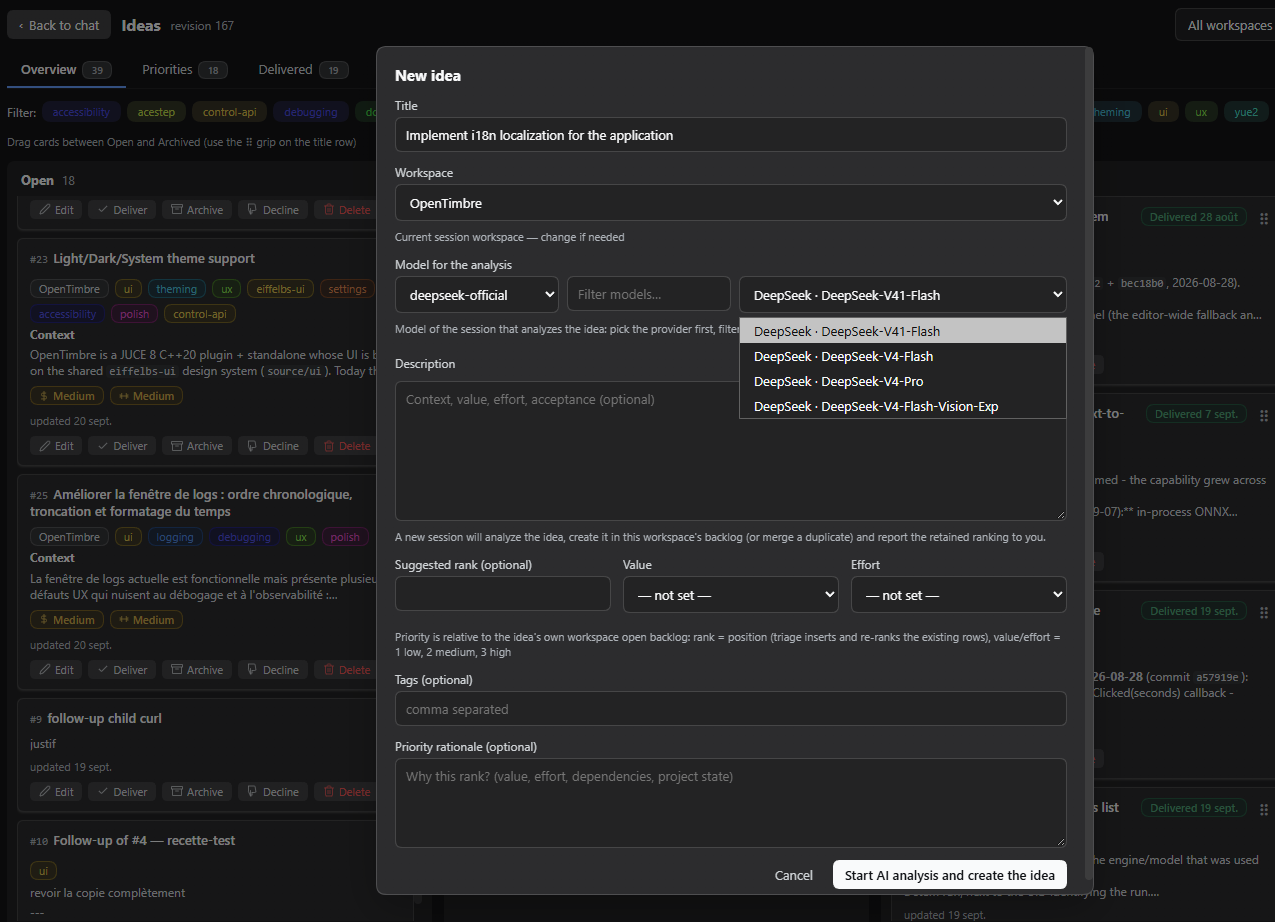
- A sidebar entry (New Session → Ideas) opens the panel.
- Capture an idea with the New idea button or the quick-add row at the top of the Open column — a Title is the only required field.
- Optional description (markdown), tags, workspace and a Suggested rank.
- The AI capture button opens a fresh session that analyzes the draft, creates/merges the idea in the backlog, and reports the retained ranking.
A 4-column kanban
Open · Under review · Archived · Declined.
- Drag & drop moves cards between columns and reorders them; the columns auto-scroll when you drag toward an edge (vertically and horizontally when Archived/Declined are off-screen on a narrow window).
- Search and a conjunctive tag filter narrow the whole board — all three tabs (Overview columns, Priorities ranking, Delivered log) share both filters. Cards render a short body excerpt (idea #34): the full analysis is fetched on demand when the edit modal, follow-up composer or re-analyze opens, and the first active search loads a deep index once so whole-body matches keep working.
- Single click on a card title or description opens the edit modal (raw text or rendered markdown of the full body).
- Every card shows its stable
#Nnumber, workspace chip, tags, value/effort badges and update date.
Scoring & ranking
- Each idea carries Value and Effort (low / medium / high), shown as color-coded badges.
- The Suggested rank is the position in the open backlog of its workspace; entering one re-ranks the backlog transactionally (existing rows shift).
- A dedicated Priorities tab ranks the open ideas per workspace, with ↑/↓ buttons and drag & drop to re-rank.
The lifecycle
- Deliver ✓ archives the idea with a green Delivered {date} stamp.
- Under review is the review gate: finished work lands there, and each card offers Approve (deliver), Follow-up needed (creates a linked open child plus justification, archives the parent) and Decline.
- A Task failed badge marks an open card whose linked TaskBoard task failed: the idea deliberately stays in the backlog (a failed run delivered nothing, so the review gate does not apply) - the human retries the task or adjusts the idea. The badge follows the last status observed by the under-review poll (30 s) and clears itself when the task is retried.
- Delivered tab shows the exit log (delivered vs. manually archived).
- Restore, archive and delete are one click away on each card.
Workspaces
- A header selector scopes the board to one workspace (or all / none).
- New ideas default to the current session's workspace when not scoped.
- The New/Edit modal carries a workspace field so a capture lands in the right place and an idea can be moved to another workspace.
Settings
The plugin contributes an Ideas board section to the DSH Settings modal.
Options are read and written through the plugin's own fenced
GET/POST /api/ideas/config route — the DSH settings RPC domain does not serve
third-party namespaces — and the backing store follows the host generation,
detected at runtime:
- Host <= 0.1.5: a registered
ideassettings namespace (schemastery schema,applies: 'live', revision-fenced writes persisted in the profile's settings document) — the historical behaviour, unchanged. - Host >= 0.1.7: the SettingsForms refactor removed
ctx.settings.register, so the plugin keeps its options in its own versioned document,<DSH_HOME>/ideas-manager-settings.json, behind the same incrementing revision fence (an unreadable document is quarantined beside itself — renamed, never deleted — and the defaults take over).
Both hosts answer the identical wire contract (a complete sanitized value plus
its revision; a stale write is refused with 409 settings-conflict), so the
section behaves the same everywhere. Every option ships with an explicit title
and a description stating what it changes, its range and its default:
- Visible tag-filter lines (
tagRows, 1–5, default 3): how many rows of tags the board shows under the tabs before the zone scrolls; the sticky header (label + search + clear-filter) always stays visible. Applied immediately, stored per DSH profile. - Interface language (
language, defaultauto): the panel's OWN language, independent of the DSH shell setting.autofollows the shell (a Chinese shell now shows a Chinese panel, English an English one), anden/fr/zhpin the panel to one dictionary. Applied immediately — switching the row re-renders the whole panel, and the board root carries the matchinglangattribute for assistive tech and CJK font stacks. Dictionaries: English (default fallback), French, Simplified Chinese — kept in strict key parity (the build fails on a missing key).
Deployments without a settings service keep the spelled defaults (the section says so) — the board never depends on the settings surface.
TaskBoard integration
When the TaskBoard plugin
(@linxin666/dsh-client-ui-task-board,
repo: zhu1090093659/dsh-web) is
present, the Ideas manager mirrors its ledger onto TaskBoard's backlog so
both tools stay in sync — one-way (Ideas → TaskBoard).
The mirror is detected at runtime (GET /api/task-board/state); if TaskBoard is
absent the Ideas manager simply works standalone.
| Ideas action | TaskBoard mirror |
|---|---|
| Create idea | New read-only card in backlog (bound to the idea id) |
| Update idea | Card updated |
| Decline / drag to Archived | Card archived |
| Restore | Card restored |
| Delete | No-op (closing to done stays manual) |
Task-Board card reaches done |
Idea auto-moves to Under review (the review gate) |
Triage (scores, rationale, rank) is ideas-only and is never mirrored — it's a backlog opinion, not a board state.
Card weight: the card description carries the idea's summary (<= 300
chars, produced by the ideas-analyst; a derived body excerpt otherwise) while
the full analysis rides the card prompt (the run instruction) and the ledger
— the body is never stored twice in the snapshot.
Duplicate guard (exactly one card per idea)
Card ids are deterministic (idea- + the idea id), so re-running any
mirror path re-touches the same card instead of minting a twin. A bound idea's
card is only rebuilt when a non-empty task-board snapshot proves it was
deleted out-of-band — every ensureTask decision (idea id, binding, snapshot
size, branch) is logged, and an empty or unreadable snapshot keeps the binding
and attempts the patch, never a create. Mirror operations are serialized per
idea id, so a create always completes (and binds) before a following update
runs — "update" can never silently mean "create".
Two scripts close the loop:
node scripts/reconcile-taskboard-mirror.mjs [--url …] [--apply]— detects orphan duplicates (unbound card whose exact title matches a bound idea) and archives them, always keeping the bound card; dry-run by default.node scripts/validate-mirror-cycle.mjs [--base …]— live acceptance run against a test instance: create → re-analyze → analyst rewrite → decline must end with exactly one card.
Note for agent-driven workflows: the capture → triage → lifecycle protocol and the full wire contract are documented in
SKILL.md, so an agent can author cards directly over the HTTP API without the UI.
Host API (agents)
The Host exposes a REST API so scripts and agents can read the board and write
ideas. Prefix /api/ideas, same-origin fence (loopback socket + browser
markers), JSON envelopes { requestId, action, initiator? }.
| Route | Purpose |
|---|---|
GET /api/ideas/state |
Frozen full snapshot { schemaVersion: 1, revision, ideas[] } |
GET /api/ideas/state?view=summary |
Bounded summary reads with workspace/id/number/status filters, pagination, selected fields, body-byte caps, and explicit truncation metadata |
GET /api/ideas/state?view=detail |
Bounded field-selectable detail reads; use GET /api/ideas/idea?id=<id> for one complete raw record |
POST /api/ideas/action |
create, update, move, decline, deliver, followUp, triage, restore, delete, reanalyze, reorder, import, export |
GET /api/ideas/events |
SSE { revision } |
Every action is deduplicated by requestId (fresh id per call), and a
mutating action returns the whole board so the caller can confirm the result.
The bounded read envelope keeps revision at the top level and adds meta
with matched, returned, rowTruncated, nextOffset, bodyTruncated, and
omittedFields; at most 200 rows and 512 KiB are returned. The ./client
entry exports HttpIdeasHostTransport and IdeasClient; call read(query) or
readIdeas(query) for the same bounded envelope without mutating board state.
Full contract (verb table, read-query fields, mirror mapping, PowerShell
gotchas) lives in SKILL.md.
Host compatibility
- Requires Host >= 0.1.5 (see
dsh.engines.dshinpackage.json). - Settings section works on host 0.1.5 and 0.1.7+: the settings service
contract is detected at runtime (
settings.registerpresent = legacyideasnamespace, exactly as before; absent after the 0.1.7 SettingsForms refactor = plugin-owned<DSH_HOME>/ideas-manager-settings.json), so 0.1.7 boots with nosettings namespace registration failedline and 0.1.5 keeps the exact 0.3.3 behaviour. - On Host >= 0.1.7 the client retains the agent scope before prompting:
sessions.scope(id)became a pure read there (a just-created session is no longer visible through it until its scope is retained), so the AI capture / re-analyze launcher first callsretainAgentScope(id)— which materializes the scope — takes the context from the reference'sbinding.ctx, prompts, and always releases the retention (success, prompt rejection or missing session face). - On Host <= 0.1.5 the method does not exist and the launcher keeps the
exact previous call sequence (
scope(id)materializes the scope on demand).
Install & update
From npm (recommended):
dsh plugin --profile web add dsh-plugin-ideas-manager
Pinned to a version:
dsh plugin --profile web add dsh-plugin-ideas-manager@0.3.4
From a local checkout (no registry needed):
dsh plugin --profile web add link:/path/to/dsh-plugin-ideas-manager
From a git URL (fallback, pinned to a released tag):
dsh plugin --profile web add github:EiffelBS/dsh-plugin-ideas-manager#v0.3.4
dsh plugin runs pnpm add in the profile directory, then reconciles
dsh.profile.bundles: because this package declares a dsh.bundle, it is
auto-appended as a profile layer. Restart the web instance (or open a fresh
page session) for the bundle change to take effect.
Verify installation:
dsh web --profile web --no-open # then look for the Ideas entry in the sidebar
To pick up a newer revision after a release (versions follow the package's
version field; releases are tagged, e.g. v0.3.4):
dsh plugin --profile web add dsh-plugin-ideas-manager@latest
then restart the web instance.
Uninstall / disable:
dsh plugin --profile web remove dsh-plugin-ideas-manager
Maintainers: bump
versioninpackage.jsonon each meaningful push so an installed profile's version stays observable (e.g. viadsh plugin lsorpnpm listin the profile directory).
Build, test & install (dev)
pnpm run typecheck   # tsc --noEmit
pnpm test            # vitest (protocol gate, ledger persistence, export golden, mirror, markdown parser)
pnpm run build       # tsc -p tsconfig.build.json (types -> lib/types) && tsdown (lib/index.js + lib/client.js)

# isolated test profile (never the production profile of a live instance)
dsh --profile ideas-test --from-default-profile web --dump-config
dsh plugin --profile ideas-test add link:C:/path/to/dsh-plugin-ideas-manager
dsh --profile ideas-test --port 3099                # omitting --no-open opens the browser with the token URL
The browser half is served at /plugins/<id>/client.js (re-resolved per
request); the host half registers the /api/ideas routes at boot.
Architecture
src/
  index.ts            # apply + mountOnce + Config + guidance section
  protocol.ts         # /api/ideas prefix, types, parseActionEnvelope (exactKeys)
  host-service.ts     # apply + mirror scheduling
  host-ledger.ts      # persisted ledger, dedupe cache, lock, internal bind
  host-routes.ts      # state (+ list and bounded summary/detail views) / idea?id= / action / events + loopback guard
  taskboard-bridge.ts # runtime feature-detect + one-way mirror (no hard import)
  export-markdown.ts  # unidirectional ledger -> markdown (golden-tested)
  http.ts / loopback.ts / mount-once.ts   # shared discipline
  core/ideas.ts       # IdeaRecord, statuses, tag validation
  client/             # sidebar entry + kanban + Priorities/Delivered + workspace scoping
tests/                # vitest suites per module
  SKILL.md / README.md
Persistence lives in ~/.dsh/ideas/ledger-v2.json (atomic tmp+rename writes,
corruption quarantine, single-writer lock, restart-safe request-id dedupe).
High-card-load evaluation (before/after numbers, deferred-vs-priority
decision): see docs/perf-evaluation.md; live profiler:
scripts/perf-live.mjs (test instance only).
License
MIT — see LICENSE.
No comments yet. Be the first to write one.