@edwindigital/dsh-web-search-microsoft-webiq
English | 中文


A Microsoft Web IQ-backed WebSearchProvider for the harness web capability (ctx.web). The package calls the Web Search v3 REST endpoint and maps query-relevant passages into the provider-neutral WebSearchResult consumed by @deepseek-ai/dsh-tool-web.
This is one dual-half plugin package. Its Host half registers provider microsoft-webiq; its browser half contributes a package-local card to the Plugins settings page. It does not register webiq_search or any other model-facing tool. Agent calls continue to use the single web_search tool.
Installing the package does not silently replace an existing search provider. The web seam keeps deepseek-official selected until the user turns on Use Web IQ for web search in the card or stores web.searchProvider: microsoft-webiq explicitly.
About Microsoft Web IQ
Microsoft describes Web IQ as a suite of AI-native APIs that give applications access to fresh, real-world intelligence from across the web — web pages, news, images, and videos. This package consumes one of them, the Web Search v3 endpoint.
[!IMPORTANT] Web IQ is in limited access for select Azure customers, so a key is not self-service. Request one through the waitlist before installing. Without a resolvable key the provider still registers and then fails every search with
WEB_PROVIDER_CREDENTIAL_MISSING.
Figures Microsoft publishes for the service, against alternatives it does not name:
| Measure | Web IQ | Best alternative in the set |
|---|---|---|
| p95 latency | 164 ms | 406 ms |
| Grounding satisfaction | 79.05 | 75.70 |
Source: the Web IQ site, over a 3,000-query production sample at 10 results and 10,000 characters per result. This package does not verify them, and the mapping documented below decides what actually reaches the model.
Where this package sits between the model and that API:
flowchart LR
  M["Conversation model"] -->|web_search| T["dsh-tool-web"]
  T --> W["ctx.web seam"]
  W -->|"selected provider"| P["this package<br/>microsoft-webiq"]
  P -->|"POST /v3/search/web"| A["Microsoft Web IQ"]
  A -->|"passages"| P
  P -->|"WebSearchSource[]"| W
Screenshots
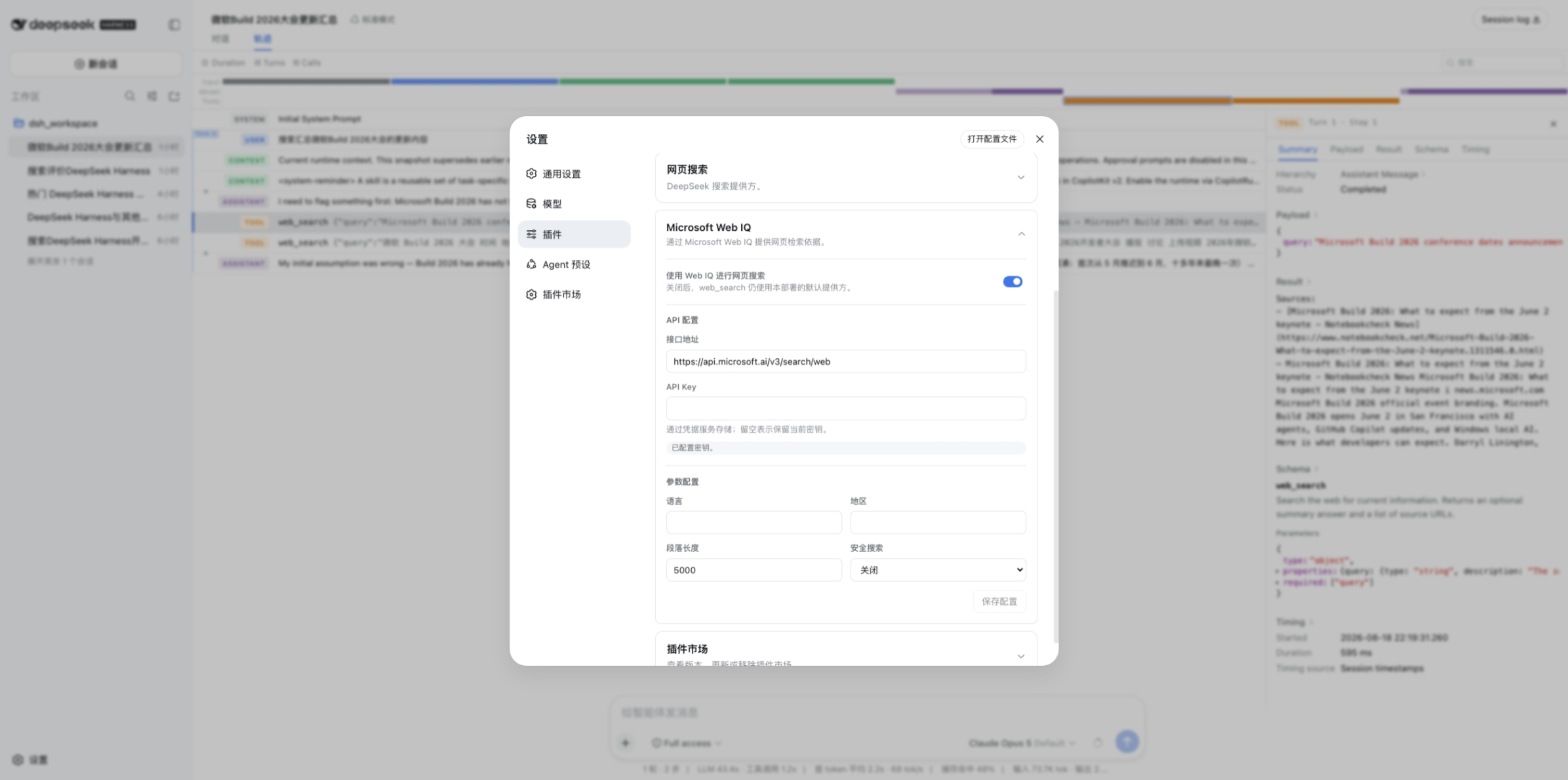
The card on the Plugins settings page. Use Web IQ for web search is the switch that selects this provider; turned off, web_search goes back to the composed default. Below it, one group holds the endpoint and the API key and another holds language, region, passage length, and SafeSearch. The password field is blank after load — the line under it reports only that a key is stored, which is all the card can say about a value it never reads back.
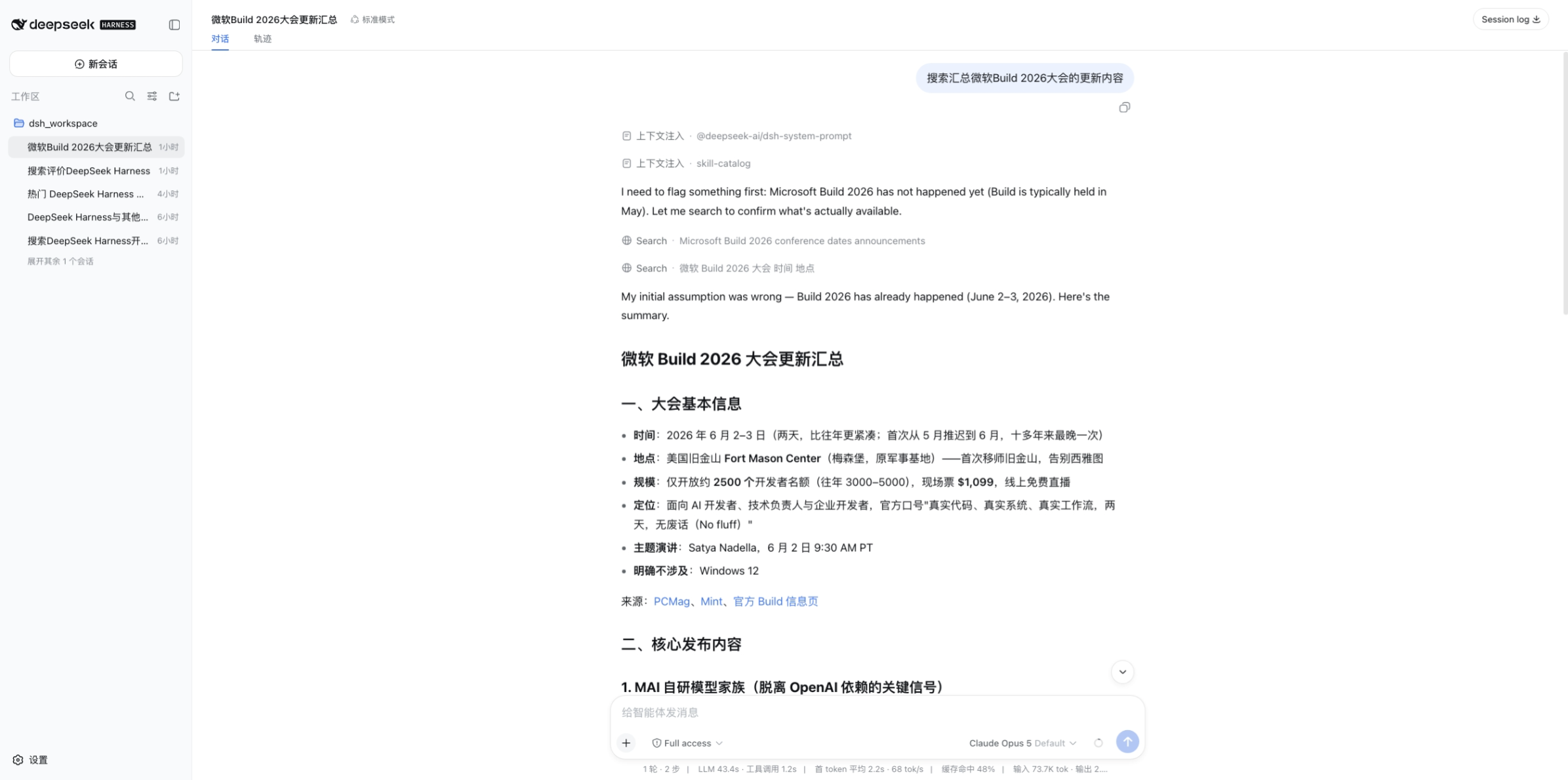
An agent answering from Web IQ results. Registration adds no tool, so the model issues the same web_search it always had — twice here — and nothing in the transcript names the provider. Only the sources behind the answer changed.
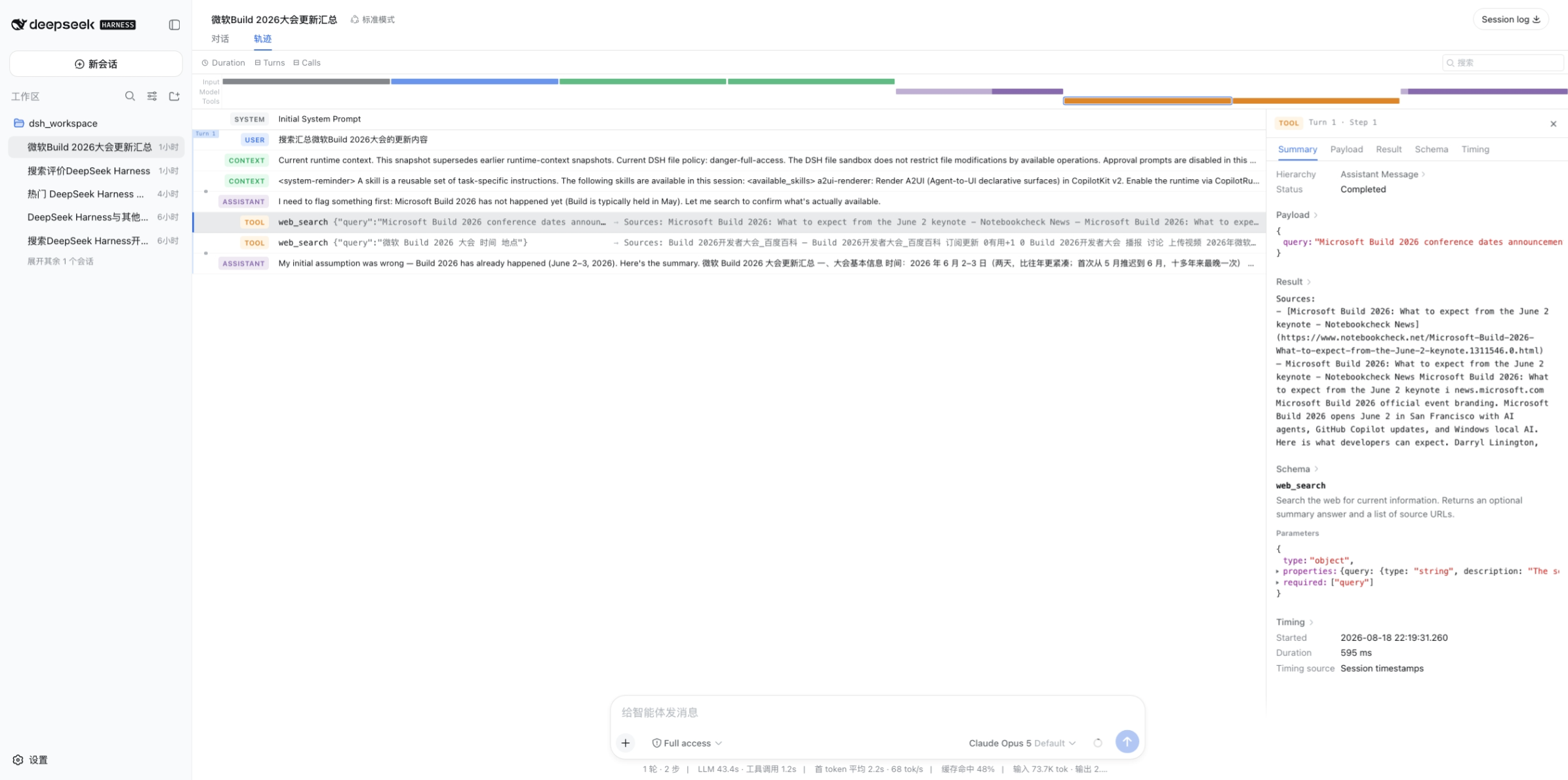
The session trace for one of those calls. The call takes 595 ms measured from session timestamps, and the turn's two calls total 1.2 s against 43.4 s of model time — retrieval is not where the turn spends its time.
Installation and selection
The plugin is listed in awesome-dsh-plugin, so any storefront reading that list offers it. In dsh-market, open Settings → Plugin Market, search webiq, and install from the entry — it is filed under Browser & web:
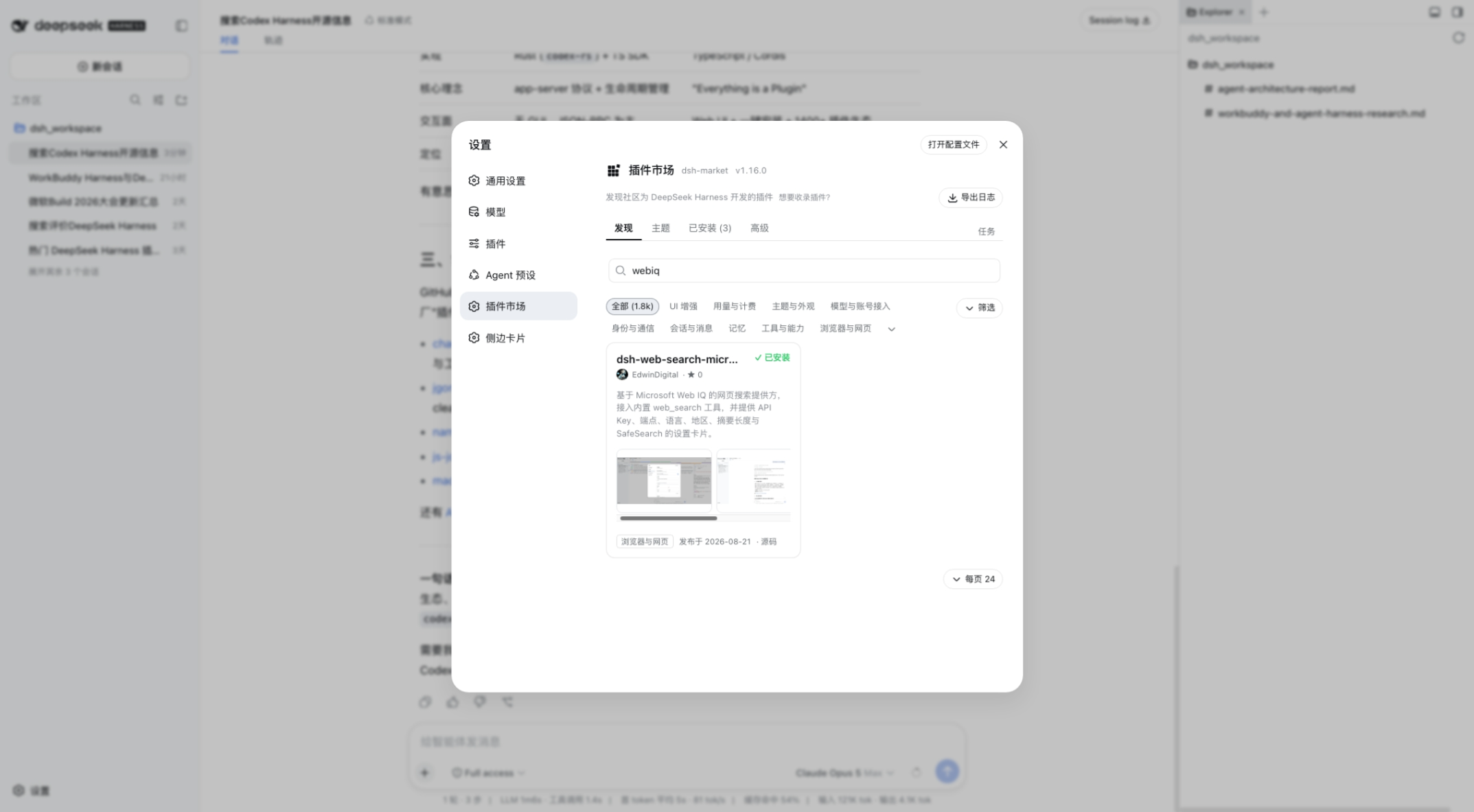
The package is not on npm and its listing carries no prebuilt tarball, so the storefront installs from source — the same thing this command does:
dsh plugin --profile web add github:EdwinDigital/dsh-web-search-microsoft-webiq
Either route makes this an installed profile bundle, and the shipped composition mounts no Web IQ row until one of them runs.
The build output is committed, so a git install runs no build step. That is deliberate: preparing a git-hosted package runs npm install in a scratch tree, and npm auto-installs peer dependencies — which would pull a second, registry-resolved copy of the harness whose internal version constraints conflict with the installation this plugin is meant to extend. Shipping the artifact keeps the harness packages purely as peers resolved from the running installation.
Either route records the dependency, appends the package to the profile's dsh.profile.bundles, and layers this package's own patch after the shipped bundles:
- insert:
    - id: web-search-microsoft-webiq
      name: '@edwindigital/dsh-web-search-microsoft-webiq'
The credential reference resolves from the schema default; a deployment states apiKeyEnv in the row only to redirect the lookup.
Peer dependencies stay unresolved by design
Every harness package this plugin uses is an optional peer, and pnpm peers check inside the profile reports all of them missing. That is the expected state, not a broken install: bundles resolve from the running dsh installation through $DSH_HOME/profiles/node_modules, a directory the harness maintains and pnpm never sees. Marking them optional keeps the package manager from installing a competing copy — the failure mode that made the first git install unusable.
A peer therefore reports missing right up until the plugin loads it successfully. The signal that actually matters is the dsh boot: an absent package fails there by name.
Replacing an earlier install
An install that predates this repository points at the package's old name and location. Remove it before adding this one, or the profile keeps a bundle entry whose target no longer exists:
dsh plugin --profile web remove @deepseek-ai/dsh-web-search-microsoft-webiq
dsh plugin --profile web add github:EdwinDigital/dsh-web-search-microsoft-webiq
Skipping the removal fails the next boot with cannot resolve profile bundle, naming the entry to remove. A running server keeps its loaded plugins, so restart it after either command.
A composition that mounts rows directly states the same row beside the seam and the tool:
- id: web
  name: '@deepseek-ai/dsh-web'
  config:
    searchProvider: deepseek-official

- id: web-search-microsoft-webiq
  name: '@edwindigital/dsh-web-search-microsoft-webiq'
  config:
    apiKeyEnv: MICROSOFT_WEBIQ_API_KEY

- id: tool-web
  name: '@deepseek-ai/dsh-tool-web'
The Web IQ row registers the provider and activates this package's browser module. Select it in the card or configure:
web:
  searchProvider: microsoft-webiq
@deepseek-ai/dsh-web reads that setting at operation entry. The next web_search uses Web IQ without a restart, while an already-running search keeps the provider and options it started with. Without an explicit selection, the web seam auto-selects only when exactly one usable provider is registered.
Credentials
The default credential reference is MICROSOFT_WEBIQ_API_KEY. Resolution occurs for every search in this order:
- A non-empty literal
apiKeyfrom direct Cordis composition. - The optional
ctx.credentialsservice forapiKeyEnv. - The launching environment for the same reference.
The browser card writes replacement keys only through the credentials RPC. The password field is always blank after load and after an accepted save. Key literals are marked secret in the Host schema and are omitted from Settings descriptions, browser boot data, logs, and normal configuration reads. A missing key fails the selected provider with WEB_PROVIDER_CREDENTIAL_MISSING and names only the unresolved reference. A key inherited from the launch environment is the one layer this process cannot rewrite, so the card disables its password field and says which layer owns the key instead of failing an accepted-looking save.
Config
| Key | Default | Meaning |
|---|---|---|
apiKey |
omitted | Literal API key for direct composition. Prefer apiKeyEnv; a non-empty literal wins. |
apiKeyEnv |
MICROSOFT_WEBIQ_API_KEY |
Credential reference resolved for each search. A deployment choice; the browser card neither shows nor edits it. |
endpoint |
https://api.microsoft.ai/v3/search/web |
Full HTTPS Web Search v3 endpoint. A deployment proxy may be used, but it receives the resolved key. |
language |
omitted | Optional two-letter ISO 639-1 interface language. Web IQ defaults to en. |
region |
omitted | Optional two-letter country or region code. Web IQ defaults to US. |
maxLength |
5000 |
Maximum passage characters per result; positive integer, maximum 500000. |
safeSearch |
strict |
strict or off. Web IQ still blocks illegal content when set to off. |
The Host owns settings namespace web-search-microsoft-webiq; provider selection lives separately in namespace web. The card opens with a switch that selects Web IQ for web_search and, once off, clears the user override so the composed provider applies again. Below it, one API configuration group holds the endpoint and the API key, a search parameter group holds language, region, passage length, and SafeSearch, and a single command at the bottom commits both owners: the key crosses the credentials RPC and the rest goes to the settings namespace. The credential reference stays a deployment choice made in cordis.yml, so no configuration surface asks a user for an environment variable name. Each owner is read back after a write, so a refused operation is reported rather than presented as accepted.
REST contract and mapping
Each search sends:
POST https://api.microsoft.ai/v3/search/web
x-apikey: <resolved credential>
content-type: application/json
{
  "query": "current TypeScript release",
  "maxResults": 10,
  "contentFormat": "passage",
  "maxLength": 5000,
  "safeSearch": "strict"
}
language and region are omitted unless configured. maxResults is forwarded only when the caller sets one — an unbounded request omits the field and takes Web IQ's own default — and an explicit value is capped at Web IQ's maximum of 50. Queries longer than 1,000 characters fail locally before credential or network work begins.
Every webResults[] item maps as follows:
| Web IQ | WebSearchSource |
|---|---|
url |
url |
non-empty title |
title |
non-empty query-relevant content |
snippet |
non-empty crawledAt |
publishedAt |
The provider reports truncated: false; ctx.web performs the final maxResults enforcement on normalized sources. The adapter validates the external envelope and every consumed item field. A missing webResults array, malformed item, non-JSON success body, redirect, network failure, or non-success status becomes WEB_PROVIDER_ERROR. HTTP messages include Web IQ's userMessage, errorCode, retryAfter, and traceId when present, never the key. Caller cancellation remains WEB_ABORTED, including during credential resolution or body parsing. The provider does not retry internally.
Model Experience
web_search tool result, when Web IQ is the selected provider
What the model sees
Registration adds no tool. Through @deepseek-ai/dsh-tool-web, the conversation model sees the existing web_search arguments and a normalized result containing URLs, titles, passages, and optional crawl timestamps. Web IQ receives only the search query and configured REST parameters; it does not receive the conversation transcript.
Token effect
Registration costs zero model tokens. Result tokens scale with the number and maxLength of passages returned, then the existing tool rendering limits apply. Web IQ is a retrieval API, so this package does not create a separate model turn.
KV Cache effect
Append-only. The tool result follows the reusable conversation prefix and does not invalidate earlier cache entries.
Reaching the other Web IQ methods
This package registers one search provider, so every web_search posts to the web endpoint. Web IQ also publishes a Streamable HTTP MCP server exposing web, videos, browse, news, and images as five separate tools — the one route where the model picks the method per call instead of a deployment picking it once for every call.
Compose @deepseek-ai/dsh-mcp-client next to this package:
- id: web-search-microsoft-webiq
  name: '@edwindigital/dsh-web-search-microsoft-webiq'

- id: mcp-webiq
  name: '@deepseek-ai/dsh-mcp-client'
  config:
    serverName: webiq
    transport: streamable-http
    url: https://api.microsoft.ai/v3/mcp
    headers:
      x-apikey: !!js process.env.MICROSOFT_WEBIQ_API_KEY
The model then sees mcp__webiq__web, mcp__webiq__videos, mcp__webiq__browse, mcp__webiq__news, and mcp__webiq__images beside web_search. Web IQ scopes that list to the calling key's allowed services, so a tool the key may not use never appears. These tools bypass ctx.web: their results are not normalized into WebSearchSource, maxResults and the settings card do not reach them, and web.searchProvider does not select among them.
One key for both halves
Both halves name the same reference, MICROSOFT_WEBIQ_API_KEY, but they read it through different mechanisms, so which layer holds the value decides whether one key serves both.
The loader evaluates headers against process.env, and the launch environment materializes each of its layers there. A key in the launching shell, <cwd>/.env, or $DSH_HOME/.env therefore reaches the MCP entry and, through the credential provider, this package as well — one key, configured once.
A key typed into the settings card does not: that write crosses the credentials RPC into the credential provider's managed document, which the loader never reads. Prefer $DSH_HOME/.env, which sits below that document, so the card still reports the reference as configured and still accepts a replacement; the cost is that a replacement saved there outranks .env for web_search while the MCP tools keep reading the process.env value. The launching shell removes that split by shadowing the managed document outright, at the price of a read-only password field on the card.
Known Limitations and Deferred Work
- Only
/v3/search/webis wired for search — Web IQ also serves news (trusted sources, last 14 days), videos, images, and classic multi-answer, butWebSearchRequestcarries only a query and a result bound, so no caller can name a method and every search postscontentFormat: passageto the web endpoint. Provider-specific modes wait on provider-neutral Service Definition fields; Reaching the other Web IQ methods is the route that reaches them today, outside this seam. - No fetch provider for
/v3/browse— the seam already has aregisterFetchProviderrole behind theweb_fetchtool and needs no new field, so aweb_fetchcall reaches whichever other provider is composed rather than Web IQ's own extraction and itsliveCrawl=fallbackretry path. - A request for more than 50 results is capped without a signal — Web IQ's own maximum is 50, and
truncatedreports seam-side dropping rather than a provider limit, so a caller asking for more receives at most 50 with nothing marking the difference. safeSearch: offdoes not transfer the caller's content duty — Web IQ still blocks illegal content, but potentially sensitive legal content reaches the model unchanged; this package adds no further filtering.site:and-site:operators degrade the result set — relevance drops, andsite:can return adult content regardless of the configured SafeSearch mode.- A custom
endpointreceives the resolved key — the deployment, not this package, decides where the credential is sent; only the HTTPS requirement is enforced locally. available()cannot confirm a resolvable credential — resolution is asynchronous, so a selected provider with no stored or ambient value fails at search start withWEB_PROVIDER_CREDENTIAL_MISSINGrather than at selection.- Real-API coverage is opt-in —
tests/microsoft-webiq.e2e.tsself-skips unlessMICROSOFT_WEBIQ_API_KEYis set, so drift in Web IQ's own responses surfaces only when a key is present.
Development
npm run build runs tsc -b for the declarations and tsdown for both halves. Only what the manifest publishes is tracked: lib/index.js, lib/invariant.js, lib/client.js with its map, and lib/types/**/*.d.ts.
Committing the artifact removes the install-time build and moves an obligation onto every change: rebuild and commit lib/ in the same commit as any src/ edit. Nothing enforces this, and a stale artifact is silent — installers keep resolving the previous code with no warning at any layer. git status after a build is the check, which works because the build is deterministic: repeated builds of unchanged sources produce byte-identical output, so any diff is a real change.
The browser half is bundled to the harness client-loader contract: a CJS closure handed to window.__ModuleLoader__.load, platform modules kept external so they resolve from the frozen module table, and CSS Modules compiled through lightningcss into one injected style tag. That contract lives in a harness build helper that is not a published package, so tsdown.config.ts reproduces it here. A harness change to the loader format would break this plugin at load time; the wrapper header in lib/client.js is what to compare against.
Type checking needs the harness packages resolvable. There is no release to install them from, so point the peers at a harness checkout — linking its workspace packages into node_modules — before running npm run typecheck.
No comments yet. Be the first to write one.