dsh-verifier
An LLM-as-a-verifier plugin for DeepSeek Harness (dsh). It adds a quality gate that runs at the end of every agent turn, plus three tools the agent can call to check its own work.
The scoring method is a port of llm-as-a-verifier by Kwok et al. (project site llm-as-a-verifier.com, paper arXiv 2607.05391, MIT). That repo selects the best of N agent trajectories. This plugin takes the same math and wires it into a running harness.
Why a verifier
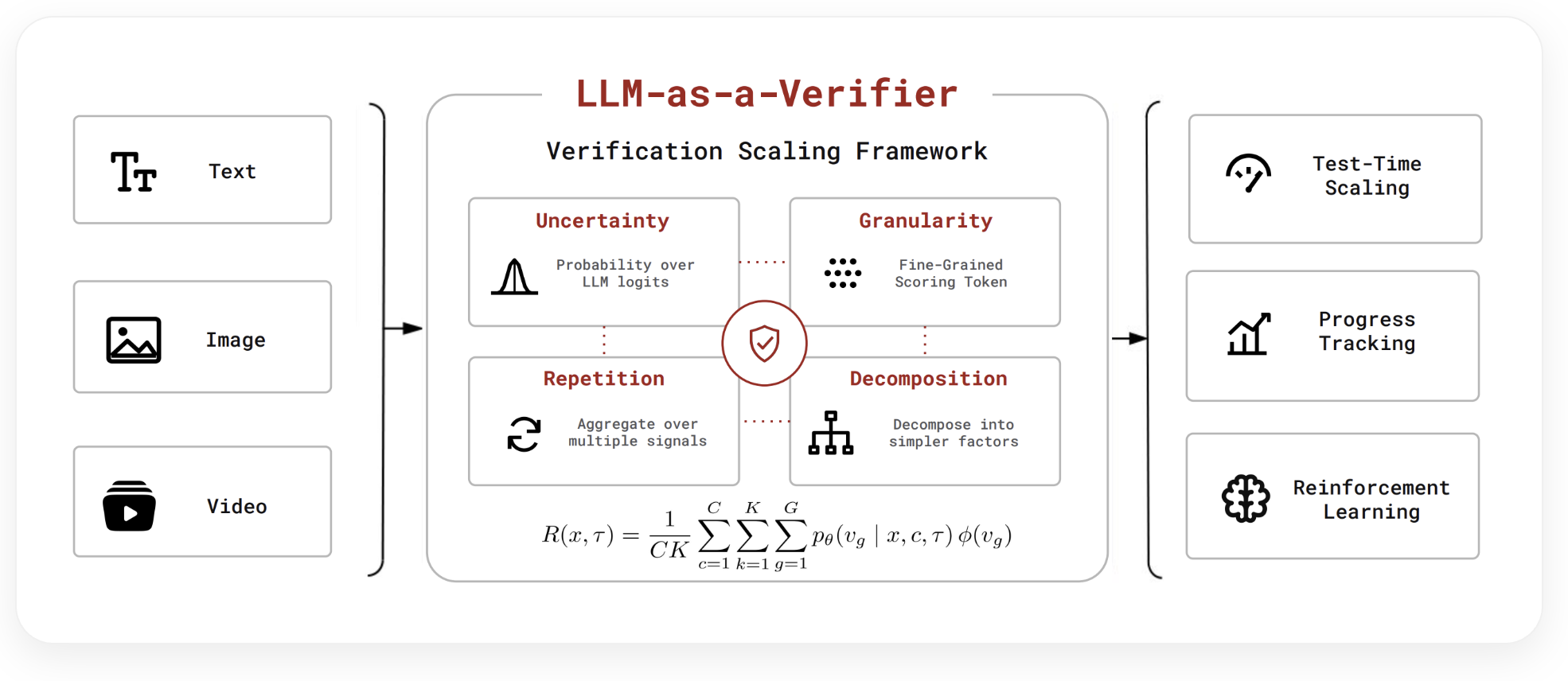
The method comes from the llm-as-a-verifier authors. Their framework (source: llm-as-a-verifier.com): probability over the logits instead of a sampled token, a fine-grained scoring token, repetition, and decomposition into simpler criteria, aggregated as R(x, tau) = 1/(C K) sum over criteria, repeats and scale values of p(v | x, c, tau) phi(v).
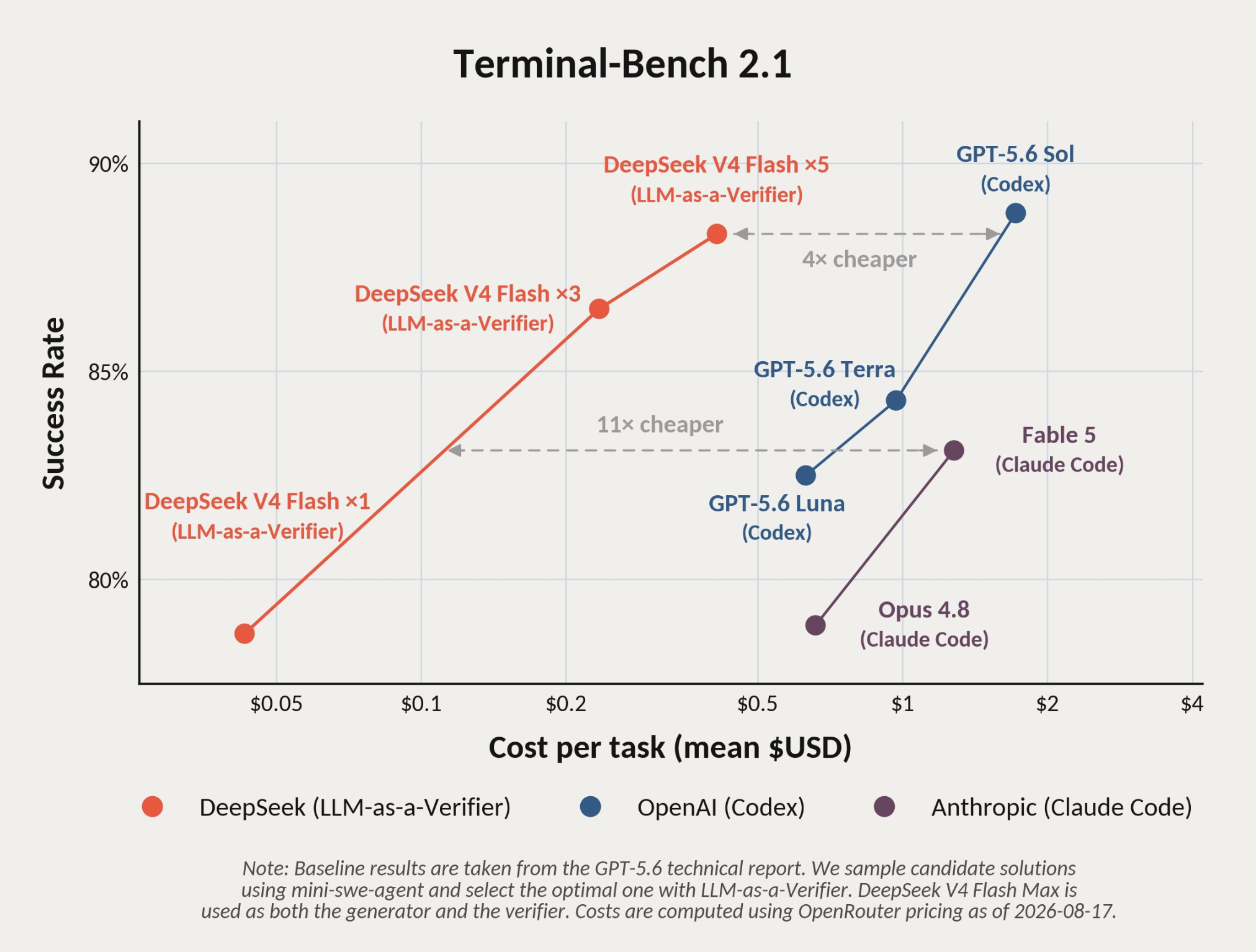
What that buys with the same model this plugin runs on (chart from the llm-as-a-verifier README; Terminal-Bench 2.1, mini-swe-agent, DeepSeek V4 Flash as generator and verifier, costs at OpenRouter prices of 2026-08-17): best-of-3 lifts DeepSeek V4 Flash from 78.7% to 86.5%, best-of-5 to 88.0%, at roughly a quarter of the cost per task of GPT-5.6 Sol in Codex.
The gate in this plugin is the cheaper cousin of that best-of-N selection: one trajectory, scored once, repaired once. verifier_select is the best-of-N itself.
What it does
The gate. When an agent is about to end a turn, the plugin serializes the turn (the task, the assistant messages, every tool call and its observed output) and asks a verifier model to score it per criterion on a 20-letter scale. The score is not the sampled letter. It is the expectation over the logprob distribution of the score token, so the verdict is continuous in [0, 1]. If the mean falls below gate.threshold, the verifier's findings go back to the agent as a plugin message and the harness runs another step. The agent sees text like this:
[dsh-verifier] Automatic verification of your last turn scored 0.28 / 1.00 (pass threshold 0.60). Round 1 of 1.
Per-criterion rewards: Empirical verification & error signals=0.13, Specification adherence=0.21, Code quality & root cause=0.50.

Verifier findings, Empirical verification & error signals (0.13):
The agent launched three background subagents ... There is zero observed verification in the trajectory: no npm test run, no curl of the service endpoints, no screenshot ...
That example is from a real run. The agent answered "Fair criticism, let me check what's actually on disk now instead of trusting narration" and went back to work. Continuations are capped per turn (gate.maxRounds, default 1). Turns that end with a question to the user are never forced on.
The tools.
| Tool | What it does |
|---|---|
verifier_assess(task, answer) |
Scores one result per criterion and returns the findings. By default it also hands the verifier the observed trajectory of the current turn, so the verdict rests on tool output rather than on the agent's summary. |
verifier_select(task, candidates[]) |
Best-of-N. Pairwise comparisons with slot swapping, then a probabilistic pivot tournament picks the winner in N + k(N-k) comparisons instead of N². |
verifier_compare(task, a, b) |
One directed pairwise reward. |
ui_snapshot(url) |
Evidence for visual work: headless screenshots of one URL across viewports (default 1440x900 and 390x844) in light and dark mode, written as PNGs under $DSH_HOME/verifier/snapshots/<label>/, plus the console errors, page errors and failed requests seen while loading. Runs Playwright against the installed Google Chrome (then Playwright's Chromium); nothing opens on screen. Pair it with a vision tool such as analyze_image for the verdict. |
The backend. openai-compatible calls any chat-completions endpoint with logprobs and top_logprobs (vLLM, SGLang, the DeepSeek API). That is what makes the fine-grained score possible. harness routes through the harness LLM seam instead, which carries no logprobs, so scores fall back to the literal letter. Use the direct endpoint when you can.
Prompts
The verifier-facing text is the reference's. The pairwise prompt (build_prompt), the progress prompt (build_progress_prompt, one checkpoint), the two scale descriptions and the ground-truth notes are verbatim. The coding criteria are specification from criteria/terminal_bench.md plus code_review and verification from criteria/swe_bench.md ("issue" read as "task", and the patch defined as diff output or the file contents written through tools, because a harness trajectory carries edits as tool calls); terminal is criteria/terminal_bench.md; general is this plugin's own set for prose and answers. The single-trajectory assessment prompt behind verifier_assess and the gate is the progress prompt reduced to the final state and extended with one criterion guideline and a request to name what is missing, because that analysis is what the agent gets back. The agent-facing texts (tool descriptions, gate and checkpoint messages) are this plugin's own.
What is ported, and where
| Reference concept | File |
|---|---|
| 20-letter scale, pairwise orientation (A = best) and progress orientation (T = best) | src/core/scale.ts |
Reward as logprob expectation, last-tag match, fused >A tokens, whitespace skip, literal-letter fallback |
src/core/scoring.ts |
Criteria × repeats with slot swap on odd repeats; compare, select, assess |
src/core/verifier.ts |
| Pivot tournament: ring pass, top-k pivots, pivot round, Bradley-Terry argmax | src/core/tournament.ts |
Prompts with the invariant part first and the criterion last (prefix-cache friendly); criteria sets general, coding, terminal |
src/core/prompts.ts |
| Trajectory serialization from the harness session log | src/trajectory.ts |
Things the reference repo does not have: the turn gate (src/gate.ts), the tools (src/tools.ts), hot-reloadable settings, and the handling of unscored verdicts described below.
Install
git clone https://github.com/DevRico003/dsh-verifier
dsh plugin --profile web add /path/to/dsh-verifier
dsh plugin --profile headless add /path/to/dsh-verifier
dsh plugin --profile desktop add /path/to/dsh-verifier    # DSH Desktop
lib/ is committed, so no build step is needed to install. Restart dsh web or the desktop app afterwards.
Configure
Defaults live in cordis.patch.yml. The shipped backend.baseURL is the placeholder http://YOUR_SPARK_HOST:8000/v1; until you set a real endpoint the plugin loads but every verifier call fails with a message naming this setting (the gate then closes turns unverified and logs a warning, verifier_assess returns scoredCriteria: 0 with the message in findings). Set at least backend.baseURL and backend.model. Everything is a hot-reloadable verifier: section in $DSH_HOME/settings.yaml; no restart.
verifier:
  backend:
    kind: openai-compatible        # or: harness
    baseURL: http://YOUR_SPARK_HOST:8000/v1
    model: deepseek-v4-flash-0731
    apiKeyEnv: SPARK_API_KEY       # env var or credential reference; empty = no Authorization header
    reasoningEffort: high          # the reference setting for DeepSeek V4 Flash; none = fast and cheap, worse calibration
    maxTokens: 32768               # reasoning shares the budget; too small = no score tags
    temperature: 1.0               # the reference default; keeps the logprob distribution informative
    topLogprobs: 20
    concurrency: 4
    retriesOnFallback: 1
    warmPrefix: false              # true = first call per prompt prefix alone, then the rest (saves prefill, doubles wall-clock)
    toolReasoningEffort: low       # effort for the verifier_* tools; the gate and checkpoints use reasoningEffort
    timeoutMs: 600000
  gate:
    enabled: true
    threshold: 0.6
    maxRounds: 1
    evaluations: 1                 # repeats per criterion
    criteriaMode: auto             # coding when the turn used tools, else general
    criteria: general
    skipWhenAskingUser: true
    skipSubagents: true            # child agents are not gated; their parent turn is
    minSteps: 1
    feedbackMaxChars: 2500
    timeoutMs: 900000
  select:
    evaluations: 2                 # for the tools; 2 or more cancels slot bias
    pivots: 1
    seed: 0
    criteria: general
  trajectory:
    maxStepChars: 6000             # per tool output / message excerpt
    maxTotalChars: 300000          # whole turn; oldest steps are elided first
    continuationTurns: 1           # a turn opening with "Continue." gets this many earlier turns prepended
    toolMaxTotalChars: 80000       # trajectory cap for the verifier_* tools
  checkpoint:
    enabled: true                  # mid-turn verification, see below
    minSteps: 40
    everySteps: 40
    evaluations: 1
    threshold: 0.3                 # steer when progress is below this
    drop: 0.25                     # or fell by this much since the last checkpoint
    minRise: 0.05                  # below threshold and rising less than this = stalled
    maxSteers: 3                   # per turn
    gateDebtEdits: 12              # remind after this many file edits without a verifier_* call (0 = off)
    editTools: [write, edit, str_replace_editor, apply_patch, notebook_edit]
    timeoutMs: 900000
  snapshot:
    enabled: true                  # the ui_snapshot tool
    channels: [chrome, chromium]   # tried in order; chrome = installed Google Chrome
    headless: true
    viewports: ["1440x900", "390x844"]
    settleMs: 500
    navigationTimeoutMs: 30000
    dir: ""                        # empty = $DSH_HOME/verifier/snapshots
  tools: true
  verbose: false
gate.enabled: false keeps the tools and drops the gate. enabled: false turns the plugin off.
One long turn
An unattended coding run is often a single turn of several hundred steps, and an end-of-turn gate verifies that turn once, at the end. Two mechanisms make one turn verifiable while it runs, both hooked into agent/pre-step:
Progress checkpoints. Every checkpoint.everySteps steps (from minSteps on) the turn so far is scored with the reference progress prompt, verbatim, one checkpoint (the current state), letter only, evaluations repeats. That is the reference's ProgressTracker.update. Scoring runs in the background; the agent keeps working. The first checkpoint sets the baseline (a long goal reads low early, by design). From the second on, a fall by drop or a reading that stays below threshold without rising by minRise (the reference's plateau and regression patterns) gets the turn assessed with findings, and the agent receives a [dsh-verifier checkpoint] message at its next step boundary, capped at maxSteers per turn. A run that keeps climbing costs one cheap call per checkpoint and no steer.
Gate debt. When the agent has made gateDebtEdits file edits since its last verifier_* call, it receives one reminder to gate the node (no model call). The graph-verified-coding skill asks for one verifier_assess per completed multi-file node; this is what catches an agent that forgot.
Turn ends still get the full gate. A goal that runs in phases (one turn per phase) gets a gate per phase on top. A turn that opens with "Continue." (auto-continue after an interruption, a resumed goal round) holds little of the work, so the trajectory handed to the verifier prepends the previous turn (trajectory.continuationTurns); otherwise a gate right after a restart would see commands but no code.
Cost
One gate pass is criteria × evaluations verifier calls, three by default, fanned out together. warmPrefix: true runs the first call alone so the server caches the prompt prefix (task, trajectory, scale; the criterion sits at the tail) before the rest go out; that is the reference's 3.4× saving in uncached input tokens, worth it on a priced API or a slow prefill. On a local vLLM that prefills at over 10k tokens per second it only doubles the wall-clock of every gate, so it ships off.
The verifier thinks. reasoningEffort: high with a 32k budget is the setting the reference used for its DeepSeek-V4-Flash self-verification numbers (best-of-3 86.5% against 79.4% pass@1 on Terminal-Bench 2.1), and it is the default here. On a local vLLM that means a gate pass over a long turn takes one to several minutes of wall clock: prefill of the trajectory once, then reasoning per call. reasoningEffort: none brings a short turn down to 6 to 10 seconds but the verdict is a one-shot reading; use it for chat-heavy sessions, keep high for unattended coding runs where the gate is what catches the errors. The verifier_* tools, which the agent calls as node gates many times per run, think at toolReasoningEffort: low over a trajectory capped at toolMaxTotalChars; at high with the full trajectory one node gate took ten minutes on a long turn, which is too slow for something that should happen after every node.
With thinking on, vLLM returns the reasoning tokens inside logprobs.content as well; the score reader walks the token stream and takes the letter after the last <score> tag, so that is handled. A reply that spends the whole budget on reasoning carries no answer and is reported as a failed call (retried once, then unscored), never as a 0.5.
verifier_select with three candidates is 5 pairs × 3 criteria × 2 repeats, about 30 calls; with thinking that is a few minutes on six slots.
Unscored verdicts
A verifier reply sometimes carries no parseable score tag. The plugin retries such a call (backend.retriesOnFallback, default 1). What still has no verdict is excluded from every mean and reported as scored: false, never counted as a neutral 0.5. A gate pass with zero scored criteria closes the turn unverified and logs it instead of steering the agent on noise.
Skill
skills/graph-verified-coding/SKILL.md is a dsh skill (also usable by Claude Code or Codex from ~/.agents/skills) that tells the agent how to use the verifier inside a graph-engineered coding process. Seven steps, each with a done-condition: contract (acceptance criteria with observable artifacts), cut false edges (independent nodes in parallel, dependent ones in sequence), work node (keep the proving output), gate (tests, browser loop for rendered output, verifier_assess when evidence is ambiguous), join (verifier_select over competing candidates), cycle with a stop (repair and re-gate, bounded rounds), report with evidence. A reference block lists the tools and their cost so the agent places gates where they pay: before merges and before the final answer. Link it into a skill root dsh scans:
ln -s /path/to/dsh-verifier/skills/graph-verified-coding ~/.dsh/skills/graph-verified-coding
Development
Typechecking needs a DeepSeek Harness checkout next to this repo (the link: devDependencies point at ../deepseek-harness). The published @deepseek-ai/dsh-* packages on npm are an older generation and do not typecheck against the current harness.
pnpm install
pnpm run build      # tsc -> lib/
pnpm test           # node:test unit tests
Limitations
- Logprobs need a direct endpoint.
kind: harnessdegrades to a 20-level letter judge. - Score caching exists only inside one
selectcall. There is no on-disk cache across calls. - Criteria sets are built in. Custom criteria files are not loaded yet.
- No custom session events are appended, so session logs stay readable by processes without this plugin. Outcomes are visible through the steered message and the harness logger.
License
MIT. The scoring method and prompt texts are ported from llm-as-a-verifier (llm-as-a-verifier.com, MIT); see LICENSE. Thank you to the authors for publishing the method, the prompts and the benchmarks.
还没有评论,来写第一条。