🧩 dsh-moa-native
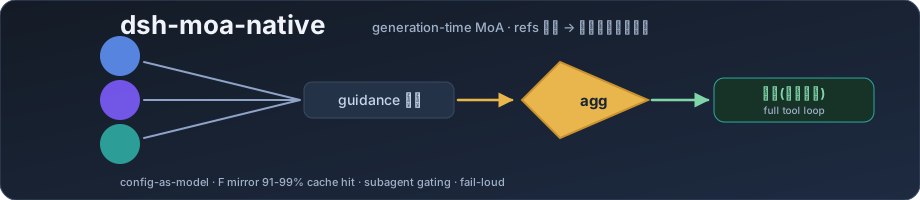
Native Mixture-of-Agents for DeepSeek Harness — generation-time fusion: reference models produce pre-run drafts in parallel every turn; the single acting model executes with full tooling.


English | 中文说明
What it solves
A single model has blind spots. In long sessions you want a few models reviewing the situation behind every reply — without switching tools, copy-pasting, or giving up tool use. dsh-moa-native internalizes that loop: picking one model entry runs the whole MoA pipeline for the session.
user message ──► refs consulted in parallel (private drafts, mutually unaware)
                      │
                      ▼
                guidance injected as a trailing message (never pollutes session
                history, never breaks KV prefix caching)
                      │
                      ▼
                aggregator (acting model) executes with full tooling ──► reply
Recommended mode (advanced)
F mirror + 3-4 heterogeneous blank-injection refs + a single aggregator + the parallel-plan discipline — one glance:
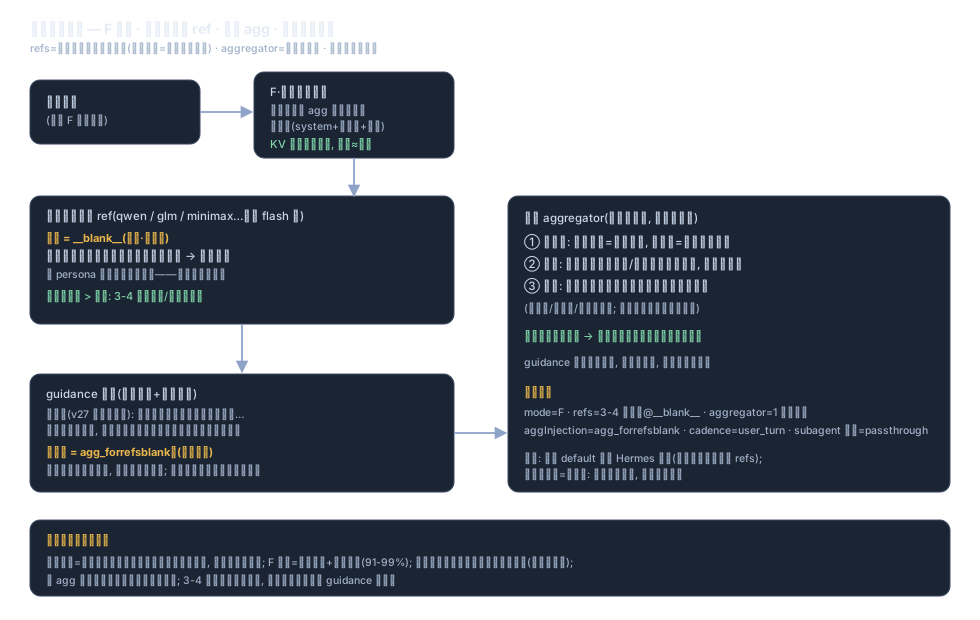
- Every ref uses the
__blank__injection (zero instruction, pure continuation — pure model-family signal, no persona noise); - The aggregator uses
agg_forrefsblank(majority direction gets high weight, disagreements judged independently, all actions executed by the aggregator itself); - The factory
defaultstays Hermes-aligned (review-style refs with the default injection) — start there, switch to the recommended combo once familiar.
Full part-by-part, parameter-by-parameter walkthrough: architecture.svg.

Install
dsh plugin --profile web add dsh-moa-native
Restart the instance and refresh the browser.
Quick start
- Settings → MoA-Native console: pick 3-4 reference routes (flash tiers work well — fast and cheap) and one aggregator (the model you want to keep). This step is mandatory on first install — the factory lineup is only an example and must point at your own configured providers/models. Since references are framed as the aggregator's own pre-run drafts, you can skip a ref that shares the aggregator's model (saves one route).
- Save (hot-reloads), then select a moa-native entry in the session model picker —
defaultor any recipe you saved. - Chat normally. Fusion happens every turn;
/moaR/moaFtemporarily switch the reference view (lineup, aggregator, and cadence stay with the current entry; the console shows the live slash preview). Subagent sessions stream straight through the aggregator by default (zero fanout) — switch via the subagent gating dropdown (7 tiers: 3/5/8/10/15/20/30).
Highlights
Config as model — default and every recipe appear as model entries on the provider page; a recipe is a full preset (lineup, mode, cadence, params).
Three-level model picker (identical to the session UI) — provider → model → effort for every route.
Injection modules — each route's trailing note is a visible, editable text module: built-in default (Hermes-style), blank (zero injection), or any custom one. No hidden personas, no output-length contracts.
Two reference modes:
- F · full mirror — references see exactly what the acting model sees; KV prefix cache hit rates above 90%
- R · trimmed view — Hermes-style tool-result trimming with input budgets
Subagent gating — MoA applies to the main session by default; subagent sessions pass straight through the aggregator, with an optional every-N-steps upgrade. Design rationale: SUBAGENT-GATING-DESIGN.md.
Run traces — four-level drill-down: sessions (workspace-isolated) → turns → per-model cards → full advisory text. Cold-start backfill from daily zstd archives; inputs are never persisted.
Fail-loud — a failing reference route is reported as-is, never silently replaced.
Theory positioning
Comparison with the MoA paper (arXiv:2406.04692), Hermes /moa, and community dsh-moa plugins — inheritance, superseding forms, and honest boundaries: THEORY-POSITION.md.
Configuration
~/.dsh/profiles/web/moa-native.config.json (panel saves hot-reload):
{
  "refs": [                                 // direct lineup; or use named recipes
    "provider-a/model-flash@high",          // string = default injection
    { "model": "provider-b/model-x@max", "injection": "__blank__" } // object = explicit injection module
  ],
  "aggregator": "provider-c/main-model@max",
  "aggInjection": "agg_forrefsblank",       // parallel-plan discipline (recommended); default agg_default
  "mode": "F",                              // F full mirror | R trimmed view
  "cadence": "user_turn",                   // user_turn | per_iteration | {every_n: 2}
  "subagent_policy": "passthrough",         // subagent gating: passthrough | {every_n: 5} | full
  "injections": { "critic": "Your first duty is to scrutinize…" },
  "recipes": { "my-lineup": { "refs": ["..."], "aggregator": "...", "mode": "F" } },
  "prices": { "provider-a/model-flash": { "in": 0.2, "out": 0.8 } },  // optional cost estimates
  "trace": true
}
HTTP endpoints
| Endpoint | Description |
|---|---|
GET /moa-native/panel.json |
Config + model tables |
GET /moa-native/trace.json?limit=&ws= |
Run traces |
GET /moa-native/trace-archive.json?date=YYYYMMDD |
Daily archive read |
GET /moa-native/efforts.json?provider=&model= |
Effort tiers |
Design boundaries
- guidance is a per-request injection and never enters session history — refs originals are invisible in the session UI by design (see the trace panel instead);
- references are pure advisers with no tool execution; the acting model decides what to adopt;
- complementary to "competitive draft" MoA (multiple full answers then a verdict): this plugin targets per-turn continuous quality lift.
License
MIT
No comments yet. Be the first to write one.